Smart Wardrobe Market Size
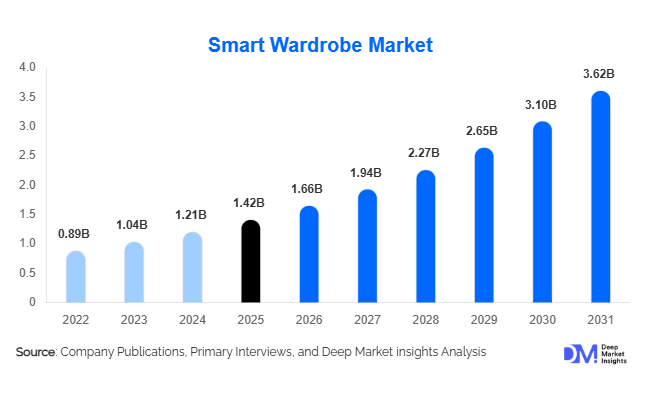
According to Deep Market Insights, the global smart wardrobe market size was valued at USD 1.42 billion in 2025 and is projected to grow from USD 1.66 billion in 2026 to reach USD 3.62 billion by 2031, expanding at a CAGR of 16.9% during the forecast period (2026–2031). The smart wardrobe market growth is primarily driven by increasing smart home adoption, growing demand for personalized lifestyle automation, advancements in artificial intelligence and IoT-enabled furniture, and rising consumer preference for luxury connected living solutions. Smart wardrobes are evolving beyond conventional storage systems into intelligent lifestyle management platforms capable of inventory tracking, outfit recommendations, garment preservation, and integration with broader home automation ecosystems.
Key Market Insights
- AI-powered outfit recommendation systems are becoming a major purchasing criterion, allowing users to receive personalized clothing suggestions based on weather, schedules, and fashion preferences.
- Luxury residential developments are increasingly incorporating smart wardrobes as standard premium amenities, particularly across North America, China, the UAE, and Singapore.
- North America dominates the global market, accounting for approximately 34% of total revenue in 2025 due to strong smart home penetration and high consumer spending power.
- Asia-Pacific is the fastest-growing regional market, supported by rapid urbanization, rising disposable income, and expanding smart home infrastructure.
- RFID and IoT technologies are transforming wardrobe management, enabling automated garment tracking, inventory monitoring, and digital wardrobe organization.
- Sustainability-focused wardrobe analytics are emerging as a key trend, helping consumers optimize clothing utilization and reduce fashion waste.
Smart Wardrobe Market Trends
AI-Powered Personal Styling and Wardrobe Intelligence
Artificial intelligence is rapidly transforming smart wardrobes into intelligent fashion management platforms. Advanced AI algorithms analyze user behavior, clothing preferences, weather forecasts, event schedules, and seasonal trends to recommend personalized outfits. This functionality is particularly appealing to time-constrained professionals and fashion-conscious consumers seeking convenience and personalization. Manufacturers are increasingly integrating generative AI capabilities that can suggest wardrobe combinations, identify underutilized garments, and even recommend future clothing purchases based on existing wardrobe inventory. As AI technologies become more sophisticated, smart wardrobes are expected to evolve into digital fashion assistants capable of enhancing customer engagement and driving recurring software revenues.
Integration with Smart Home Ecosystems
Smart wardrobes are becoming an integral component of connected homes. Integration with voice assistants, home automation hubs, mobile applications, and smart mirrors enables seamless user experiences. Consumers can remotely monitor wardrobe inventory, receive clothing care notifications, and access outfit recommendations through connected devices. Compatibility with broader smart home ecosystems is becoming a major differentiator among manufacturers. The trend is particularly prominent in premium residential developments where integrated home automation systems are increasingly viewed as standard lifestyle features. As smart home adoption accelerates globally, connected wardrobe systems are expected to benefit significantly from ecosystem-driven demand.
Smart Wardrobe Market Drivers
Growing Adoption of Smart Home Technologies
The increasing penetration of smart homes worldwide is one of the primary growth drivers for the smart wardrobe market. Consumers are becoming more comfortable integrating connected devices into their daily lives, creating favorable conditions for intelligent furniture adoption. Smart wardrobes complement existing smart home investments by extending automation into personal lifestyle management. Rising installation of smart lighting, connected appliances, security systems, and voice assistants is creating a supportive ecosystem that encourages adoption of advanced wardrobe technologies.
Expansion of Premium and Luxury Residential Construction
Luxury residential developments are increasingly incorporating smart wardrobes as part of premium interior offerings. Developers view intelligent storage systems as valuable differentiators that enhance property value and appeal to affluent buyers. Demand is particularly strong in high-income urban markets across North America, Europe, the Middle East, and Asia-Pacific. Smart wardrobes equipped with automated lighting, climate control, and inventory management capabilities are becoming highly desirable features in luxury apartments, villas, and penthouses.
Advancements in RFID, Sensors, and IoT Infrastructure
Technological innovation continues to improve smart wardrobe functionality while reducing implementation costs. RFID-enabled garment tracking, intelligent sensors, cloud-based analytics, and IoT connectivity are enabling more sophisticated wardrobe management capabilities. These advancements enhance user convenience by automating inventory monitoring, clothing organization, and garment preservation. Improved interoperability with mobile applications and smart home ecosystems further strengthens the value proposition of smart wardrobe solutions.
Smart Wardrobe Market Restraints
High Installation and Ownership Costs
Despite growing interest, smart wardrobes remain relatively expensive compared to traditional furniture solutions. Premium systems often require customized installation, integrated sensors, RFID infrastructure, software platforms, and connectivity modules. These costs can discourage adoption among middle-income consumers and limit market penetration beyond affluent customer segments. The challenge is particularly significant in developing economies where smart home adoption remains at an early stage.
Data Privacy and Cybersecurity Concerns
Smart wardrobes generate and store personal information related to clothing preferences, purchasing behavior, schedules, and lifestyle patterns. Concerns regarding data security, unauthorized access, and privacy protection continue to influence purchasing decisions. Manufacturers must invest in cybersecurity infrastructure, encryption technologies, and compliance frameworks to address consumer concerns and build trust. Failure to adequately address these issues could slow adoption rates and increase regulatory scrutiny.
Smart Wardrobe Market Opportunities
AI-Based Fashion Ecosystems and Subscription Services
The emergence of AI-driven fashion ecosystems presents a significant growth opportunity for smart wardrobe providers. Companies can expand beyond hardware sales by offering subscription-based styling services, wardrobe analytics platforms, personalized shopping recommendations, and digital fashion consulting. These value-added services create recurring revenue streams while strengthening customer engagement. Integration with e-commerce platforms and apparel brands can further enhance monetization opportunities.
Sustainability and Circular Fashion Management
Consumers and regulators are increasingly focused on sustainable consumption practices. Smart wardrobes can help users reduce waste by monitoring clothing utilization, recommending wardrobe optimization strategies, and facilitating resale or donation of underused garments. Sustainability-focused analytics and circular fashion integrations are expected to become important differentiators, particularly in environmentally conscious markets such as Europe and North America. Manufacturers that align products with sustainability objectives are likely to benefit from favorable consumer sentiment and regulatory support.
Luxury Hospitality and Commercial Applications
Hotels, luxury resorts, executive residences, fashion showrooms, and premium retail environments represent emerging application areas for smart wardrobe solutions. Hospitality operators are increasingly adopting intelligent wardrobe systems to enhance guest experiences through personalized storage, garment care, and digital concierge services. Commercial adoption is expected to create additional revenue streams and diversify market demand beyond residential applications.
Report Scope
| Report Metric | Details |
|---|---|
| Market Size in 2025 | USD 1.42 Billion |
| Market Size in 2026 | USD 1.66 Billion |
| Market Size in 2031 | USD 3.62 Billion |
| CAGR | 16.9% (2026-2031) |
| Base Year for Estimation | 2025 |
| Historical Data | 2022-2024 |
| Forecast Period | 2026-2031 |
| Report Coverage | Revenue Forecast, Competitive Landscape, Supply Chain Disruption, Growth Factors, Environment & Regulatory Landscape and Trends |
| Geographies Covered | North America, Europe, APAC, Middle East and Africa, LATAM |
| Countries Covered | U.S., Canada, U.K., Germany, France, Spain, Italy, Russia, Nordic, Benelux, Rest of Europe, China, Korea, Japan, India, Australia, Singapore, Taiwan, South East Asia, Rest of Asia-Pacific, UAE, Turky, Saudi Arabia, South Africa, Egypt, Nigeria, Rest of MEA, Brazil, Mexico, Argentina, Chile, Colombia, Rest of LATAM |
Explore more data points, trends and opportunities Download Free Sample Report
Product Type Insights
Integrated smart closet systems dominate the market, accounting for approximately 57% of global revenue in 2025. Their leadership is driven by strong demand from luxury residential projects and premium home renovations where consumers seek comprehensive wardrobe automation solutions. These systems typically combine RFID tracking, climate control, automated lighting, intelligent shelving, and mobile connectivity within a unified platform. Standalone smart wardrobes continue to gain traction among urban consumers seeking modular installations without extensive renovation requirements. Retrofit kits are emerging as a promising segment by enabling existing wardrobes to be upgraded with intelligent functionalities at lower costs. Smart mirrors and automated garment care modules are also expanding rapidly as complementary product categories within the broader smart wardrobe ecosystem.
Technology Insights
IoT-enabled wardrobes represent the largest technology segment, accounting for approximately 45% of total market revenue in 2025. Connectivity remains the foundation of smart wardrobe functionality, enabling communication between sensors, mobile applications, and cloud-based analytics platforms. RFID-based systems are witnessing strong adoption due to their ability to automate garment identification and inventory management. AI-powered wardrobes are among the fastest-growing technology categories, supported by increasing demand for personalized styling recommendations and predictive wardrobe management. Sensor-based climate control systems are also becoming increasingly important for preserving luxury apparel and enhancing garment longevity.
Functionality Insights
Automated inventory management remains the leading functionality segment, representing approximately 32% of global market demand. Consumers increasingly value the ability to digitally track clothing items, monitor wardrobe utilization, and eliminate inefficiencies associated with manual organization. Outfit recommendation platforms are experiencing rapid growth due to advances in artificial intelligence and machine learning. Climate-controlled storage solutions are gaining popularity among luxury apparel owners, while virtual try-on capabilities and wardrobe analytics are creating new opportunities for enhanced consumer engagement. Sustainability-focused functionalities that track garment usage and support circular fashion practices are also emerging as important market differentiators.
End User Insights
Residential households account for approximately 59% of global smart wardrobe demand, making them the largest end-user segment. Rising smart home adoption, increasing disposable income, and growing consumer interest in connected living environments continue to support residential demand. Luxury residential projects represent the fastest-growing application area as developers increasingly incorporate intelligent furniture solutions into premium properties. Hospitality establishments, including luxury hotels and resorts, are also expanding adoption to enhance guest experiences. Fashion retailers, apparel brands, and designer showrooms are utilizing smart wardrobe systems to improve inventory visibility, customer engagement, and operational efficiency.
Distribution Channel Insights
Offline sales channels account for approximately 62% of market revenue, supported by furniture showrooms, interior designers, home improvement retailers, and direct project-based installations. Many consumers prefer physical demonstrations before investing in premium smart furniture solutions. However, online sales channels are expanding rapidly as manufacturers enhance digital marketing capabilities and offer virtual product demonstrations. Direct-to-consumer sales models, supported by smart home integration services and customization options, are expected to gain increasing importance throughout the forecast period.
Explore more data points, trends and opportunities Download Free Sample Report
Smart Wardrobe Market Segmentations
By Product Type
- Integrated Smart Closet Systems
- Standalone Smart Wardrobes
- Smart Wardrobe Retrofit Kits
- Smart Shelving Systems
- Smart Hanger Systems
- Smart Drawer & Storage Modules
- Smart Mirrors Integrated with Wardrobe Systems
- Automated Garment Care Wardrobes
By Technology
- IoT-Enabled Wardrobes
- AI-Powered Wardrobes
- RFID-Based Clothing Tracking Systems
- Sensor-Based Wardrobe Systems
- Computer Vision-Based Wardrobe Systems
- Voice-Controlled Wardrobe Systems
- Cloud-Connected Wardrobe Platforms
By Functionality
- Automated Inventory Management
- Outfit Recommendation & Styling
- Garment Tracking & Retrieval
- Climate & Humidity Control
- Laundry & Garment Care Management
- Wardrobe Analytics & Usage Monitoring
- Virtual Try-On & Fashion Visualization
- Sustainability & Circular Fashion Tracking
By Distribution Channel
- Direct Sales
- Specialty Smart Home Retailers
- Furniture Retail Chains
- Interior Design & Home Improvement Channels
- E-commerce Platforms
By End User
- Residential Households
- Luxury Residential Projects
- Hospitality & Hotels
- Fashion Retailers
- Apparel Brands & Showrooms
- Corporate & Executive Dressing Rooms
- Fashion Designers & Stylists
- Institutional Applications
Regional Insights
North America
North America is the largest regional market, accounting for approximately 34% of global revenue in 2025. The United States represents nearly 28% of worldwide demand due to strong smart home penetration, advanced digital infrastructure, and high consumer spending on premium home technologies. Canada continues to experience steady growth supported by increasing adoption of connected home solutions and luxury residential developments. The region's leadership is further reinforced by widespread consumer awareness of IoT technologies and early adoption of smart furniture products.
Europe
Europe accounts for approximately 26% of global market demand and remains one of the most technologically advanced regions for smart furniture adoption. Germany, the United Kingdom, France, Italy, and the Netherlands lead regional consumption. Demand is supported by strong sustainability initiatives, premium furniture manufacturing capabilities, and growing interest in connected living environments. European consumers are increasingly attracted to smart wardrobes that promote efficient clothing management and sustainable consumption practices.
Asia-Pacific
Asia-Pacific represents approximately 31% of global demand and is projected to be the fastest-growing region during the forecast period. China leads regional adoption, accounting for approximately 12% of global market revenue, driven by rapid urbanization and strong smart home investments. Japan and South Korea continue to benefit from advanced consumer electronics ecosystems and technology acceptance. India is emerging as a promising growth market due to expanding middle-class income and increasing interest in premium home automation solutions. Southeast Asian countries are also witnessing growing adoption as smart city initiatives and connected living concepts gain momentum.
Latin America
Latin America accounts for approximately 3% of global market revenue. Brazil and Mexico are the leading markets, supported by luxury residential construction and increasing awareness of smart home technologies. While adoption remains concentrated among affluent consumers, gradual improvements in digital infrastructure and rising disposable incomes are expected to support future growth.
Middle East & Africa
The Middle East & Africa region accounts for approximately 6% of global demand, led by the UAE and Saudi Arabia. Smart wardrobes are increasingly being installed in luxury residential projects, premium hotels, and smart city developments throughout the Gulf region. High-income populations and strong demand for technologically advanced living solutions continue to support market expansion. South Africa represents an emerging market within the region due to increasing smart home investments and premium housing developments.
Key Players in the Smart Wardrobe Market
- Oppein Home Group
- California Closets
- Poliform
- Hammonds Furniture
- Sharps Bedrooms
- Inspired Closets
- ClosetMaid
- Organized Living
- Häfele
- IKEA Smart Furniture Division
- Molteni&C
- Hülsta
- Poggenpohl
- Stanley Furniture
- Fitted Furniture Solutions