Reed Diffusers Market Size
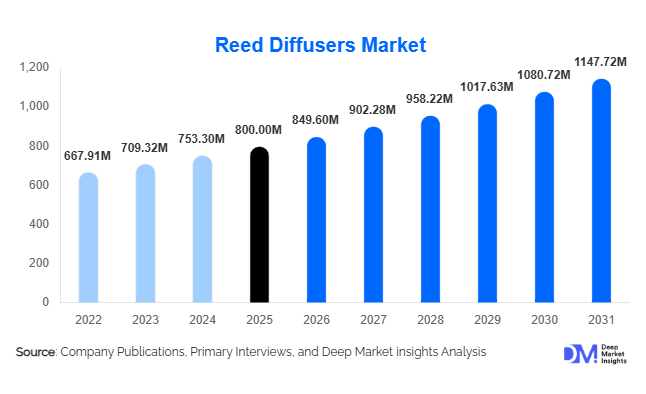
According to Deep Market Insights, the global reed diffusers market size was valued at USD 800 million in 2025 and is projected to grow from USD 849.60 million in 2026 to reach USD 1,147.72 million by 2031, expanding at a CAGR of 6.2% during the forecast period (2026–2031). The reed diffusers market growth is primarily driven by rising consumer spending on home fragrance products, increasing interest in wellness-oriented lifestyles, growing demand for premium home décor accessories, and expanding adoption of scent marketing solutions across commercial establishments. The market continues to benefit from the shift toward non-electric, flame-free fragrance delivery systems that offer convenience, safety, and long-lasting fragrance dispersion. Furthermore, the increasing popularity of aromatherapy, natural essential oils, and sustainable home fragrance products is creating new opportunities for manufacturers to introduce premium and refillable reed diffuser solutions.
Key Market Insights
- Traditional reed diffusers account for more than 60% of global market revenue, supported by widespread consumer familiarity, affordability, and ease of use.
- Residential applications dominate global demand, contributing nearly 70% of total market revenue as consumers increasingly invest in home ambiance and wellness products.
- North America remains the largest regional market, accounting for approximately 42% of global demand, led by strong consumer spending on premium home fragrance products.
- Asia-Pacific is the fastest-growing region, driven by rising disposable incomes, urbanization, and growing demand for luxury home décor products.
- Essential oil-based reed diffusers are gaining significant traction, as consumers increasingly prefer natural and wellness-oriented fragrance solutions.
- E-commerce platforms continue to reshape distribution dynamics, enabling direct-to-consumer brands to expand their global reach while improving customer engagement and product customization.
Reed Diffusers Market Trends
Premium Home Fragrance Products Becoming Mainstream
The reed diffusers market is witnessing a significant shift toward premium and luxury home fragrance offerings. Consumers increasingly view reed diffusers as lifestyle and décor products rather than functional air fresheners. This trend has encouraged manufacturers to introduce designer packaging, luxury fragrance blends, handcrafted vessels, and premium refill systems. High-end fragrance brands are expanding their product portfolios with exclusive collections featuring botanical ingredients, artisanal fragrances, and sustainable packaging. The integration of home fragrance products into interior design trends has further elevated consumer willingness to spend on aesthetically appealing reed diffusers. Luxury hotels, boutique hospitality establishments, and premium retail stores are also contributing to demand by incorporating signature fragrance experiences into customer engagement strategies.
Sustainable and Refillable Diffuser Solutions Driving Innovation
Sustainability has emerged as a major market trend influencing product development and purchasing decisions. Consumers increasingly prefer reed diffusers manufactured using recyclable glass containers, biodegradable reeds, organic fragrance oils, and refillable packaging formats. Brands are investing in circular economy initiatives by introducing refill pouches, reusable decorative vessels, and environmentally friendly sourcing practices. Regulatory focus on sustainable consumer goods across Europe and North America is accelerating the adoption of eco-conscious fragrance solutions. In addition, sustainability-focused marketing strategies are helping manufacturers strengthen brand loyalty among environmentally conscious consumers while improving long-term profitability through repeat refill purchases.
Reed Diffusers Market Drivers
Growing Consumer Focus on Home Wellness and Aromatherapy
The growing global emphasis on wellness, stress management, and mental well-being has become a significant growth driver for the reed diffusers market. Consumers increasingly incorporate aromatherapy products into their daily routines to create calming and relaxing indoor environments. Essential oil-based reed diffusers featuring lavender, eucalyptus, chamomile, and citrus fragrances are gaining popularity due to their perceived therapeutic benefits. The broader wellness economy continues to support demand for fragrance products that contribute to relaxation, sleep enhancement, and mood improvement. As consumers spend more time at home and prioritize self-care practices, reed diffusers are becoming an integral component of wellness-oriented living spaces.
Expansion of Premium Home Décor and Lifestyle Spending
Rising disposable incomes and growing interest in home personalization are driving increased spending on decorative fragrance products. Reed diffusers serve a dual purpose by enhancing both fragrance and visual aesthetics within residential and commercial environments. Premium home décor trends, supported by social media influence and interior design inspiration, are encouraging consumers to purchase higher-value fragrance products. Manufacturers continue to capitalize on this trend by introducing elegant bottle designs, customized fragrance collections, and luxury gifting options that appeal to affluent consumers.
Rapid Growth of E-Commerce and Direct-to-Consumer Sales
The proliferation of e-commerce platforms has significantly expanded market accessibility. Consumers can now easily compare fragrance profiles, access customer reviews, and purchase premium reed diffusers directly from brands. Subscription-based refill services, personalized fragrance recommendations, and digital marketing campaigns have strengthened online sales channels. Direct-to-consumer business models are enabling brands to improve profit margins while developing stronger customer relationships through recurring fragrance purchases and loyalty programs.
Reed Diffusers Market Restraints
Competition from Advanced Fragrance Diffusion Technologies
The reed diffusers market faces increasing competition from ultrasonic diffusers, nebulizing diffusers, smart fragrance devices, and automated scent delivery systems. These technologies offer stronger scent projection, programmable fragrance schedules, and greater customization capabilities. As consumers become more technologically inclined, some households and commercial users are shifting toward advanced fragrance solutions that provide enhanced performance and convenience.
Volatility in Raw Material and Fragrance Oil Prices
Manufacturers remain vulnerable to fluctuations in the prices of essential oils, fragrance compounds, alcohol-based carriers, glass containers, and packaging materials. Supply chain disruptions and agricultural variability affecting natural fragrance ingredients can impact production costs and profit margins. Premium brands relying on high-quality essential oils face additional sourcing challenges, particularly when dealing with limited seasonal harvests and sustainability requirements.
Reed Diffusers Market Opportunities
Expansion of Commercial Scent Marketing Applications
The growing adoption of scent marketing across hospitality, retail, healthcare, and corporate environments presents substantial opportunities for market participants. Hotels, spas, luxury boutiques, and premium office spaces increasingly utilize signature fragrances to strengthen brand identity and enhance customer experiences. Commercial scenting applications typically require larger-capacity diffuser systems and recurring fragrance replenishment programs, creating long-term revenue opportunities for manufacturers. As businesses increasingly recognize the impact of ambient scent on consumer behavior and brand perception, commercial demand is expected to accelerate significantly.
Development of Sustainable and Natural Product Portfolios
Consumer demand for environmentally friendly products continues to create opportunities for innovation. Brands introducing organic fragrance oils, alcohol-free formulations, biodegradable reeds, and refillable systems are well positioned to capture premium market segments. Sustainability-focused product portfolios can help manufacturers differentiate themselves in a highly competitive market while addressing evolving regulatory requirements. Continued investment in natural ingredient sourcing and sustainable packaging solutions is expected to generate long-term growth opportunities globally.
Report Scope
| Report Metric | Details |
|---|---|
| Market Size in 2025 | USD 800 Million |
| Market Size in 2026 | USD 849.60 Million |
| Market Size in 2031 | USD 1147.72 Million |
| CAGR | 6.2% (2026-2031) |
| Base Year for Estimation | 2025 |
| Historical Data | 2022-2024 |
| Forecast Period | 2026-2031 |
| Report Coverage | Revenue Forecast, Competitive Landscape, Supply Chain Disruption, Growth Factors, Environment & Regulatory Landscape and Trends |
| Geographies Covered | North America, Europe, APAC, Middle East and Africa, LATAM |
| Countries Covered | U.S., Canada, U.K., Germany, France, Spain, Italy, Russia, Nordic, Benelux, Rest of Europe, China, Korea, Japan, India, Australia, Singapore, Taiwan, South East Asia, Rest of Asia-Pacific, UAE, Turky, Saudi Arabia, South Africa, Egypt, Nigeria, Rest of MEA, Brazil, Mexico, Argentina, Chile, Colombia, Rest of LATAM |
Explore more data points, trends and opportunities Download Free Sample Report
Product Type Insights
Traditional reed diffusers represent the largest product segment, accounting for approximately 62% of global market revenue in 2025. Their dominance is supported by affordability, widespread consumer awareness, and compatibility with a broad range of fragrance formulations. Premium decorative reed diffusers are gaining traction among affluent consumers seeking luxury home décor products that combine fragrance functionality with aesthetic appeal. Refillable reed diffusers are emerging as one of the fastest-growing product categories due to increasing sustainability concerns and growing consumer preference for reusable packaging formats. Essential oil-based reed diffusers continue to outperform synthetic alternatives within premium segments, supported by rising demand for natural wellness products.
Fragrance Category Insights
Floral fragrances dominate the reed diffusers market, accounting for nearly 28% of global demand due to their broad consumer appeal and versatility across residential and commercial applications. Popular variants include lavender, jasmine, rose, and peony-based fragrances. Citrus fragrances continue to experience strong growth, driven by consumer preferences for fresh and energizing scent profiles. Woody and oriental fragrance categories maintain significant demand within premium and luxury product segments, particularly among consumers seeking sophisticated and long-lasting fragrance experiences. Seasonal and customized fragrance blends are increasingly contributing to market growth through limited-edition product launches and personalization strategies.
Distribution Channel Insights
Offline retail channels account for approximately 58% of global market revenue, supported by consumer preferences for in-store fragrance evaluation prior to purchase. Specialty fragrance stores, department stores, gift retailers, and home décor outlets remain critical sales channels for premium products. However, online distribution is rapidly expanding, supported by direct-to-consumer websites, e-commerce marketplaces, and subscription-based refill programs. Digital channels enable brands to provide personalized fragrance recommendations, virtual shopping experiences, and targeted promotional campaigns. Social media marketing and influencer partnerships continue to play a significant role in driving online consumer engagement and product discovery.
End-Use Insights
Residential consumers remain the largest end-use segment, accounting for nearly 70% of global market demand. Increasing interest in home wellness, interior aesthetics, and aromatherapy continues to support strong residential adoption. Hospitality applications represent the fastest-growing end-use segment, with luxury hotels, resorts, and wellness retreats increasingly utilizing signature scent programs to enhance guest experiences. Corporate offices, healthcare facilities, and premium retail stores are also expanding their use of reed diffusers to improve indoor environments and strengthen customer engagement strategies. The growing use of scent marketing across commercial establishments is expected to create substantial opportunities throughout the forecast period.
Explore more data points, trends and opportunities Download Free Sample Report
Reed Diffusers Market Segmentations
By Product Type
- Traditional Reed Diffusers
- Premium Decorative Reed Diffusers
- Refillable Reed Diffusers
- Disposable Reed Diffusers
- Essential Oil Reed Diffusers
- Synthetic Fragrance Reed Diffusers
By Fragrance Category
- Floral
- Citrus
- Woody
- Oriental/Amber
- Aromatic & Herbal
- Fruity
- Fresh & Clean Linen
- Oceanic/Aquatic
- Seasonal Fragrances
- Custom/Blended Fragrances
By End User
- Residential Consumers
- Hospitality
- Corporate Offices
- Retail Stores
- Healthcare Facilities
- Wellness & Spa Centers
- Religious & Meditation Centers
- Real Estate & Property Staging
By Distribution Channel
- Online Retail
- Brand-Owned Websites
- E-Commerce Marketplaces
- Subscription Commerce Platforms
- Hypermarkets & Supermarkets
- Specialty Home Fragrance Stores
- Department Stores
- Gift Stores
Regional Insights
North America
North America remains the largest regional market, accounting for approximately 42% of global revenue in 2025. The United States represents the dominant country market, supported by strong consumer spending on premium home fragrance products and widespread adoption of wellness-oriented lifestyles. Canada continues to experience steady demand growth, particularly within premium and sustainable product categories. High levels of product innovation, strong retail distribution networks, and mature consumer awareness support regional market leadership.
Europe
Europe accounts for approximately 29% of global demand and remains a highly developed market for reed diffusers. The United Kingdom, France, Germany, Italy, and Spain represent the primary consuming countries. Strong fragrance traditions, premium lifestyle spending, and growing sustainability awareness continue to drive regional demand. European consumers demonstrate particularly strong interest in natural fragrance formulations, refillable products, and environmentally responsible packaging solutions.
Asia-Pacific
Asia-Pacific is the fastest-growing regional market and is projected to expand at a CAGR exceeding 8% through 2031. China, Japan, South Korea, Australia, and India are the major growth contributors. Rising urbanization, increasing disposable incomes, expanding middle-class populations, and growing interest in premium home décor products are accelerating market adoption. India represents the fastest-growing national market within the region, supported by rapid growth in organized retail and increasing consumer awareness of home fragrance products.
Latin America
Latin America accounts for approximately 4% of global market revenue, led by Brazil and Mexico. Rising urbanization, improving retail infrastructure, and growing consumer spending on lifestyle products are supporting regional market expansion. Premium home fragrance products remain concentrated within affluent urban populations, while mass-market offerings continue to drive broader consumer adoption.
Middle East & Africa
The Middle East and Africa region accounts for approximately 3% of global demand. The United Arab Emirates and Saudi Arabia are key markets due to strong fragrance traditions, luxury consumer spending, and growing hospitality investments. Increasing tourism activity and expansion of premium retail environments continue to create favorable growth opportunities. South Africa also represents an important market due to rising demand for home fragrance and wellness products among urban consumers.
Key Players in the Reed Diffusers Market
- Bath & Body Works
- Reckitt
- Diptyque
- Jo Malone London
- Nest Fragrances
- L'Occitane International
- Molton Brown
- Capri Blue
- Paddywax
- Aromatherapy Associates
- LAFCO
- Archipelago Botanicals
- Voluspa
- Aromatique
- Thymes