Potted Plants Market Size
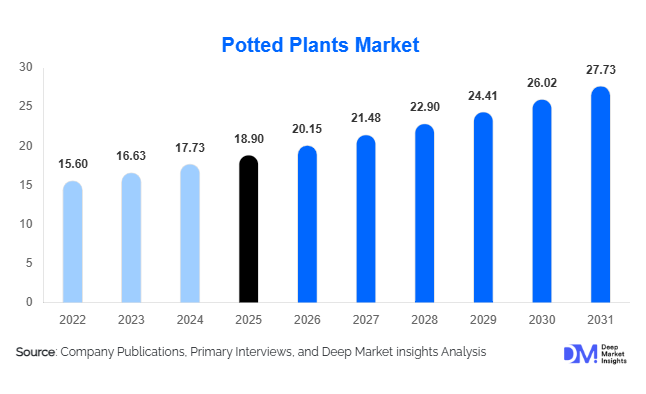
According to Deep Market Insights, the global potted plants market size was valued at USD 18.9 billion in 2025 and is projected to grow from USD 20.15 billion in 2026 to reach USD 27.73 billion by 2031, expanding at a CAGR of 6.6% during the forecast period (2026–2031). The potted plants market growth is primarily driven by rising urbanization, increasing consumer preference for indoor décor and wellness-oriented lifestyles, and the growing adoption of biophilic design across residential and commercial infrastructure. Expanding demand for indoor air-purifying plants, premium ornamental greenery, and sustainable home décor products is further strengthening global market expansion.
Key Market Insights
- Indoor foliage plants continue to dominate the market, supported by increasing demand for low-maintenance decorative greenery in urban apartments and office environments.
- Online plant retailing and subscription-based plant delivery services are rapidly expanding, reshaping consumer purchasing behavior and improving accessibility to premium ornamental plants.
- Europe remains the largest regional market, driven by strong horticulture traditions, sustainable consumer preferences, and advanced ornamental plant retail infrastructure.
- Asia-Pacific is the fastest-growing regional market, supported by rapid urbanization, rising middle-class spending, and growing apartment-based living in China and India.
- Commercial adoption of biophilic interior design is accelerating globally, increasing demand for decorative plants across offices, hospitality infrastructure, healthcare facilities, and retail spaces.
- Sustainable cultivation technologies and biodegradable planter solutions are gaining traction, as consumers increasingly prioritize environmentally responsible products.
Potted Plants Market Trends
Biophilic Interior Design Driving Global Demand
Biophilic design principles are increasingly influencing residential and commercial interior spaces globally. Consumers and businesses are incorporating potted plants into indoor environments to improve aesthetics, reduce stress, and create healthier living and working spaces. Offices, hotels, restaurants, shopping malls, and healthcare facilities are integrating large indoor plant installations as part of wellness-focused infrastructure design strategies. The trend is especially prominent in urban markets where access to natural outdoor spaces remains limited. Real estate developers are increasingly partnering with indoor landscaping firms and ornamental plant suppliers to integrate greenery into commercial projects, supporting long-term demand for decorative potted plants.
Growth of Smart Indoor Gardening Solutions
Technological integration is transforming the potted plants industry through smart irrigation systems, AI-enabled plant monitoring applications, and hydroponic indoor gardening kits. Consumers are increasingly adopting self-watering planters, app-connected plant care systems, and automated indoor cultivation technologies that simplify plant maintenance. Smart indoor gardening solutions are particularly popular among younger urban consumers who seek convenience-driven home décor products. Several companies are also introducing subscription-based services that combine plant delivery with digital plant care assistance, creating recurring revenue opportunities within the market. The integration of sustainability-focused technologies, including water-efficient hydroponic systems and biodegradable planters, is further shaping future market trends.
Potted Plants Market Drivers
Rising Urbanization and Apartment-Based Living
Rapid urbanization across major economies is significantly increasing demand for compact indoor gardening solutions. Apartment-based living continues to expand in countries such as China, India, the United States, Japan, and South Korea, limiting access to traditional outdoor gardens. As a result, consumers are increasingly purchasing tabletop plants, balcony plants, succulents, and decorative indoor foliage to enhance living spaces. Millennials and Gen Z consumers are particularly driving this trend, viewing potted plants as affordable lifestyle and wellness products that complement modern interior aesthetics. Growing residential real estate development in urban regions is expected to further accelerate long-term market growth.
Growing Consumer Focus on Wellness and Indoor Air Quality
Consumers are increasingly recognizing the psychological and health benefits associated with indoor greenery. Studies linking indoor plants with stress reduction, productivity enhancement, and improved indoor air quality have strengthened adoption across households and workplaces. Post-pandemic work-from-home culture has further increased spending on home décor and wellness-enhancing products, positioning potted plants as a mainstream lifestyle category. Commercial organizations are also integrating indoor plants into office layouts to support employee wellness initiatives and improve workplace environments. This growing wellness-driven demand is expected to remain a major long-term growth driver for the global market.
Potted Plants Market Restraints
High Logistics Complexity and Plant Perishability
The transportation and storage of live plants remain operationally challenging due to their perishability and maintenance sensitivity. Temperature fluctuations, improper handling, water stress, and pest exposure during transportation can significantly impact product quality. International plant trade is also subject to strict phytosanitary regulations, increasing compliance complexity for exporters and distributors. E-commerce operators face particularly high return and replacement costs due to damage during last-mile delivery. These operational challenges continue to limit profitability and scalability for several market participants.
Volatility in Cultivation and Raw Material Costs
Rising prices of fertilizers, greenhouse energy consumption, potting materials, labor, and transportation continue to impact production costs across the horticulture industry. Decorative planter materials such as ceramics, terracotta, and sustainable composites have also experienced inflationary pressure in recent years. Climate change-related disruptions, including water shortages, unpredictable weather patterns, and pest outbreaks, are further affecting cultivation cycles and plant availability in major producing regions. These factors may constrain pricing flexibility and pressure operating margins for growers and retailers globally.
Potted Plants Market Opportunities
Expansion of Commercial Indoor Landscaping
The increasing adoption of indoor landscaping across commercial real estate, hospitality infrastructure, healthcare facilities, and retail environments presents a significant growth opportunity for market participants. Businesses are investing heavily in wellness-oriented infrastructure and green-certified buildings that incorporate decorative indoor greenery. Hotels, airports, restaurants, luxury retail outlets, and corporate offices are increasingly utilizing large-scale potted plant installations to improve customer experience and support sustainability branding initiatives. This trend is creating opportunities for plant leasing services, commercial maintenance contracts, and customized indoor landscaping solutions.
Sustainable and Eco-Friendly Product Innovation
Sustainability-focused product innovation represents another major opportunity within the global potted plants market. Consumers are increasingly seeking biodegradable pots, recycled planter materials, organic cultivation practices, and environmentally responsible packaging solutions. Governments across Europe and North America are supporting urban greening initiatives and encouraging sustainable horticulture practices through environmental regulations and infrastructure funding. Companies investing in low-carbon greenhouse systems, water-efficient hydroponic technologies, and recyclable planter production are expected to gain significant competitive advantages over the coming years.
Report Scope
| Report Metric | Details |
|---|---|
| Market Size in 2025 | USD 18.9 |
| Market Size in 2026 | USD 20.15 |
| Market Size in 2031 | USD 27.73 |
| CAGR | 6.6% (2026-2031) |
| Base Year for Estimation | 2025 |
| Historical Data | 2022-2024 |
| Forecast Period | 2026-2031 |
| Report Coverage | Revenue Forecast, Competitive Landscape, Supply Chain Disruption, Growth Factors, Environment & Regulatory Landscape and Trends |
| Geographies Covered | North America, Europe, APAC, Middle East and Africa, LATAM |
| Countries Covered | U.S., Canada, U.K., Germany, France, Spain, Italy, Russia, Nordic, Benelux, Rest of Europe, China, Korea, Japan, India, Australia, Singapore, Taiwan, South East Asia, Rest of Asia-Pacific, UAE, Turky, Saudi Arabia, South Africa, Egypt, Nigeria, Rest of MEA, Brazil, Mexico, Argentina, Chile, Colombia, Rest of LATAM |
Explore more data points, trends and opportunities Download Free Sample Report
Plant Type Insights
Indoor foliage plants account for the largest share of the global potted plants market, representing approximately 31% of total market revenue in 2025. Strong demand for air-purifying and low-maintenance plants such as snake plants, pothos, monstera, and peace lilies continues to support segment dominance. Flowering potted plants remain highly popular across seasonal gifting and decorative applications, particularly in Europe and North America. Succulents and cacti are witnessing rapid growth among younger urban consumers due to their aesthetic appeal, minimal maintenance requirements, and compatibility with compact living spaces. Premium bonsai and exotic ornamental plants are also gaining traction within luxury residential and hospitality applications, where consumers increasingly seek customized decorative greenery solutions.
Pot Material Insights
Plastic pots continue to dominate the global market, accounting for nearly 36% of total demand in 2025 due to affordability, durability, lightweight handling, and compatibility with large-scale commercial cultivation. Ceramic and terracotta pots remain highly preferred within premium decorative segments because of their aesthetic appeal and suitability for luxury interior décor applications. Sustainable and biodegradable planters are emerging as one of the fastest-growing categories globally, supported by rising environmental awareness and increasing regulatory pressure to reduce plastic waste. Manufacturers are increasingly investing in recycled composites, fiber-based materials, and eco-friendly planter innovations to align with sustainability-focused consumer preferences.
Distribution Channel Insights
Garden centers and nurseries continue to dominate potted plant sales globally, accounting for approximately 34% of market revenue in 2025. Consumers often prefer physical retail outlets for live plant purchases because they can directly inspect plant quality, size, and health before purchasing. However, online retail and direct-to-consumer platforms are experiencing the fastest growth due to increasing digital adoption and improvements in logistics infrastructure. Subscription-based plant delivery models, personalized plant recommendation services, and social commerce marketing are significantly reshaping consumer purchasing behavior. Home improvement retailers and specialty home décor stores are also expanding their indoor plant assortments to capitalize on rising consumer interest in biophilic interior design.
End-Use Insights
Residential households represent the largest end-use segment within the potted plants market, accounting for nearly 48% of global revenue in 2025. Urban consumers are increasingly investing in decorative indoor plants to improve home aesthetics, wellness, and indoor environmental quality. Commercial offices are among the fastest-growing application segments due to rising corporate investment in employee wellness and sustainable workplace infrastructure. Hospitality establishments, including hotels, cafés, and luxury resorts, continue expanding decorative indoor landscaping installations to enhance customer experience and support premium branding. Healthcare facilities and educational institutions are also emerging as important growth sectors due to growing emphasis on therapeutic environments and sustainable campus infrastructure.
Consumer Demographic Insights
Millennials and Gen Z consumers represent the fastest-growing buyer demographic within the global potted plants market. These consumer groups strongly favor indoor greenery as part of modern lifestyle aesthetics, wellness-oriented living, and social media-driven home décor trends. High-income urban consumers continue to drive premium demand for rare ornamental species, designer planters, and customized indoor landscaping solutions. Corporate buyers and hospitality operators remain important institutional purchasers, particularly for large-scale indoor landscaping projects. Gardening enthusiasts and hobbyists also contribute significantly to recurring plant purchases, particularly within premium bonsai, flowering plant, and hydroponic gardening categories.
Explore more data points, trends and opportunities Download Free Sample Report
Potted Plants Market Segmentations
By Plant Type
- Indoor Foliage Plants
- Flowering Potted Plants
- Succulents & Cacti
- Herb & Edible Potted Plants
- Bonsai & Premium Decorative Plants
- Outdoor Decorative Potted Plants
By Pot Material
- Plastic Pots
- Ceramic Pots
- Terracotta Pots
- Fiber & Composite Pots
- Biodegradable & Sustainable Pots
By Distribution Channel
- Garden Centers & Nurseries
- Home Improvement Stores
- Supermarkets & Hypermarkets
- Online Retail & E-Commerce Platforms
- Specialty Home Décor Stores
- Direct-to-Consumer Subscription Services
By End Use
- Residential Households
- Commercial Offices
- Hospitality & Tourism
- Retail & Shopping Centers
- Healthcare Facilities
- Educational Institutions
- Government & Public Infrastructure
By Cultivation Type
- Conventional Cultivation
- Organic Cultivation
- Hydroponic & Soil-Free Cultivation
- Smart Indoor Cultivation Systems
Regional Insights
North America
North America accounted for approximately 28% of the global potted plants market in 2025. The United States remains the largest regional market due to strong consumer spending on home décor, widespread adoption of indoor gardening trends, and mature horticulture retail infrastructure. Increasing work-from-home culture and rising interest in wellness-oriented living are supporting strong demand for indoor foliage plants and decorative planters. Canada is also witnessing growing adoption of balcony gardening and compact indoor greenery solutions due to expanding urban apartment living.
Europe
Europe held nearly 30% of the global potted plants market share in 2025, making it the leading regional market globally. Germany, the United Kingdom, France, Italy, and the Netherlands remain major demand centers supported by advanced ornamental horticulture industries and strong consumer preference for sustainable home décor products. The Netherlands continues to serve as a major global export hub for ornamental plants due to its sophisticated greenhouse infrastructure and international distribution capabilities. Government-supported urban greening initiatives and sustainability-focused consumer behavior continue driving regional market growth.
Asia-Pacific
Asia-Pacific represents the fastest-growing regional market and accounted for approximately 26% of global revenue in 2025. China dominates regional demand due to rapid urbanization, increasing disposable income, and strong residential real estate expansion. India is emerging as one of the fastest-growing country-level markets globally, driven by rising apartment-based living, expanding online plant retailing, and growing interest in indoor décor products among millennials. Japan and South Korea continue witnessing strong demand for premium bonsai plants, minimalist decorative greenery, and smart indoor gardening systems.
Latin America
Latin America is witnessing gradual market expansion led primarily by Brazil and Mexico. Rising urban consumer spending, increasing awareness of indoor wellness products, and expanding hospitality infrastructure are supporting demand for ornamental potted plants across the region. Brazil also remains an important exporter of tropical ornamental plant varieties, contributing to regional horticulture industry development.
Key Players in the Potted Plants Market
- Costa Farms
- Dümmen Orange
- Ball Horticultural Company
- Syngenta Flowers
- Selecta One
- Altman Plants
- Rocket Farms
- Green Circle Growers
- Royal FloraHolland
- Suntory Flowers
- PanAmerican Seed
- Beekenkamp Plants
- Flamingo Holland
- Oserian Development Company
- The Sill