Pork Belly Meat Market Size
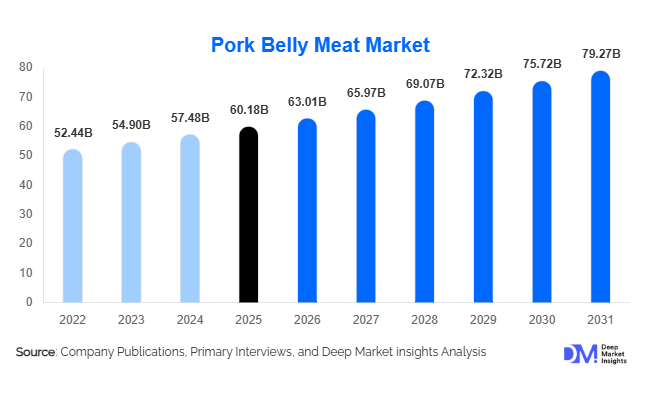
According to Deep Market Insights, the global pork belly meat market size was valued at USD 60.18 billion in 2025 and is projected to grow from USD 63.01 billion in 2026 to reach USD 79.27 billion by 2031, expanding at a CAGR of 4.7% during the forecast period (2026–2031). The pork belly meat market growth is primarily driven by rising global protein consumption, expanding demand for bacon and processed meat products, increasing popularity of Asian cuisines, and the rapid growth of foodservice channels worldwide. Pork belly remains one of the highest-value cuts in the pork industry due to its extensive use in bacon manufacturing, barbecue preparations, ready meals, and premium culinary applications. The market is also benefiting from advancements in cold-chain logistics, improvements in meat processing technologies, and growing consumer interest in premium, organic, and antibiotic-free pork products.
Key Market Insights
- Asia-Pacific dominates the global pork belly meat market, accounting for more than half of worldwide consumption, driven by exceptionally high demand in China, Japan, South Korea, and Southeast Asia.
- Foodservice applications represent the largest end-use segment, supported by the global expansion of restaurants, barbecue chains, and Asian cuisine establishments.
- Fresh pork belly remains the leading product category, particularly in Asian countries where consumers strongly prefer fresh meat over frozen alternatives.
- Premium and antibiotic-free pork products are witnessing robust growth, supported by increasing consumer awareness regarding food safety, traceability, and animal welfare.
- International trade is expanding rapidly, with China, Japan, Mexico, and South Korea remaining the largest import markets for pork belly products.
- Technological investments in processing automation and cold-chain infrastructure are improving product quality, extending shelf life, and facilitating global exports.
Pork Belly Meat Market Latest Trends
Premium and Specialty Pork Products Gaining Popularity
Consumers worldwide are increasingly seeking premium pork products with superior taste, higher traceability, and improved animal welfare standards. Organic pork, antibiotic-free pork, and heritage breed pork products are witnessing growing demand, particularly in developed markets and affluent Asian economies. Premium black pork varieties in China, Japan, and South Korea are commanding substantially higher margins compared to conventional products. Meat processors and producers are introducing branded pork belly products with certifications related to sustainability, organic farming, and traceability to differentiate themselves in increasingly competitive markets.
Growing Demand for Asian Cuisine and Barbecue Applications
The global popularity of Korean barbecue, Japanese yakiniku, Chinese hotpot, and other Asian culinary traditions has significantly increased pork belly consumption outside Asia. Restaurant operators in North America and Europe are expanding pork belly menu offerings to cater to changing consumer preferences and demand for authentic ethnic cuisine. The increasing influence of social media and food tourism has further accelerated the adoption of pork belly dishes globally, creating new opportunities for foodservice operators and exporters.
Pork Belly Meat Market Drivers
Rising Global Protein Consumption
Increasing population growth, urbanization, and rising disposable incomes are driving higher consumption of animal protein globally. Pork remains one of the most affordable and widely consumed protein sources, particularly in Asia and Latin America. As consumers shift toward protein-rich diets, pork belly demand is benefiting from both direct household consumption and foodservice applications.
Expansion of Processed Meat Industry
The growing demand for bacon, ready meals, and processed meat products is significantly supporting pork belly consumption worldwide. Pork belly is a primary raw material used in bacon manufacturing and various processed meat applications. Rising convenience food consumption and the expansion of quick-service restaurant chains are expected to sustain demand growth over the long term.
Recovery and Expansion of Foodservice Industry
The global foodservice industry has experienced strong recovery and expansion, particularly in emerging economies. The rapid proliferation of barbecue restaurants, premium dining establishments, and Asian cuisine chains has created substantial demand for pork belly products. The foodservice segment remains one of the most important growth engines for the global market.
Pork Belly Meat Market Restraints
Disease Outbreak Risks and Supply Volatility
Outbreaks of African Swine Fever (ASF) and other livestock diseases continue to create significant disruptions in pork supply chains worldwide. Disease outbreaks often lead to herd reductions, production shortages, and substantial price volatility, affecting market stability and profitability across the value chain.
Environmental and Regulatory Challenges
The pork industry is increasingly facing regulatory pressures related to greenhouse gas emissions, water usage, waste management, and animal welfare standards. Compliance with stricter regulations has increased operating costs for producers and processors, particularly in developed economies. Environmental concerns also continue to influence consumer perceptions and purchasing decisions.
Pork Belly Meat Industry Key Opportunities
Expansion of Premium and Organic Pork Segment
The premium pork segment represents one of the most attractive growth opportunities in the industry. Consumer willingness to pay higher prices for organic, antibiotic-free, and traceable pork products is increasing significantly across North America, Europe, and Asia-Pacific. Producers are investing heavily in specialty breeds and premium product lines that offer superior margins and brand differentiation. The premium segment also benefits from increasing demand among affluent consumers and health-conscious demographics seeking higher-quality protein products.
Growth in Asian Cuisine and International Foodservice Demand
The international popularity of Asian cuisine continues to create new growth opportunities for pork belly suppliers. Korean barbecue restaurants, Japanese ramen chains, and Chinese hotpot establishments are rapidly expanding across global markets, increasing demand for premium pork belly products. Exporters and processors are developing customized offerings tailored to regional culinary preferences, supporting market diversification and higher value realization.
Digitalization and Advanced Cold-Chain Infrastructure
Technological investments in cold-chain logistics, blockchain traceability, and automated meat processing facilities present significant opportunities for industry participants. Digital supply chain systems improve product quality, reduce wastage, and enhance inventory management capabilities. The expansion of e-commerce grocery channels and direct-to-consumer meat delivery platforms is further creating new avenues for branded pork belly products and premium offerings.
Report Scope
| Report Metric | Details |
|---|---|
| Market Size in 2025 | USD 60.18 Billion |
| Market Size in 2026 | USD 63.01 Billion |
| Market Size in 2031 | USD 79.27 Billion |
| CAGR | 4.7% (2026-2031) |
| Base Year for Estimation | 2025 |
| Historical Data | 2022-2024 |
| Forecast Period | 2026-2031 |
| Report Coverage | Revenue Forecast, Competitive Landscape, Supply Chain Disruption, Growth Factors, Environment & Regulatory Landscape and Trends |
| Geographies Covered | North America, Europe, APAC, Middle East and Africa, LATAM |
| Countries Covered | U.S., Canada, U.K., Germany, France, Spain, Italy, Russia, Nordic, Benelux, Rest of Europe, China, Korea, Japan, India, Australia, Singapore, Taiwan, South East Asia, Rest of Asia-Pacific, UAE, Turky, Saudi Arabia, South Africa, Egypt, Nigeria, Rest of MEA, Brazil, Mexico, Argentina, Chile, Colombia, Rest of LATAM |
Explore more data points, trends and opportunities Download Free Sample Report
Product Form Insights
The fresh pork belly segment dominated the global pork belly market and accounted for approximately 38% of total revenue in 2025. The segment's leadership is primarily driven by strong consumer preference for freshly slaughtered meat products, particularly across Asia-Pacific markets where fresh pork is widely associated with superior taste, texture, and nutritional quality. The widespread presence of wet markets, traditional butcher channels, and frequent household purchasing patterns in China, Vietnam, and other Southeast Asian countries continues to support the consumption of fresh pork belly. In addition, the growing popularity of premium fresh cuts among foodservice operators and specialty restaurants is further reinforcing demand.Frozen pork belly constitutes a significant share of global trade owing to its extended shelf life, ease of storage, and suitability for long-distance transportation and export activities. The segment plays a critical role in balancing supply and demand across deficit markets and enables producers to access international consumers through efficient cold chain logistics. Increasing investments in refrigerated infrastructure and the expansion of cross-border meat trade are expected to support the growth of frozen pork belly products over the forecast period.Processed and value-added pork belly products, including smoked, marinated, seasoned, and ready-to-cook offerings, are witnessing robust growth as consumers increasingly seek convenience-oriented meal solutions. Rising urbanization, changing dietary habits, and increasing demand for premium and restaurant-style food experiences at home are encouraging manufacturers to introduce innovative processed pork belly products. The segment is also benefiting from the expansion of modern retail channels and the growing penetration of packaged meat products in emerging economies.
Cut Specification Insights
Skin-on pork belly represented approximately 44% of global market demand in 2025, making it the leading cut specification segment. The segment's dominance is largely attributed to its extensive use in Asian culinary traditions, particularly in Chinese, Korean, Japanese, and Southeast Asian cuisines, where the skin contributes significantly to texture, flavor retention, and cooking versatility. Traditional dishes such as roasted pork, braised pork belly, and barbecue preparations continue to sustain strong demand for skin-on cuts. In addition, consumers increasingly perceive skin-on products as offering better authenticity and premium quality, further supporting segment growth.Boneless and sliced pork belly products are experiencing rapid growth due to rising demand for convenience, portion-controlled packaging, and ease of preparation. Foodservice establishments, quick-service restaurants, and retail consumers increasingly prefer pre-cut and ready-to-cook formats that minimize preparation time and reduce waste. The expansion of modern retail channels and growing demand for packaged meat products are expected to accelerate the adoption of these value-added cut specifications throughout the forecast period.
Production System Insights
Conventional pork production continued to dominate the global industry and accounted for approximately 85% of global market revenue in 2025. The segment's leadership is primarily driven by its cost efficiency, high production volumes, established supply chains, and ability to meet large-scale global demand. Large commercial farming operations, advancements in breeding technologies, and productivity improvements have enabled conventional producers to maintain competitive pricing and consistent supply, making conventionally produced pork belly the preferred choice across both developed and emerging markets.Meanwhile, organic, antibiotic-free, and naturally raised pork products are expanding at a considerably faster pace than conventional offerings. Growing consumer concerns regarding food safety, antibiotic resistance, animal welfare, and environmental sustainability are encouraging demand for premium pork products produced under stricter farming standards. Increasing disposable incomes and the willingness of consumers to pay premium prices for clean-label and ethically sourced meat products are expected to create substantial opportunities for alternative production systems during the forecast period.
Distribution Channel Insights
Supermarkets and hypermarkets accounted for nearly 36% of global sales in 2025, making them the largest distribution channel in the pork belly market. The segment's leadership is primarily driven by extensive product availability, competitive pricing, attractive promotional activities, and consumers' preference for one-stop shopping experiences. Organized retail channels offer a diverse assortment of fresh, frozen, and processed pork belly products while ensuring quality assurance, product traceability, and convenient access, thereby strengthening their position in the market.Online retail channels are witnessing substantial growth as digital grocery shopping continues to gain popularity worldwide. Rising internet penetration, growing smartphone usage, improvements in cold chain delivery systems, and increasing consumer preference for doorstep delivery are supporting the expansion of e-commerce channels. The trend is particularly evident in urban areas and developed economies, where consumers increasingly favor digital purchasing platforms for convenience and product variety.
Application Insights
Bacon manufacturing remained the largest application segment and accounted for approximately 34% of total market revenue in 2025. The segment's dominance is primarily driven by consistently high bacon consumption across North America and Europe, where bacon is deeply integrated into breakfast culture, quick-service restaurant menus, and processed food applications. The growing popularity of premium, flavored, and ready-to-eat bacon products is further supporting demand for pork belly as a key raw material.Culinary applications, including barbecue, hotpot, roasted dishes, and restaurant preparations, constitute another significant demand segment. The expanding global popularity of Asian cuisine and premium dining experiences is creating new consumption opportunities for pork belly products. In addition, the ready meal and convenience food industries are emerging as important demand drivers, as manufacturers increasingly incorporate processed pork belly into frozen meals, meal kits, and prepared food offerings designed to meet changing consumer lifestyles.
End-Use Insights
The foodservice industry represented the largest end-use segment and accounted for approximately 48% of global pork belly demand in 2025. The segment's dominance is primarily driven by the widespread use of pork belly in restaurants, hotels, barbecue chains, casual dining establishments, and Asian cuisine outlets. The recovery of tourism activities, increasing dining-out expenditure, and expansion of international restaurant chains continue to support strong demand from foodservice operators.Household consumption also represents a substantial share of global demand, supported by rising at-home cooking trends, increasing retail availability of packaged pork products, and growing consumer interest in experimenting with international cuisines. The meat processing industry remains another important demand center, particularly for bacon, cured meats, and ready-to-eat products. Furthermore, emerging applications in meal kits, premium frozen foods, and convenience food categories are expected to generate additional growth opportunities as manufacturers continue to develop innovative and value-added pork belly offerings.
Explore more data points, trends and opportunities Download Free Sample Report
Pork Belly Meat Market Segmentations
By Product Form
- Fresh Pork Belly
- Chilled Pork Belly
- Frozen Pork Belly
- Cured/Processed Pork Belly
- Ready-to-Cook Pork Belly Products
- Ready-to-Eat Pork Belly Products
By Cut Specification
- Skin-On Pork Belly
- Skinless Pork Belly
- Boneless Pork Belly
- Bone-In Pork Belly
- Whole Pork Belly Slabs
- Sliced Pork Belly
- Cubed/Diced Pork Belly
By Production System
- Conventional Pork Belly
- Organic Pork Belly
- Antibiotic-Free Pork Belly
- Premium Heritage Breed Pork Belly
By Packaging Type
- Vacuum Packaging
- Modified Atmosphere Packaging (MAP)
- Shrink Packaging
- Bulk Industrial Packaging
- Retail Tray Packaging
By Distribution Channel
- Direct Sales to Processors
- Supermarkets & Hypermarkets
- Traditional Grocery Stores
- Specialty Meat Stores
- Wholesale Clubs
- Online Retail
- Foodservice Distributors
Regional Insights
Asia-Pacific
Asia-Pacific accounted for approximately 52% of global market revenue in 2025, making it the largest regional market for pork belly. China alone represented nearly 34% of global demand, supported by the world's largest pork consumption base and the extensive use of pork belly in traditional cuisine. Japan and South Korea remain significant premium markets owing to strong demand for barbecue, specialty pork products, and high-quality imported meat. Southeast Asian countries, particularly Vietnam and the Philippines, are witnessing rapid market expansion due to rising incomes, urbanization, and increasing protein consumption.The region's growth is further driven by rapid population growth, increasing disposable incomes, expanding middle-class demographics, and the deep cultural significance of pork in daily diets across several Asian countries. The expansion of organized retail, rising foodservice expenditure, increasing consumption of Korean and Japanese cuisine, and continuous investments in commercial pig farming and cold chain infrastructure are further accelerating market growth throughout the region.
Europe
Europe accounted for approximately 23% of global demand in 2025 and remains one of the world's most established pork-producing regions. Germany, Spain, Denmark, and Poland are among the largest producers and exporters of pork products globally, supported by highly developed livestock industries and advanced meat processing capabilities. Strong bacon consumption and a mature processed meat industry continue to support regional demand, while premium and organic pork products are gaining increasing consumer acceptance.Regional growth is being driven by strong export demand, technological advancements in meat processing, increasing consumer preference for premium and sustainably sourced meat products, and the growing popularity of convenience foods. In addition, the region benefits from well-established cold chain infrastructure, stringent quality standards, and ongoing investments in value-added pork processing technologies, which continue to strengthen Europe's position in the global market.
North America
North America represented approximately 15% of the global market in 2025. The United States remains the dominant consumer and producer due to high bacon consumption, a large foodservice industry, and strong demand for processed meat products. Mexico is among the world's largest pork importing countries and continues to exhibit robust demand growth driven by changing dietary preferences and rising meat consumption.The region's market growth is supported by the continued popularity of bacon and barbecue products, increasing demand for convenience foods, strong restaurant and quick-service sectors, and high per capita meat consumption. Technological advancements in meat processing, the growing premiumization of pork products, and increasing demand for ready-to-cook and value-added meat offerings are also contributing to sustained market expansion across North America.
Latin America
Latin America is emerging as an increasingly important market for pork belly, with Brazil and Chile serving as major pork producers and exporters within the region. Rising disposable incomes, increasing urbanization, and higher protein consumption are supporting market expansion. Export opportunities are also encouraging investments in processing facilities, production capacity expansion, and improvements in supply chain efficiency.Regional growth is being driven by improving economic conditions, changing dietary patterns, increasing penetration of modern retail channels, and growing demand for processed and packaged meat products. The region is also benefiting from expanding export opportunities to Asia and other international markets, which are encouraging producers to invest in productivity improvements and advanced processing capabilities.
Middle East & Africa
The Middle East and Africa account for a comparatively smaller share of the global pork belly market but are witnessing steady demand growth through tourism-driven foodservice channels and premium retail segments. South Africa remains the largest regional market, while the United Arab Emirates and Saudi Arabia are increasingly importing premium meat products to support their expanding hospitality sectors and international dining establishments.Growth across the region is being driven by the expansion of tourism and hospitality industries, increasing expatriate populations, rising disposable incomes among urban consumers, and the development of premium retail infrastructure. The proliferation of international hotel chains, specialty restaurants, and modern foodservice establishments is creating additional demand for imported and premium pork products, particularly in key metropolitan centers and tourism destinations.
Key Players in the Pork Belly Meat Market
- WH Group
- JBS S.A.
- Tyson Foods Inc.
- Danish Crown A/S
- Hormel Foods Corporation
- Tönnies Group
- Vion Food Group
- Seaboard Foods
- Clemens Food Group
- TriOak Foods
- Muyuan Foods Co., Ltd.
- New Hope Liuhe Co., Ltd.
- COFCO Meat Holdings Limited
- Olymel L.P.
- The Maschhoffs LLC