Party Supplies Market Size
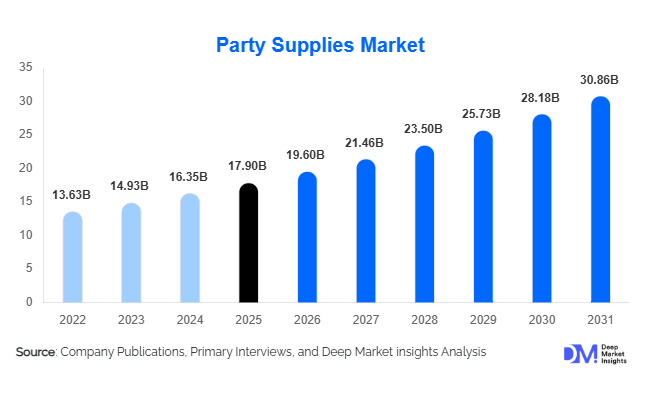
According to Deep Market Insights, the global party supplies market size was valued at USD 17.9 billion in 2025 and is projected to grow from USD 19.60 billion in 2026 to reach USD 30.86 billion by 2031, expanding at a CAGR of 9.5% during the forecast period (2026–2031). The party supplies market growth is primarily driven by increasing consumer spending on celebrations, rising demand for personalized and themed events, expanding e-commerce penetration, and the growing popularity of social-media-inspired party experiences. The market encompasses a broad range of products including balloons, decorative supplies, disposable tableware, party favors, celebration accessories, invitations, and seasonal decorations used across birthdays, weddings, corporate events, religious celebrations, and holiday gatherings.
The growing trend toward experiential celebrations has significantly transformed the industry, encouraging consumers to invest in premium decorations, customized products, and coordinated event themes. Manufacturers are increasingly focusing on sustainability through biodegradable tableware, recyclable decorations, and eco-friendly packaging solutions. Additionally, the rise of digital customization platforms and print-on-demand capabilities has enabled consumers to personalize party supplies more easily than ever before. Emerging economies across Asia-Pacific, Latin America, and the Middle East are becoming major growth centers due to rising disposable incomes, urbanization, and expanding middle-class populations. As celebrations become increasingly elaborate and experience-focused, the party supplies market is expected to maintain robust growth throughout the forecast period.
Key Market Insights
- Birthday celebrations remain the largest demand segment, accounting for approximately 42% of global party supplies consumption.
- Tableware and disposable supplies dominate product demand, representing nearly 28% of total market revenue.
- North America leads the global market, supported by high consumer spending on personal and seasonal celebrations.
- Asia-Pacific is the fastest-growing region, driven by increasing urbanization and rising middle-class spending in China and India.
- Eco-friendly and biodegradable party supplies are witnessing strong adoption as governments implement restrictions on single-use plastics.
- Personalization and digital customization technologies are creating premium revenue opportunities for manufacturers and retailers.
Party Supplies Market Trends
Growing Demand for Sustainable Party Products
Sustainability has emerged as one of the most influential trends shaping the party supplies industry. Consumers are increasingly seeking environmentally friendly alternatives to traditional plastic-based decorations and disposable tableware. Manufacturers are responding by introducing biodegradable plates, compostable cutlery, paper-based decorations, recyclable packaging, and reusable celebration products. Regulatory restrictions on single-use plastics across Europe, North America, and parts of Asia are accelerating this transition. Corporate event organizers and educational institutions are also prioritizing sustainable procurement practices, further supporting demand for eco-conscious party supplies. As environmental awareness continues to increase globally, sustainable products are expected to capture a growing share of industry revenues.
Rise of Personalized and Social Media-Inspired Celebrations
Consumers increasingly seek customized experiences that reflect individual preferences and social media aesthetics. Personalized balloons, customized banners, themed decorations, printed party favors, and bespoke event accessories have become highly popular across birthdays, weddings, and corporate events. Social media platforms continue to influence event planning decisions, encouraging visually coordinated themes and premium decorative products. Advanced digital printing technologies and online design platforms allow consumers to customize products with minimal lead times, creating significant opportunities for manufacturers to increase margins through value-added offerings.
Party Supplies Market Drivers
Expansion of Celebration Culture and Event Spending
Consumer spending on celebrations continues to increase globally as birthdays, anniversaries, weddings, graduations, and themed events become more elaborate. The influence of social media has amplified demand for visually appealing event experiences, encouraging greater spending on decorations, tableware, balloons, and customized accessories. Millennials and Generation Z consumers are particularly driving this trend, viewing celebrations as memorable experiences worthy of premium investment.
Rapid Growth of E-Commerce and Omnichannel Retail
The proliferation of online marketplaces and direct-to-consumer platforms has transformed the accessibility of party supplies. Consumers can easily browse extensive product portfolios, compare pricing, personalize products, and receive rapid home delivery. Online retail channels have become particularly important for customized and niche party products, allowing manufacturers to reach broader customer bases while reducing dependence on physical retail infrastructure.
Party Supplies Market Restraints
Seasonal Demand Volatility
Demand for party supplies remains highly seasonal, particularly around major holidays such as Christmas, Halloween, New Year celebrations, and Valentine's Day. These seasonal fluctuations create inventory management challenges for manufacturers and retailers, increasing working capital requirements and forecasting complexity. Companies must carefully balance production planning with unpredictable consumer demand patterns.
Raw Material Price Fluctuations
Manufacturers remain vulnerable to volatility in paper pulp, plastic resin, foil materials, packaging inputs, and transportation costs. Sudden increases in raw material prices can significantly affect profit margins, particularly in highly competitive market segments where passing costs onto consumers remains difficult. Supply chain disruptions and global logistics challenges further contribute to pricing uncertainty across the industry.
Party Supplies Market Opportunities
Expansion of Eco-Friendly Product Portfolios
Growing environmental regulations and consumer awareness present substantial opportunities for manufacturers to expand biodegradable and reusable product offerings. Companies investing in sustainable materials and environmentally responsible production methods can access premium market segments while strengthening brand differentiation. Corporate buyers and event organizers increasingly prefer eco-certified products, creating additional growth opportunities within commercial channels.
Digital Personalization and Custom Manufacturing
Customization represents one of the fastest-growing revenue opportunities in the party supplies market. Consumers increasingly demand personalized invitations, decorations, banners, balloons, and party favors. Advances in digital printing, AI-powered design tools, and print-on-demand manufacturing enable companies to offer unique products while maintaining operational efficiency. Customized products typically generate higher margins than standard offerings and support stronger customer engagement.
Report Scope
| Report Metric | Details |
|---|---|
| Market Size in 2025 | USD 17.9 Billion |
| Market Size in 2026 | USD 19.60 Billion |
| Market Size in 2031 | USD 30.86 Billion |
| CAGR | 9.5% (2026-2031) |
| Base Year for Estimation | 2025 |
| Historical Data | 2022-2024 |
| Forecast Period | 2026-2031 |
| Report Coverage | Revenue Forecast, Competitive Landscape, Supply Chain Disruption, Growth Factors, Environment & Regulatory Landscape and Trends |
| Geographies Covered | North America, Europe, APAC, Middle East and Africa, LATAM |
| Countries Covered | U.S., Canada, U.K., Germany, France, Spain, Italy, Russia, Nordic, Benelux, Rest of Europe, China, Korea, Japan, India, Australia, Singapore, Taiwan, South East Asia, Rest of Asia-Pacific, UAE, Turky, Saudi Arabia, South Africa, Egypt, Nigeria, Rest of MEA, Brazil, Mexico, Argentina, Chile, Colombia, Rest of LATAM |
Explore more data points, trends and opportunities Download Free Sample Report
Product Type Insights
Tableware and disposable supplies emerged as the leading product segment, accounting for approximately 28% of the global party supplies market in 2025. The segment's dominance is primarily attributed to its universal applicability across virtually every celebration format, including birthdays, weddings, corporate events, baby showers, graduation ceremonies, religious gatherings, and seasonal festivities. Unlike decorations or specialty accessories that may vary by occasion, disposable plates, cups, napkins, cutlery, and table covers are essential consumption items, creating recurring and predictable demand throughout the year.
The segment has also benefited from growing consumer preference for convenience and time-saving solutions. Modern consumers increasingly favor ready-to-use disposable tableware over reusable alternatives due to reduced cleanup requirements and improved event management efficiency. Premiumization trends are further supporting segment growth, with consumers opting for designer tableware, themed collections, metallic finishes, and coordinated event sets that enhance overall event aesthetics. Additionally, sustainability initiatives have accelerated the adoption of biodegradable paper-based plates, compostable cutlery, and recyclable tableware products, creating new revenue opportunities for manufacturers. The increasing frequency of home-hosted celebrations, expansion of the event management industry, and rising expenditure on themed parties continue to strengthen demand for disposable tableware globally.
Decorative supplies remain the second-largest segment, supported by the growing influence of social media platforms that encourage visually appealing event setups. Balloons continue to generate substantial revenue due to their affordability, versatility, and applicability across both personal and commercial celebrations. Seasonal and holiday-specific decorations experience strong cyclical demand, while personalized decorations and customized party favors are among the fastest-growing categories as consumers increasingly seek unique and memorable event experiences.
Application Insights
Residential applications dominate the global party supplies market, accounting for approximately 62% of total demand in 2025. The segment's leadership is driven by the sheer volume of household celebrations occurring globally, including birthdays, anniversaries, holiday gatherings, family reunions, baby showers, graduation parties, and religious celebrations. The growing trend toward experiential celebrations and social media-inspired event planning has encouraged households to increase spending on decorations, themed tableware, customized accessories, and party favors.
Rising disposable incomes across both developed and emerging economies have further supported residential demand, enabling consumers to allocate larger portions of discretionary spending toward celebration-related products. The increasing popularity of DIY party planning, facilitated by online marketplaces and social media inspiration platforms, has also expanded product consumption among households.
While residential applications remain dominant, the commercial segment is witnessing accelerated growth driven by increasing investments in corporate events, conferences, employee engagement programs, product launches, promotional campaigns, hospitality events, and destination weddings. Event management companies are emerging as significant buyers of premium decorations and customized party supplies. Educational institutions are also contributing to demand through graduations, annual functions, cultural festivals, and student engagement activities. The continued professionalization of event planning services is expected to support sustained growth within the commercial application segment during the forecast period.
Distribution Channel Insights
Hypermarkets and supermarkets remain the leading distribution channel, representing approximately 31% of global party supplies sales. Their market leadership is supported by extensive product assortments, convenient shopping experiences, strong brand visibility, and the ability to offer competitive pricing through large-scale procurement. Consumers frequently purchase party supplies alongside routine household shopping, making organized retail stores a preferred channel for last-minute and planned event purchases. The growth of private-label offerings within major retail chains has further strengthened this channel's competitive position by providing consumers with affordable alternatives to branded products. Seasonal merchandising strategies and dedicated celebration sections within stores also contribute to higher sales volumes during key holiday periods.
Specialty party stores continue to play a critical role by offering premium decorations, licensed character merchandise, personalized products, and event planning expertise. However, the fastest growth is occurring within online channels. E-commerce platforms benefit from extensive product availability, customization capabilities, direct-to-consumer business models, and increasing consumer preference for digital purchasing. Online marketplaces have become particularly important for personalized banners, customized balloons, and niche-themed products that may not be widely available through traditional retail channels. Brand-owned e-commerce websites are also gaining traction as manufacturers seek greater control over customer engagement, product presentation, and profit margins.
Customer Type Insights
Individual consumers constitute the largest customer segment, accounting for approximately 58% of global party supplies demand. The recurring nature of personal celebrations and family-oriented events primarily drives this leadership position. Consumers purchase party supplies throughout the year for birthdays, anniversaries, holiday gatherings, graduation celebrations, and other social occasions, creating a broad and stable demand base across geographies. The segment has particularly benefited from increasing social media influence, which has elevated consumer expectations regarding event aesthetics and personalization. Growing awareness of themed celebrations, celebrity-inspired event concepts, and customized decorations continues to drive higher spending among individual buyers.
Event management companies represent one of the fastest-growing customer categories due to increasing outsourcing of event planning activities. These companies require large quantities of decorations, tableware, promotional materials, and customized accessories, creating significant bulk purchasing opportunities for suppliers. Corporate organizations continue to expand spending on employee engagement programs, conferences, product launches, and brand activation campaigns. Educational institutions, hospitality businesses, community organizations, and religious groups also contribute significantly to market demand through recurring events and ceremonies, creating additional avenues for market expansion.
Explore more data points, trends and opportunities Download Free Sample Report
Party Supplies Market Segmentations
By Product Type
- Balloons
- Decorative Supplies
- Tableware & Disposable Supplies
- Party Favors & Gifts
- Celebration Accessories
- Games & Entertainment Products
- Invitations & Greeting Products
- Seasonal & Holiday Supplies
By Application
- Residential Use
- Commercial Use
By Distribution Channel
- Hypermarkets & Supermarkets
- Specialty Party Stores
- Mass Merchandise Retailers
- Online Marketplaces
- Brand-Owned E-commerce Platforms
- Wholesale & B2B Distribution
By Customer Type
- Individual Consumers
- Event Management Companies
- Corporate Organizations
- Educational Institutions
- Hospitality Sector
- Religious & Community Organizations
Regional Insights
North America
North America accounted for approximately 33% of global party supplies market revenue in 2025, making it the largest regional market. The United States alone contributes nearly 27% of global demand due to its strong celebration culture, high consumer spending power, mature retail ecosystem, and widespread adoption of themed events. Demand is particularly strong for premium decorations, personalized party supplies, licensed character products, and seasonal merchandise associated with Halloween, Thanksgiving, Christmas, and Independence Day celebrations.
The region's growth is supported by high per-capita expenditure on celebrations, widespread penetration of organized retail, and a rapidly expanding e-commerce ecosystem. The presence of large event management companies, robust hospitality infrastructure, and increasing consumer preference for customized products further contribute to market expansion. Canada also maintains a significant market presence, driven by rising adoption of eco-friendly party products and increasing demand for premium celebration experiences.
Europe
Europe accounted for approximately 24% of global market demand in 2025, with Germany, the United Kingdom, France, Italy, and Spain representing the largest national markets. Regional growth is primarily driven by increasing demand for sustainable and environmentally responsible party supplies. Regulatory measures aimed at reducing single-use plastics have accelerated adoption of biodegradable tableware, recyclable decorations, and paper-based celebration products.
The region also benefits from strong consumer spending on weddings, holiday celebrations, and cultural festivals. Premiumization trends are particularly evident across Western Europe, where consumers increasingly seek high-quality decorations, customized products, and designer event accessories. Additionally, the region's well-developed event management industry and strong corporate event culture continue to support commercial demand.
Asia-Pacific
Asia-Pacific accounted for approximately 29% of global market revenue in 2025 and represents the fastest-growing regional market. China remains the largest market within the region due to its extensive manufacturing base, expanding middle-class population, and growing expenditure on celebrations and social events. India is emerging as one of the fastest-growing countries globally, supported by rapid urbanization, rising disposable incomes, increasing adoption of Western-style celebrations, and a thriving wedding industry.
Regional growth is further supported by expanding e-commerce penetration, increasing influence of social media, and growing demand for personalized party supplies. Japan, South Korea, and Australia continue to contribute stable demand through premium product segments and organized retail networks. The region's large youth population and increasing spending on experiential celebrations are expected to sustain strong growth momentum through the forecast period.
Latin America
Latin America represented approximately 8% of global market demand in 2025, led by Brazil and Mexico. The region's growth is primarily driven by increasing urbanization, rising disposable incomes, and strong cultural emphasis on social gatherings and celebrations. Birthdays, religious festivals, weddings, and community events continue to generate substantial demand for decorations, balloons, and disposable tableware.
Expansion of organized retail channels and growing internet penetration have significantly improved product accessibility throughout the region. E-commerce adoption is also increasing rapidly, enabling consumers to access a broader range of themed and customized products. Economic development and growing middle-class populations are expected to support long-term market growth across major Latin American economies.
Middle East & Africa
The Middle East and Africa accounted for approximately 6% of global market revenue in 2025. Saudi Arabia, the United Arab Emirates, and South Africa represent the region's most significant markets. Growth is being driven by increasing investments in hospitality, tourism, entertainment, and large-scale public events. Government-led economic diversification initiatives, particularly in Saudi Arabia and the UAE, are creating substantial opportunities for celebration-related products through festivals, sporting events, exhibitions, and cultural programs.
The region also benefits from a rapidly expanding wedding industry, growing corporate event spending, and increasing consumer preference for premium celebration experiences. Rising urbanization, growing youth populations, and improving retail infrastructure are further supporting market expansion. Saudi Arabia is expected to remain one of the fastest-growing markets globally as entertainment sector development and tourism investments continue to accelerate under Vision 2031 initiatives.
Key Players in the Party Supplies Market
- American Greetings Corporation
- Unique Industries
- Hallmark Licensing LLC
- PartyDeco
- The Beistle Company
- Betallic LLC
- Meri Meri
- Shindigz
- Amscan
- Pioneer Worldwide
- Creative Converting
- Ginger Ray
- Artisano Designs
- Party Pieces
- Oriental Trading Company