Global Pancakes Market Size
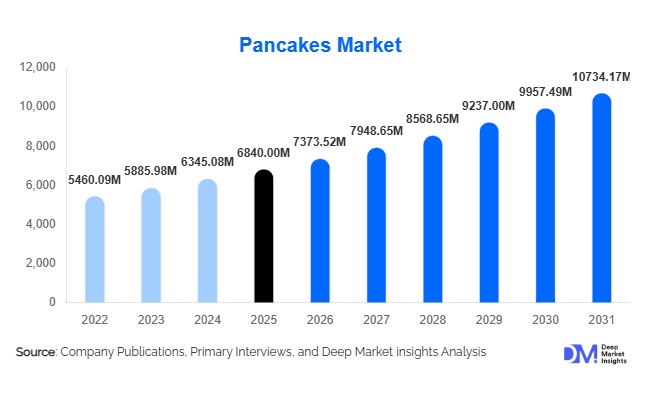
According to Deep Market Insights, the global pancakes market size was valued at USD 6,840 million in 2025 and is projected to grow from USD 7,373.52 million in 2026 to reach USD 10,734.17 million by 2031, expanding at a CAGR of 7.8% during the forecast period (2026–2031). The pancakes market growth is primarily driven by rising demand for convenient breakfast solutions, increasing penetration of packaged food products, rapid expansion of café culture globally, and growing consumer preference for healthier, protein-rich, and gluten-free breakfast alternatives. The market is also benefiting from strong innovation in frozen ready-to-eat pancakes, functional pancake mixes, and premium café-style offerings that replicate restaurant-quality experiences at home.
Key Market Insights
- Convenience-driven consumption is reshaping breakfast habits globally, boosting demand for pancake mixes and ready-to-eat formats across urban households.
- Health-focused product innovation is accelerating, with protein pancakes, gluten-free, keto, and organic variants gaining strong traction among fitness-conscious consumers.
- North America remains the dominant market, supported by strong breakfast culture and high frozen food penetration.
- Asia-Pacific is the fastest-growing region, driven by westernization of diets, café expansion, and rising disposable incomes.
- E-commerce and quick-commerce platforms are transforming distribution, enabling wider access to niche and premium pancake products.
- Foodservice and café channels are expanding rapidly, with premium pancake offerings becoming a core brunch menu item globally.
What are the latest trends in the global pancakes market?
Health-Oriented and Functional Pancake Innovation
The pancakes market is experiencing a major shift toward health-oriented formulations, as consumers increasingly prioritize nutrition alongside taste. Protein-enriched pancakes, oat-based mixes, keto-friendly formulations, and gluten-free variants are gaining significant popularity across developed and emerging economies. Manufacturers are incorporating functional ingredients such as plant proteins, fiber, probiotics, and low-glycemic sweeteners to appeal to fitness-focused consumers. Clean-label positioning is also becoming a key differentiator, with brands emphasizing non-GMO, organic, and preservative-free formulations. This trend is particularly strong in North America and Europe, where health awareness and dietary specialization are highly advanced.
Premiumization and Café-Style Breakfast Experiences
Another major trend shaping the market is the premiumization of pancakes, driven by the global café culture boom. Consumers increasingly seek restaurant-quality breakfast experiences at home, fueling demand for gourmet pancake mixes and frozen specialty pancakes. Japanese soufflé pancakes, artisan-style buttermilk pancakes, and indulgent flavored varieties such as chocolate and berry blends are gaining traction. Foodservice operators are also expanding their breakfast menus to include premium pancakes as a signature offering. This trend is particularly strong in urban centers across Asia-Pacific, North America, and Europe, where experiential dining is a key consumer preference.
What are the key drivers in the global pancakes market?
Rising Demand for Convenience Breakfast Foods
One of the strongest growth drivers in the pancakes market is the increasing demand for convenient and time-saving breakfast solutions. Busy urban lifestyles, dual-income households, and changing eating habits have significantly increased reliance on ready-to-cook and ready-to-eat breakfast products. Pancake mixes and frozen pancakes offer quick preparation without compromising taste or quality, making them highly attractive for modern consumers. This shift is especially prominent in metropolitan regions where time efficiency is a key purchase factor, driving consistent demand growth across retail and foodservice channels.
Expansion of Health-Conscious and Functional Food Consumption
Growing awareness of health and wellness is significantly influencing pancake consumption patterns. Consumers are actively seeking products that support dietary goals such as high protein intake, low sugar consumption, and improved digestive health. This has led to the rapid expansion of functional pancake variants including protein pancakes, gluten-free mixes, and organic formulations. The rise of fitness culture, weight management trends, and preventive healthcare awareness is further accelerating demand for nutritious breakfast alternatives. Manufacturers are responding with continuous product innovation to meet evolving dietary expectations globally.
Growth of Café Culture and Foodservice Expansion
The rapid expansion of cafés, quick-service restaurants, and boutique breakfast outlets is another major driver of the pancakes market. Pancakes have become a staple item in brunch menus worldwide, particularly in urban centers. Foodservice operators are introducing innovative pancake formats, including layered pancakes, dessert-style pancakes, and savory variations, enhancing consumer appeal. This trend is further supported by tourism growth and the rising popularity of experiential dining, where consumers prioritize unique food experiences over traditional meals.
What are the restraints for the global market?
Raw Material Price Volatility
The pancakes market is highly sensitive to fluctuations in raw material costs, including wheat, dairy, eggs, sugar, and edible oils. These commodities are influenced by weather conditions, global supply chain disruptions, and geopolitical uncertainties, leading to inconsistent pricing structures. Such volatility directly impacts production costs and profit margins for manufacturers, particularly in the mass-market segment where pricing competition is intense. This remains a persistent challenge for global players seeking cost stability and pricing consistency.
Health Perception Challenges of Processed Breakfast Foods
Despite innovation in healthier variants, traditional pancake products are still perceived by some consumers as high in carbohydrates and calories. Increasing regulatory focus on sugar reduction, clean-label compliance, and nutritional transparency is also pressuring manufacturers to reformulate products. Additionally, rising competition from alternative breakfast options such as smoothies, cereal bars, and yogurt-based meals is limiting growth potential in certain mature markets. These factors collectively restrain the overall expansion pace of the market.
What are the key opportunities in the global pancakes industry?
Expansion in Emerging Economies and Westernized Breakfast Adoption
Emerging markets in Asia-Pacific, Latin America, and the Middle East present significant growth opportunities due to rising disposable incomes and increasing exposure to Western dietary habits. Countries such as India, China, Brazil, and the UAE are witnessing rapid adoption of packaged breakfast foods and café-style dining culture. International food brands are expanding aggressively in these regions by introducing localized flavors and affordable product ranges. This shift is expected to significantly increase market penetration over the forecast period.
Growth of E-commerce and Direct-to-Consumer Channels
The rapid expansion of online grocery platforms and quick-commerce services is creating new opportunities for pancake manufacturers. Digital channels enable brands to reach niche consumer segments, including vegan, organic, and protein-focused buyers, without traditional retail constraints. Subscription-based breakfast kits and premium pancake delivery models are gaining popularity in developed markets. Digital marketing, influencer engagement, and personalized nutrition targeting are further enhancing brand visibility and customer acquisition.
Innovation in Functional and Specialty Pancakes
There is strong opportunity in the development of specialty pancake products tailored to evolving consumer needs. This includes high-protein fitness pancakes, allergen-free formulations, plant-based alternatives, and fortified breakfast solutions enriched with vitamins and minerals. The growing demand for personalized nutrition is encouraging manufacturers to invest in R&D and product differentiation strategies. This segment is expected to deliver higher margins and stronger brand loyalty compared to traditional offerings.
Report Scope
| Report Metric | Details |
|---|---|
| Market Size in 2025 | USD 6840.00 Million |
| Market Size in 2026 | USD 7373.52 Million |
| Market Size in 2031 | USD 10734.17 Million |
| CAGR | 7.8% (2026-2031) |
| Base Year for Estimation | 2025 |
| Historical Data | 2022-2024 |
| Forecast Period | 2026-2031 |
| Report Coverage | Revenue Forecast, Competitive Landscape, Supply Chain Disruption, Growth Factors, Environment & Regulatory Landscape and Trends |
| Geographies Covered | North America, Europe, APAC, Middle East and Africa, LATAM |
| Countries Covered | U.S., Canada, U.K., Germany, France, Spain, Italy, Russia, Nordic, Benelux, Rest of Europe, China, Korea, Japan, India, Australia, Singapore, Taiwan, South East Asia, Rest of Asia-Pacific, UAE, Turky, Saudi Arabia, South Africa, Egypt, Nigeria, Rest of MEA, Brazil, Mexico, Argentina, Chile, Colombia, Rest of LATAM |
Explore more data points, trends and opportunities Download Free Sample Report
Product Type Insights
The global pancakes market is characterized by a diversified product portfolio that continues to evolve in response to shifting consumer lifestyles, nutritional awareness, and convenience-driven eating habits. Among all product categories, pancake mixes maintain a dominant position in the global landscape due to their exceptional convenience, affordability, and adaptability across both household and foodservice applications. These mixes are widely available across supermarkets, hypermarkets, convenience stores, and online retail channels, making them highly accessible to a broad consumer base. The key growth driver behind pancake mixes is the increasing preference for quick breakfast solutions that require minimal preparation time while still offering a homemade taste experience. Urban consumers, particularly working professionals and students, are increasingly relying on ready-to-cook products, which significantly boosts the demand for pancake mix formulations enriched with additional nutritional benefits such as whole grains, protein fortification, and gluten-free ingredients.Specialty pancakes represent a rapidly expanding and highly innovative sub-segment within the global market. This category includes protein-rich pancakes, plant-based formulations, organic variants, gluten-free options, and culturally inspired formats such as Japanese soufflé pancakes and Scandinavian-style thin pancakes. The growth of this segment is primarily driven by the rising global emphasis on health, wellness, and functional nutrition. Consumers are increasingly seeking food products that align with specific dietary goals such as weight management, muscle building, or allergen-free consumption. The premiumization trend within the food industry has also led to increased experimentation with gourmet pancake formats, incorporating exotic flavors, superfoods, and alternative flours such as almond, oat, and coconut flour. This segment is expected to witness sustained growth as manufacturers continue to innovate and cater to niche dietary requirements and indulgence-oriented consumption patterns.
End-Use Insights
The household segment remains the largest and most influential end-use category within the global pancakes market, supported by the growing penetration of packaged food products and the increasing adoption of at-home breakfast consumption habits. Modern consumers are increasingly shifting toward convenient meal solutions that reduce preparation time while maintaining taste and nutritional value. The rise of dual-income households, busy lifestyles, and urbanization has significantly contributed to the growth of packaged pancake products in domestic kitchens. Additionally, marketing efforts emphasizing family-friendly breakfast experiences and easy-to-prepare food options have strengthened household adoption rates. The availability of diverse product formats, including instant mixes and frozen pancakes, has further enhanced consumer accessibility and repeat purchase behavior. Health-oriented household consumers are also driving demand for fortified and organic pancake options that align with dietary wellness trends.Export-driven demand is also emerging as a notable growth factor within the end-use landscape, as global food manufacturers expand distribution networks across developing and emerging economies. The increasing globalization of food culture has led to the widespread adoption of Western-style breakfast products, particularly pancakes, in regions where they were previously considered niche or specialty items. Cross-border trade agreements, improved logistics infrastructure, and the expansion of multinational food brands are further facilitating international market penetration. As consumer exposure to global cuisines increases, pancake products are gaining acceptance across a wider demographic base, strengthening their position in both developed and developing markets.
Explore more data points, trends and opportunities Download Free Sample Report
Pancakes Market Segmentations
By Product Type
- Pancake Mixes
- Ready-to-Eat Pancakes
- Freshly Prepared Pancakes
- Specialty Pancakes
By Ingredient Type
- Wheat-Based Pancakes
- Oat-Based Pancakes
- Alternative Flour Pancakes
- Mixed Grain Pancakes
By Dietary Preference
- Conventional Pancakes
- Gluten-Free Pancakes
- Vegan Pancakes
- High-Protein & Keto Pancakes
- Low-Sugar & Dairy-Free Pancakes
By Distribution Channel
- Supermarkets & Hypermarkets
- Convenience & Specialty Stores
- Online Retail & E-Commerce Platforms
- Quick Commerce Platforms
- Foodservice
By End User
- Household Consumers
- Foodservice Industry
- Institutional Catering
- Hospitality & Travel Sector
Regional Insights
North America
North America continues to dominate the global pancakes market, accounting for approximately 36% of the total market share in 2025. The United States remains the primary contributor to regional growth due to its deeply entrenched breakfast culture, where pancakes are a traditional and widely consumed food item. The strong presence of packaged food manufacturers, coupled with high consumer spending on convenience foods, significantly supports market expansion. One of the key drivers in this region is the high penetration of frozen and ready-to-eat breakfast products, which aligns with the fast-paced lifestyle of urban consumers. Additionally, the growing demand for health-conscious alternatives, such as high-protein and low-carb pancake mixes, is reshaping product innovation strategies. Furthermore, strong branding and aggressive marketing strategies by leading food companies continue to reinforce consumer loyalty and repeat purchases across the region.
Europe
Europe holds nearly 28% of the global pancakes market share, driven by strong demand across countries such as the United Kingdom, Germany, France, and the Netherlands. The region is characterized by a growing preference for healthier and more sustainable food choices, which has led to increased consumption of organic, gluten-free, and plant-based pancake products. One of the major growth drivers in Europe is the rising awareness of clean-label food products, where consumers actively seek transparency in ingredient sourcing and production processes. This trend has encouraged manufacturers to reformulate traditional pancake mixes with natural and minimally processed ingredients. Eastern Europe, while still developing in terms of consumption patterns, is emerging as a high-growth region due to increasing urbanization, rising disposable incomes, and expanding modern retail infrastructure. The gradual shift from traditional homemade breakfast foods to packaged and convenience-based options is expected to further strengthen market growth in this region.
Asia-Pacific
Asia-Pacific represents the fastest-growing regional market for pancakes globally, driven by rapid urbanization, increasing disposable incomes, and the widespread adoption of Western dietary habits. Countries such as China, India, Japan, South Korea, and Australia are at the forefront of this growth trajectory. One of the key drivers in the region is the expansion of café culture, particularly among younger consumers who are increasingly influenced by global food trends and social media-driven dining experiences. The rising popularity of Western-style breakfasts has significantly boosted pancake consumption across urban centers.In China, the growing urban population and the expansion of frozen food retail channels are driving demand for ready-to-eat pancake products. The overall region benefits from strong economic growth, technological advancements in food processing, and increasing penetration of international food brands, making it a key future growth engine for the global market.
Latin America
Latin America is witnessing gradual but steady growth in the pancakes market, with Brazil and Mexico serving as the primary contributors. The region’s growth is largely driven by increasing urbanization, improving retail infrastructure, and rising exposure to international food trends. As consumer lifestyles evolve, there is a growing preference for convenient breakfast options that fit into busy daily routines. Pancake mixes are particularly popular in this region due to their affordability and ease of preparation, making them suitable for a wide range of income groups. The region is also witnessing a gradual shift toward packaged and processed food consumption, which is expected to further support long-term market expansion.
Middle East & Africa
The Middle East & Africa region is emerging as a promising growth market for pancakes, driven by increasing tourism activity, rapid urban development, and expanding hospitality infrastructure. Countries such as the United Arab Emirates, Saudi Arabia, and South Africa are leading regional demand due to their strong hospitality sectors and high influx of international visitors. Pancakes are widely featured in hotel breakfast buffets and café menus, reflecting their global appeal and adaptability to diverse consumer preferences. While price sensitivity remains a key consideration in certain markets, rising income levels and improved distribution networks are expected to support long-term market expansion across the region. The combination of tourism growth, cultural diversification, and evolving dietary habits positions the Middle East & Africa as a strategically important emerging market within the global pancakes industry.
Key Players in the Global Pancakes Market
- General Mills
- The Kraft Heinz Company
- Conagra Brands
- Continental Mills
- PepsiCo
- Bob’s Red Mill Natural Foods
- Dr. Oetker
- Grupo Bimbo
- Premier Foods
- TreeHouse Foods