Magazine Shelf Market Size
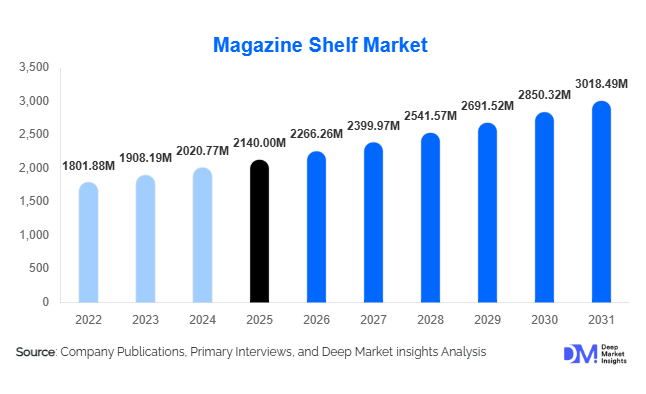
According to Deep Market Insights, the global magazine shelf market size was valued at USD 2,140 million in 2025 and is projected to grow from USD 2,266.26 million in 2026 to reach USD 3,018.49 million by 2031, expanding at a CAGR of 5.9% during the forecast period (2026–2031). The magazine shelf market growth is primarily driven by rising demand for organized interior spaces, increasing commercial infrastructure development, and growing consumer spending on home décor and functional furniture.
Magazine shelves are widely used across residential homes, corporate offices, hospitality venues, healthcare waiting areas, libraries, and retail stores to store and display magazines, catalogs, brochures, and printed materials. Although digital media consumption has grown significantly in recent years, physical reading materials remain common in waiting rooms, hotels, and office reception areas, sustaining steady demand for magazine shelving furniture.
Interior design trends emphasizing minimalism, modular storage, and multifunctional furniture are further supporting the market’s growth. Manufacturers are increasingly offering wall-mounted magazine shelves, tiered display racks, and modular shelving systems that maximize storage efficiency while enhancing aesthetic appeal. Additionally, the rise of e-commerce furniture platforms has improved product accessibility and global distribution, enabling manufacturers to reach new consumer segments across emerging markets.
Sustainability is also shaping product innovation within the magazine shelf market. Furniture manufacturers are incorporating eco-friendly materials such as bamboo, recycled metals, engineered wood, and biodegradable composites to meet increasing demand for environmentally responsible furniture solutions. As commercial real estate construction, hospitality development, and home renovation activity continue to grow globally, the magazine shelf market is expected to maintain steady expansion throughout the forecast period.
Key Market Insights
- Wall-mounted magazine shelves are gaining popularity due to their space-saving design and compatibility with modern minimalist interiors.
- Wood-based magazine shelves dominate the material segment, accounting for a significant share due to durability, aesthetics, and cost efficiency.
- North America leads the global market, driven by strong home décor spending and widespread use of magazine racks in commercial spaces.
- Asia-Pacific is the fastest-growing region, supported by rapid urbanization, expanding commercial infrastructure, and rising consumer interest in interior décor.
- E-commerce platforms are transforming distribution channels, enabling global consumers to purchase customizable furniture products online.
- Sustainable furniture materials are gaining traction, with manufacturers increasingly adopting bamboo, recycled wood, and eco-certified materials.
What are the latest trends in the magazine shelf market?
Growing Adoption of Space-Saving Wall-Mounted Designs
One of the most prominent trends in the magazine shelf market is the increasing popularity of wall-mounted shelving solutions. With urban housing becoming more compact, consumers are prioritizing furniture designs that maximize vertical storage while minimizing floor space. Wall-mounted magazine shelves offer a practical solution for small apartments, home offices, and reading corners by utilizing unused wall areas.
Manufacturers are introducing sleek and minimalist wall shelving units that integrate seamlessly with contemporary interior design styles such as Scandinavian, industrial, and modern minimalist décor. Many designs also incorporate multi-functional features, allowing users to store books, tablets, and decorative objects alongside magazines. As urban living spaces continue to shrink, space-efficient wall shelving systems are expected to remain a key product trend across both residential and commercial environments.
Increasing Demand for Modular and Customizable Furniture
Another important trend shaping the magazine shelf market is the rise of modular and customizable furniture solutions. Consumers increasingly prefer furniture that can be adapted to different interior layouts, allowing for flexibility and personalization. Modular magazine shelves can be expanded, rearranged, or integrated with larger shelving systems, enabling users to adjust storage capacity as their needs change.
Furniture manufacturers are leveraging advanced manufacturing technologies such as CNC machining and digital design tools to produce customizable shelving systems. Online furniture platforms also allow customers to select materials, colors, and dimensions before purchasing, making personalization more accessible than ever. This trend is particularly strong in markets such as Europe and North America, where interior design customization plays a major role in consumer purchasing decisions.
What are the key drivers in the magazine shelf market?
Growing Demand for Organized Living and Workspace Environments
The global trend toward organized and clutter-free living spaces is a major driver of the magazine shelf market. Consumers increasingly value furniture solutions that help maintain tidy and well-organized interiors. Magazine shelves provide a convenient storage option for printed materials, catalogs, newspapers, and books while enhancing interior aesthetics.
Workplace organization is also contributing to demand growth. Corporate offices, coworking spaces, and reception areas often display magazines and brochures for visitors, requiring durable and visually appealing shelving units. As the number of commercial office spaces continues to increase globally, demand for magazine shelving furniture is expected to rise accordingly.
Expansion of Hospitality and Healthcare Infrastructure
The rapid expansion of global hospitality and healthcare infrastructure is another significant growth driver for the magazine shelf market. Hotels, resorts, airports, clinics, and hospitals commonly provide reading materials in waiting areas, lounges, and guest rooms. These establishments require specialized magazine racks capable of storing multiple publications while complementing the overall interior design.
In particular, the healthcare sector continues to generate consistent demand for magazine shelving furniture due to the presence of waiting areas in hospitals, diagnostic centers, and clinics. As global healthcare infrastructure investments increase, this sector will remain a stable end-use market for magazine shelf manufacturers.
What are the restraints for the global market?
Declining Printed Media Consumption
The shift toward digital media consumption represents a structural challenge for the magazine shelf market. Smartphones, tablets, and digital publishing platforms have significantly reduced demand for printed magazines in many developed markets. As consumers increasingly access digital content, the need for physical magazine storage may gradually decline in residential settings.
However, commercial environments such as hospitality venues and healthcare facilities continue to maintain printed reading materials, which partially offsets the impact of declining print consumption.
Space Constraints in Urban Housing
Rapid urbanization has led to smaller residential living spaces in many major cities worldwide. Limited floor space restricts the adoption of larger freestanding magazine racks, particularly in compact apartments and micro-housing developments. Consumers in such environments often prioritize multifunctional furniture solutions that combine multiple storage functions within a single unit.
Although wall-mounted designs mitigate some of these limitations, space constraints remain an ongoing challenge for certain magazine shelf product categories.
What are the key opportunities in the magazine shelf industry?
Expansion of Hospitality and Commercial Infrastructure
The rapid growth of global hospitality and commercial infrastructure presents a significant opportunity for the magazine shelf market. Hotels, resorts, airport lounges, and coworking spaces frequently incorporate reading zones and waiting areas where magazines and brochures are displayed for visitors. As hospitality developers increasingly invest in high-quality interior design, demand for aesthetically pleasing magazine shelving solutions is rising.
Large-scale hotel construction projects across Asia-Pacific and the Middle East are expected to generate sustained demand for commercial magazine display furniture. Manufacturers can capitalize on this opportunity by designing durable and modular shelving systems specifically tailored for high-traffic environments.
Growth of E-Commerce Furniture Retail
The expansion of online furniture retail platforms represents another major opportunity for magazine shelf manufacturers. E-commerce channels allow companies to reach global consumers without relying solely on traditional retail distribution networks. Online marketplaces also enable customers to compare designs, materials, and pricing more easily, increasing product visibility.
Direct-to-consumer furniture brands are particularly benefiting from digital sales channels, offering customizable magazine shelves and interior décor accessories through online platforms. As global e-commerce penetration continues to grow, especially in emerging economies, online retail will play an increasingly important role in driving market growth.
Report Scope
| Report Metric | Details |
|---|---|
| Market Size in 2025 | USD 2140 Million |
| Market Size in 2026 | USD 2266.26 Million |
| Market Size in 2031 | USD 3018.49 Million |
| CAGR | 5.9% (2026-2031) |
| Base Year for Estimation | 2025 |
| Historical Data | 2022-2024 |
| Forecast Period | 2026-2031 |
| Report Coverage | Revenue Forecast, Competitive Landscape, Supply Chain Disruption, Growth Factors, Environment & Regulatory Landscape and Trends |
| Geographies Covered | North America, Europe, APAC, Middle East and Africa, LATAM |
| Countries Covered | U.S., Canada, U.K., Germany, France, Spain, Italy, Russia, Nordic, Benelux, Rest of Europe, China, Korea, Japan, India, Australia, Singapore, Taiwan, South East Asia, Rest of Asia-Pacific, UAE, Turky, Saudi Arabia, South Africa, Egypt, Nigeria, Rest of MEA, Brazil, Mexico, Argentina, Chile, Colombia, Rest of LATAM |
Explore more data points, trends and opportunities Download Free Sample Report
Product Type Insights
Wall-mounted magazine shelves represent the leading product type in the global magazine shelf market, accounting for approximately 32% of total market revenue. Their dominance is largely attributed to the growing preference for space-efficient furniture solutions, particularly in urban residential environments where floor space is limited. By utilizing vertical wall areas, wall-mounted shelves allow consumers and businesses to maximize storage capacity without occupying valuable floor space. This design flexibility makes them highly suitable for apartments, home offices, libraries, and modern workplace environments that prioritize minimalist layouts and functional interior design. The increasing popularity of contemporary interior aesthetics and modular wall storage systems has further strengthened demand for wall-mounted shelving units.Freestanding magazine shelves remain an important segment of the market, particularly within commercial environments where larger storage capacity and mobility are required. These units are commonly installed in hotel lobbies, clinics, waiting areas, educational institutions, and public libraries where they provide accessible storage for magazines, newspapers, and informational brochures. Their portability allows facility managers to reposition shelving units based on interior layout changes or customer traffic patterns, making them a practical choice for high-traffic spaces.
Rotating and carousel magazine shelves are widely used in retail stores, bookstores, and public venues where visibility and accessibility are critical for customer engagement. The rotating design enables users to browse multiple magazines or catalogs from a compact footprint, improving product visibility and enhancing browsing convenience. These units are particularly effective for promotional display purposes in retail showrooms and hospitality environments.Modular magazine shelving systems are also gaining increasing traction as consumers and commercial buyers seek customizable storage solutions that can adapt to evolving interior layouts. Modular designs allow users to combine multiple units, adjust shelf spacing, and integrate additional storage features, making them suitable for both residential and professional environments. The rising demand for multifunctional furniture and adaptable storage systems is expected to support continued growth within this segment.
Application Insights
The commercial segment represents the largest application area in the global magazine shelf market, accounting for approximately 52% of total demand. Commercial establishments such as corporate offices, hospitality venues, healthcare facilities, retail showrooms, and educational institutions frequently install magazine shelves to organize reading materials, display informational brochures, and enhance customer waiting areas. The leading driver of this segment is the continued expansion of service-based industries and the growing emphasis on improving customer experience within reception areas, lounges, and waiting rooms. Businesses increasingly view well-organized reading displays as part of a professional interior environment that contributes to visitor comfort and brand perception.Residential applications are also expanding steadily as consumers incorporate organized storage furniture into home interiors. Magazine shelves are commonly used in living rooms, home offices, reading corners, and study areas to store magazines, newspapers, books, and decorative materials. The growth of home-based workspaces and increased interest in organized living environments are encouraging homeowners to adopt compact storage furniture that improves both functionality and interior aesthetics.
Libraries and educational institutions represent another significant application segment. Public libraries, university reading rooms, and research centers require structured storage solutions to organize periodicals, journals, and magazines for easy access by readers. Magazine shelves designed for institutional use often feature tiered layouts that allow multiple publications to be displayed simultaneously, improving accessibility and catalog visibility.Retail stores and commercial showrooms also utilize magazine shelves to display catalogs, product guides, promotional materials, and branded publications. Tiered shelving systems are particularly popular in retail environments where they enable customers to browse marketing materials while waiting or exploring store offerings. As retailers increasingly invest in experiential store layouts, organized display furniture such as magazine shelves plays an important role in enhancing customer engagement.
Distribution Channel Insights
Furniture retail stores remain the dominant distribution channel for magazine shelves, accounting for approximately 44% of global sales. Physical retail outlets allow consumers to evaluate product materials, structural stability, design quality, and finishing before making purchasing decisions. This hands-on evaluation is particularly important for furniture products, where durability and visual aesthetics significantly influence buyer preferences. In-store consultations with sales representatives and interior design guidance also contribute to strong consumer reliance on traditional furniture retail channels.Online marketplaces and e-commerce platforms are experiencing rapid growth as digital retail expands globally. Online channels provide consumers with access to a wider variety of product designs, sizes, and price ranges compared to traditional retail stores. Manufacturers increasingly utilize digital platforms to offer customizable configurations, modular product systems, and direct-to-consumer shipping. The growth of e-commerce logistics infrastructure and improved online visualization tools such as 3D product displays are further strengthening this distribution channel.Office furniture suppliers and direct business-to-business procurement channels also represent an important component of market distribution. Corporate offices, hotels, hospitals, and educational institutions often purchase magazine shelves in bulk as part of larger interior furnishing projects. In such cases, businesses typically work directly with furniture manufacturers or specialized office furniture distributors to obtain customized shelving units designed to match broader interior design themes.
End-Use Industry Insights
The hospitality industry represents one of the most influential end-use sectors in the magazine shelf market. Hotels, resorts, luxury guest accommodations, and airport lounges frequently install magazine shelves in reception areas, waiting lounges, and guest service zones to provide reading materials and travel information to visitors. The leading driver of this segment is the continued expansion of global tourism infrastructure and hospitality construction projects, particularly in emerging travel destinations where hotels invest heavily in premium interior furnishings to enhance guest experience.Healthcare facilities also represent a major end-use market for magazine shelves. Hospitals, clinics, dental offices, and diagnostic centers commonly install magazine racks within waiting areas to improve patient comfort and reduce perceived waiting times. Organized reading displays help maintain tidy waiting environments while providing informational materials related to health services, patient education, and wellness topics.
Corporate offices and coworking spaces contribute substantial demand for magazine shelves as organizations increasingly focus on professional reception area design. Businesses often install magazine racks in visitor lounges, meeting area foyers, and employee break rooms to provide industry publications, company newsletters, and informational brochures. The expansion of coworking spaces and flexible office environments is further contributing to demand for compact, visually appealing furniture solutions.Residential consumers are also emerging as an important end-use segment as modern homeowners adopt magazine shelves as both functional storage units and decorative furniture pieces. Interior design trends emphasizing organized living spaces, minimalist décor, and multifunctional furniture are encouraging consumers to integrate magazine shelving into home libraries, living rooms, and personal reading areas.
Explore more data points, trends and opportunities Download Free Sample Report
Magazine Shelf Market Segmentations
By Product Type
- Wall-Mounted Magazine Shelves
- Freestanding Magazine Shelves
- Tabletop Magazine Shelves
- Rotating / Carousel Magazine Shelves
- Modular Magazine Shelf Systems
- Built-in Magazine Shelves
By Material
- Wood
- Metal
- Plastic / Polymer
- Glass
- Hybrid / Composite Materials
By Distribution Channel
- Furniture Retail Stores
- Specialty Interior Décor Stores
- Online Marketplaces / E-commerce Platforms
- Office Furniture Suppliers
- Direct B2B Procurement
By End-Use
- Residential Homes
- Corporate Offices
- Hospitality
- Healthcare Facilities
- Libraries and Educational Institutions
- Retail Stores and Showrooms
- Public Infrastructure
Regional Insights
North America
North America dominates the global magazine shelf market, accounting for approximately 38% of total market share. The United States represents the largest national market in the region, supported by high consumer spending on home décor, furniture products, and interior organization solutions. Strong demand from corporate offices, hospitality venues, and healthcare facilities continues to drive commercial installations of magazine shelves across reception areas and waiting rooms. The growing popularity of modern interior design trends, combined with increasing demand for multifunctional and space-saving furniture, further supports market growth. Additionally, the well-developed retail furniture industry and widespread adoption of e-commerce platforms contribute to strong product accessibility across the region. Canada also represents a significant market, driven by growth in hospitality infrastructure, commercial interior design projects, and residential home improvement spending.
Europe
Europe accounts for roughly 30% of global demand, supported by strong consumer interest in premium furniture products and sustainable materials. Countries such as Germany, the United Kingdom, France, and Italy represent key markets where magazine shelves are widely used in residential interiors, libraries, corporate offices, and hospitality spaces. A major driver of regional growth is the increasing consumer preference for environmentally sustainable furniture manufactured from certified wood and recyclable materials. European furniture manufacturers are actively investing in eco-friendly production processes and modular product designs to align with stringent environmental regulations and sustainability standards. Additionally, the region’s strong tradition of interior design and high adoption of contemporary furniture styles continues to stimulate demand for aesthetically appealing magazine storage solutions.
Asia-Pacific
Asia-Pacific represents the fastest-growing regional market and is expected to expand at a CAGR exceeding 6% during the forecast period. Rapid urbanization, rising disposable income levels, and expanding middle-class populations are key drivers supporting growth in residential furniture demand across the region. China and India are particularly significant markets due to large-scale urban housing development, growing office infrastructure, and increasing consumer spending on interior décor and space-saving furniture solutions. The rapid expansion of coworking spaces, commercial real estate, and retail environments is also contributing to commercial demand for magazine shelves. Japan and South Korea represent mature markets characterized by strong demand for compact, minimalist furniture designs that align with smaller living spaces and contemporary interior aesthetics.
Latin America
Latin America accounts for approximately 6% of the global magazine shelf market. Brazil and Mexico are the largest regional markets, supported by the expansion of retail furniture distribution networks and ongoing development within hospitality and commercial infrastructure sectors. Increasing urbanization across major metropolitan areas is encouraging greater adoption of organized home storage furniture among urban households. Rising middle-class income levels and improving consumer access to modern furniture retail outlets are further contributing to market growth. In addition, the gradual expansion of e-commerce platforms across the region is improving product availability and allowing international furniture brands to reach new customer segments.
Middle East & Africa
The Middle East and Africa region represents approximately 4% of global demand but is experiencing steady market expansion driven primarily by large-scale hospitality and infrastructure development projects. Countries such as the United Arab Emirates, Saudi Arabia, and Qatar are investing heavily in luxury hotels, resorts, airports, and tourism facilities, all of which require high-quality interior furnishings including magazine display racks for guest waiting areas. Rapid urban development, particularly in major Gulf cities, is also stimulating demand for premium commercial furniture. In Africa, growing urbanization, expanding retail sectors, and the gradual development of modern office infrastructure are contributing to emerging demand for functional storage furniture solutions.
Key Players in the Magazine Shelf Market
- IKEA
- Steelcase
- Herman Miller
- Haworth
- Lammhults Möbel
- Vitra
- HNI Corporation
- Teknion
- Kimball International
- Senator Group
- Karl Andersson & Söner
- Cassina
- TONELLI Design
- COVO
- Matière Grise