Lemon Squeezer Market Size
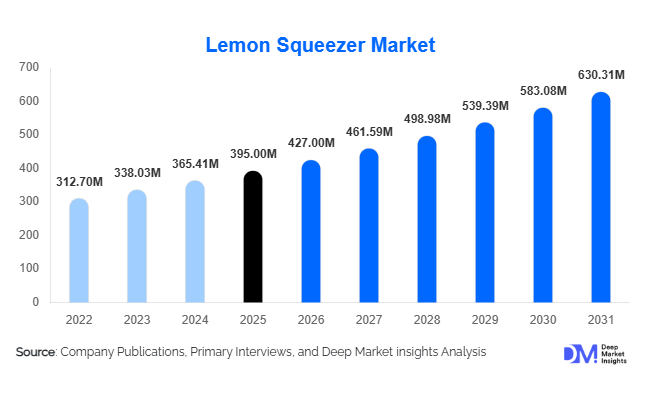
According to Deep Market Insights, the global lemon squeezer market size was valued at USD 395 million in 2025 and is projected to grow from USD 427 million in 2026 to reach USD 630.31 million by 2031, expanding at a CAGR of 8.1% during the forecast period (2026–2031). The lemon squeezer market growth is primarily driven by rising consumer preference for fresh and preservative-free beverages, increasing adoption of convenient kitchen tools, and the rapid expansion of the global foodservice industry. The growing awareness of health benefits associated with citrus consumption, particularly vitamin C intake, is further accelerating demand across both household and commercial segments.
Key Market Insights
- Manual lemon squeezers dominate the market, accounting for over 65% share due to affordability and ease of use across households globally.
- Stainless steel products are gaining strong traction, driven by durability, hygiene, and premium consumer perception.
- Asia-Pacific leads the global market, supported by high population density, rising disposable incomes, and strong manufacturing capabilities.
- Commercial demand is the fastest-growing segment, fueled by rapid expansion of cafés, restaurants, and juice bars worldwide.
- E-commerce platforms are reshaping distribution, offering wider product accessibility, competitive pricing, and consumer reviews.
- Product innovation and ergonomic designs are emerging as key differentiators among global manufacturers.
What are the latest trends in the lemon squeezer market?
Shift Toward Durable and Eco-Friendly Materials
The market is witnessing a strong shift toward sustainable and durable materials such as stainless steel and BPA-free plastics. Consumers are increasingly prioritizing long-lasting kitchen tools that are both environmentally friendly and safe for food contact. Manufacturers are responding by introducing recyclable materials, eco-friendly packaging, and corrosion-resistant designs. This trend is particularly strong in developed markets where sustainability awareness is high, but it is also gradually influencing purchasing decisions in emerging economies.
Rise of Multifunctional and Ergonomic Designs
Modern consumers prefer multifunctional kitchen tools that save time and space. Lemon squeezers with integrated strainers, measuring cups, and ergonomic grips are gaining popularity. Manufacturers are focusing on user-friendly designs that improve juice extraction efficiency while minimizing effort. Compact electric citrus juicers are also becoming more prevalent in urban households, reflecting the broader trend of smart and convenient kitchen appliances.
What are the key drivers in the lemon squeezer market?
Growing Health Consciousness and Fresh Food Consumption
The increasing global emphasis on healthy lifestyles is a major driver for the lemon squeezer market. Consumers are actively shifting toward fresh juices and natural ingredients, avoiding processed alternatives. Lemon juice, known for its immunity-boosting properties, has become a staple in daily diets, thereby increasing demand for efficient extraction tools across households and foodservice establishments.
Expansion of the Foodservice Industry
The rapid growth of restaurants, cafés, juice bars, and quick-service outlets is significantly driving demand for lemon squeezers. Commercial establishments require reliable and durable tools for high-frequency use, leading to increased adoption of both heavy-duty manual and electric variants. The global trend toward fresh beverages and artisanal drinks further strengthens this driver.
What are the restraints for the global market?
Availability of Ready-to-Use Lemon Juice Products
The availability of packaged lemon juice acts as a key restraint, particularly in commercial settings where convenience and speed are prioritized. These alternatives reduce the dependency on manual squeezing tools, limiting demand growth in certain segments.
Price Sensitivity in Developing Markets
A large portion of consumers in emerging economies remains highly price-sensitive, favoring low-cost plastic variants over premium stainless steel products. This limits the penetration of high-margin products and creates pricing pressure for manufacturers operating in competitive markets.
What are the key opportunities in the lemon squeezer industry?
Expansion in Emerging Markets
Rapid urbanization and rising disposable incomes in countries such as India, China, and Brazil present significant growth opportunities. Increasing penetration of organized retail and e-commerce platforms is enabling manufacturers to reach a broader consumer base, particularly in tier-2 and tier-3 cities. Localization strategies, including affordable pricing and region-specific product designs, can further accelerate adoption.
Growth in Commercial and Foodservice Applications
The expansion of global foodservice chains and beverage outlets is creating strong demand for durable and efficient lemon squeezing solutions. Commercial buyers prioritize performance and longevity, offering opportunities for manufacturers to introduce premium-grade and industrial variants tailored to high-volume usage environments.
Report Scope
| Report Metric | Details |
|---|---|
| Market Size in 2025 | USD 395 Million |
| Market Size in 2026 | USD 427 Million |
| Market Size in 2031 | USD 630.31 Million |
| CAGR | 8.1% (2026-2031) |
| Base Year for Estimation | 2025 |
| Historical Data | 2022-2024 |
| Forecast Period | 2026-2031 |
| Report Coverage | Revenue Forecast, Competitive Landscape, Supply Chain Disruption, Growth Factors, Environment & Regulatory Landscape and Trends |
| Geographies Covered | North America, Europe, APAC, Middle East and Africa, LATAM |
| Countries Covered | U.S., Canada, U.K., Germany, France, Spain, Italy, Russia, Nordic, Benelux, Rest of Europe, China, Korea, Japan, India, Australia, Singapore, Taiwan, South East Asia, Rest of Asia-Pacific, UAE, Turky, Saudi Arabia, South Africa, Egypt, Nigeria, Rest of MEA, Brazil, Mexico, Argentina, Chile, Colombia, Rest of LATAM |
Explore more data points, trends and opportunities Download Free Sample Report
Product Type Insights
The global lemon squeezer market is predominantly led by manual variants, accounting for approximately 68% of the total market share in 2025. This segment’s leadership is fundamentally driven by its cost-effectiveness, operational simplicity, and widespread accessibility across both developed and developing economies. Manual lemon squeezers require no electricity, making them highly practical for everyday use in households, particularly in regions where affordability and convenience remain primary purchasing considerations. Their lightweight design, portability, and ease of cleaning further enhance their appeal among consumers seeking functional and low-maintenance kitchen tools. Additionally, the strong cultural preference for traditional cooking methods in emerging economies continues to support sustained demand for manual products.The leading segment driver for manual lemon squeezers lies in their universal usability and price advantage, enabling mass adoption across diverse income groups and geographic regions. Conversely, electric lemon squeezers, although currently representing a smaller market share, are witnessing steady growth supported by rising urbanization and increasing consumer preference for time-saving kitchen appliances. The growing penetration of modular kitchens, higher disposable incomes, and the expansion of the foodservice sector are further accelerating demand for electric variants. As consumers increasingly prioritize efficiency, automation, and convenience in food preparation, the electric segment is expected to register robust growth, particularly in urban and semi-urban markets over the forecast period.
Material Type Insights
Stainless steel dominates the material segment, accounting for approximately 36% of the global market share, primarily due to its superior durability, corrosion resistance, and hygienic properties. The increasing consumer focus on food safety and long-lasting kitchen tools has significantly contributed to the widespread adoption of stainless steel lemon squeezers. In addition, its premium aesthetic appeal aligns well with modern kitchen designs, further driving demand in developed markets. The material’s recyclability and alignment with sustainability trends also make it highly attractive among environmentally conscious consumers.The leading segment driver for stainless steel products is the growing preference for durable, non-toxic, and eco-friendly kitchenware that ensures long-term value and safety. Meanwhile, plastic lemon squeezers continue to hold a notable share due to their affordability, lightweight structure, and availability in a wide variety of designs and colors. These characteristics make them particularly popular in price-sensitive markets across Asia-Pacific and Latin America. However, increasing concerns regarding plastic waste, environmental impact, and potential health risks associated with low-quality plastics are gradually shifting consumer preference toward premium materials. This ongoing transition toward sustainable and high-quality materials is expected to significantly reshape the competitive landscape in the coming years.
Mechanism Type Insights
Press-based lemon squeezers lead the market with an estimated share of 42%, driven by their superior efficiency in juice extraction and user-friendly design. These devices are specifically engineered to maximize juice output with minimal effort, making them highly suitable for both household and commercial applications. Their ergonomic construction, ability to handle larger citrus fruits, and reduced spillage significantly enhance user convenience, positioning them as the preferred choice among consumers.The leading segment driver for press-based mechanisms is their ability to deliver higher juice yield with improved ease of use, addressing the growing consumer demand for efficient and mess-free kitchen tools. Compared to traditional reamer or rotary mechanisms, press-based squeezers offer greater control, faster operation, and enhanced durability, which are critical factors influencing purchasing decisions. The increasing adoption of convenient kitchen solutions, particularly in fast-paced urban environments and high-volume foodservice settings, continues to reinforce the dominance of this segment. Ongoing innovations in ergonomic design and material strength are further expected to sustain its leadership position throughout the forecast period.
Distribution Channel Insights
Offline retail channels remain dominant in the lemon squeezer market, accounting for nearly 58% of the total share. This dominance is largely attributed to consumers’ preference for physically evaluating product quality, durability, and functionality before purchase. Traditional retail formats such as supermarkets, hypermarkets, specialty kitchen stores, and local outlets continue to play a crucial role, particularly in regions with strong brick-and-mortar retail infrastructure. The tactile shopping experience and immediate product availability significantly influence consumer buying behavior in this segment.The leading segment driver for offline channels is the trust associated with physical product inspection and instant purchase satisfaction. However, the online distribution channel is rapidly gaining traction and is expected to witness accelerated growth over the forecast period. The expansion of e-commerce platforms, increasing internet penetration, and widespread smartphone adoption are transforming consumer purchasing patterns. Online platforms offer competitive pricing, a broader product assortment, detailed customer reviews, and convenient home delivery services, making them increasingly attractive to modern consumers. As digital adoption continues to rise globally, online channels are expected to complement and gradually challenge the dominance of traditional retail formats.
End-Use Insights
The household segment dominates the lemon squeezer market, accounting for approximately 62% of the total share. This dominance is driven by the increasing trend of home cooking and the frequent use of citrus fruits in daily food preparation and beverages. Growing health awareness among consumers, particularly the rising consumption of fresh lemon water, detox drinks, and homemade juices, has significantly boosted demand for lemon squeezers in residential settings. The influence of social media platforms, cooking tutorials, and food content has further encouraged consumers to invest in efficient and aesthetically appealing kitchen tools.The leading segment driver for household usage is the rising preference for healthy, home-prepared beverages and meals, which necessitates convenient kitchen tools. Meanwhile, the commercial segment is emerging as the fastest-growing segment, supported by the rapid expansion of the global foodservice industry, including restaurants, cafes, hotels, and juice bars. The increasing demand for fresh, natural ingredients and efficient food preparation tools in high-volume environments is driving adoption in commercial settings. As the hospitality industry continues to expand and evolve, this segment is expected to witness strong and sustained growth.
Explore more data points, trends and opportunities Download Free Sample Report
Lemon Squeezer Market Segmentations
By Product Type
- Manual Lemon Squeezers
- Electric Lemon Squeezers
By Material Type
- Stainless Steel
- Aluminum
- Plastic
- Silicone-Based
- Glass
By Mechanism Type
- Press-Based
- Rotary
- Motorized Extraction
- Lever-Based Commercial Press
By Distribution Channel
- Online Retail
- Supermarkets/Hypermarkets
- Kitchen Specialty Stores
- Wholesale Distributors
By End-Use
- Household
- Commercial
Regional Insights
North America
North America accounts for approximately 28% of the global lemon squeezer market share, with the United States serving as the primary contributor. The region’s growth is driven by high disposable incomes, strong consumer preference for premium and durable kitchenware, and widespread adoption of modern cooking practices. A well-established foodservice industry further supports consistent demand for high-quality and efficient kitchen tools.Key regional growth drivers include the increasing trend of health-conscious consumption, particularly the rising popularity of fresh juices and detox beverages, as well as the growing inclination toward home cooking and kitchen upgrades. The presence of advanced retail infrastructure, strong brand penetration, and continuous product innovation further contribute to market expansion. In addition, sustainability trends and the growing demand for eco-friendly products are encouraging consumers to opt for stainless steel and other durable materials, strengthening overall market growth in the region.
Europe
Europe holds around 25% of the global market share, with major markets including Germany, France, and the United Kingdom. The region is characterized by a strong emphasis on product quality, sustainability, and design, which drives demand for premium kitchen tools. Stringent regulations related to food safety and environmental sustainability further encourage the adoption of durable and recyclable materials such as stainless steel.Regional growth is driven by increasing consumer awareness of sustainable living, a strong culinary culture, and the rising trend of home cooking. Additionally, the presence of established kitchenware manufacturers and a well-developed distribution network supports steady market expansion. The growing focus on reducing plastic usage and promoting environmentally friendly products is also significantly influencing purchasing behavior, thereby driving demand for high-quality lemon squeezers across both household and commercial sectors.
Asia-Pacific
Asia-Pacific dominates the global lemon squeezer market with approximately 32% share and is also the fastest-growing region. The region’s growth is primarily fueled by large population bases in countries such as China and India, rising disposable incomes, and rapid urbanization. The expanding middle-class population is increasingly adopting modern kitchen tools, driven by changing lifestyles and greater exposure to global consumption trends.Key regional growth drivers include strong manufacturing capabilities that enable the production of cost-effective products, increasing penetration of e-commerce platforms, and rising smartphone usage. Additionally, growing health awareness and the increasing consumption of fresh juices and homemade beverages are significantly boosting demand. Government initiatives supporting manufacturing, retail development, and digitalization further contribute to market expansion. The combination of affordability, accessibility, and evolving consumer preferences positions Asia-Pacific as a key growth engine for the global market.
Latin America
Latin America is experiencing steady growth in the lemon squeezer market, with Brazil and Mexico emerging as key markets. The region’s expansion is supported by improving economic conditions, increasing urbanization, and a gradual shift toward modern kitchen tools and appliances.Regional growth drivers include rising consumer awareness of health and wellness, leading to increased consumption of fresh juices and natural beverages. The expanding foodservice industry, including restaurants and juice bars, is also contributing to higher product demand. Furthermore, the growing presence of organized retail chains and the rapid expansion of e-commerce platforms are enhancing product accessibility, thereby supporting market growth across both urban and semi-urban areas.
Middle East & Africa
The Middle East & Africa region is witnessing moderate growth in the lemon squeezer market, driven by the rapid expansion of the hospitality and tourism sectors in countries such as the UAE and Saudi Arabia. The increasing number of hotels, restaurants, and cafes is creating sustained demand for efficient and durable kitchen tools.Key growth drivers in the region include rising disposable incomes, improving living standards, and increasing exposure to international cuisines, which are influencing dietary habits and boosting the consumption of fresh juices and beverages. Additionally, the expansion of organized retail and e-commerce platforms is improving product availability and accessibility. The growing urban population and evolving consumer preferences toward modern kitchen solutions are expected to further support market growth in the coming years.
Key Players in the Lemon Squeezer Market
- OXO International Ltd.
- KitchenAid
- Cuisinart
- Zulay Kitchen
- Chef’n Corporation
- Norpro Inc.
- Bellemain
- Tovolo Company
- Progressive International
- Dreamfarm
- Trudeau Corporation
- Kuhn Rikon
- Joseph Joseph Ltd.
- Zyliss
- Hamilton Beach Brands