Knife Sharpener and Honer Market Size
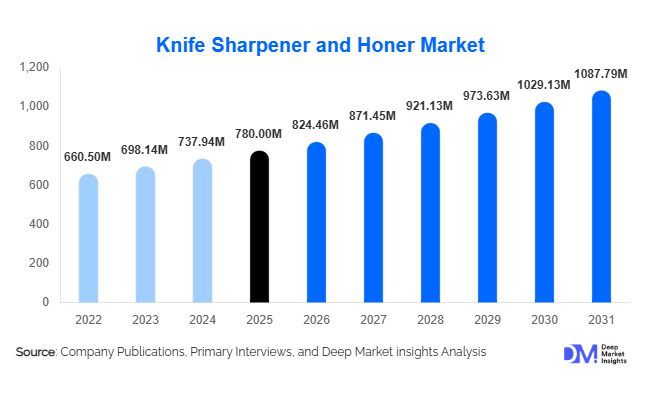
According to Deep Market Insights, the global knife sharpener and honer market size was valued at USD 780 million in 2025 and is projected to grow from USD 824.46 million in 2026 to reach USD 1,087.79 million by 2031, expanding at a CAGR of 5.7% during the forecast period (2026–2031). The knife sharpener and honer market growth is primarily driven by increasing global demand for premium kitchen knives, rising culinary enthusiasm among households, and the expansion of commercial foodservice industries worldwide. These sharpening devices play a critical role in maintaining blade efficiency, safety, and durability across residential kitchens, professional culinary environments, and outdoor applications.
The market is also benefiting from technological innovation in sharpening systems. Electric sharpeners equipped with multi-stage grinding mechanisms, precision angle guides, and automated blade detection systems are gaining popularity among both consumers and professional chefs. Meanwhile, traditional sharpening stones and honing rods remain widely used in professional kitchens due to their precision and control.
Increasing interest in home cooking, fueled by digital culinary platforms, cooking shows, and food-focused social media content, is further expanding the market. Consumers are investing in premium kitchen equipment and maintenance tools to replicate restaurant-quality cooking experiences at home. Additionally, the rapid expansion of restaurants, hospitality establishments, and butcheries is driving consistent demand for high-performance sharpening equipment capable of maintaining large volumes of knives.
Key Market Insights
- Electric knife sharpeners are gaining widespread adoption, particularly in commercial kitchens, due to their ease of use and consistent sharpening performance.
- Diamond abrasive technology is increasingly preferred for its durability and superior sharpening efficiency compared to ceramic or carbide alternatives.
- North America dominates the global market, driven by strong consumer spending on premium kitchen tools and a large restaurant industry.
- Asia-Pacific is the fastest-growing region, supported by expanding urban populations, rising disposable incomes, and growing foodservice sectors.
- Online retail channels are transforming product accessibility, allowing consumers to compare sharpening technologies and purchase globally recognized brands.
- Technological innovation is reshaping the market, with automated angle adjustment systems and multi-stage sharpening mechanisms improving user convenience.
What are the latest trends in the knife sharpener and honer market?
Growing Popularity of Electric Sharpening Systems
Electric knife sharpeners are rapidly gaining popularity among both residential users and professional chefs. These devices feature automated sharpening stages that replicate traditional sharpening techniques without requiring specialized skills. Multi-stage sharpening systems typically include coarse grinding, fine sharpening, and polishing functions, producing consistent blade edges with minimal effort. Many modern electric sharpeners incorporate precision angle guides, ensuring optimal sharpening angles for different knife types.
This trend is particularly strong in North America and Europe, where households increasingly purchase premium kitchen appliances. Electric sharpening devices are also widely adopted in restaurants, catering facilities, and hospitality kitchens where time efficiency and consistency are critical operational requirements.
Rising Demand for Diamond Abrasive Sharpening Technology
Diamond abrasive technology is emerging as one of the most preferred sharpening solutions globally. Diamond particles provide superior hardness and durability compared to traditional abrasives such as ceramic or aluminum oxide. This enables faster sharpening, improved blade precision, and longer product lifespan.
Professional chefs and knife enthusiasts prefer diamond sharpening systems because they can sharpen high-carbon steel and specialty blades without excessive wear. Manufacturers are increasingly integrating diamond abrasives into both manual and electric sharpeners, positioning them as premium solutions for professional-grade knife maintenance.
What are the key drivers in the knife sharpener and honer market?
Rising Popularity of Premium Kitchen Knives
The growing global popularity of premium kitchen knives is a major driver of the knife sharpener and honer market. High-quality knives made from advanced materials such as Damascus steel and high-carbon stainless steel require regular sharpening to maintain their performance. As consumers invest in expensive kitchen knives, they are increasingly purchasing sharpening tools to extend blade lifespan and preserve cutting efficiency.
Premium knife ownership is particularly strong in developed markets such as the United States, Germany, and Japan. Culinary enthusiasts and professional chefs in these regions prioritize proper knife maintenance, driving consistent demand for sharpening systems.
Expansion of the Global Foodservice Industry
The rapid growth of the global restaurant and hospitality industry is significantly contributing to the demand for knife-sharpening tools. Commercial kitchens depend heavily on sharp knives to maintain food preparation efficiency and ensure workplace safety. Dull knives increase preparation time and pose greater risks of accidents, making regular sharpening essential.
Restaurant chains, catering services, and institutional kitchens are investing in electric sharpening systems capable of maintaining multiple knives quickly. This demand is particularly strong in regions experiencing rapid tourism growth and urbanization.
What are the restraints for the global market?
Availability of Professional Sharpening Services
Professional knife sharpening services are widely available in many urban markets, providing an alternative to purchasing sharpening equipment. Restaurants and households sometimes outsource knife maintenance to specialized service providers rather than investing in sharpening tools. This can reduce product demand in regions where such services are easily accessible.
Limited Consumer Knowledge of Sharpening Techniques
Many consumers lack familiarity with proper knife sharpening methods, particularly when using traditional tools such as whetstones. Concerns about damaging expensive knives can discourage consumers from purchasing sharpening equipment. Manufacturers are addressing this challenge by introducing simplified sharpening devices that provide guided sharpening angles and safety mechanisms.
What are the key opportunities in the knife sharpener and honer industry?
Growth in Home Cooking and Culinary Enthusiasm
The increasing popularity of home cooking presents significant opportunities for manufacturers of knife-sharpening tools. Social media cooking channels, culinary influencers, and online recipe platforms have inspired consumers to invest in professional-grade kitchen equipment. As households adopt high-quality chef knives, the need for sharpening tools grows proportionally.
Manufacturers are responding by developing beginner-friendly sharpening devices designed for residential kitchens. These products often feature ergonomic designs, non-slip bases, and automated sharpening stages that make knife maintenance easier for non-professional users.
Technological Innovation in Smart Sharpening Systems
Advancements in sharpening technology are creating new opportunities within the market. Smart sharpening systems equipped with sensors, automated blade detection, and digital guidance are gaining traction among professional kitchens and premium consumers. These systems ensure consistent sharpening angles and reduce the risk of blade damage.
Such innovations allow manufacturers to introduce premium product lines with higher profit margins. They also appeal to culinary training institutes and hospitality establishments that require reliable sharpening performance.
Report Scope
| Report Metric | Details |
|---|---|
| Market Size in 2025 | USD 780 Million |
| Market Size in 2026 | USD 824.46 Million |
| Market Size in 2031 | USD 1087.79 Million |
| CAGR | 5.7% (2026-2031) |
| Base Year for Estimation | 2025 |
| Historical Data | 2022-2024 |
| Forecast Period | 2026-2031 |
| Report Coverage | Revenue Forecast, Competitive Landscape, Supply Chain Disruption, Growth Factors, Environment & Regulatory Landscape and Trends |
| Geographies Covered | North America, Europe, APAC, Middle East and Africa, LATAM |
| Countries Covered | U.S., Canada, U.K., Germany, France, Spain, Italy, Russia, Nordic, Benelux, Rest of Europe, China, Korea, Japan, India, Australia, Singapore, Taiwan, South East Asia, Rest of Asia-Pacific, UAE, Turky, Saudi Arabia, South Africa, Egypt, Nigeria, Rest of MEA, Brazil, Mexico, Argentina, Chile, Colombia, Rest of LATAM |
Explore more data points, trends and opportunities Download Free Sample Report
Product Type Insights
The product landscape of the knife sharpener and honer market is diverse, encompassing electric sharpeners, manual sharpeners, sharpening stones, honing rods, and precision-guided sharpening systems. Among these, electric knife sharpeners represent the leading product segment globally, primarily driven by their ease of use, efficiency, and ability to deliver consistent sharpening results without requiring specialized skills. Electric sharpeners typically incorporate multi-stage grinding systems, precision angle guides, and advanced abrasive materials such as diamond or ceramic coatings. These features allow users to quickly restore blade sharpness while minimizing the risk of damaging expensive knives. The growing demand from both residential kitchens and professional foodservice establishments is significantly contributing to the dominance of this segment.
Manual pull-through sharpeners remain a widely adopted solution among household consumers, particularly in entry-level and mid-range price segments. Their affordability, portability, and compact design make them suitable for everyday knife maintenance. As a result, manual sharpeners maintain strong demand in emerging markets where consumers prioritize cost-effective kitchen tools. Precision-guided sharpening systems are emerging as a niche but growing category, targeting culinary professionals, knife collectors, and outdoor enthusiasts. These systems offer highly accurate angle adjustments and controlled sharpening processes, making them particularly valuable for premium knife maintenance. With increasing consumer awareness about proper knife care and the rising popularity of high-end culinary tools, demand for advanced sharpening systems is expected to continue expanding.
Application Insights
From an application perspective, kitchen knife sharpening remains the dominant application segment, accounting for the majority of global demand. This leadership is driven by the widespread use of kitchen knives across households, restaurants, and hospitality establishments worldwide. Regular sharpening is essential to maintain cutting efficiency, improve food preparation speed, and reduce safety risks associated with dull blades. As culinary culture expands globally and consumers invest in higher-quality knives, the demand for reliable sharpening tools continues to grow. Household kitchens and professional restaurants collectively represent the largest consumption base within this segment. In commercial foodservice environments, sharp knives are essential for maintaining operational efficiency, reducing preparation time, and ensuring consistent food presentation. Consequently, restaurants and catering facilities often invest in electric or professional-grade sharpening systems capable of maintaining large volumes of knives.
Outdoor applications such as hunting, fishing, and camping represent a growing niche within the knife sharpener market. Outdoor enthusiasts frequently rely on survival knives and field blades that require portable sharpening solutions during expeditions. As the global outdoor recreation industry continues to expand, manufacturers are introducing compact, lightweight sharpening tools specifically designed for field use. Industrial applications also contribute to market demand. Meat processing facilities, food manufacturing plants, and butcheries require frequent blade maintenance to ensure precise cutting operations and maintain hygiene standards. Additionally, culinary training institutes and professional cooking schools are emerging as new application areas. These institutions emphasize proper knife maintenance techniques as part of culinary education, further increasing demand for sharpening equipment.
Distribution Channel Insights
The distribution landscape for knife sharpeners and honers has evolved significantly with the growth of digital commerce and global retail networks. Online retail platforms have emerged as the fastest-growing distribution channel, driven by increasing consumer reliance on e-commerce marketplaces to purchase kitchen tools and appliances. Online platforms allow consumers to compare multiple brands, evaluate product features, read customer reviews, and access a wider selection of sharpening technologies than traditional retail stores. The growth of online marketplaces has also enabled smaller manufacturers to reach international markets, significantly expanding global product availability. In addition, many brands are adopting direct-to-consumer (D2C) strategies through their own websites, offering exclusive product bundles, subscription-based knife maintenance kits, and personalized sharpening solutions.
Despite the rapid expansion of e-commerce, specialty kitchen equipment stores continue to play a vital role in the market. These stores cater particularly to professional chefs and culinary enthusiasts who seek expert guidance before purchasing sharpening equipment. Premium sharpening systems and traditional whetstones are often sold through these channels, where customers value product demonstrations and professional recommendations. Outdoor and sporting goods retailers also represent an important distribution channel, especially for sharpening products designed for hunting, camping, and survival knives. Meanwhile, hypermarkets and supermarkets contribute significantly to sales of entry-level sharpening tools. These retail outlets offer affordable manual sharpeners that appeal to everyday household consumers seeking convenient kitchen maintenance solutions.
End-Use Insights
The household segment represents the largest end-use category in the knife sharpener and honer market, accounting for approximately 58% of global demand. This dominance is primarily driven by increasing consumer interest in home cooking and premium kitchen equipment. The widespread influence of cooking shows, social media culinary content, and food-focused digital platforms has inspired consumers to invest in professional-quality kitchen tools, including sharpening devices that help maintain knife performance. Households increasingly prefer convenient and user-friendly sharpening solutions such as electric sharpeners and manual pull-through devices. As premium kitchen knives become more popular among home cooks, the need for reliable maintenance tools is growing steadily.
The restaurant and foodservice sector represents the fastest-growing end-use segment. The global restaurant industry generates trillions of dollars annually and continues to expand as urbanization, tourism, and changing consumer lifestyles increase demand for dining services. Commercial kitchens rely heavily on sharp knives for food preparation, making regular sharpening essential for maintaining efficiency and safety. Other important end-use segments include butcheries, meat processing facilities, and catering services. These industries use specialized cutting tools that require frequent sharpening to maintain productivity and ensure precise cutting operations. The outdoor recreation industry is also emerging as a growing niche market, where portable sharpening tools are essential for hunters, campers, and fishing enthusiasts who need to maintain blades during field activities.
Explore more data points, trends and opportunities Download Free Sample Report
Knife Sharpener and Honer Market Segmentations
By Product Type
- Electric Knife Sharpeners
- Manual Knife Sharpeners
- Sharpening Stones
- Honing Rods
- Precision-Guided Sharpening Systems
By Application
- Kitchen Knife Sharpening
- Outdoor & Hunting Knives
- Industrial Blade Maintenance
- Culinary Training Institutes
By Distribution Channel
- Online Retail
- Specialty Kitchen Equipment Stores
- Outdoor & Sporting Goods Retailers
- Hypermarkets & Supermarkets
- Direct-to-Consumer Brand Channels
By End-Use
- Household / Residential
- Restaurants & Foodservice
- Meat Processing Facilities & Butcheries
- Outdoor Recreation
Regional Insights
North America
North America holds the largest share of the global knife sharpener and honer market, accounting for approximately 35% of global demand in 2025. The United States represents the dominant market within the region, supported by strong consumer spending on kitchen appliances, a large restaurant industry, and a well-established culture of home cooking. Increasing adoption of premium kitchen knives among households is driving demand for high-performance sharpening equipment.
Another key growth driver in North America is the expansion of the foodservice and hospitality industries. The region hosts a large number of restaurants, catering businesses, and commercial kitchens that require regular knife maintenance to maintain operational efficiency. Additionally, the popularity of outdoor recreational activities such as hunting, fishing, and camping in the United States and Canada is contributing to demand for portable sharpening tools. The widespread presence of leading knife and sharpening equipment manufacturers further strengthens the regional market.
Europe
Europe accounts for approximately 28% of the global knife sharpener market, with Germany, France, the United Kingdom, and Italy serving as the primary demand centers. The region has a long-standing culinary heritage and is home to several globally recognized knife manufacturers. This tradition of high-quality knife craftsmanship drives consistent demand for sharpening tools that maintain blade performance.
European consumers also show a strong preference for traditional sharpening methods such as whetstones and honing rods. Professional chefs across the region often favor these tools because they provide greater control over sharpening angles and blade finishing. Additionally, the growing popularity of gourmet cooking and culinary education in Europe is increasing awareness about proper knife maintenance. The region’s expanding hospitality sector and strong tourism industry are further supporting market growth, particularly in countries with large restaurant networks.
Asia-Pacific
Asia-Pacific represents approximately 24% of the global market and is the fastest-growing regional market. Rapid urbanization, rising disposable incomes, and the expansion of middle-class populations are major factors driving market growth across countries such as China, Japan, South Korea, and India. Japan plays a particularly important role in the regional market due to its global reputation for producing high-quality chef knives and sharpening equipment. Japanese culinary traditions emphasize precise knife maintenance, creating a strong demand for sharpening stones and professional sharpening systems. China’s rapidly growing restaurant industry and expanding e-commerce sector are also fueling demand for both manual and electric sharpeners. In addition, the increasing popularity of home cooking and culinary education across the Asia-Pacific is encouraging consumers to invest in professional kitchen tools. Manufacturers are also expanding production capacities within the region, making sharpening equipment more accessible and affordable.
Latin America
Latin America accounts for approximately 6% of the global knife sharpener market, with Brazil and Mexico representing the largest markets in the region. The expansion of restaurant chains, quick-service restaurants, and foodservice establishments in major urban centers is supporting steady demand for knife maintenance equipment. Growing interest in culinary culture and the increasing adoption of modern kitchen appliances among middle-class households are also contributing to market growth. In addition, the region’s expanding meat processing and food manufacturing industries require reliable cutting tools, creating demand for sharpening systems that maintain blade efficiency in industrial environments.
Middle East & Africa
The Middle East and Africa collectively represent approximately 7% of the global knife sharpener market. Rapid growth in the hospitality and tourism sectors, particularly in the United Arab Emirates, Saudi Arabia, and South Africa, is driving demand for commercial kitchen equipment including knife sharpening systems. Government investments in tourism infrastructure, large-scale hotel developments, and international culinary establishments are increasing the number of professional kitchens across the region. As a result, demand for reliable knife maintenance tools is rising steadily. Additionally, the growing popularity of outdoor recreational activities and hunting in certain parts of the region is supporting demand for portable sharpening devices.
With expanding hospitality industries and increasing consumer spending on kitchen equipment, the Middle East and Africa are expected to witness gradual but steady growth in the knife sharpener and honer market over the coming years.