Internal Bifold Door Market Size
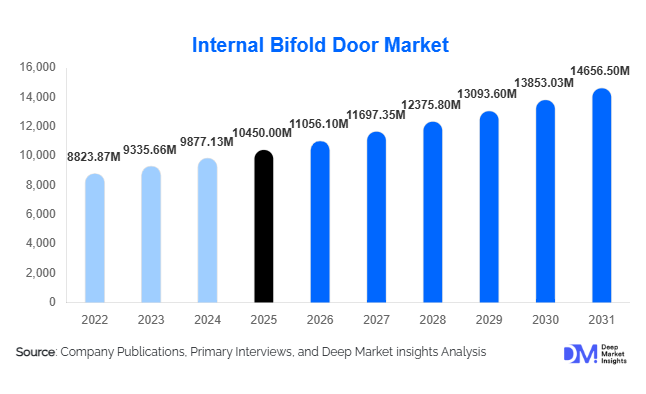
According to Deep Market Insights, the global internal bifold door market size was valued at USD 10,450 million in 2025 and is projected to grow from USD 11,056.10 million in 2026 to reach USD 14,656.50 million by 2031, expanding at a CAGR of 5.8% during the forecast period (2026–2031). The internal bifold door market growth is primarily driven by increasing residential construction, rising demand for space-efficient interior solutions, and the growing popularity of modern interior design trends that prioritize flexible and multifunctional living spaces.
Internal bifold doors, also known as folding or concertina doors, consist of hinged panels that fold together when opened, allowing wider access and improved space optimization compared to traditional swing doors. These doors are widely used in wardrobes, closets, kitchen pantries, office partitions, and room dividers. Growing urbanization and shrinking residential living spaces are increasing the demand for interior architectural solutions that maximize usable floor area while maintaining aesthetic appeal.
Technological advancements in sliding tracks, durable hinges, lightweight composite materials, and automated door systems are also contributing to market expansion. Additionally, rising investments in home renovation and interior upgrades across North America and Europe are creating steady demand for premium bifold door designs. The emergence of smart home technologies and automated interior partition systems is further transforming the market, particularly in luxury residential and commercial construction projects.
Key Market Insights
- Wood-based bifold doors dominate the market, accounting for nearly 40% of global revenue due to their aesthetic appeal and widespread use in residential interiors.
- Residential construction represents the largest demand segment, contributing more than 50% of global market revenue.
- North America leads the global market, driven by strong home renovation spending and demand for modern interior design solutions.
- Asia-Pacific is the fastest-growing region, supported by rapid urbanization and expanding residential housing projects in China and India.
- Closet and wardrobe installations remain the largest application segment, representing approximately one-third of total demand.
- Technological innovation, including motorized folding systems and smart home integration, is creating new opportunities in premium residential and commercial construction projects.
What are the latest trends in the internal bifold door market?
Rising Popularity of Space-Saving Interior Architecture
One of the most prominent trends in the internal bifold door market is the increasing demand for space-efficient architectural solutions. As urban apartments and residential units become smaller, homeowners and architects are prioritizing interior products that maximize usable living space. Bifold doors allow wider access while occupying minimal floor area when opened, making them an ideal solution for closets, wardrobes, kitchens, and room partitions.
Modern interior design trends emphasizing open-plan living spaces have also contributed to this demand. Bifold doors allow homeowners to seamlessly divide or combine rooms depending on functional requirements. For example, living rooms can be temporarily separated from home offices or dining spaces, providing flexibility in residential layouts. This trend is particularly strong in densely populated urban areas where efficient use of space is critical.
Integration of Smart and Automated Door Systems
Technological integration is emerging as another major trend in the internal bifold door industry. Manufacturers are increasingly developing automated bifold door systems equipped with motorized tracks, smart locking mechanisms, and remote-control functionality. These advanced systems allow users to operate doors through smartphone apps or voice-controlled smart home platforms.
Luxury residential developments, hotels, and premium office spaces are increasingly adopting these automated systems to enhance convenience and aesthetics. In addition, innovations in soft-close hinges, noise-reduction mechanisms, and durable sliding tracks are improving product performance and lifespan. As smart building technologies become more widespread globally, automated bifold door systems are expected to capture a growing share of the premium market segment.
What are the key drivers in the internal bifold door market?
Growth of Residential Construction Worldwide
The expansion of residential construction globally remains one of the strongest drivers for the internal bifold door market. Rapid urbanization and population growth in emerging economies are leading to large-scale apartment and housing developments. These modern residential projects increasingly incorporate bifold door systems due to their functionality and aesthetic appeal.
Developers prefer bifold doors because they require less swing clearance compared to traditional hinged doors, making them suitable for compact apartments and smaller living spaces. As governments continue to invest in affordable housing and urban infrastructure, the demand for bifold doors is expected to grow steadily across emerging markets.
Growing Home Renovation and Remodeling Activities
The global home renovation market has experienced significant growth in recent years, particularly in developed economies such as the United States, Germany, and the United Kingdom. Homeowners are increasingly investing in interior upgrades to improve comfort, aesthetics, and property value.
Bifold doors are commonly installed during renovation projects because they provide a quick and efficient way to modernize interiors without extensive structural modifications. Closet upgrades, kitchen remodels, and living space redesigns frequently involve bifold door installations, making the renovation sector an important demand driver.
What are the restraints for the global market?
Higher Installation and Hardware Costs
Although bifold doors offer several advantages, they often involve higher installation costs compared to traditional hinged doors. The systems require specialized tracks, hinges, and rollers, which increase the overall cost of installation. In price-sensitive markets, this cost difference may discourage adoption among budget-conscious consumers.
Professional installation is also typically required to ensure proper alignment and smooth operation. This additional labor cost can further increase project expenses, particularly for large installations or customized door systems.
Maintenance and Durability Concerns
Bifold doors rely on multiple hinges, rollers, and sliding tracks, which may require periodic maintenance to maintain smooth functionality. Over time, wear and tear in these components can lead to alignment issues or operational difficulties. In commercial environments where doors experience heavy usage, maintenance requirements may become a concern for building owners.
Manufacturers are addressing these challenges through improved materials, reinforced hardware components, and advanced track systems designed to reduce wear and extend product lifespan.
What are the key opportunities in the internal bifold door industry?
Growing Demand for Compact Urban Housing
The global shift toward compact urban housing presents a major opportunity for bifold door manufacturers. Rapid urbanization and rising real estate costs in metropolitan areas are encouraging developers to build smaller residential units. These compact living spaces require innovative architectural solutions that maximize interior flexibility.
Bifold doors allow homeowners to create multi-functional spaces by easily separating or combining rooms. This capability makes them particularly attractive for micro-apartments, studio apartments, and compact housing developments. As urban populations continue to grow, demand for such flexible interior design solutions is expected to increase.
Expansion of Smart Home Technologies
The rapid adoption of smart home technologies presents another significant opportunity for the internal bifold door market. Consumers are increasingly integrating automated lighting, climate control, and security systems into residential environments. Automated bifold doors can be integrated into these smart ecosystems, allowing remote operation and enhanced convenience.
Luxury residential developments and modern office spaces are already adopting automated door systems as part of integrated smart building solutions. Manufacturers that develop motorized bifold systems with IoT connectivity and advanced safety features are likely to benefit from this emerging market trend.
Report Scope
| Report Metric | Details |
|---|---|
| Market Size in 2025 | USD 10450 Million |
| Market Size in 2026 | USD 11056.10 Million |
| Market Size in 2031 | USD 14656.50 Million |
| CAGR | 5.8% (2026-2031) |
| Base Year for Estimation | 2025 |
| Historical Data | 2022-2024 |
| Forecast Period | 2026-2031 |
| Report Coverage | Revenue Forecast, Competitive Landscape, Supply Chain Disruption, Growth Factors, Environment & Regulatory Landscape and Trends |
| Geographies Covered | North America, Europe, APAC, Middle East and Africa, LATAM |
| Countries Covered | U.S., Canada, U.K., Germany, France, Spain, Italy, Russia, Nordic, Benelux, Rest of Europe, China, Korea, Japan, India, Australia, Singapore, Taiwan, South East Asia, Rest of Asia-Pacific, UAE, Turky, Saudi Arabia, South Africa, Egypt, Nigeria, Rest of MEA, Brazil, Mexico, Argentina, Chile, Colombia, Rest of LATAM |
Explore more data points, trends and opportunities Download Free Sample Report
Product Type Insights
Single bifold doors remain the most widely used configuration in the market, accounting for approximately 47% of global demand. These systems typically consist of two folding panels and are commonly used in closets, wardrobes, and pantry spaces. Their simple design and cost-effectiveness make them suitable for residential applications. Double or multi-panel bifold door systems are used in larger room partitions and office spaces where wider openings are required. Corner bifold systems and room-divider bifold doors are also gaining popularity in modern open-plan homes, allowing flexible partitioning of living spaces.
Application Insights
Closet and wardrobe installations represent the largest application segment in the internal bifold door market, accounting for nearly 34% of total demand. These doors provide convenient access to storage areas while occupying minimal floor space. Interior room divider applications are also growing rapidly as homeowners increasingly adopt flexible living spaces. In commercial buildings, bifold doors are frequently used in offices, conference rooms, and hospitality environments to create adaptable layouts that can accommodate changing functional requirements.
Distribution Channel Insights
Specialty door retailers and contractor supply channels dominate the distribution landscape, accounting for approximately 46% of global sales. These channels primarily serve large construction and renovation projects where professional installation is required. Home improvement stores are another important distribution channel, particularly in the residential renovation market. Online sales platforms are also gaining traction as manufacturers expand their direct-to-consumer offerings through digital storefronts and e-commerce marketplaces.
End-Use Insights
The residential sector represents the largest end-use segment, contributing around 52% of total market revenue. Increasing housing construction and growing consumer interest in interior design upgrades are driving demand in this segment. Commercial applications account for a significant share of the market as well, particularly in hotels, office buildings, restaurants, and coworking spaces where flexible interior layouts are essential. Institutional buildings such as schools and healthcare facilities are also adopting bifold doors for interior partitions and space management.
Explore more data points, trends and opportunities Download Free Sample Report
Internal Bifold Door Market Segmentations
By Door Configuration Type
- Single Bifold
- Double Bifold
- Corner Bifold Systems
- Room Divider Bifold Systems
- Wardrobe / Closet Bifold Doors
By Material Type
- Wood
- Aluminum
- Glass
- uPVC / Vinyl
- Composite / Hybrid Materials
By Application
- Interior Room Divider Doors
- Closet and Wardrobe Doors
- Kitchen / Pantry Bifold Doors
- Bathroom Bifold Doors
- Office Partition Doors
By Distribution Channel
- Direct Sales
- Specialty Door & Window Retailers
- Home Improvement Stores
- Online Retail / E-commerce
By End-Use Sector
- Residential Buildings
- Commercial Buildings
- Institutional Buildings
- Industrial Facilities
Regional Insights
North America
North America holds the largest share of the global internal bifold door market, accounting for approximately 37% of total revenue. The United States dominates the region due to strong residential renovation spending and widespread adoption of modern interior design trends. High consumer awareness and well-developed home improvement retail networks further support demand for bifold door installations.
Europe
Europe represents nearly 29% of global market demand, with Germany, the United Kingdom, France, and Italy serving as key markets. The region’s well-established construction industry and strong renovation culture are major contributors to market growth. European consumers also favor high-quality wooden bifold doors with customized finishes, supporting demand for premium products.
Asia-Pacific
Asia-Pacific is the fastest-growing regional market, driven by rapid urbanization and large-scale housing developments in China and India. Rising middle-class incomes and increasing investments in residential infrastructure are contributing to the expansion of the market. China remains the largest market within the region, while India is experiencing strong growth due to expanding urban housing projects.
Latin America
The Latin American market is gradually expanding, with Brazil and Mexico leading regional demand. Growth is primarily supported by residential construction projects and increasing consumer interest in modern interior architecture.
Middle East & Africa
The Middle East and Africa region is witnessing steady demand for internal bifold doors, particularly in luxury residential developments and hospitality infrastructure projects. Countries such as the United Arab Emirates and Saudi Arabia are investing heavily in modern real estate developments, which is contributing to market growth.
Key Players in the Internal Bifold Door Market
- JELD-WEN
- Andersen Corporation
- Pella Corporation
- Masonite International
- Hörmann Group
- Marvin
- Milgard Windows & Doors
- Schüco International
- Simpson Door Company
- VELUX Group
- Western Window Systems
- Loewen
- Atrium Windows & Doors
- Therma-Tru Doors
- Harvey Building Products