Home Textiles Market Size
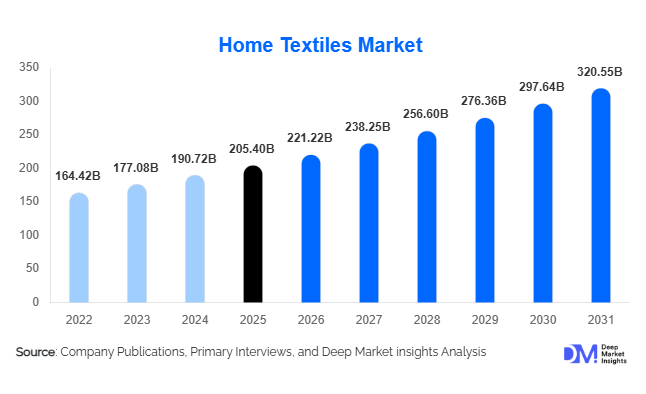
According to Deep Market Insights, the global home textiles market size was valued at USD 205.4 billion in 2025 and is projected to grow from USD 221.22 billion in 2026 to reach USD 320.55 billion by 2031, expanding at a CAGR of 7.7% during the forecast period (2026–2031). Market growth is being supported by rising consumer expenditure on home décor and interior aesthetics, increasing residential construction activities, growing hospitality infrastructure investments, and the rapid expansion of e-commerce channels. Consumers are increasingly viewing home furnishings as lifestyle products rather than utility purchases, driving demand for premium bedding, luxury bath linens, designer curtains, and decorative textiles. Additionally, sustainability trends, smart textile innovations, and growing awareness of environmentally responsible products are creating new growth avenues across both developed and emerging markets.
Key Market Insights
- Bedroom textiles remain the largest product category, accounting for nearly 38.5% of global market revenue due to strong replacement demand and hospitality sector consumption.
- Cotton continues to dominate material consumption, representing more than one-third of global demand owing to its comfort, durability, and sustainability perception.
- Asia-Pacific leads the global market, supported by large-scale textile manufacturing, rising disposable incomes, and expanding urban populations.
- India is among the fastest-growing markets globally, driven by increasing domestic consumption and export-oriented production capacity expansion.
- Sustainable home textiles are becoming mainstream, with growing demand for organic cotton, recycled polyester, bamboo fibers, and eco-certified products.
- Digital commerce is transforming purchasing behavior, allowing brands to expand direct-to-consumer sales while improving product customization and customer engagement.
Home Textiles Market Trends
Sustainable and Eco-Friendly Textiles Becoming Industry Standard
Sustainability has emerged as one of the most influential trends in the home textiles market. Consumers increasingly prefer products manufactured using organic cotton, recycled fibers, low-impact dyes, and environmentally responsible production methods. Major retailers and manufacturers are expanding their sustainable product portfolios to comply with evolving environmental regulations and consumer expectations. Certifications such as OEKO-TEX and Global Organic Textile Standard (GOTS) are becoming key purchasing criteria, particularly in Europe and North America. The adoption of circular textile manufacturing practices, including fabric recycling and waste reduction initiatives, is further reshaping product development strategies across the industry.
Smart and Functional Home Textiles Gaining Adoption
Technological innovation is transforming traditional textile products into functional lifestyle solutions. Manufacturers are introducing temperature-regulating bedding, moisture-management fabrics, antimicrobial towels, stain-resistant upholstery materials, and allergen-resistant textiles. Smart fabrics equipped with advanced performance characteristics are gaining traction among premium consumers seeking enhanced comfort and convenience. As consumer awareness of health, hygiene, and wellness increases, demand for technologically enhanced home textile products is expected to accelerate across both residential and hospitality applications.
Home Textiles Market Drivers
Growth in Residential Construction and Home Renovation Activities
Residential construction remains a primary growth driver for the home textiles market. Rapid urbanization across Asia-Pacific, the Middle East, and Latin America continues to generate demand for bedding, curtains, carpets, rugs, and decorative furnishings. Simultaneously, mature markets such as North America and Europe are witnessing robust renovation and remodeling activities, creating replacement demand for premium home textile products. The growing trend of personalized interior design is further encouraging consumers to invest in higher-value textile solutions that enhance living environments.
Premiumization and Lifestyle Upgradation
Consumers worldwide are increasingly investing in premium home furnishing products as disposable incomes rise and lifestyle aspirations evolve. Luxury bed linens, designer upholstery fabrics, premium towels, and customized decorative textiles are experiencing strong demand across urban households. Social media influence, interior design trends, and increased focus on home aesthetics following remote working trends have significantly contributed to the premiumization of the market. This shift is enabling manufacturers to achieve higher margins while expanding their premium product offerings.
Home Textiles Market Restraints
Volatility in Raw Material Prices
The home textiles industry remains highly sensitive to fluctuations in cotton, polyester, wool, and energy prices. Changes in weather conditions, geopolitical disruptions, and supply chain constraints can significantly impact raw material availability and manufacturing costs. Cotton price volatility, in particular, continues to challenge manufacturers by affecting procurement strategies, production planning, and profit margins. Frequent cost fluctuations also create pricing uncertainties for retailers and end users.
Intense Market Competition and Pricing Pressure
The global home textiles market is characterized by the presence of numerous regional and international manufacturers, resulting in substantial pricing competition. Low-cost production centers in Asia continue to intensify competitive pressure, particularly within commoditized product categories such as bed sheets, towels, and curtains. While premium segments offer differentiation opportunities, manufacturers operating in mass-market categories often face margin compression and increasing pressure to balance quality with affordability.
Home Textiles Market Opportunities
Expansion of Hospitality and Tourism Infrastructure
The rapid development of hotels, resorts, serviced apartments, vacation rentals, and wellness retreats presents significant growth opportunities for home textile manufacturers. Hospitality operators require continuous procurement of bedding, bath linens, upholstery fabrics, and decorative furnishings to maintain service standards and guest experiences. Emerging tourism destinations across Southeast Asia, the Middle East, and Africa are creating substantial institutional demand for premium textile products, enabling manufacturers to secure long-term supply agreements and recurring revenue streams.
Direct-to-Consumer and Digital Retail Expansion
E-commerce platforms and direct-to-consumer business models are transforming how home textile products are marketed and sold. Brands increasingly leverage digital channels to offer customized designs, subscription-based textile replacement services, and personalized product recommendations. Online retail allows manufacturers to reach broader customer bases while improving margins through reduced intermediary costs. Integration of AI-driven product visualization tools, virtual room design platforms, and omnichannel retail strategies is expected to create new growth opportunities throughout the forecast period.
Report Scope
| Report Metric | Details |
|---|---|
| Market Size in 2025 | USD 205.4 Billion |
| Market Size in 2026 | USD 221.22 Billion |
| Market Size in 2031 | USD 320.55 Billion |
| CAGR | 7.7% (2026-2031) |
| Base Year for Estimation | 2025 |
| Historical Data | 2022-2024 |
| Forecast Period | 2026-2031 |
| Report Coverage | Revenue Forecast, Competitive Landscape, Supply Chain Disruption, Growth Factors, Environment & Regulatory Landscape and Trends |
| Geographies Covered | North America, Europe, APAC, Middle East and Africa, LATAM |
| Countries Covered | U.S., Canada, U.K., Germany, France, Spain, Italy, Russia, Nordic, Benelux, Rest of Europe, China, Korea, Japan, India, Australia, Singapore, Taiwan, South East Asia, Rest of Asia-Pacific, UAE, Turky, Saudi Arabia, South Africa, Egypt, Nigeria, Rest of MEA, Brazil, Mexico, Argentina, Chile, Colombia, Rest of LATAM |
Explore more data points, trends and opportunities Download Free Sample Report
Product Type Insights
Bedroom textiles constitute the largest product segment within the home textiles market, accounting for approximately 38.5% of total revenue. Bed sheets, duvet covers, comforters, blankets, and pillowcases continue to generate significant demand due to high replacement rates and strong institutional purchasing from hotels and hospitality establishments. Bathroom textiles, including bath towels, robes, and bath mats, represent another major category driven by both residential and commercial consumption. Window textiles, such as curtains and drapes,s are benefiting from increasing investments in home décor, while floor textiles, es including carpets and rugs, ugs continue to witness stable demand from both new construction and renovation projects. Decorative textiles and upholstery fabrics are gaining traction among consumers seeking personalized and premium interior aesthetics.
Material Insights
Cotton remains the dominant material segment, accounting for approximately 34.2% of global market demand due to its softness, breathability, durability, and natural appeal. Polyester and blended fabrics continue to gain market share owing to their cost-effectiveness, wrinkle resistance, and ease of maintenance. Sustainable materials such as bamboo fibers, recycled polyester, and organic cotton are witnessing above-average growth rates as consumers increasingly prioritize environmental responsibility. Premium materials, including linen, silk, and wool, maintain strong demand within luxury product categories and high-end hospitality applications.
Distribution Channel Insights
Offline retail channels continue to account for the largest share of market revenue, representing approximately 61.5% of global sales. Specialty home furnishing stores, department stores, and branded retail outlets remain preferred purchasing channels due to consumers’ desire to physically evaluate product texture, quality, and appearance. However, online retail is emerging as the fastest-growing distribution channel, driven by expanding internet penetration, digital payment adoption, and convenience-oriented shopping behavior. Direct-to-consumer websites, online marketplaces, and social commerce platforms are enabling manufacturers to strengthen customer relationships while enhancing profit margins through reduced distribution costs.
End-Use Insights
Residential households represent the largest end-use segment, accounting for nearly 74% of total market demand. Rising homeownership rates, urban housing developments, and increasing spending on interior decoration continue to support strong household consumption. The hospitality sector is among the fastest-growing end-use industries, driven by hotel construction, tourism growth, and the expansion of vacation rental properties. Healthcare institutions are also emerging as important consumers of specialized textiles, particularly antimicrobial bedding, protective fabrics, and hygienic linen products. Corporate housing, student accommodation, and institutional facilities are creating additional opportunities for bulk procurement and long-term supply contracts.
Explore more data points, trends and opportunities Download Free Sample Report
Home Textiles Market Segmentations
By Product Type
- Bedroom Textiles
- Bathroom Textiles
- Window Textiles
- Floor Textiles
- Kitchen & Dining Textiles
- Upholstery & Decorative Textile
By Material Type
- Cotton
- Polyester
- Blended Fabrics
- Linen
- Wool
- Silk
- Bamboo Fiber
- Recycled Fibers
- Other Natural Fibers
By Distribution Channel
- Offline Retail
- Online Retail
By End User
- Residential Households
- Hospitality
- Healthcare Facilities
- Student Housing & Dormitories
- Corporate Housing & Serviced Apartments
- Institutional Buyers
Regional Insights
Asia-Pacific
Asia-Pacific dominates the global home textiles market, accounting for approximately 43.5% of global revenue in 2026. The region serves as both the largest manufacturing hub and the fastest-growing consumption market for home textile products. China remains the largest contributor owing to its highly integrated textile supply chain, large-scale production infrastructure, strong domestic demand, and leadership in global exports. India is emerging as one of the fastest-growing markets, supported by rising urbanization, increasing disposable incomes, government initiatives promoting textile manufacturing, and a rapidly expanding middle-class population. Japan and South Korea continue to generate strong demand for premium, technologically advanced, and sustainable home textile products.
Regional growth is primarily driven by accelerating residential construction activities, rising homeownership rates, rapid urban migration, and increasing consumer spending on home décor and lifestyle products. The expansion of organized retail and e-commerce platforms has significantly improved product accessibility across both metropolitan and tier-2 cities. Additionally, Asia-Pacific benefits from its position as a major global sourcing destination, with countries such as China, India, Pakistan, Bangladesh, and Vietnam supplying a substantial share of global home textile exports. The growing hospitality sector, expansion of tourism infrastructure, and increasing investments in residential real estate are expected to further strengthen regional demand throughout the forecast period.
North America
North America accounts for approximately 27.8% of global home textiles market revenue, with the United States representing the largest share of regional demand. The region is characterized by high consumer purchasing power, mature retail infrastructure, and strong spending on home improvement and interior renovation projects. Consumers increasingly view home textiles as lifestyle products, driving demand for premium bedding, luxury bath linens, designer upholstery fabrics, and decorative furnishings.
The primary drivers of regional growth include rising expenditure on home remodeling, growing adoption of premium and sustainable products, and increasing consumer preference for personalized living spaces. The popularity of remote and hybrid working models has also encouraged greater investments in home comfort and interior aesthetics. Furthermore, the region has witnessed strong growth in online home furnishing sales, enabling consumers to access a broader range of products through digital channels. Sustainability trends are particularly influential, with growing demand for organic cotton, recycled materials, and environmentally certified products driving product innovation and premiumization across the market.
Europe
Europe represents one of the most mature and innovation-driven markets for home textiles, led by Germany, the United Kingdom, France, Italy, and Spain. The region benefits from strong consumer awareness regarding sustainability, product quality, and ethical sourcing practices. Demand remains concentrated in premium bedding, decorative textiles, luxury bath products, and environmentally certified home furnishing solutions.
Market growth in Europe is largely driven by increasing consumer preference for sustainable and circular economy products, stringent environmental regulations, and growing adoption of organic and recycled textile materials. European consumers demonstrate a willingness to pay premium prices for products that meet environmental and social responsibility standards, encouraging manufacturers to invest in eco-friendly production technologies. Additionally, growth in residential renovation projects, expansion of premium hospitality establishments, and increasing demand for customized interior décor solutions continue to support market expansion. The region is also witnessing rising adoption of smart and functional textiles, particularly in Western European countries where consumers prioritize innovation and product performance.
Latin America
Latin America represents a developing but increasingly attractive market for home textiles, with Brazil and Mexico accounting for the majority of regional demand. Growing urbanization, improving economic conditions, and expansion of residential housing projects are contributing to higher consumption of bedding, bath textiles, curtains, and decorative home furnishing products. Rising middle-class populations are further supporting demand for affordable and mid-range home textile offerings.
Regional growth is being driven by increasing investment in residential real estate, improving consumer confidence, and growing awareness of home décor trends influenced by global retail brands and digital media platforms. The expansion of organized retail networks and online marketplaces has improved product availability across major urban centers. In addition, the hospitality and tourism sectors in countries such as Mexico, Brazil, and Colombia are generating institutional demand for bed linens, towels, upholstery fabrics, and other hospitality-grade textile products. As disposable incomes continue to improve, consumers are expected to allocate a larger share of household expenditure toward home improvement and interior decoration, creating long-term growth opportunities for market participants.
Middle East & Africa
The Middle East & Africa region is witnessing steady growth in the home textiles market, supported by rapid urban development, expanding tourism infrastructure, and increasing investments in premium residential and hospitality projects. The United Arab Emirates and Saudi Arabia represent the largest markets within the region, while South Africa remains an important consumer market supported by a relatively developed retail sector.
Growth across the region is primarily driven by large-scale construction projects, luxury real estate developments, and substantial investments in tourism and hospitality infrastructure. Government-led economic diversification initiatives, including Saudi Arabia’s Vision 2031 and major infrastructure programs in the UAE, are creating strong demand for premium bedding, upholstery fabrics, curtains, and decorative textiles across hotels, resorts, serviced apartments, and residential properties. Rising disposable incomes, increasing expatriate populations, and growing consumer interest in premium home décor products are further supporting market expansion. The hospitality sector remains a particularly important demand driver, as the region continues to attract international tourism and business travel, resulting in sustained procurement of high-quality home textile products.
Key Players in the Home Textiles Market
- Welspun Living Limited
- Trident Limited
- Luolai Lifestyle Technology Co., Ltd.
- Sunvim Group Co., Ltd.
- Loftex Home LLC
- IKEA
- WestPoint Home Inc.
- Springs Global
- Himatsingka Seide Limited
- Indo Count Industries Limited
- Dohia Home Textile Co., Ltd.
- Fuanna Co., Ltd.
- Frette S.r.l.
- Yves Delorme
- Ralph Lauren Home