Garden Fencing Market Size
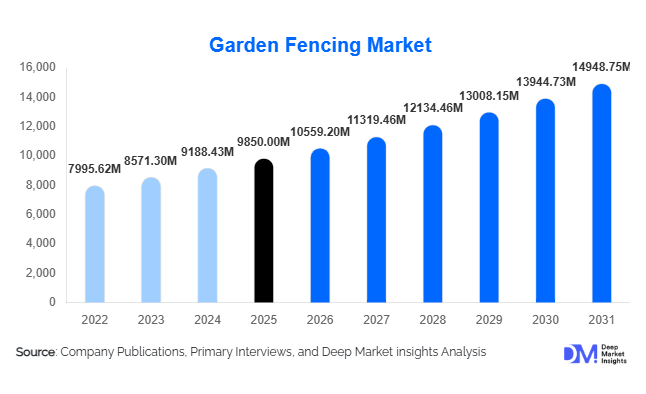
According to Deep Market Insights, the global garden fencing market size was valued at USD 9,850 million in 2025 and is projected to grow from USD 10,559.20 million in 2026 to reach USD 14,948.75 million by 2031, expanding at a CAGR of 7.2% during the forecast period (2026–2031). The market growth is primarily driven by increasing residential landscaping activities, rising home renovation spending, and growing consumer interest in outdoor living spaces and garden aesthetics. Garden fencing products serve both functional and decorative roles by providing property boundaries, protecting plants from animals, and enhancing landscape design.
In developed regions such as North America and Europe, the demand for garden fencing is supported by a strong home improvement culture and widespread gardening practices. Meanwhile, emerging economies in the Asia-Pacific are witnessing growing adoption due to rapid urbanization and expanding residential housing developments that integrate landscaped outdoor areas. The market is also evolving due to material innovations such as vinyl, composite, and powder-coated metal fencing, which provide higher durability and lower maintenance compared to traditional wood fencing. Sustainability trends are further encouraging the use of eco-friendly fencing materials, including recycled composites and bamboo fencing.
Key Market Insights
- Residential gardening accounts for the majority of fencing installations, driven by increasing homeowner spending on backyard landscaping and privacy solutions.
- Wood fencing remains the most widely used material, representing about 34% of the global market due to its natural aesthetics and affordability.
- North America dominates the global market, supported by a strong DIY gardening culture and high spending on home renovation projects.
- Asia-Pacific is the fastest-growing regional market, driven by urban housing developments and rising disposable incomes.
- Composite and vinyl fencing are gaining popularity due to their durability, weather resistance, and low maintenance requirements.
- Retail home improvement stores and e-commerce channels are increasingly influencing purchasing decisions, particularly for DIY fencing installations.
What are the latest trends in the garden fencing market?
Sustainable and Eco-Friendly Fencing Materials
Sustainability has become a defining trend in the garden fencing market as consumers increasingly seek environmentally responsible home improvement products. Manufacturers are introducing fencing systems made from recycled plastics, reclaimed wood fibers, and bamboo materials that reduce environmental impact while maintaining durability. Composite fencing, which combines recycled polymers and wood fibers, is gaining traction due to its resistance to rot, termites, and moisture. These products also require minimal maintenance compared to traditional wood fencing, making them attractive to homeowners seeking long-term cost savings.
Government initiatives promoting sustainable construction and landscaping practices are further accelerating adoption. In Europe and North America, certifications such as FSC-certified wood and eco-labeled construction materials are influencing consumer purchasing decisions. Manufacturers are responding by expanding their product lines to include environmentally friendly fencing panels, recycled composite boards, and biodegradable garden borders. This shift toward sustainable materials is expected to reshape the competitive landscape as companies invest in green manufacturing technologies and circular production systems.
Growth of DIY and Modular Fencing Systems
The rising popularity of DIY home improvement projects has significantly influenced the garden fencing market. Consumers are increasingly opting for modular fencing systems that can be easily installed without professional assistance. Prefabricated fence panels, interlocking fencing modules, and lightweight composite fencing kits are widely available through home improvement retail stores and online platforms.
This trend is particularly strong in North America and Europe, where homeowners frequently undertake backyard improvement projects themselves. E-commerce platforms have also accelerated adoption by offering detailed installation guides, product customization tools, and doorstep delivery of fencing materials. Modular fencing systems allow homeowners to install or expand fences incrementally, reducing installation costs while maintaining aesthetic flexibility. As a result, manufacturers are investing in lightweight materials, snap-fit installation systems, and customizable panel designs to capture growing DIY demand.
What are the key drivers in the garden fencing market?
Increasing Residential Construction and Home Renovation
One of the primary drivers of the garden fencing market is the continuous expansion of residential construction and renovation activities worldwide. Housing developments in suburban areas often incorporate landscaped gardens and private outdoor spaces that require fencing for boundary definition and security. Homeowners are increasingly upgrading their backyards with privacy fences, decorative garden borders, and trellis fencing systems to enhance property value and visual appeal.
Rising spending on home improvement projects, particularly in the United States, Canada, Germany, and the United Kingdom, is further driving demand. The growing popularity of outdoor entertainment areas, pet-friendly gardens, and vegetable gardens has also increased the need for durable fencing solutions that protect plants and maintain property boundaries.
Expansion of the Professional Landscaping Industry
The professional landscaping industry has grown significantly over the past decade, creating new opportunities for garden fencing products. Landscape architects and contractors frequently integrate fencing elements into garden designs to enhance aesthetics and structure outdoor spaces. Decorative metal fencing, lattice panels, and trellis structures are widely used in high-end landscaping projects.
Commercial landscaping for hotels, resorts, office campuses, and retail properties is also contributing to fencing demand. Businesses increasingly invest in well-designed outdoor environments to improve property value and customer experience. These projects often require durable fencing solutions that combine security with aesthetic design.
What are the restraints for the global market?
Fluctuating Raw Material Prices
The garden fencing market is sensitive to fluctuations in the prices of raw materials such as timber, steel, aluminum, and PVC. Lumber price volatility has particularly impacted wood fencing manufacturers, increasing production costs and affecting profit margins. Similarly, changes in global steel and aluminum prices can influence the pricing of metal fencing systems.
Manufacturers often need to adjust product prices to maintain profitability, which can reduce consumer affordability and slow demand growth. Supply chain disruptions and transportation cost fluctuations also contribute to price instability within the fencing industry.
Maintenance and Weather Durability Challenges
Traditional fencing materials, such as wood, require regular maintenance, including painting, sealing, and repairs. Exposure to harsh weather conditions can lead to rot, warping, or termite damage, particularly in humid climates. These maintenance concerns can discourage homeowners from installing wooden fences or delay replacement cycles.
Although alternative materials such as vinyl and composite fencing address many durability issues, they often have higher initial costs, which can limit adoption among budget-conscious consumers. Balancing affordability with durability remains a key challenge for manufacturers in the garden fencing market.
What are the key opportunities in the garden fencing industry?
Urban Housing Developments in Emerging Markets
Rapid urbanization across Asia-Pacific, Latin America, and parts of the Middle East is creating substantial opportunities for garden fencing manufacturers. Large-scale residential projects, gated communities, and mixed-use developments increasingly incorporate landscaped gardens and recreational spaces. These developments require fencing solutions to define property boundaries and enhance aesthetic appeal.
Countries such as China, India, Indonesia, and the United Arab Emirates are witnessing significant growth in residential housing construction. As urban residents seek better living environments, landscaped outdoor areas have become a standard feature in new housing developments. This trend is expected to generate strong demand for decorative fencing panels, garden borders, and privacy fencing systems.
Smart and Decorative Fencing Solutions
Innovation in fencing design and technology presents another major opportunity for industry participants. Manufacturers are increasingly introducing fencing products with enhanced functionality, such as integrated lighting systems, automated gates, and modular decorative panels. These solutions cater to homeowners seeking modern outdoor aesthetics combined with convenience and security. Advanced coating technologies and powder-coated metal fencing systems are also gaining popularity due to their durability and resistance to corrosion. The development of customizable fencing designs and color options further expands consumer choices, enabling manufacturers to target premium landscaping segments.
Report Scope
| Report Metric | Details |
|---|---|
| Market Size in 2025 | USD 9850 Million |
| Market Size in 2026 | USD 10559.20 Million |
| Market Size in 2031 | USD 14948.75 Million |
| CAGR | 7.2% (2026-2031) |
| Base Year for Estimation | 2025 |
| Historical Data | 2022-2024 |
| Forecast Period | 2026-2031 |
| Report Coverage | Revenue Forecast, Competitive Landscape, Supply Chain Disruption, Growth Factors, Environment & Regulatory Landscape and Trends |
| Geographies Covered | North America, Europe, APAC, Middle East and Africa, LATAM |
| Countries Covered | U.S., Canada, U.K., Germany, France, Spain, Italy, Russia, Nordic, Benelux, Rest of Europe, China, Korea, Japan, India, Australia, Singapore, Taiwan, South East Asia, Rest of Asia-Pacific, UAE, Turky, Saudi Arabia, South Africa, Egypt, Nigeria, Rest of MEA, Brazil, Mexico, Argentina, Chile, Colombia, Rest of LATAM |
Explore more data points, trends and opportunities Download Free Sample Report
Material Type Insights
Wood fencing remains the dominant material segment, accounting for approximately 34% of the global garden fencing market in 2025. Its popularity is largely attributed to its natural aesthetic appeal and relatively low upfront cost. Cedar and pressure-treated wood are widely used for residential garden fences across North America and Europe. However, composite and vinyl fencing materials are rapidly gaining market share due to their durability, resistance to weather damage, and minimal maintenance requirements. Metal fencing, particularly aluminum and wrought iron, is widely used in decorative landscaping projects and high-end residential properties where aesthetic design and security are prioritized.
Product Type Insights
Panel fencing systems represent one of the largest product segments, accounting for nearly 28% of total market demand. These prefabricated fence panels are widely preferred due to their ease of installation and cost efficiency. Panel fences are commonly used in residential gardens and commercial landscaping projects where quick installation and standardized design are essential. Privacy fences are also gaining popularity as homeowners seek to create secluded outdoor spaces for relaxation and entertainment. Decorative lattice fences and trellis fencing are increasingly used in garden design to support climbing plants and improve visual appeal.
Installation Type Insights
Permanent fencing installations dominate the market, representing about 67% of total demand. These systems are designed to provide long-term boundary protection and property security. Materials such as treated wood, powder-coated steel, and composite fencing are commonly used for permanent installations due to their durability. Semi-permanent and temporary fencing solutions are typically used for seasonal gardens, landscaping projects, and temporary property boundaries.
Distribution Channel Insights
Retail home improvement stores remain the leading distribution channel, accounting for approximately 38% of global fencing product sales. Consumers often purchase fencing materials from large retail chains for DIY installation projects. E-commerce platforms are also gaining significant traction, enabling homeowners to compare fencing designs, access installation tutorials, and purchase customized fencing kits online. Landscape contractors and installers represent another important channel, particularly for large residential and commercial projects requiring professional installation.
End-Use Insights
The residential sector dominates the garden fencing market with approximately 61% of total demand. Homeowners increasingly invest in garden fences to enhance privacy, protect plants, and improve landscape aesthetics. Commercial landscaping represents a growing segment, particularly for hotels, resorts, office complexes, and public parks that require decorative fencing solutions. Municipal infrastructure projects also contribute to market growth, as public gardens and recreational parks frequently require fencing systems for safety and landscaping management.
Explore more data points, trends and opportunities Download Free Sample Report
Garden Fencing Market Segmentations
By Material Type
- Wood Fencing
- Metal Fencing
- Plastic & Vinyl Fencing
- Wire & Chain-Link Fencing
- Bamboo Fencing
- Composite & Recycled Material Fencing
By Product Type
- Picket Fences
- Panel Fences
- Post and Rail Fences
- Lattice Fences
- Privacy Fences
- Decorative Garden Borders
- Trellis Fencing
By Installation Type
- Permanent Fencing
- Semi-Permanent Fencing
- Temporary Fencing
By Distribution Channel
- Direct Sales
- Retail Home Improvement Stores
- E-commerce Platforms
- Landscape Contractors & Installers
By End Use
- Residential Gardening
- Commercial Landscaping
- Public Infrastructure & Parks
- Agricultural Gardens & Hobby Farms
Regional Insights
North America
North America holds the largest share of the global garden fencing market, accounting for approximately 36% of total demand in 2025. The United States dominates the regional market due to strong consumer spending on home renovation and landscaping projects. Backyard gardening is a widely practiced hobby, and homeowners frequently install fencing systems to improve privacy and property aesthetics. Canada also represents a significant market due to rising investments in residential property upgrades and suburban housing developments.
Europe
Europe accounts for roughly 29% of the global garden fencing market. Countries such as Germany, the United Kingdom, France, and the Netherlands have long-standing gardening traditions that drive consistent demand for fencing products. In the United Kingdom, wooden panel fencing is particularly popular for residential gardens, while Germany exhibits strong demand for metal and decorative fencing solutions. European consumers also show a high interest in sustainable fencing materials, encouraging manufacturers to expand eco-friendly product offerings.
Asia-Pacific
Asia-Pacific is the fastest-growing regional market, expected to expand at a CAGR above 8.5% during the forecast period. China represents the largest market within the region due to extensive residential construction activities and growing landscaping adoption in urban housing complexes. Japan and South Korea also show strong demand for decorative garden fencing in residential communities. India and Southeast Asian countries are emerging markets where increasing urbanization and housing developments are gradually boosting fencing demand.
Latin America
Latin America represents a smaller but steadily growing market. Brazil and Mexico are the leading countries due to increasing residential construction and urban housing development. Garden fencing is gradually gaining popularity in suburban residential communities and gated housing complexes across the region.
Middle East & Africa
The Middle East and Africa region is witnessing moderate growth in the garden fencing market. Countries such as the United Arab Emirates and Saudi Arabia are investing heavily in residential infrastructure and landscaped communities, driving demand for decorative fencing products. In Africa, fencing is commonly used in residential and agricultural gardens to protect plants from animals and define property boundaries.
Key Players in the Garden Fencing Market
- Betafence Group
- Bekaert
- Barrette Outdoor Living
- Gregory Industries
- Jerith Manufacturing
- Long Fence Company
- Ameristar Fence Products
- Associated Materials
- CertainTeed Corporation
- Master Halco
- Allied Tube & Conduit
- Fencing Supply Group
- Jacksons Fencing
- Poly Vinyl Creations
- Ply Gem Industries