Freeze Dried Snack Market Size
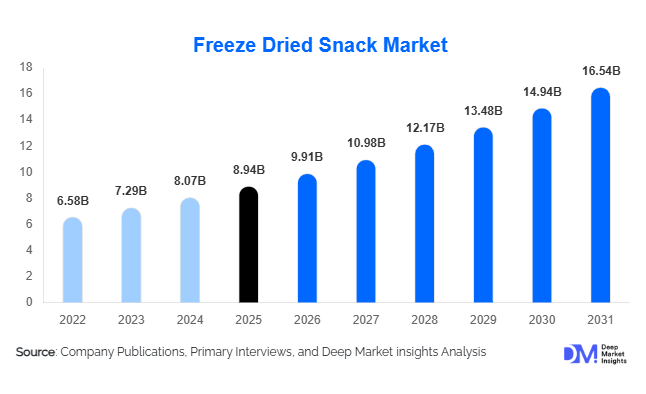
According to Deep Market Insights, the global freeze dried snack market size was valued at USD 8.94 billion in 2025 and is projected to grow from USD 9.91 billion in 2026 to reach USD 16.42 billion by 2031, expanding at a CAGR of 10.8% during the forecast period (2026–2031). The freeze dried snack market growth is primarily driven by rising consumer demand for healthy, clean-label, and convenient snacking products that retain nutritional value, flavor, and texture without requiring extensive preservatives. Increasing health consciousness, premiumization of packaged snacks, and advancements in freeze-drying technology are significantly contributing to global market expansion.
Key Market Insights
- Fruit-based freeze dried snacks dominate the global market, supported by increasing demand for natural, low-calorie, and nutrient-rich snack alternatives.
- Consumers are increasingly shifting toward clean-label and organic freeze dried snacks, driving innovation in minimally processed and preservative-free products.
- North America remains the largest regional market, led by strong health-conscious consumer behavior and premium snack consumption trends.
- Asia-Pacific is the fastest-growing region, supported by rising disposable incomes, urbanization, and rapid expansion of organized retail and e-commerce.
- Online and direct-to-consumer distribution channels are expanding rapidly, enabling premium snack brands to scale internationally.
- Technological advancements in freeze-drying systems, including automation and energy-efficient processing, are improving production scalability and reducing waste.
What are the latest trends in the freeze dried snack market?
Clean-Label and Functional Nutrition Trends Accelerating Demand
Consumers are increasingly prioritizing snacks that combine convenience with nutritional value, resulting in strong demand for clean-label freeze dried snacks. Products free from artificial preservatives, colors, and additives are gaining popularity across developed and emerging markets. Manufacturers are also integrating functional ingredients such as probiotics, plant proteins, vitamins, adaptogens, and superfoods into freeze dried snacks to enhance their health positioning. Functional fruit blends, protein-enhanced snack bites, and immunity-support formulations are becoming mainstream offerings in supermarkets and online retail platforms. Organic certification and non-GMO labeling are also emerging as key purchase drivers, particularly in North America and Europe.
Expansion of Premium and Sustainable Snack Packaging
Sustainability is becoming a major focus area within the freeze dried snack industry. Brands are increasingly investing in recyclable and biodegradable packaging materials to strengthen their environmental positioning. Resealable pouches and lightweight packaging formats are improving convenience while reducing transportation costs and food waste. Premium snack brands are also leveraging transparent packaging, traceable sourcing, and environmentally conscious branding to attract younger consumers seeking ethical purchasing options. In parallel, manufacturers are adopting energy-efficient freeze-drying technologies and automation systems to improve operational sustainability and production consistency.
What are the key drivers in the freeze dried snack market?
Rising Demand for Healthy and Convenient Snacking
The increasing global focus on healthier lifestyles is one of the strongest growth drivers for the freeze dried snack market. Consumers are actively replacing fried and heavily processed snacks with alternatives perceived as healthier, natural, and nutrient-rich. Freeze dried products retain much of their original vitamin, mineral, antioxidant, and fiber content, making them attractive among fitness-focused and wellness-conscious consumers. Busy urban lifestyles and rising demand for portable, shelf-stable food products are further accelerating adoption across working professionals, students, and travelers.
Growth of E-Commerce and Direct-to-Consumer Channels
The rapid expansion of online grocery platforms and direct-to-consumer snack brands is significantly improving product accessibility and category visibility. Consumers increasingly prefer purchasing specialty snacks online due to wider product availability, subscription-based snack models, and convenience. Social media marketing and influencer-driven health trends are further boosting awareness of freeze dried snacks among younger demographics. Online channels are also enabling smaller premium brands to compete effectively with multinational food companies by targeting niche wellness and fitness segments.
What are the restraints for the global market?
High Production and Processing Costs
Freeze-drying technology remains highly capital-intensive compared to conventional dehydration and snack manufacturing methods. The process requires advanced vacuum systems, temperature control equipment, and high energy consumption, significantly increasing operational expenses. These high production costs contribute to premium retail pricing, limiting mass-market affordability in price-sensitive regions. Smaller manufacturers often face challenges in scaling production due to substantial machinery investment requirements.
Volatility in Raw Material Supply and Pricing
The freeze dried snack market is highly dependent on agricultural raw materials such as berries, tropical fruits, vegetables, and proteins. Seasonal crop variability, climate-related disruptions, transportation challenges, and fluctuating commodity prices can directly impact production stability and manufacturer profit margins. Extreme weather conditions and global supply chain disruptions continue to create uncertainty regarding raw material availability, particularly for premium fruit-based snack categories.
What are the key opportunities in the freeze dried snack industry?
Expansion of Functional and Sports Nutrition Snacks
The growing sports nutrition and functional food industries present significant opportunities for freeze dried snack manufacturers. Protein-enriched fruit snacks, electrolyte-based products, and energy-focused snack formulations are gaining popularity among athletes, fitness consumers, and wellness-focused demographics. Freeze dried snacks are particularly attractive for sports nutrition because of their lightweight structure, long shelf life, and nutritional density. Manufacturers are increasingly targeting gyms, fitness retail channels, and outdoor recreation consumers with specialized product launches.
Emerging Market Growth and Premium Snacking Adoption
Emerging economies such as India, Indonesia, Brazil, Vietnam, and the UAE are witnessing strong growth in premium packaged food consumption due to rising disposable incomes and urbanization. Consumers in these markets are increasingly shifting toward healthy and convenient snacks as organized retail and online grocery penetration expand. International snack brands are entering these markets with localized flavors, smaller pack sizes, and region-specific marketing strategies. Government support for food processing infrastructure and export-oriented manufacturing is further strengthening opportunities for freeze dried snack producers.
Report Scope
| Report Metric | Details |
|---|---|
| Market Size in 2025 | USD 8.94 Billion |
| Market Size in 2026 | USD 9.91 Billion |
| Market Size in 2031 | USD 16.54 Billion |
| CAGR | 10.8% (2026-2031) |
| Base Year for Estimation | 2025 |
| Historical Data | 2022-2024 |
| Forecast Period | 2026-2031 |
| Report Coverage | Revenue Forecast, Competitive Landscape, Supply Chain Disruption, Growth Factors, Environment & Regulatory Landscape and Trends |
| Geographies Covered | North America, Europe, APAC, Middle East and Africa, LATAM |
| Countries Covered | U.S., Canada, U.K., Germany, France, Spain, Italy, Russia, Nordic, Benelux, Rest of Europe, China, Korea, Japan, India, Australia, Singapore, Taiwan, South East Asia, Rest of Asia-Pacific, UAE, Turky, Saudi Arabia, South Africa, Egypt, Nigeria, Rest of MEA, Brazil, Mexico, Argentina, Chile, Colombia, Rest of LATAM |
Explore more data points, trends and opportunities Download Free Sample Report
Product Type Insights
The fruit-based freeze dried snacks segment continues to dominate the global freeze dried snack market and accounted for nearly 42% of total market revenue in 2025. The leadership of this segment is primarily driven by rising global consumer preference for naturally sweet, nutrient-dense, and minimally processed snack alternatives that align with clean-label dietary trends. Freeze dried fruits such as strawberries, blueberries, mangoes, bananas, raspberries, pineapples, apples, and mixed fruit blends have gained widespread popularity among both adult and pediatric consumer groups because they retain much of their original nutritional profile, natural color, aroma, and flavor after the freeze drying process. Increasing awareness regarding the harmful effects of artificial preservatives and synthetic additives has further accelerated consumer adoption of fruit-based freeze dried products across developed and developing markets. The ability of freeze dried fruits to deliver extended shelf life without compromising nutritional quality is also strengthening their penetration within convenience snack categories, travel foods, school snacks, and fitness-oriented dietary applications.Protein-based freeze dried snacks are emerging rapidly within sports nutrition, outdoor recreation, military food systems, and functional nutrition applications. Freeze dried meat products, seafood snacks, chicken bites, and protein-enriched snack combinations are gaining traction among fitness-oriented consumers seeking portable high-protein foods with long shelf stability. Increasing gym memberships, sports participation rates, and consumer awareness regarding protein intake are contributing significantly to segment expansion. Dairy-based freeze dried products, including yogurt bites, freeze dried ice cream, and probiotic snack formulations, are also witnessing increasing adoption within premium snack categories. Meanwhile, confectionery-oriented freeze dried snacks, including freeze dried candies and chocolate-coated fruit products, are rapidly expanding through online retail channels and specialty snack stores due to growing consumer interest in texture innovation and indulgent snacking experiences.
Nature Insights
Conventional freeze dried snacks continue to account for the largest market share, representing approximately 68% of global demand in 2025. The dominance of this segment is primarily supported by greater affordability, extensive product availability, and widespread retail penetration across supermarkets, convenience stores, and mass-market grocery channels. Conventional products remain highly attractive to price-sensitive consumers, particularly in emerging economies where premium organic snack penetration remains relatively limited. Large-scale manufacturing capabilities and established agricultural sourcing networks further contribute to the cost competitiveness of conventional freeze dried snack products.The growing emphasis on clean-label nutrition is also reshaping product development strategies across the industry. Consumers are increasingly examining ingredient lists and preferring products with transparent sourcing practices and minimal processing claims. As a result, manufacturers are focusing heavily on non-GMO certifications, organic fruit sourcing, natural sweetening systems, and environmentally sustainable agricultural partnerships to strengthen premium brand positioning. Organic freeze dried fruits and vegetables are particularly gaining traction among millennial consumers, parents purchasing healthier snack alternatives for children, and wellness-focused urban populations.In addition, sustainability considerations are increasingly influencing consumer purchasing behavior across global food markets. Ethical sourcing, environmentally responsible farming, and reduced chemical usage are becoming important competitive differentiators for freeze dried snack manufacturers. Companies investing in traceable supply chains, sustainable packaging solutions, and regenerative agriculture partnerships are expected to strengthen long-term market positioning as environmentally conscious consumption patterns continue to expand globally.
Flavor Insights
Sweet flavor profiles dominate the global freeze dried snack market and accounted for nearly 47% of total market share in 2025. The leading position of this segment is primarily driven by strong consumer demand for fruit-based freeze dried snacks, which naturally deliver sweetness without the need for excessive added sugars or artificial flavor enhancers. Consumers increasingly perceive naturally sweet freeze dried snacks as healthier alternatives to traditional confectionery and processed snack products. The combination of crunchy texture, concentrated fruit flavor, and nutritional value continues to support widespread product adoption across children, millennials, and health-conscious adult populations.Savory freeze dried snacks are witnessing rapid growth due to increasing demand for low-sugar, protein-rich, and vegetable-oriented snack alternatives. Consumers seeking healthier replacements for fried chips and processed salty snacks are increasingly adopting savory freeze dried vegetable crisps and protein-based snacks. Innovative seasoning profiles, including sea salt, barbecue, garlic herb, cheese blends, and regional spice combinations, are helping manufacturers broaden consumer appeal and diversify product portfolios.Spicy and tangy flavor profiles are gaining significant traction across Asia-Pacific and Latin America, where consumer preference for bold and regionally inspired taste experiences continues to expand. Manufacturers are increasingly localizing product formulations to cater to regional flavor preferences, including chili-lime combinations, spicy seafood seasonings, masala-inspired flavors, and tropical tangy fruit blends. The growing influence of international cuisine trends and social media-driven food experimentation is expected to further support flavor innovation across the global freeze dried snack industry.
Packaging Insights
Stand-up pouches remain the leading packaging format in the freeze dried snack market and accounted for nearly 39% of global market share in 2025. The dominance of this segment is primarily driven by convenience, resealability, portability, lightweight structure, and enhanced shelf visibility. Stand-up pouches offer significant advantages for both manufacturers and consumers by improving product freshness retention while reducing packaging and transportation costs. The format also supports attractive product presentation and branding opportunities within highly competitive retail environments.The rapid expansion of online grocery shopping is also influencing packaging innovation across the industry. Durable packaging materials that improve product protection during shipping and reduce damage risks are becoming increasingly important for e-commerce distribution channels. In addition, premium packaging aesthetics and transparent window packaging designs are helping brands enhance consumer trust and product visibility.Sustainability trends are significantly transforming packaging strategies within the freeze dried snack market. Consumers and retailers are increasingly prioritizing recyclable, biodegradable, and environmentally friendly packaging materials to reduce plastic waste and improve environmental sustainability. Manufacturers are investing heavily in biodegradable films, recyclable pouches, compostable materials, and reduced-plastic packaging technologies to align with retailer sustainability initiatives and evolving environmental regulations. Sustainable packaging adoption is expected to accelerate further as environmental awareness continues to strengthen across major global markets.
Distribution Channel Insights
Supermarkets and hypermarkets continue to dominate global freeze dried snack sales due to strong product visibility, extensive shelf availability, and high levels of impulse purchasing behavior. Large retail chains provide consumers with convenient access to multiple product varieties, flavor options, and premium healthy snack categories under a single shopping environment. Strong promotional activities, product sampling campaigns, and expanding healthy snack aisles are further contributing to retail channel dominance.However, online distribution channels are witnessing the fastest growth globally and are expected to play an increasingly critical role in future market expansion. Rising digital grocery adoption, increasing smartphone penetration, and expanding direct-to-consumer snack brands are transforming purchasing behavior across developed and emerging economies. E-commerce platforms provide consumers with broader product accessibility, subscription-based purchasing models, personalized recommendations, and convenient home delivery services.Specialty health food stores, organic retail outlets, and fitness-oriented retail channels are also emerging as important distribution networks for premium freeze dried snack products. Consumers seeking organic, functional, and high-protein snack alternatives increasingly rely on specialized retail channels that offer curated wellness-focused product assortments. Additionally, rising partnerships between freeze dried snack manufacturers and fitness centers, wellness brands, and sports nutrition retailers are further supporting market penetration within active lifestyle consumer segments.
Consumer Group Insights
Millennials remain the largest consumer segment in the freeze dried snack market and accounted for approximately 31% of global demand in 2025. The leadership of this demographic segment is primarily driven by strong preference for convenience, wellness-focused nutrition, premium snacking experiences, and clean-label food products. Millennials are highly receptive to innovative snack formats that combine health benefits with portability and flavor variety. Increasing participation in fitness activities, growing awareness regarding nutritional intake, and rising demand for functional foods continue to support strong product adoption among this consumer group.Fitness and sports-oriented consumers represent another rapidly growing consumer category within the freeze dried snack market. Increasing gym memberships, sports participation rates, and demand for protein-rich portable nutrition products are supporting segment growth. Protein-enriched freeze dried snacks, functional fruit blends, and energy-supportive formulations are gaining strong traction within athletic and active lifestyle communities.Children’s snacks remain a major application area for freeze dried fruits due to rising parental preference for healthier alternatives to traditional sugary snacks and confectionery products. Parents increasingly value freeze dried fruits for their natural ingredient profiles, reduced sugar content, and convenience for school lunches and travel consumption. Elderly consumers are also contributing steadily to market growth because of increasing interest in nutrient-dense, easy-to-consume foods with long shelf stability and digestive convenience.
Application Insights
Ready-to-eat snacks continue to represent the largest application segment in the global freeze dried snack market and accounted for nearly 54% of market revenue in 2025. The leading position of this segment is strongly driven by increasing urbanization, changing dietary habits, convenience-focused lifestyles, and expanding on-the-go snacking culture. Busy work schedules, rising commuting times, and growing preference for portable meal replacements are encouraging consumers to adopt healthier ready-to-consume snack options.Sports nutrition applications are expanding rapidly due to increasing fitness participation and rising demand for portable high-energy foods. Freeze dried protein snacks, fruit blends, and functional nutrition products are gaining popularity among athletes and physically active consumers seeking convenient nutritional supplementation. Outdoor recreation activities such as hiking, camping, trekking, and adventure tourism are also supporting demand for lightweight and shelf-stable snack products.In addition, military food systems, emergency preparedness kits, disaster relief programs, and travel catering industries are increasingly utilizing freeze dried snacks because of their extended shelf life, low storage requirements, and transportation efficiency. Functional nutrition applications, including immunity-supportive formulations, probiotic snacks, collagen-enriched products, and vitamin-fortified snack solutions, are further broadening market opportunities globally.
End-Use Industry Insights
The food and beverage retail industry continues to dominate the freeze dried snack market due to increasing shelf space allocation toward healthy snack categories and premium packaged food products. Retailers are increasingly prioritizing functional nutrition, clean-label snacks, and organic food offerings to address evolving consumer preferences for healthier lifestyles. The growing popularity of premium snacking and convenience foods is supporting strong long-term growth across food retail channels.Sports nutrition and wellness industries represent some of the fastest-growing end-use sectors within the freeze dried snack market. Rising consumer interest in fitness, active lifestyles, weight management, and performance nutrition is creating substantial opportunities for protein-rich and functional freeze dried products. Manufacturers are increasingly collaborating with sports nutrition brands and wellness companies to develop targeted snack formulations that support energy enhancement, muscle recovery, and overall wellness.Hospitality, airline catering, and travel food service industries are increasingly adopting freeze dried snack products because of their convenience, long storage life, and reduced food waste generation. Freeze dried products are highly suitable for travel applications due to their lightweight nature and minimal refrigeration requirements. Healthcare and clinical nutrition applications are also emerging steadily, particularly among elderly consumers and individuals requiring specialized dietary support.Export-oriented food manufacturing hubs across Asia-Pacific continue to support industrial-scale freeze dried snack production for international distribution. Rising global trade in processed fruit and vegetable products, combined with expanding investment in food processing infrastructure, is strengthening manufacturing capabilities across key producing regions.
Explore more data points, trends and opportunities Download Free Sample Report
Freeze Dried Snack Market Segmentations
By Product Type
- Fruit-Based Freeze Dried Snacks
- Vegetable-Based Freeze Dried Snacks
- Protein-Based Freeze Dried Snacks
- Dairy-Based Freeze Dried Snacks
- Confectionery & Dessert Freeze Dried Snacks
- Pet-Oriented Freeze Dried Snacks
By Nature
- Conventional
- Organic
- Non-GMO Certified
- Clean-Label Products
By Flavor Profile
- Sweet
- Savory
- Spicy
- Tangy & Sour
- Mixed Flavor Combinations
By Packaging Type
- Stand-Up Pouches
- Rigid Containers
- Sachets & Single-Serve Packs
- Multi-Pack Family Packs
- Resealable Packaging
- Sustainable/Biodegradable Packaging
By Distribution Channel
- Supermarkets & Hypermarkets
- Convenience Stores
- Specialty Health Food Stores
- E-Commerce Platforms
- Direct-to-Consumer Channels
Regional Insights
North America
North America accounted for approximately 34% of the global freeze dried snack market in 2025, making it the largest regional market worldwide. The United States dominates regional demand due to strong health-conscious consumer behavior, high consumption of premium packaged snacks, and advanced organized retail infrastructure. Consumers across the region increasingly prefer convenient, clean-label, and nutrient-dense snack products that align with wellness-focused lifestyles.Several growth drivers continue to support regional market expansion. Rising obesity concerns, increasing awareness regarding healthy eating habits, and growing demand for functional nutrition products are significantly accelerating freeze dried snack adoption across North America. The strong presence of established snack brands, continuous product innovation, and aggressive marketing strategies are also contributing to market maturity. In addition, the region benefits from advanced cold chain logistics, robust e-commerce infrastructure, and high consumer spending power. Canadian consumers are increasingly adopting organic and sustainably sourced freeze dried snacks, while rising participation in fitness activities and outdoor recreation continues supporting demand for protein-based and portable snack products throughout the region.
Europe
Europe represented nearly 24% of the global freeze dried snack market in 2025 and continues to demonstrate stable long-term growth potential. Germany, the United Kingdom, and France remain key regional consumption markets due to strong demand for organic foods, clean-label products, and environmentally sustainable packaging solutions. European consumers generally demonstrate high awareness regarding food quality, nutritional transparency, and sustainable sourcing practices, which strongly supports freeze dried snack adoption.The regional market is further driven by stringent food safety regulations, increasing vegan and plant-based food consumption, and rising demand for premium convenience snacks. Scandinavian countries are witnessing increasing adoption of environmentally friendly and plant-based snack products due to strong sustainability consciousness among consumers. Poland has emerged as an important freeze dried fruit manufacturing and export hub because of its strong agricultural production capabilities and expanding food processing infrastructure. Growing investments in sustainable packaging innovation, organic farming, and functional food development continue to strengthen Europe’s position within the global freeze dried snack industry.
Asia-Pacific
Asia-Pacific accounted for approximately 29% of the global freeze dried snack market in 2025 and is projected to remain the fastest-growing regional market during the forecast period. Rapid urbanization, rising disposable incomes, expanding middle-class populations, and changing dietary patterns are strongly driving regional market growth. Increasing adoption of modern retail formats and rapid expansion of e-commerce grocery platforms are also improving product accessibility across major urban centers.China leads regional manufacturing capacity and export production due to its large-scale fruit processing industry, cost-efficient manufacturing ecosystem, and strong agricultural output. India is emerging as a major consumption market because of increasing health awareness, growing demand for convenience foods, and rapid expansion of organized retail channels. Japan and South Korea continue witnessing strong demand for premium functional snacks, innovative flavor formats, and technologically advanced food products. Southeast Asian countries such as Thailand and Vietnam are strengthening their positions as export-oriented manufacturing hubs due to abundant tropical fruit availability, competitive labor costs, and growing foreign investment in food processing infrastructure. The region’s expanding young population and rising digital food retail penetration are expected to further accelerate market growth over the coming years.
Latin America
Latin America is witnessing growing demand for freeze dried snacks, led primarily by Brazil and Mexico. Increasing middle-class populations, improving economic conditions, rising health awareness, and expanding organized retail infrastructure are supporting regional market development. Consumers are increasingly shifting toward convenient packaged snack products that offer better nutritional value and premium quality.Brazil’s abundant tropical fruit production is creating strong opportunities for domestic freeze dried fruit manufacturing and export-oriented production activities. Growing investment in food processing technologies and increasing penetration of international snack brands are also supporting regional expansion. Additionally, younger consumers across Latin America are increasingly adopting Western-style healthy snacking habits, which is encouraging demand for clean-label and functional snack products. Rising e-commerce adoption and expansion of modern supermarket chains are expected to further improve regional product accessibility.
Middle East & Africa
The Middle East and Africa region is gradually emerging as a promising market for freeze dried snacks, particularly in countries such as the UAE, Saudi Arabia, and South Africa. Increasing urbanization, rising disposable income levels, and growing consumer awareness regarding healthy eating habits are supporting regional demand growth. Premium retail expansion and the increasing presence of international healthy snack brands are also contributing to stronger market penetration.The UAE is increasingly functioning as a regional import and distribution hub for premium healthy snack products due to its strategic trade location and advanced retail infrastructure. Tourism growth, rising expatriate populations, and strong demand for travel-friendly foods are further supporting freeze dried snack consumption across the Gulf region. In Africa, improving retail infrastructure, expanding middle-class populations, and rising interest in packaged convenience foods are gradually creating new growth opportunities. Long shelf stability, lightweight transportation advantages, and suitability for hot climatic conditions continue to strengthen the attractiveness of freeze dried snacks across the Middle East and Africa region.
Key Players in the Freeze Dried Snack Market
- Nestlé S.A.
- European Freeze Dry
- Mercer Foods LLC
- Chaucer Foods Ltd
- Brothers International Food Holdings LLC
- Crispy Green Inc.
- Harmony House Foods Inc.
- Karen’s Naturals
- Asahi Group Holdings Ltd
- Ajinomoto Co., Inc.
- Dongwon Industries Co., Ltd
- Paradise Fruits Solutions GmbH
- Lyo Food Sp. z o.o.
- Thrive Foods
- Van Drunen Farms