Egg Beater Market Size
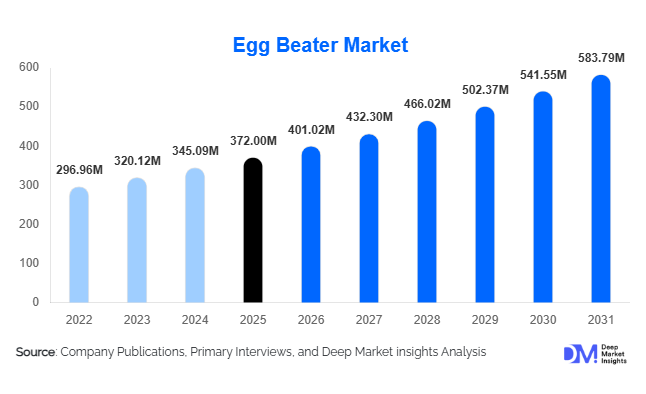
According to Deep Market Insights, the global egg beater market size was valued at USD 372 million in 2025 and is projected to grow from USD 401.02 million in 2026 to reach USD 583.79 million by 2031, expanding at a CAGR of 7.8% during the forecast period (2026–2031). The egg beater market growth is primarily driven by increasing consumer interest in home cooking and baking, the expansion of the global bakery and foodservice industry, and rising demand for ergonomic and multifunctional kitchen tools. Egg beaters remain essential kitchen utensils for whipping eggs, mixing batter, and preparing sauces across residential and commercial kitchens.
The market has witnessed steady growth due to rising kitchen appliance penetration and the popularity of compact and efficient food preparation tools. In recent years, manufacturers have introduced innovative designs featuring ergonomic handles, corrosion-resistant materials, and multi-speed electric functions to improve convenience and usability. The increasing penetration of e-commerce platforms has also improved product accessibility and price transparency, enabling global brands to reach a wider consumer base. Furthermore, growing disposable income in emerging economies is encouraging consumers to invest in higher-quality kitchen utensils, further supporting market expansion.
Key Market Insights
- Manual egg beaters dominate the market, accounting for over 60% of global demand due to their affordability, reliability, and ease of use.
- Stainless steel egg beaters represent the leading material segment, favored for durability, hygiene, and corrosion resistance in both households and commercial kitchens.
- Asia-Pacific holds the largest market share, supported by strong manufacturing bases in China and increasing household demand across India and Southeast Asia.
- E-commerce channels are rapidly expanding, enabling manufacturers to reach global consumers through direct-to-consumer and marketplace platforms.
- The commercial bakery and foodservice industries are emerging as key demand drivers, particularly for electric and multi-functional egg beaters.
- Product innovation and ergonomic designs are increasingly influencing consumer purchasing decisions, particularly in premium product segments.
What are the latest trends in the egg beater market?
Growing Popularity of Multi-Functional Kitchen Tools
Consumers are increasingly seeking kitchen tools capable of performing multiple functions. As a result, manufacturers are introducing egg beaters equipped with interchangeable attachments that allow users to whip cream, mix batter, and prepare sauces in addition to beating eggs. These multi-functional tools provide greater value and reduce the need for multiple utensils, particularly in compact kitchens where storage space is limited. Electric egg beaters with adjustable speed controls and additional whisking accessories are becoming popular among home bakers and small commercial kitchens.
Expansion of Online Retail and Direct-to-Consumer Sales
E-commerce platforms are transforming how consumers purchase kitchen utensils. Online marketplaces enable customers to compare features, read reviews, and access competitive pricing. This shift toward digital retail is particularly prominent in emerging markets where smartphone penetration and online shopping adoption are increasing rapidly. Manufacturers are investing heavily in digital marketing, influencer partnerships, and recipe-driven promotional campaigns to attract consumers through online channels. Direct-to-consumer sales strategies are also allowing brands to build stronger relationships with customers and collect valuable feedback for product innovation.
What are the key drivers in the egg beater market?
Rising Popularity of Home Baking and Cooking
The global surge in home cooking and baking activities has significantly increased demand for kitchen tools such as egg beaters. Social media platforms and online recipe tutorials have inspired consumers to experiment with baking cakes, pastries, and desserts at home. Egg beaters are essential tools for preparing these recipes, making them a common household utensil. As consumers continue to prioritize homemade food preparation for both health and recreational purposes, demand for reliable and durable egg beaters is expected to remain strong.
Growth of the Global Bakery and Foodservice Industry
The expansion of the bakery and foodservice industries is another major driver for the egg beater market. Restaurants, cafes, and catering companies rely heavily on egg beaters and mixing equipment for preparing sauces, batters, and baked products. The global bakery industry is projected to surpass USD 750 billion by 2030, generating substantial demand for efficient food preparation tools. Electric egg beaters with higher capacity and speed control are increasingly being adopted in commercial kitchens to improve productivity and consistency.
What are the restraints for the global market?
Availability of Multi-Functional Kitchen Appliances
The availability of substitute appliances such as stand mixers, food processors, and immersion blenders presents a challenge for the egg beater market. These appliances offer multiple functions, including mixing, blending, and whipping, which can reduce reliance on standalone egg beaters. Consumers seeking multifunctional appliances may prefer these alternatives, particularly in developed markets where kitchen appliance adoption is high.
Price Sensitivity in Developing Markets
In many emerging economies, consumers remain highly price-sensitive when purchasing kitchen utensils. Low-cost generic products dominate local markets, creating intense price competition and limiting profit margins for premium brands. Manufacturers must balance product quality and pricing strategies to remain competitive while maintaining profitability.
What are the key opportunities in the egg beater industry?
Technological Innovation in Electric Egg Beaters
Advancements in product design and technology present significant opportunities for market participants. Manufacturers are developing electric egg beaters with rechargeable batteries, ergonomic designs, and multi-speed controls that improve user convenience. These innovations are particularly attractive to younger consumers who prioritize efficiency and modern design in kitchen appliances. The integration of durable materials and energy-efficient motors can further enhance product performance and longevity.
Growing Demand from Emerging Economies
Emerging economies such as India, Indonesia, Vietnam, and Brazil offer strong growth potential for the egg beater market. Rapid urbanization, rising disposable income, and increasing adoption of modern kitchen appliances are encouraging consumers to upgrade traditional cooking tools. Localized manufacturing, affordable pricing strategies, and targeted marketing campaigns can enable companies to capture significant market share in these rapidly growing regions.
Report Scope
| Report Metric | Details |
|---|---|
| Market Size in 2025 | USD 372 Million |
| Market Size in 2026 | USD 401.02 Million |
| Market Size in 2031 | USD 583.79 Million |
| CAGR | 7.8% (2026-2031) |
| Base Year for Estimation | 2025 |
| Historical Data | 2022-2024 |
| Forecast Period | 2026-2031 |
| Report Coverage | Revenue Forecast, Competitive Landscape, Supply Chain Disruption, Growth Factors, Environment & Regulatory Landscape and Trends |
| Geographies Covered | North America, Europe, APAC, Middle East and Africa, LATAM |
| Countries Covered | U.S., Canada, U.K., Germany, France, Spain, Italy, Russia, Nordic, Benelux, Rest of Europe, China, Korea, Japan, India, Australia, Singapore, Taiwan, South East Asia, Rest of Asia-Pacific, UAE, Turky, Saudi Arabia, South Africa, Egypt, Nigeria, Rest of MEA, Brazil, Mexico, Argentina, Chile, Colombia, Rest of LATAM |
Explore more data points, trends and opportunities Download Free Sample Report
Product Type Insights
Manual egg beaters represent the leading product segment in the global egg beater market, accounting for approximately 62% of total demand. The dominance of this segment is primarily driven by affordability, ease of use, and long product lifespan. Manual egg beaters require no electricity, making them highly suitable for households in developing and emerging markets where consumers prefer cost-effective and durable kitchen tools. Their simple mechanical design also makes them easy to clean, maintain, and store, which further increases their popularity among residential users. In addition, manual variants are widely available through both online and offline retail channels and are commonly included in basic kitchen utensil sets.Electric egg beaters represent a rapidly expanding segment of the market, particularly in developed regions where consumers are increasingly adopting automated kitchen appliances to save time and improve efficiency in food preparation. These products typically feature multiple speed settings, detachable beaters, ergonomic grips, and compact designs that enhance usability. Electric egg beaters are especially popular among professional bakers, restaurants, and home baking enthusiasts who require consistent mixing performance and the ability to process larger ingredient volumes. The increasing popularity of home baking, cooking shows, and social media food content is further encouraging demand for electric kitchen appliances across global markets.
Material Type Insights
Stainless steel egg beaters hold the largest share of the global market, accounting for nearly 48% of total demand. The leading position of stainless steel is largely attributed to its superior durability, corrosion resistance, and hygienic properties. Stainless steel materials can withstand frequent washing, high moisture environments, and long-term usage without rusting or degrading, making them ideal for food preparation tools. In addition, stainless steel beaters are widely preferred in both residential and commercial kitchens due to their ability to maintain food safety standards and provide long operational lifespans.Plastic egg beaters represent another important segment, particularly within entry-level and budget-friendly product categories. Plastic materials offer lightweight construction, lower manufacturing costs, and attractive color options that appeal to younger consumers and modern kitchen aesthetics. These products are widely used in household kitchens where heavy-duty mixing is not required.Silicone-coated egg beaters are gaining increasing traction in the market due to their non-stick performance and ability to protect cookware surfaces. Silicone coatings help prevent scratches on non-stick pans and bowls, making these variants particularly attractive for consumers who prioritize cookware protection and ease of cleaning. As consumers continue to demand multifunctional and cookware-friendly kitchen tools, the adoption of silicone-coated designs is expected to expand further.
Distribution Channel Insights
Offline retail channels remain the dominant distribution segment in the global egg beater market. Supermarkets, hypermarkets, kitchenware stores, and department stores collectively account for a significant share of global sales. The leading position of offline channels is driven by consumers' preference to physically examine kitchen utensils before purchasing. Customers often evaluate product build quality, grip comfort, material durability, and weight before making a purchase decision. Additionally, brick-and-mortar stores frequently offer bundled kitchen utensil sets, promotional discounts, and in-store demonstrations that support higher product adoption.However, online distribution channels are witnessing the fastest growth within the market. E-commerce platforms allow consumers to access a wider range of brands, product types, and price points compared to traditional retail outlets. The convenience of home delivery, competitive pricing, detailed product reviews, and promotional offers are encouraging consumers to purchase kitchen tools through digital channels. Furthermore, online platforms provide small and emerging kitchenware brands with direct access to global customers, allowing them to compete with established manufacturers and expand their market reach.
End-Use Insights
The residential segment dominates the global egg beater market, accounting for nearly 68% of total demand. The leading position of this segment is primarily driven by increasing interest in home cooking, baking, and meal preparation activities. Consumers are investing in efficient and easy-to-use kitchen tools to enhance their cooking experience and simplify food preparation tasks. The rising influence of cooking shows, online recipe platforms, and social media food content has further encouraged households to purchase specialized kitchen utensils such as egg beaters.The commercial foodservice segment represents the fastest-growing end-use category. Restaurants, bakeries, cafes, hotels, and catering services require reliable mixing equipment to support high-volume food preparation. Electric egg beaters are particularly popular in commercial kitchens due to their ability to operate continuously and handle large ingredient batches efficiently. The expansion of the global hospitality industry, rapid urbanization, and the growth of food delivery services are collectively driving demand for professional-grade kitchen tools in the foodservice sector.
Explore more data points, trends and opportunities Download Free Sample Report
Egg Beater Market Segmentations
By Product Type
- Manual Egg Beaters
- Electric Egg Beaters
- Battery-Operated Egg Beaters
- Multi-Functional Hand Mixers with Beater Attachments
By Material Type
- Stainless Steel
- Plastic
- Silicone-Coated
- Aluminum & Alloy-Based
By End Use
- Residential Households
- Commercial Kitchens
- Bakery & Confectionery Industry
- Hotels & Foodservice Establishments
By Distribution Channel
- Online Retail & E-Commerce Platforms
- Supermarkets & Hypermarkets
- Specialty Kitchenware Stores
- Department Stores
- Wholesale & Institutional Supply
Regional Insights
Asia-Pacific
Asia-Pacific represents the largest regional market for egg beaters, accounting for approximately 36% of global demand. The region benefits from a large consumer base, strong manufacturing infrastructure, and increasing household adoption of modern kitchen tools. China dominates both production and consumption due to its extensive manufacturing ecosystem, cost-efficient labor, and large-scale export network that supplies kitchen utensils to international markets.India is emerging as one of the fastest-growing markets in the region due to rising disposable incomes, expanding middle-class populations, and growing interest in home cooking and baking. Increasing penetration of e-commerce platforms is also making kitchen tools more accessible to consumers across both urban and semi-urban areas. Meanwhile, developed markets such as Japan, South Korea, and Australia contribute significantly to regional demand through purchases of premium kitchenware products and technologically advanced electric appliances.Key drivers supporting regional market growth include rapid urbanization, expanding retail and e-commerce sectors, growing foodservice industries, and increasing consumer awareness of modern kitchen appliances. Additionally, the presence of large manufacturing hubs in China and Southeast Asia enables efficient production and global distribution of egg beater products.
North America
North America accounts for nearly 27% of the global egg beater market share. The United States represents the largest market in the region due to high household appliance ownership, strong consumer purchasing power, and a well-established culture of home baking and cooking. Consumers in this region frequently invest in premium kitchen tools that offer convenience, durability, and advanced features.Electric egg beaters are particularly popular in North America due to consumer preference for automated kitchen appliances that improve efficiency and reduce preparation time. Many products sold in this region feature multi-speed settings, ergonomic designs, detachable components, and compact storage capabilities.Regional growth is driven by rising interest in home baking, increasing adoption of smart kitchen appliances, strong retail distribution networks, and the growing popularity of cooking-related digital content across social media platforms and streaming services.
Europe
Europe contributes approximately 24% of global demand for egg beaters. The region has a strong tradition of home cooking and baking, which continues to support consistent demand for kitchen utensils and preparation tools. Countries such as Germany, the United Kingdom, France, and Italy represent major markets due to their large consumer bases and well-developed retail infrastructure.European consumers often prefer premium kitchenware products that offer high durability and comply with strict food safety regulations. Stainless steel egg beaters are particularly popular in this region because they meet hygiene standards and provide long-term reliability in food preparation environments.Regional market growth is supported by rising consumer interest in sustainable and long-lasting kitchen products, strong demand for high-quality cookware, and continued expansion of specialty kitchenware retail outlets across major European cities.
Latin America
Latin America accounts for nearly 7% of the global egg beater market. Brazil and Mexico are the leading markets in the region due to expanding urban populations, increasing household appliance adoption, and growing middle-class consumer spending. As disposable income levels rise, more households are investing in affordable kitchen tools that simplify daily food preparation tasks.The region is also witnessing steady growth in the foodservice and hospitality industries, which is increasing demand for kitchen utensils used in restaurants, bakeries, and catering services. Electric egg beaters are gradually gaining popularity in commercial kitchens where faster food preparation is required.Key regional growth drivers include urbanization, expansion of modern retail chains, increasing penetration of e-commerce platforms, and rising interest in home cooking across major metropolitan areas.
Middle East & Africa
The Middle East and Africa represent approximately 6% of global egg beater demand. The region is experiencing steady growth in the kitchenware market as consumers increasingly adopt modern kitchen appliances and cooking tools. Countries such as the United Arab Emirates, Saudi Arabia, and South Africa represent key markets due to their expanding hospitality industries and rising consumer spending on home appliances.In the Middle East, strong growth in the tourism and hospitality sectors has encouraged restaurants and hotels to invest in efficient kitchen equipment. Meanwhile, African markets are gradually increasing their adoption of affordable kitchen tools as retail infrastructure and consumer purchasing power improve.Regional growth is primarily driven by expanding hospitality and tourism industries, increasing urbanization, rising disposable incomes, and growing availability of kitchen appliances through modern retail and e-commerce channels.
Key Players in the Egg Beater Market
- Whirlpool Corporation
- Philips
- Panasonic Corporation
- Breville Group
- Hamilton Beach Brands
- Groupe SEB
- Conair Corporation
- KitchenAid
- Cuisinart
- Braun
- Bosch
- Kenwood
- Morphy Richards
- Tefal
- Black+Decker