Custom Closets Market Size
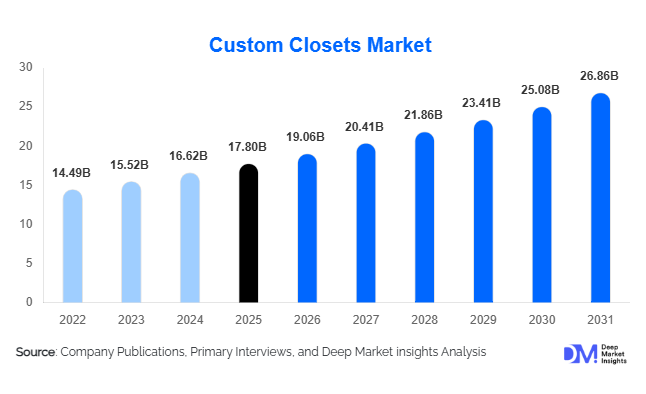
According to Deep Market Insights, the global custom closets market size was valued at USD 17.8 billion in 2025 and is projected to grow from USD 19.06 billion in 2026 to reach USD 26.86 billion by 2031, expanding at a CAGR of 7.1% during the forecast period (2026–2031). The custom closets market growth is primarily driven by increasing consumer investment in home organization solutions, rising demand for premium interior customization, and the growing adoption of modular storage systems across residential and commercial spaces. The market is also benefiting from rapid urbanization, shrinking apartment sizes, and evolving lifestyle preferences that emphasize efficient space utilization and aesthetic home interiors.
Key Market Insights
- Walk-in closets continue to dominate premium residential demand, particularly in North America and luxury urban housing developments globally.
- Smart storage integration is rapidly transforming the market, with motion-sensor lighting, app-controlled systems, and automated organization features gaining traction.
- North America dominates the global custom closets market, accounting for nearly 39% of total revenue in 2025 due to strong home renovation spending and high consumer preference for customized interiors.
- Asia-Pacific is the fastest-growing region, led by China and India, where rising middle-class incomes and organized residential development are boosting modular storage adoption.
- Engineered wood remains the most widely used material, supported by affordability, flexibility in design, and compatibility with modular manufacturing.
- Digital customization platforms and virtual consultation tools are reshaping customer purchasing behavior and improving direct-to-consumer sales channels.
Custom Closets Market Trends
Growing Adoption of Smart and Connected Closet Systems
Technology integration is becoming one of the most important trends within the custom closets market. Consumers increasingly prefer intelligent storage systems that combine convenience, automation, and premium aesthetics. Smart closets equipped with motion-activated lighting, automated hanging systems, app-controlled inventory management, and voice-assisted controls are gaining popularity among luxury homeowners and technology-focused consumers. Manufacturers are incorporating IoT-enabled features and AI-based space optimization tools to improve personalization and enhance the user experience. Digital closet management systems that help consumers organize clothing categories, track wardrobe inventory, and improve accessibility are emerging as premium differentiators in developed markets. This trend is particularly strong in the United States, Japan, South Korea, and the UAE, where smart home adoption rates continue to increase rapidly.
Rising Demand for Modular and Space-Saving Storage Solutions
Urbanization and shrinking residential spaces are accelerating demand for modular and multifunctional closet systems globally. Consumers living in apartments and compact urban homes increasingly prioritize flexible storage layouts that maximize usable space while maintaining visual appeal. Modular closet systems with adjustable shelving, hidden compartments, sliding doors, and multifunctional furniture integration are witnessing strong demand across Asia-Pacific and Europe. Open-concept closet layouts and boutique-inspired wardrobe systems are also becoming increasingly popular among younger consumers seeking premium lifestyle-oriented interiors. In addition, manufacturers are focusing on easy-installation modular systems that can be customized according to changing residential requirements. This trend is further supported by rising demand from co-living developments, student housing, and compact luxury apartments in densely populated cities.
Custom Closets Market Drivers
Rising Home Renovation and Remodeling Activity
One of the primary growth drivers for the custom closets market is the increasing global expenditure on residential remodeling and home improvement projects. Homeowners are investing heavily in interior upgrades that improve organization, convenience, and property value. Custom closets are increasingly viewed as premium lifestyle investments rather than optional furniture additions. In North America and Europe, aging housing stock and rising disposable incomes are driving strong renovation activity, particularly in bedrooms, dressing spaces, and luxury residential interiors. Real estate developers are also incorporating customized closets into premium residential projects to improve differentiation and attract high-income buyers. The growing popularity of home renovation television content and social media-driven interior design trends is further supporting market growth.
Urbanization and Demand for Space Optimization
Rapid urbanization is significantly influencing demand for efficient storage systems worldwide. As apartment sizes decline in major metropolitan cities, consumers increasingly require smart and compact storage solutions that maximize limited living spaces. Custom closets help optimize vertical space utilization while enhancing room aesthetics and functionality. Modular systems designed for urban apartments, compact homes, and co-living spaces are witnessing strong adoption across China, India, Southeast Asia, and major European cities. Manufacturers are responding by introducing highly flexible and customizable designs that accommodate changing residential layouts and lifestyle preferences. This growing focus on efficient living spaces continues to create long-term demand for custom storage systems globally.
Custom Closets Market Restraints
High Installation and Customization Costs
The high cost associated with fully customized closet systems remains a major restraint for broader market adoption. Premium closet installations often involve specialized design consultation, custom manufacturing, high-quality materials, and professional installation services, making them significantly more expensive than conventional ready-made furniture. Luxury walk-in closet systems can cost several thousand dollars depending on customization complexity and material selection, limiting accessibility among price-sensitive consumers. In emerging markets, many middle-income households continue to prefer modular ready-to-assemble furniture due to affordability concerns.
Raw Material Price Volatility and Supply Chain Challenges
Volatility in raw material prices continues to impact profitability and pricing within the custom closets market. Materials such as MDF, plywood, aluminum, decorative laminates, and premium wood products have experienced price fluctuations due to inflationary pressures, supply chain disruptions, and transportation cost increases. Manufacturers also face challenges related to labor shortages, delayed installations, and inconsistent component availability. Rising logistics costs and import dependencies for hardware fittings and specialty finishes can further impact production efficiency and profit margins, particularly for smaller manufacturers and regional installers.
Custom Closets Market Opportunities
Expansion of Smart Home Integration
The rapid expansion of smart home ecosystems presents a significant growth opportunity for custom closet manufacturers. Consumers increasingly seek integrated living environments where lighting, climate control, security, and storage systems are digitally connected. Smart closets featuring sensor-enabled lighting, automated rails, humidity control, and AI-assisted wardrobe organization are emerging as premium lifestyle products. Companies investing in connected storage systems, digital customization platforms, and app-enabled functionality can access high-margin opportunities within luxury residential projects. Integration with broader smart home systems is expected to become a major competitive differentiator over the next decade.
Sustainable and Eco-Friendly Closet Solutions
Sustainability is becoming an increasingly important purchasing factor among residential and commercial buyers. Consumers are showing stronger preference for products manufactured using FSC-certified wood, recycled materials, low-VOC coatings, and environmentally responsible manufacturing processes. Companies focusing on sustainable sourcing and eco-friendly product design are strengthening their competitive positioning among environmentally conscious buyers. In addition, governments across Europe and North America are tightening regulations regarding emissions and sustainable building materials, encouraging manufacturers to invest in greener production technologies. Sustainable closet systems are expected to gain substantial traction within premium housing and green-certified commercial projects.
Report Scope
| Report Metric | Details |
|---|---|
| Market Size in 2025 | USD 17.8 Billion |
| Market Size in 2026 | USD 19.06 Billion |
| Market Size in 2031 | USD 26.86 Billion |
| CAGR | 7.1% (2026-2031) |
| Base Year for Estimation | 2025 |
| Historical Data | 2022-2024 |
| Forecast Period | 2026-2031 |
| Report Coverage | Revenue Forecast, Competitive Landscape, Supply Chain Disruption, Growth Factors, Environment & Regulatory Landscape and Trends |
| Geographies Covered | North America, Europe, APAC, Middle East and Africa, LATAM |
| Countries Covered | U.S., Canada, U.K., Germany, France, Spain, Italy, Russia, Nordic, Benelux, Rest of Europe, China, Korea, Japan, India, Australia, Singapore, Taiwan, South East Asia, Rest of Asia-Pacific, UAE, Turky, Saudi Arabia, South Africa, Egypt, Nigeria, Rest of MEA, Brazil, Mexico, Argentina, Chile, Colombia, Rest of LATAM |
Explore more data points, trends and opportunities Download Free Sample Report
Product Type Insights
Walk-in closets dominate the global custom closets market, accounting for nearly 34% of total revenue in 2025. Demand is particularly strong among luxury homeowners and premium residential developments seeking boutique-style wardrobe experiences and enhanced property aesthetics. Reach-in closets continue to maintain significant market presence due to their affordability and compatibility with compact urban housing. Multifunctional closet systems integrating office spaces, utility storage, and entertainment functions are rapidly gaining popularity among urban consumers. Modular wardrobe systems are also witnessing increasing adoption due to their flexibility, ease of installation, and suitability for apartments and rental properties. Smart closet systems remain the fastest-growing category, supported by increasing adoption of connected home technologies and luxury automation trends.
Material Type Insights
Engineered wood remains the leading material category within the custom closets market and accounted for approximately 48% of global demand in 2025. MDF and particleboard systems are widely preferred due to cost efficiency, customization flexibility, and compatibility with modular production techniques. Solid wood closets continue to dominate the premium luxury segment, particularly in North America and Europe, where consumers value durability and premium aesthetics. Hybrid material systems combining wood, glass, and metal components are increasingly popular in modern interior designs. Glass-accented closets and aluminum-based modular systems are also gaining traction in contemporary urban apartments and luxury commercial applications.
Installation Type Insights
Fully customized professional installations represent the largest installation category, accounting for nearly 45% of the global market in 2025. Consumers continue to prioritize personalized design consultation, precision fitting, and premium finishing quality, particularly within luxury residential projects. Semi-custom modular systems are gaining popularity among mid-income households seeking balance between affordability and customization. DIY custom closet kits are expanding steadily through e-commerce platforms, especially among younger homeowners and apartment residents looking for cost-effective storage upgrades. Manufacturers are increasingly introducing simplified modular installation systems that reduce labor dependency and improve scalability.
Distribution Channel Insights
Direct-to-consumer retail channels and franchise-based showroom models dominate global sales, collectively accounting for more than 50% of market revenue. Consumers prefer physical showroom experiences that allow them to evaluate materials, layouts, and design options before making high-value purchasing decisions. Online customization platforms are growing rapidly as manufacturers invest in virtual room planning tools, augmented reality visualization, and digital consultation services. Home improvement retail chains and builder partnerships remain important channels for modular and mid-range closet systems. Social media-driven marketing and influencer-led interior design trends are also increasingly shaping customer preferences and product discovery.
Application Insights
Residential applications dominate the custom closets market and accounted for nearly 82% of global demand in 2025. Single-family homes, luxury apartments, and premium residential developments continue to drive installation volumes globally. Walk-in closets are increasingly viewed as standard features in upscale housing projects across North America, the Middle East, and Asia-Pacific. Commercial applications are steadily expanding across hospitality, luxury retail, and corporate office environments. Hotels and serviced apartments are investing in customized storage systems to improve guest experience and optimize room functionality. Co-living spaces, student housing, and smart apartments are also emerging as important application areas for modular and multifunctional closet systems.
End-Use Insights
Individual homeowners remain the largest end-user segment within the custom closets market due to rising spending on home organization and premium interior customization. Real estate developers are increasingly incorporating customized closets into premium housing projects to improve property value and buyer appeal. Hospitality operators are emerging as a fast-growing customer category, driven by investments in luxury hotels, resorts, and serviced residences. Interior designers and architects continue to influence purchasing decisions significantly, particularly in premium and luxury projects where aesthetics and personalization are key priorities. Commercial property owners are also increasingly adopting modular storage systems to optimize office organization and employee convenience.
Explore more data points, trends and opportunities Download Free Sample Report
Custom Closets Market Segmentations
By Product Type
- Walk-in Closets
- Reach-in Closets
- Wardrobe Systems
- Kids’ and Specialty Closets
- Multi-functional Storage Systems
By Material Type
- Engineered Wood
- Solid Wood
- Metal-based Closets
- Glass and Acrylic Components
- Hybrid Material Systems
By Technology Integration
- Conventional Closet Systems
- Smart Closets
By Distribution Channel
- Direct-to-Consumer Retail
- Franchise-based Closet Design Studios
- Home Improvement Retail Chains
- Online Platforms and E-commerce
- Interior Design and Architectural Firms
- Builder and Contractor Partnerships
By Application
- Residential
- Commercial
Regional Insights
North America
North America remains the dominant regional market for custom closets, accounting for approximately 39% of global revenue in 2025. The United States leads regional demand due to high homeownership rates, large residential floor areas, and strong consumer spending on home remodeling and premium interiors. Walk-in closets are widely considered standard features in luxury residential properties across the country. Canada also demonstrates robust market growth supported by urban condominium construction and rising investment in premium home renovation projects. Growing adoption of smart storage systems and connected home technologies continues to strengthen regional demand.
Europe
Europe accounted for nearly 26% of global market share in 2025, led by Germany, the United Kingdom, France, and Italy. The region benefits from strong consumer preference for modular furniture, sustainable materials, and premium interior aesthetics. Germany remains one of the strongest markets due to its advanced furniture manufacturing industry and high demand for engineered storage systems. Italy continues to influence premium closet design trends globally through luxury craftsmanship and innovative interior concepts. Growing urbanization and apartment living across major European cities are also driving demand for multifunctional modular closet systems.
Asia-Pacific
Asia-Pacific is the fastest-growing regional market and is projected to expand at nearly 9% CAGR through 2031. China dominates regional demand due to rapid urbanization, large-scale residential construction, and rising middle-class incomes. Modular storage systems are increasingly popular among apartment residents in major metropolitan areas. India is emerging as a high-growth market driven by organized real estate expansion, increasing premium housing development, and rising consumer expenditure on home décor. Japan and South Korea continue to witness strong adoption of compact storage technologies and smart closet systems, particularly in urban residential projects.
Latin America
Latin America represents a steadily developing market for custom closets, led primarily by Brazil and Mexico. Urban residential expansion, rising middle-class purchasing power, and growing awareness regarding modular storage systems are supporting market growth. Consumers increasingly prefer affordable modular closets and multifunctional storage systems suitable for compact urban apartments. Regional furniture manufacturers are also expanding their product offerings to address rising demand for customizable and cost-efficient storage solutions.
Middle East & Africa
The Middle East & Africa region is witnessing increasing demand for premium custom closet systems, particularly in the UAE and Saudi Arabia. Luxury residential developments, hospitality investments, and premium interior design trends are driving strong regional growth. Mega infrastructure projects and tourism-related construction continue to support demand for high-end storage systems in hotels and serviced residences. South Africa remains one of the leading markets within Africa due to established furniture manufacturing capabilities and increasing adoption of modular home interiors.
Key Players in the Custom Closets Market
- California Closets
- Closets By Design
- The Container Store
- EasyClosets
- Inspired Closets
- Closet Factory
- IKEA
- Hafele
- ORG Home
- Modular Closets
- Closet World
- Elfa
- John Louis Home
- Spaceworks
- Hulsta