Composting Toilet Market Size
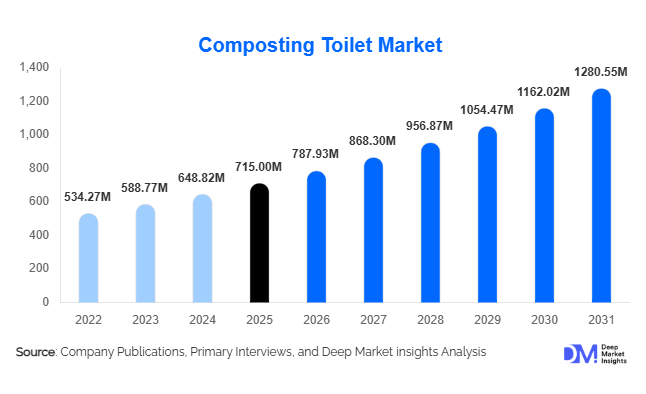
According to Deep Market Insights, the global composting toilet market size was valued at USD 715 million in 2025 and is projected to grow from USD 787.93 million in 2026 to reach USD 1,280.55 million by 2031, expanding at a CAGR of 10.2% during the forecast period (2026–2031). The composting toilet market growth is primarily driven by increasing demand for sustainable sanitation infrastructure, rising global concerns regarding water scarcity, and the growing adoption of decentralized wastewater management systems across residential, commercial, and institutional sectors.
Key Market Insights
- Composting toilets are increasingly being adopted as water-efficient sanitation alternatives, particularly in regions facing freshwater shortages and inadequate sewage infrastructure.
- Residential off-grid living and tiny home developments are accelerating market demand, especially across North America, Europe, and Australia.
- North America dominates the global composting toilet market, supported by strong demand from eco-conscious homeowners, RV owners, campgrounds, and sustainable tourism operators.
- Asia-Pacific is the fastest-growing regional market, driven by rural sanitation investments, sustainable housing projects, and increasing eco-tourism infrastructure.
- Technological innovation is reshaping the industry, with automated composting systems, odor-control technologies, smart ventilation, and solar-powered units gaining traction.
- Commercial demand from eco-resorts, national parks, and remote industrial facilities is expanding significantly due to the lower infrastructure and operating costs associated with composting sanitation systems.
Composting Toilet Market Trends
Smart and Automated Composting Systems Gaining Popularity
Manufacturers are increasingly integrating smart technologies into composting toilet systems to improve operational efficiency, hygiene, and user convenience. Features such as automatic waste mixing, temperature regulation, humidity monitoring, fan-assisted ventilation, and remote monitoring capabilities are becoming more common in premium product categories. Smart composting systems are particularly gaining traction in luxury eco-resorts, high-end residential applications, modular housing projects, and recreational vehicles where consumers prioritize convenience and odor-free performance. IoT-enabled systems capable of monitoring composting cycles and maintenance requirements through mobile applications are also entering the market. These technological upgrades are improving mainstream consumer acceptance and helping manufacturers position composting toilets as modern sanitation solutions rather than niche eco-products.
Growing Adoption Across Eco-Tourism and Sustainable Infrastructure
The rapid expansion of eco-tourism infrastructure is becoming a major market trend globally. Eco-lodges, glamping sites, campgrounds, wilderness resorts, and national parks are increasingly deploying composting toilet systems to minimize environmental impact and reduce water consumption. Governments and private operators are favoring decentralized sanitation solutions in environmentally sensitive locations where conventional sewage systems are costly or impractical. Composting toilets are also becoming more common across public parks, disaster-relief facilities, remote industrial camps, and sustainable tourism projects. The integration of low-water sanitation technologies within green building standards and carbon-reduction initiatives is further strengthening adoption across commercial and public infrastructure sectors.
Composting Toilet Market Drivers
Rising Focus on Water Conservation and Sustainable Sanitation
Growing concerns regarding freshwater scarcity and wastewater management are significantly driving demand for composting toilet systems globally. Conventional flush toilets consume large volumes of water annually, creating pressure on municipal water supplies and wastewater infrastructure. Composting toilets offer a sustainable alternative by operating with little or no water usage, making them highly attractive in drought-prone regions and off-grid environments. Governments, environmental agencies, and green building developers are increasingly promoting water-efficient sanitation technologies as part of climate adaptation and sustainability initiatives. The growing implementation of eco-friendly building certifications such as LEED and BREEAM is also supporting adoption within residential and commercial construction projects.
Expansion of Off-Grid Housing and Eco-Living Trends
The increasing popularity of off-grid living, tiny homes, remote cabins, and modular housing developments is accelerating composting toilet market growth. Consumers seeking energy independence and environmentally responsible lifestyles are increasingly investing in decentralized sanitation systems that reduce infrastructure dependency. Recreational vehicle owners, mobile home users, and sustainable housing communities are emerging as key customer groups for portable and self-contained composting systems. In addition, remote work trends and migration toward rural living environments have increased demand for sanitation systems suitable for locations lacking conventional sewage infrastructure.
Composting Toilet Market Restraints
Limited Consumer Awareness and Cultural Acceptance
Despite increasing environmental awareness, composting toilets still face adoption challenges due to limited consumer familiarity and cultural resistance in several markets. Many consumers continue to perceive composting systems as less hygienic or more difficult to maintain compared to conventional flush toilets. Misconceptions regarding odor management, compost handling, and operational complexity continue to restrict broader mainstream acceptance. In urban regions where centralized sewage systems are well established, convincing consumers to transition toward alternative sanitation technologies remains a key industry challenge.
High Initial Installation and Maintenance Costs
Advanced composting toilet systems, particularly electric and automated models, involve relatively high upfront costs compared to traditional sanitation systems. Installation expenses associated with ventilation systems, compost chambers, electrical components, and plumbing modifications may discourage price-sensitive consumers. Commercial-grade and institutional systems can involve even higher capital expenditures depending on capacity and customization requirements. Ongoing maintenance, periodic compost removal, and compliance with local sanitation regulations further add to operational complexity, particularly in regions where regulatory frameworks for composting sanitation systems remain inconsistent.
Composting Toilet Market Opportunities
Expansion of Sustainable Tourism Infrastructure
The rapid growth of eco-tourism and sustainable hospitality infrastructure presents substantial opportunities for composting toilet manufacturers. Eco-resorts, glamping facilities, wilderness lodges, and protected natural tourism destinations increasingly require low-water sanitation systems that minimize environmental impact. Composting toilets eliminate the need for extensive sewage infrastructure while supporting sustainability goals and reducing operating costs. Governments across regions including North America, Europe, and Asia-Pacific are investing heavily in nature-based tourism projects and environmentally sustainable public infrastructure, creating long-term demand opportunities for commercial-grade composting sanitation solutions.
Government Investments in Rural and Decentralized Sanitation
Developing economies continue to invest heavily in rural sanitation infrastructure and decentralized wastewater management systems. Composting toilets are increasingly being deployed across remote communities, schools, healthcare facilities, disaster-relief camps, and public sanitation projects where conventional sewer connectivity remains limited. International development agencies and public health organizations are promoting low-water sanitation technologies to improve hygiene accessibility and environmental sustainability. Countries across Asia-Pacific, Africa, and Latin America are expected to become major future demand centers as sanitation modernization programs accelerate.
Report Scope
| Report Metric | Details |
|---|---|
| Market Size in 2025 | USD 715 Million |
| Market Size in 2026 | USD 787.93 Million |
| Market Size in 2031 | USD 1280.55 Million |
| CAGR | 10.2% (2026-2031) |
| Base Year for Estimation | 2025 |
| Historical Data | 2022-2024 |
| Forecast Period | 2026-2031 |
| Report Coverage | Revenue Forecast, Competitive Landscape, Supply Chain Disruption, Growth Factors, Environment & Regulatory Landscape and Trends |
| Geographies Covered | North America, Europe, APAC, Middle East and Africa, LATAM |
| Countries Covered | U.S., Canada, U.K., Germany, France, Spain, Italy, Russia, Nordic, Benelux, Rest of Europe, China, Korea, Japan, India, Australia, Singapore, Taiwan, South East Asia, Rest of Asia-Pacific, UAE, Turky, Saudi Arabia, South Africa, Egypt, Nigeria, Rest of MEA, Brazil, Mexico, Argentina, Chile, Colombia, Rest of LATAM |
Explore more data points, trends and opportunities Download Free Sample Report
Product Type Insights
Self-contained composting toilets dominate the global market, accounting for nearly 41% of total revenue in 2025. Their leadership is supported by ease of installation, portability, and strong suitability for off-grid residential applications, recreational vehicles, cabins, and marine environments. These systems are increasingly favored by consumers seeking plug-and-play sanitation solutions requiring minimal infrastructure modifications. Central or remote composting systems are gaining adoption across commercial facilities and institutional projects due to their ability to handle higher user capacities and multiple fixtures. Electric composting toilets equipped with automated ventilation and heating systems are witnessing growing demand in premium residential and hospitality applications where convenience and odor control are critical purchasing factors. Meanwhile, non-electric composting systems continue to dominate rural and developing markets due to lower installation costs and reduced energy dependency.
Application Insights
Off-grid sanitation remains the leading application segment within the composting toilet market, driven by increasing adoption across remote housing, eco-villages, camping facilities, and wilderness tourism infrastructure. Sustainable tourism infrastructure has emerged as one of the fastest-growing application areas, with eco-resorts and glamping operators deploying composting toilets to reduce environmental impact and improve sustainability credentials. Green building projects are increasingly integrating composting sanitation systems to support water conservation objectives and sustainability certifications. Disaster-relief and emergency sanitation applications are also expanding steadily, as portable composting systems provide rapid deployment capabilities in humanitarian and climate-affected regions. In addition, demand from recreational vehicles and marine applications is increasing due to growing outdoor recreation and mobile living trends globally.
Distribution Channel Insights
Direct sales remain the dominant distribution channel for composting toilet systems due to the technical nature of installations and the importance of customized consultation. Manufacturers frequently partner directly with eco-resort developers, modular housing builders, institutional buyers, and infrastructure contractors to provide tailored sanitation solutions. Specialty sanitation dealers and sustainable infrastructure distributors also maintain a significant presence within the market by offering installation support and maintenance services. Online sales channels are expanding rapidly, particularly for portable and self-contained residential systems, as consumers increasingly research and purchase eco-friendly home products through e-commerce platforms. Home improvement retailers are gradually increasing product availability in developed markets where consumer awareness regarding sustainable sanitation solutions continues to improve.
End-User Insights
Residential users represent the largest end-user segment in the composting toilet market, accounting for nearly 46% of total market demand in 2025. Growth in tiny homes, off-grid housing communities, eco-conscious residential construction, and recreational properties continues to drive adoption within this segment. Commercial users, particularly eco-resorts, campgrounds, and hospitality operators, are among the fastest-growing customer groups due to increasing investments in sustainable tourism infrastructure. Institutional demand is expanding steadily across schools, healthcare facilities, government buildings, and public parks where decentralized sanitation systems provide infrastructure flexibility and water-saving advantages. Industrial demand from mining camps, renewable energy projects, and remote workforce accommodations is also increasing as companies seek durable sanitation solutions capable of operating in isolated environments.
Explore more data points, trends and opportunities Download Free Sample Report
Composting Toilet Market Segmentations
By Product Type
- Self-Contained Composting Toilets
- Central/Remote Composting Toilets
- Dry Composting Toilets
- Electric Composting Toilets
- Non-Electric Composting Toilets
By Application
- Residential Water Conservation
- Sustainable Tourism Infrastructure
- Off-Grid Sanitation
- Disaster Relief & Emergency Sanitation
- Remote Workforce Accommodation
- Green Building Projects
- Recreational Vehicle & Marine Use
By Distribution Channel
- Direct Sales
- Specialty Sanitation Dealers
- Home Improvement Retailers
- Online/E-commerce Platforms
- Institutional Procurement & Tenders
By End User
- Residential Users
- Commercial Users
- Institutional Users
- Industrial Users
- Municipal & Public Infrastructure Users
Regional Insights
North America
North America accounted for approximately 36% of the global composting toilet market in 2025, making it the leading regional market. The United States dominates regional demand due to widespread adoption across off-grid homes, RVs, campgrounds, eco-resorts, and national parks. Rising consumer awareness regarding sustainable living and strong demand for water-saving technologies continue to support market growth. Canada also represents a major market due to growing adoption in remote communities, wilderness tourism infrastructure, and recreational cabin installations. Government investments in sustainable infrastructure and environmental conservation initiatives are expected to further strengthen regional demand.
Europe
Europe accounted for nearly 29% of the global market in 2025 and remains one of the most environmentally conscious markets for composting sanitation technologies. Scandinavian countries including Sweden, Norway, and Finland are among the most mature markets due to strong sustainability awareness and established eco-housing infrastructure. Germany, the United Kingdom, and France are witnessing increasing demand from green building projects and eco-tourism developments. European regulations supporting water efficiency, circular economy principles, and low-carbon infrastructure are accelerating composting toilet adoption across residential and commercial applications.
Asia-Pacific
Asia-Pacific is projected to be the fastest-growing regional market, expanding at a CAGR exceeding 12% during the forecast period. China and India are emerging as major demand centers due to expanding rural sanitation programs, increasing water scarcity concerns, and growing eco-tourism infrastructure investments. Australia represents a strong mature market driven by off-grid living culture and drought-related water conservation initiatives. Japan and South Korea are increasingly adopting premium smart composting systems integrated with advanced residential and hospitality projects. Rising government support for decentralized sanitation and sustainable housing development is expected to accelerate long-term regional growth.
Latin America
Latin America is gradually emerging as a growth market for composting sanitation systems, particularly across Brazil, Chile, and Argentina. Eco-tourism development, remote community infrastructure, and environmental conservation initiatives are driving adoption in the region. Sustainable agricultural communities and off-grid tourism facilities are increasingly deploying composting toilets due to limited sewage infrastructure in remote locations. Demand remains relatively concentrated in niche applications, although government sustainability initiatives are expected to support future expansion.
Middle East & Africa
The Middle East & Africa region is witnessing growing demand for composting toilet systems due to increasing investments in sustainable tourism infrastructure and water conservation technologies. GCC countries are adopting low-water sanitation solutions across eco-resorts and remote tourism developments located in desert environments. South Africa remains one of the leading African markets due to strong eco-tourism infrastructure and growing environmental awareness. Across several African nations, composting toilets are increasingly being integrated into rural sanitation programs and humanitarian infrastructure projects supported by international development organizations.
Key Players in the Composting Toilet Market
- Nature’s Head
- Sun-Mar Corporation
- Separett AB
- BioLet
- Clivus Multrum
- Envirolet
- Kildwick
- EcoTech Products
- Phoenix Composting Toilets
- OGO Compost Toilet
- Air Head Composting Toilet