Global Cold Sauce Market Size
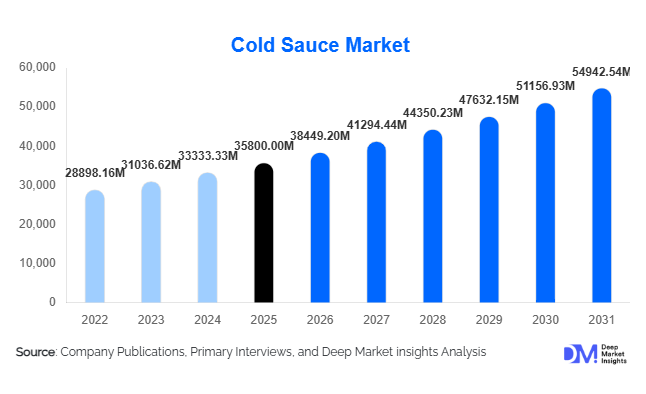
According to Deep Market Insights, the global cold sauce market size was valued at USD 35,800 million in 2025 and is projected to grow from USD 38,449.20 million in 2026 to reach USD 54,942.54 million by 2031, expanding at a CAGR of 7.4% during the forecast period (2026–2031). The market growth is primarily driven by rising consumption of convenience foods, rapid expansion of quick-service restaurants (QSRs), increasing demand for ready-to-use condiments, and strong product innovation across plant-based, clean-label, and premium cold sauce categories globally.
Key Market Insights
- Mayonnaise-based sauces remain the dominant product category globally, supported by widespread usage in fast food, sandwiches, and salads across both retail and foodservice sectors.
- Foodservice is the largest demand driver, accounting for nearly half of global consumption due to high-volume usage in QSR chains, cafés, and institutional kitchens.
- Asia-Pacific is the fastest-growing region, driven by urbanization, rising disposable income, and rapid expansion of Western-style fast-food chains in India, China, and Southeast Asia.
- Plant-based and clean-label sauces are the fastest-growing product segment, fueled by vegan adoption, health consciousness, and sustainability trends.
- Online retail and D2C channels are expanding rapidly, reshaping distribution models for premium and niche sauce brands.
- North America continues to dominate in value terms, supported by strong QSR penetration and high per-capita condiment consumption.
Global Cold Sauce Market Latest Trends
Rising Demand for Plant-Based and Clean-Label Sauces
Consumers are increasingly shifting toward healthier and transparent food options, driving strong demand for plant-based mayonnaise, dairy-free dressings, and preservative-free sauces. Manufacturers are reformulating products to remove artificial additives and reduce fat content while maintaining taste and texture. This trend is particularly strong in Europe and North America, where regulatory pressure and consumer awareness are accelerating clean-label adoption.
Premiumization and Flavor Innovation
The market is witnessing rapid innovation in premium and ethnic flavors such as truffle aioli, peri-peri mayonnaise, sriracha dressings, and herb-infused vinaigrettes. This premiumization trend is enabling manufacturers to command higher margins and differentiate products in a highly competitive retail environment. Foodservice operators are also adopting signature sauces to enhance brand identity and customer experience.
Global Cold Sauce Market Drivers
Expansion of QSR and Fast-Casual Dining Industry
The rapid global expansion of QSR chains and fast-casual restaurants is one of the strongest growth drivers for the cold sauce market. Burgers, wraps, sandwiches, and fried foods heavily rely on cold sauces as core ingredients. Standardized bulk procurement across global franchises ensures consistent and high-volume demand.
Rising Consumption of Convenience and Ready-to-Eat Foods
Urban lifestyles, increasing workforce participation, and busy schedules are driving demand for ready-to-eat meals and convenience foods. Cold sauces serve as instant flavor enhancers, making them essential household and foodservice products across developed and emerging markets.
Continuous Product Innovation and Flavor Diversification
Manufacturers are increasingly investing in R&D to introduce innovative flavors, healthier formulations, and fusion sauces. This includes low-fat mayonnaise, vegan alternatives, and ethnic-inspired dressings, expanding the consumer base and boosting repeat purchases.
Global Cold Sauce Market Restraints
Health Concerns and Nutritional Awareness
Growing awareness regarding high fat, sugar, and additive content in traditional cold sauces is restraining market growth. Consumers are increasingly shifting toward low-calorie and natural alternatives, challenging conventional mayonnaise and processed sauce categories.
Raw Material Price Volatility
The industry is highly dependent on agricultural inputs such as eggs, vegetable oils, dairy, and tomatoes. Fluctuations in raw material prices due to climate conditions, supply chain disruptions, and geopolitical instability directly impact production costs and profit margins.
Global Cold Sauce Industry Key Opportunities
Expansion of Plant-Based and Functional Sauces
The growing vegan population and health-conscious consumers are creating strong opportunities for plant-based cold sauces. Products made from avocado, hummus, and plant oils are gaining traction, especially in urban retail markets. Functional sauces enriched with probiotics, vitamins, and clean-label ingredients are also emerging as high-growth niches.
Growth of E-commerce and Direct-to-Consumer Channels
Digital transformation in food retail is enabling sauce manufacturers to reach consumers directly through online grocery platforms and D2C models. Premium and specialty sauce brands are leveraging e-commerce to offer subscription-based models, personalized flavor kits, and niche gourmet products.
Rapid Expansion in Emerging Markets
Emerging economies in Asia-Pacific, Latin America, and the Middle East present significant growth opportunities due to rising urbanization, expanding middle-class populations, and increasing penetration of international fast-food chains. These regions are expected to drive incremental demand for both retail and foodservice cold sauces.
Report Scope
| Report Metric | Details |
|---|---|
| Market Size in 2025 | USD 35800.00 Million |
| Market Size in 2026 | USD 38449.20 Million |
| Market Size in 2031 | USD 54942.54 Million |
| CAGR | 7.4% (2026-2031) |
| Base Year for Estimation | 2025 |
| Historical Data | 2022-2024 |
| Forecast Period | 2026-2031 |
| Report Coverage | Revenue Forecast, Competitive Landscape, Supply Chain Disruption, Growth Factors, Environment & Regulatory Landscape and Trends |
| Geographies Covered | North America, Europe, APAC, Middle East and Africa, LATAM |
| Countries Covered | U.S., Canada, U.K., Germany, France, Spain, Italy, Russia, Nordic, Benelux, Rest of Europe, China, Korea, Japan, India, Australia, Singapore, Taiwan, South East Asia, Rest of Asia-Pacific, UAE, Turky, Saudi Arabia, South Africa, Egypt, Nigeria, Rest of MEA, Brazil, Mexico, Argentina, Chile, Colombia, Rest of LATAM |
Explore more data points, trends and opportunities Download Free Sample Report
Product Type Insights
The global sauces market is segmented into mayonnaise-based sauces, tomato-based sauces, dairy-based sauces, oil-based sauces, plant-based sauces, and others. Mayonnaise-based sauces account for the largest share of the global market owing to their exceptional versatility across multiple food applications, including sandwiches, burgers, wraps, salads, fries, and dips. Their widespread use in quick-service restaurants (QSRs), fast-casual dining outlets, institutional catering, and household meal preparation has established mayonnaise as one of the most consumed condiment categories worldwide. Continuous product innovation through flavored variants such as garlic, peri-peri, chipotle, truffle, herb-infused, and spicy mayonnaise, along with reduced-fat and clean-label formulations, further strengthens segment growth. The leading driver for this segment is the continuously expanding global fast-food and QSR industry, where mayonnaise serves as a core ingredient across numerous menu offerings, ensuring consistent high-volume consumption.Tomato-based sauces, including ketchup, pasta sauces, pizza sauces, salsa, and barbecue sauces, continue to maintain a significant market presence due to their universal consumer acceptance and extensive usage across both retail and foodservice sectors. Dairy-based sauces such as ranch, cheese sauces, sour cream-based dressings, and creamy dips remain particularly popular in developed markets, especially across North America and Europe, supported by increasing demand for premium comfort foods and snack accompaniments. Oil-based sauces, including vinaigrettes, aioli, pesto, and herb-infused emulsions, are witnessing increasing adoption as consumers seek gourmet dining experiences, Mediterranean cuisine, and healthier dressing alternatives. Meanwhile, plant-based sauces represent the fastest-growing category, driven by rising vegan populations, increasing lactose-free dietary preferences, growing awareness of sustainable food production, and strong consumer demand for clean-label products formulated with natural ingredients and free from artificial additives.
Application Insights
The market is segmented into foodservice, household, industrial food processing, and others based on application. Foodservice remains the dominant application segment, accounting for the largest share of global sauce consumption due to its extensive utilization across quick-service restaurants, full-service restaurants, cafés, hotels, cloud kitchens, catering services, and institutional food providers. Sauces serve as essential flavor enhancers that improve menu differentiation, support product customization, and deliver consistent taste across large-scale food operations. The leading driver for this segment is the continuous global expansion of quick-service restaurant chains, increasing frequency of eating outside the home, and growing consumer preference for convenient ready-to-eat meals that rely heavily on sauces and dressings.Household consumption continues to represent a substantial portion of market demand as consumers increasingly prepare restaurant-style meals at home while seeking convenience and greater flavor variety. Expanding retail availability, premium product launches, and rising demand for international cuisines further contribute to household adoption. Industrial food processing is also experiencing robust growth as manufacturers increasingly incorporate sauces into frozen meals, ready-to-eat products, packaged snacks, processed meat products, sandwiches, pizzas, bakery fillings, and meal kits. In addition, export-oriented processed food manufacturing continues to stimulate bulk demand for standardized sauce formulations, supporting long-term expansion across global food production networks.
Distribution Channel Insights
The global sauces market is distributed through supermarkets and hypermarkets, convenience stores, online retail, foodservice distribution, institutional procurement, and other retail channels. Supermarkets and hypermarkets dominate the market owing to their extensive product assortments, established consumer trust, competitive pricing strategies, promotional activities, and widespread geographical presence. These retail formats provide consumers with access to domestic and international brands while facilitating impulse purchases through attractive merchandising and product visibility. The leading driver for this segment is the expanding organized retail sector, which continues to improve product accessibility while offering consumers greater brand selection and promotional pricing opportunities.Foodservice distribution channels represent another significant contributor, supplying bulk quantities of sauces to restaurants, hotels, catering companies, educational institutions, and healthcare facilities that require consistent quality and large-volume procurement. Online retail is emerging as the fastest-growing distribution channel due to increasing digital grocery adoption, direct-to-consumer business models, subscription-based purchasing, and expanding availability of premium, imported, specialty, and health-focused sauce brands. Convenience stores continue to support regular consumer purchases through proximity shopping, while institutional procurement channels generate stable demand from commercial foodservice operators and government organizations requiring large-scale supply contracts.
Explore more data points, trends and opportunities Download Free Sample Report
Cold Sauce Market Segmentations
By Product Type
- Mayonnaise-Based Sauces
- Tomato-Based Sauces
- Dairy-Based Sauces
- Oil-Based Sauces & Dressings
- Mustard-Based Sauces
- Plant-Based & Vegan Sauces
- Specialty & Ethnic Cold Sauces
By Application
- Foodservice
- Household/Retail Consumption
- Industrial Food Processing
- Institutional Catering
By Distribution Channel
- Supermarkets & Hypermarkets
- Convenience Stores
- Online Retail & Direct-to-Consumer (D2C)
- Foodservice Distributors
- Wholesale & Cash-and-Carry Stores
- Specialty Food Stores
Regional Insights
North America
North America dominates the global sauces market owing to exceptionally high consumption of mayonnaise, ketchup, ranch dressings, barbecue sauces, and specialty condiments across both retail and foodservice sectors. The United States accounts for the largest regional share due to its mature quick-service restaurant industry, high per-capita condiment consumption, extensive retail distribution network, and strong consumer preference for premium, organic, and flavored sauce varieties. Canada also contributes significantly through increasing demand for clean-label products and international cuisine. The primary driver supporting regional growth is the highly developed fast-food and restaurant ecosystem, complemented by continuous product innovation, premiumization, and strong consumer spending on convenience foods.
Europe
Europe represents a mature yet steadily expanding market characterized by strong consumer preference for premium, organic, sustainable, and clean-label sauces. Countries including Germany, the United Kingdom, France, Italy, Spain, and the Netherlands remain major consumption centers due to well-established food processing industries and widespread adoption of international cuisines. Consumers increasingly favor gourmet dressings, plant-based sauces, reduced-sugar formulations, and products containing natural ingredients with transparent labeling. Regional manufacturers continue to introduce innovative flavors while emphasizing sustainability and environmentally responsible packaging. The key driver for regional growth is the increasing consumer demand for healthier, premium-quality, and clean-label food products supported by stringent food quality standards and continuous innovation.
Asia-Pacific
Asia-Pacific is the fastest-growing regional market, driven by rapid urbanization, rising disposable incomes, changing dietary preferences, and expanding consumption of Western-style fast foods alongside local fusion cuisines. China, India, Japan, South Korea, Australia, and Southeast Asian countries are witnessing substantial increases in demand for mayonnaise, chili sauces, ketchup, soy-based condiments, and flavored dressings. Rapid expansion of international quick-service restaurant chains, modern retail infrastructure, food delivery platforms, and e-commerce has significantly improved product accessibility across both metropolitan and emerging urban markets. The principal driver for regional growth is the expanding middle-class population combined with accelerating fast-food consumption and increasing demand for convenient packaged food products.
Latin America
Latin America continues to experience steady market expansion, led by Brazil, Mexico, Argentina, and Chile. Consumers across the region exhibit strong demand for ketchup, chili sauces, salsa, barbecue sauces, and mayonnaise products that complement local culinary traditions. The growth of organized retail, increasing urbanization, and rising consumption of convenience foods are creating favorable conditions for market development. International sauce manufacturers are expanding their regional presence while introducing localized flavor profiles tailored to consumer preferences. The major driver for regional growth is the increasing penetration of quick-service restaurants and modern retail formats, supported by rising disposable incomes and changing food consumption patterns.
Middle East & Africa
The Middle East & Africa market is steadily emerging as an attractive growth region, supported by rapid expansion of the hospitality sector, increasing tourism activities, and growing adoption of international food cultures. Countries such as the United Arab Emirates, Saudi Arabia, South Africa, and Qatar are witnessing rising consumption of mayonnaise, ketchup, garlic sauces, and premium imported condiments across restaurants, hotels, and retail outlets. The region continues to benefit from investments in modern retail infrastructure, foodservice expansion, and rising demand for convenience foods among younger consumers. The primary driver for regional growth is the continued development of tourism and hospitality industries, coupled with increasing Western food influence and expanding organized foodservice networks across major urban centers.
Key Players in the Global Cold Sauce Market
- Unilever
- Nestlé
- The Kraft Heinz Company
- McCormick & Company
- Kewpie Corporation
- Conagra Brands
- Orkla
- Del Monte Foods
- Dr. Oetker
- BRF (Sadia)