Closet Organizer Market Size
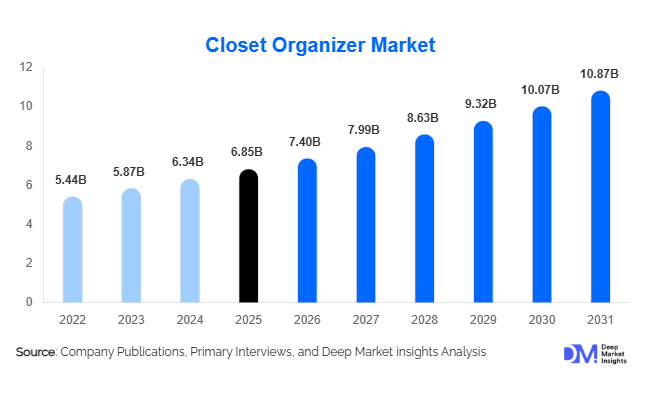
According to Deep Market Insights, the global closet organizer market size was valued at USD 6.85 billion in 2025 and is projected to grow from USD 7.38 billion in 2026 to reach USD 10.90 billion by 2031, expanding at a CAGR of 8.0% during the forecast period (2026–2031). The closet organizer market growth is primarily driven by increasing urbanization, rising residential renovation spending, growing demand for space optimization solutions, and consumer preference for aesthetically organized living environments. As living spaces become more compact, particularly in urban centers, homeowners and renters are increasingly investing in modular, customizable, and multifunctional storage systems that maximize storage efficiency while enhancing interior aesthetics.
Key Market Insights
- Modular closet systems account for the largest share of the market, driven by customization flexibility, ease of installation, and affordability.
- Residential applications dominate global demand, representing nearly 79% of total market revenue as homeowners continue investing in storage optimization and home improvement projects.
- North America remains the largest regional market, supported by high disposable incomes, strong remodeling activity, and widespread adoption of walk-in closet solutions.
- Asia-Pacific is the fastest-growing region, driven by rapid urbanization, apartment construction, and expanding middle-class populations in China, India, and Southeast Asia.
- E-commerce channels are transforming purchasing behavior, allowing consumers to compare designs, configure storage systems, and purchase DIY solutions directly online.
- Smart storage technologies are emerging as a premium market segment, incorporating automated lighting, sensor-enabled shelving, inventory tracking, and connected home integration.
Closet Organizer Market Trends
Growing Adoption of Modular and Customizable Storage Systems
Consumers increasingly prefer closet organization solutions that can be customized according to room dimensions, storage requirements, and lifestyle preferences. Modular closet systems have become particularly popular because they allow homeowners to expand, reconfigure, and personalize storage layouts without undertaking extensive renovations. Manufacturers are introducing configurable shelving units, adjustable hanging systems, integrated drawers, and multifunctional storage accessories to address diverse customer needs. The trend is especially pronounced in urban apartments where space optimization has become a primary purchasing consideration. Premium customization services are also gaining traction among affluent homeowners seeking tailored storage experiences that enhance property value and interior aesthetics.
Smart Closet Solutions and Digital Integration
Technological innovation is beginning to reshape the closet organizer industry. Premium consumers are increasingly attracted to smart closet systems featuring motion-activated lighting, automated clothing storage mechanisms, digital wardrobe management, and smartphone-enabled controls. Manufacturers are exploring integration with broader smart home ecosystems, allowing users to manage storage environments remotely. Emerging technologies such as RFID-based clothing tracking, intelligent inventory management, and energy-efficient LED lighting systems are creating new differentiation opportunities. As smart home adoption expands globally, technology-enabled closet solutions are expected to become a key growth category within the premium segment.
Closet Organizer Market Drivers
Urbanization and Smaller Living Spaces
Rapid urbanization across developed and emerging economies is increasing demand for efficient storage solutions. Residential units in major cities are becoming smaller, creating a strong need for products that maximize usable space. Closet organizers provide homeowners and renters with practical solutions for optimizing storage without expanding physical living areas. This trend is particularly evident in Asia-Pacific, where high-density residential developments continue to accelerate.
Growth in Home Renovation and Remodeling Activities
Increasing consumer spending on home improvement projects has become a major catalyst for market expansion. Homeowners are investing in customized storage systems to improve functionality, enhance aesthetics, and increase property values. Closet upgrades are now considered an essential component of modern home renovations, particularly in North America and Europe where remodeling expenditures remain robust. Growing awareness of organized living and interior design trends is further encouraging adoption of premium closet solutions.
Closet Organizer Market Restraints
High Cost of Customized Installations
Premium and fully customized closet systems often require professional design, installation services, and high-quality materials, significantly increasing project costs. These expenses limit adoption among price-sensitive consumers, particularly in developing economies. Luxury walk-in closet installations can represent a substantial investment, creating barriers to broader market penetration.
Volatility in Raw Material Prices
Manufacturers rely heavily on engineered wood, plywood, metal components, and plastic materials. Fluctuations in commodity prices and supply chain disruptions can increase production costs and compress profit margins. Sustained increases in input costs may also lead to higher retail prices, affecting affordability and purchasing decisions across certain consumer segments.
Closet Organizer Market Opportunities
Expansion Across Emerging Residential Markets
Rapid urban housing development in countries such as India, Vietnam, Indonesia, Saudi Arabia, and Brazil presents significant growth opportunities for closet organizer manufacturers. Rising homeownership rates, increasing disposable incomes, and growing awareness of interior organization solutions are creating favorable market conditions. Affordable modular systems specifically designed for compact living spaces are expected to experience strong demand across these regions.
Smart Home Integration and Premium Storage Solutions
The growing adoption of smart homes presents opportunities for manufacturers to introduce connected storage systems. Automated lighting, sensor-enabled compartments, wardrobe management software, and app-controlled storage features can help companies capture higher-margin premium customers. Early adoption of smart closet technologies may provide competitive advantages as consumers increasingly seek integrated home ecosystems.
Report Scope
| Report Metric | Details |
|---|---|
| Market Size in 2025 | USD 6.85 Billion |
| Market Size in 2026 | USD 7.40 Billion |
| Market Size in 2031 | USD 10.87 Billion |
| CAGR | 8% (2026-2031) |
| Base Year for Estimation | 2025 |
| Historical Data | 2022-2024 |
| Forecast Period | 2026-2031 |
| Report Coverage | Revenue Forecast, Competitive Landscape, Supply Chain Disruption, Growth Factors, Environment & Regulatory Landscape and Trends |
| Geographies Covered | North America, Europe, APAC, Middle East and Africa, LATAM |
| Countries Covered | U.S., Canada, U.K., Germany, France, Spain, Italy, Russia, Nordic, Benelux, Rest of Europe, China, Korea, Japan, India, Australia, Singapore, Taiwan, South East Asia, Rest of Asia-Pacific, UAE, Turky, Saudi Arabia, South Africa, Egypt, Nigeria, Rest of MEA, Brazil, Mexico, Argentina, Chile, Colombia, Rest of LATAM |
Explore more data points, trends and opportunities Download Free Sample Report
Product Type Insights
Modular closet systems dominated the global closet organizer market, accounting for approximately 31% of total revenue in 2025. The segment's leadership is primarily driven by growing consumer demand for customizable storage solutions that can be adapted to different room sizes, layouts, and storage requirements. Unlike traditional fixed closet systems, modular solutions offer flexibility in configuration, allowing homeowners to add, remove, or rearrange components as storage needs evolve. The increasing prevalence of apartment living and compact residential spaces, particularly in urban centers across North America, Europe, and Asia-Pacific, has further accelerated adoption. Additionally, manufacturers have expanded product portfolios with DIY-friendly modular systems that reduce installation costs and appeal to younger homeowners and renters.
Shelving systems continue to represent a substantial portion of market demand due to their versatility, affordability, and compatibility with both residential and commercial environments. Walk-in closet systems remain the fastest-growing premium segment, supported by rising luxury housing construction and increasing consumer expenditure on home personalization. Demand for walk-in closets is particularly strong in the United States, Canada, the UAE, and affluent urban markets across Asia-Pacific. Meanwhile, smart closet organizers are emerging as a high-growth category, fueled by increasing smart home penetration, connected living trends, and consumer interest in technology-enabled storage solutions featuring automated lighting, wardrobe tracking, and mobile application integration.
Material Insights
Engineered wood and MDF accounted for approximately 37% of global market revenue in 2025, making them the leading material segment. Their dominance is driven by an optimal combination of cost efficiency, design flexibility, durability, and manufacturing scalability. Compared with solid wood, engineered wood products offer lower production costs while enabling manufacturers to produce aesthetically appealing storage solutions across a wide range of price points. The material also supports diverse finishes, textures, and colors that align with contemporary interior design preferences.
The continued expansion of the mid-range residential furniture market has further strengthened demand for MDF-based closet organizers. Additionally, advancements in moisture-resistant and low-emission MDF technologies have improved product performance while addressing sustainability concerns. Solid wood remains highly preferred within luxury and custom closet applications due to its premium appearance, durability, and perceived long-term value. Metal-based closet systems are experiencing increased adoption in modern residential and commercial projects due to their structural strength and minimalist aesthetic appeal. Hybrid material systems that combine wood, metal, and composite materials are also gaining popularity as consumers seek improved durability and design differentiation.
Installation Type Insights
Built-in closet systems represented approximately 42% of global market demand in 2025 and remain the leading installation category. Their dominance is largely attributed to increasing consumer preference for permanent storage solutions that maximize available space while enhancing overall property value. Built-in systems provide seamless integration with interior architecture, creating a customized appearance that appeals strongly to homeowners undertaking renovation or remodeling projects.
The growth of the segment is further supported by rising investments in residential remodeling across developed markets, particularly in North America and Western Europe. Homeowners increasingly view built-in closet systems as long-term investments that improve functionality and increase resale value. Custom-fitted installations are witnessing robust growth within the premium segment, driven by demand for highly personalized storage configurations and luxury walk-in closet environments. Freestanding organizers continue to maintain strong demand among renters, students, and budget-conscious consumers due to their portability and ease of installation. Wall-mounted systems are gaining traction in urban apartments where efficient utilization of vertical space has become a key purchasing consideration.
Distribution Channel Insights
Home improvement retail stores accounted for approximately 34% of global market revenue in 2025, making them the largest distribution channel. Their leadership is supported by extensive product selection, in-store consultation services, installation support, and the ability for consumers to physically evaluate products before purchase. Major home improvement chains have successfully positioned closet organizers as a core category within broader home renovation and storage solution offerings.
However, e-commerce platforms are emerging as the fastest-growing sales channel. Increasing digital adoption, enhanced online visualization tools, and virtual room planning technologies are enabling consumers to customize and purchase closet systems remotely. The growth of direct-to-consumer sales models is also transforming competitive dynamics, allowing manufacturers to improve margins while offering personalized design services through digital platforms. Online channels are particularly popular among younger consumers who value convenience, transparent pricing, and access to a broader range of customization options than those available through traditional retail formats.
End-Use Insights
Residential applications dominated the closet organizer market, accounting for nearly 79% of total revenue in 2025. The segment's leadership is primarily driven by rising homeownership rates, growing residential construction activity, increasing renovation expenditures, and heightened consumer focus on organized living environments. Homeowners are increasingly investing in storage optimization solutions to improve functionality, aesthetics, and property value. Social media influence, home improvement television programming, and evolving interior design trends have further elevated consumer awareness regarding the benefits of customized closet systems.
The luxury residential segment continues to generate substantial demand for premium walk-in closets, custom storage solutions, and integrated wardrobe systems. Meanwhile, the commercial segment is gaining momentum across hospitality, student housing, multifamily residential developments, and senior living facilities. Hotels are increasingly incorporating premium closet systems to enhance guest experiences and differentiate accommodation offerings. Student housing developers are investing in space-efficient storage solutions to maximize room functionality, while senior living facilities are adopting accessible storage designs that improve convenience and usability for aging populations.
Explore more data points, trends and opportunities Download Free Sample Report
Closet Organizer Market Segmentations
By Product Type
- Shelving Systems
- Hanging Storage Systems
- Drawer & Cabinet Systems
- Shoe Storage Solutions
- Accessory Organizers
- Modular Closet Systems
- Walk-in Closet Systems
- Reach-in Closet Systems
- Smart Closet Organizers
By Material
- Solid Wood
- Engineered Wood / MDF
- Plywood
- Metal
- Plastic
- Fabric & Textile-Based Materials
- Hybrid Materials
By Installation Type
- Freestanding Systems
- Wall-Mounted Systems
- Built-In Systems
- Custom-Fitted Systems
By Distribution Channel
- Home Improvement Retail Stores
- Furniture Specialty Stores
- Hypermarkets & Supermarkets
- Direct-to-Consumer Sales
- E-Commerce Platforms
- Professional Closet Design & Installation Firms
By End Use
- Residential
- Commercial
Regional Insights
North America
North America accounted for approximately 36% of the global closet organizer market in 2025, making it the largest regional market. The United States alone contributed nearly 29% of global demand, supported by one of the world's largest home improvement industries and a well-established culture of residential remodeling. High disposable incomes, widespread adoption of walk-in closets, and strong consumer spending on home organization products continue to drive market expansion. The growing popularity of custom-designed storage systems, combined with rising investments in premium housing and smart home technologies, is creating additional opportunities for market participants. Canada is also experiencing stable growth due to increasing renovation activity, urban condominium development, and rising demand for customized storage solutions.
Europe
Europe represented approximately 26% of global market revenue in 2025. Growth across the region is primarily supported by strong demand for sustainable furniture solutions, increasing urbanization, and widespread adoption of modular home furnishings. Germany remains the largest market due to its robust furniture manufacturing sector and strong consumer spending on home improvement products. The United Kingdom and France continue to benefit from rising renovation expenditures and increasing interest in customized storage solutions. Additionally, stringent environmental regulations and growing consumer awareness regarding sustainable living are encouraging the adoption of eco-friendly closet organizers manufactured from certified wood and recyclable materials. Space optimization has become increasingly important in densely populated urban areas, further driving demand for modular and multifunctional storage systems.
Asia-Pacific
Asia-Pacific accounted for nearly 28% of global demand in 2025 and represents the fastest-growing regional market. The primary growth drivers include rapid urbanization, rising middle-class incomes, accelerating residential construction activity, and increasing adoption of modern home furnishings. China remains the largest market within the region, supported by extensive apartment development, growing homeownership rates, and expanding consumer spending on interior furnishings. India is expected to record the fastest growth rate during the forecast period, driven by urban housing projects, increasing disposable incomes, and growing awareness of home organization solutions. Japan, South Korea, and Australia continue to generate strong demand for premium and space-efficient closet systems due to limited living space and sophisticated consumer preferences. The rapid expansion of e-commerce platforms throughout the region is further improving market accessibility and product availability.
Latin America
Latin America represents an emerging growth market led primarily by Brazil and Mexico. Increasing urbanization, expanding middle-class populations, and improving residential construction activity are supporting demand for closet organization solutions. Rising consumer awareness regarding home organization, coupled with growing expenditure on home improvement products, is gradually expanding market penetration across the region. Government-backed housing initiatives and increasing apartment construction in major metropolitan areas are creating opportunities for affordable modular storage systems. Although overall adoption remains lower than in developed markets, improving economic conditions and greater retail availability are expected to support sustained long-term growth.
Middle East & Africa
The Middle East & Africa market is experiencing steady expansion, supported by luxury real estate development and large-scale urban infrastructure investments. Saudi Arabia and the United Arab Emirates account for the majority of regional demand, driven by premium residential projects, luxury villas, and high-end apartment developments. Government-led economic diversification programs, including Saudi Vision 2031, are stimulating substantial investments in housing and mixed-use developments, creating favorable conditions for premium closet organizer adoption. In South Africa, growing middle-class populations and increasing home renovation spending are contributing to market growth. Rising demand for customized storage solutions among affluent consumers and increasing construction of modern residential communities are expected to support continued expansion throughout the region.
Key Players in the Closet Organizer Market
- IKEA
- The Container Store
- ClosetMaid
- California Closets
- Closets By Design
- Easy Track
- Elfa
- Rubbermaid
- Sauder Woodworking
- Häfele
- Hettich
- Dorel Industries
- Prepac Manufacturing
- John Louis Home
- ORG Home