Global Chipped Beef Market Size
According to Deep Market Insights, the global chipped beef market size was valued at USD 1,620 million in 2026 and is projected to grow from USD 1,709.10 million in 2026 to reach USD 2,233.73 million by 2031, expanding at a CAGR of 5.5% during the forecast period (2026–2031). The chipped beef market growth is primarily driven by rising demand for protein-rich convenience foods, expansion of meat-snacking culture, and increasing adoption of shelf-stable meat products across households, foodservice operators, and institutional buyers including military and emergency food programs.
Key Market Insights
- Chipped beef demand is strongly supported by convenience-driven consumption trends, with increasing preference for ready-to-eat and easy-to-prepare protein products across urban households globally.
- Foodservice and institutional procurement remain a stable demand pillar, particularly in military rations, hospitals, and large-scale catering operations requiring long shelf-life meat solutions.
- North America dominates the global chipped beef market, supported by established consumer familiarity, strong retail penetration, and military-grade procurement systems.
- Asia-Pacific is the fastest-growing region, driven by rising disposable income, urbanization, and increasing adoption of Western-style processed meat products.
- Premiumization and clean-label reformulation are reshaping product development, with rising demand for low-sodium, preservative-free, and organic chipped beef variants.
- E-commerce and modern retail expansion are improving product accessibility, enabling wider global distribution of packaged and vacuum-sealed chipped beef products.
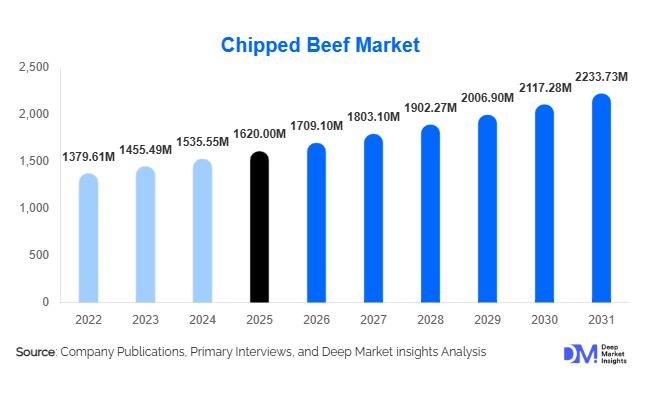
chipped beef market latest trends
Shift Toward Clean-Label and Reduced-Sodium Products
Manufacturers in the chipped beef market are increasingly reformulating products to meet consumer demand for healthier meat alternatives. Clean-label positioning, including antibiotic-free beef sourcing, minimal preservatives, and reduced sodium content, is becoming a standard expectation in premium product categories. This trend is particularly strong in North America and Europe, where regulatory scrutiny and health awareness are high. Companies are also introducing grass-fed and organic-certified variants to attract health-conscious consumers, expanding the market beyond traditional processed meat buyers.
Growth of Meat Snacking and On-the-Go Consumption
The rise of meat-based snacking is significantly influencing chipped beef consumption patterns. Consumers are increasingly substituting carbohydrate-heavy snacks with protein-dense alternatives, including vacuum-packed and ready-to-eat chipped beef formats. This shift is being driven by fitness-oriented lifestyles, increasing protein intake awareness, and convenience-oriented consumption habits. Retailers are expanding shelf space for portable protein snacks, while manufacturers are introducing flavored and smoked variants to enhance appeal across younger demographics.
Expansion of E-Commerce and Direct-to-Consumer Channels
Digital retail platforms are playing an increasingly important role in distribution. Online grocery platforms, subscription-based meat boxes, and direct-to-consumer (D2C) brand websites are enabling niche and premium chipped beef producers to reach global customers. Enhanced logistics and cold-chain improvements are supporting international shipping of vacuum-sealed products. Social media marketing and influencer-led food discovery are also accelerating awareness, especially among younger consumers seeking convenient protein options.
chipped beef market drivers
Rising Demand for Protein-Rich Convenience Foods
The global shift toward high-protein diets is a major driver of the chipped beef market. Consumers are actively seeking convenient protein sources that require minimal preparation, making chipped beef an attractive option for breakfast dishes, sandwiches, and ready meals. Urbanization, dual-income households, and busy lifestyles are further reinforcing demand for shelf-stable protein products that offer both convenience and nutritional value.
Expansion of Institutional and Military Demand
Institutional procurement, including military rations, disaster relief supplies, hospitals, and correctional facilities, provides consistent and large-scale demand for chipped beef. Its long shelf life, high caloric density, and ease of storage make it ideal for emergency food systems. Governments across North America, Europe, and parts of Asia continue to invest in food security and strategic reserves, strengthening long-term demand stability.
Growth of Processed Meat and Ready Meal Industries
The expansion of the global processed meat and ready meal sectors is significantly benefiting chipped beef consumption. Food manufacturers increasingly use chipped beef in sandwiches, sauces, soups, and frozen meal kits. Rising demand for convenience foods in retail and foodservice channels continues to support product integration across multiple culinary applications.
Key Restraints
Volatility in Raw Beef Prices
The chipped beef industry is highly sensitive to fluctuations in cattle prices, feed costs, and supply chain disruptions. Since raw beef accounts for a significant portion of production costs, price volatility directly impacts manufacturer margins and retail pricing stability. Smaller producers are particularly exposed to cost pressures during supply shortages or inflationary cycles.
Health Perception Challenges Around Processed Meat
Increasing awareness of health risks associated with processed meat consumption, including concerns around sodium levels and preservatives, is limiting growth in some developed markets. Regulatory pressure and evolving dietary preferences toward plant-based alternatives are also creating competitive challenges for traditional chipped beef products.
chipped beef industry key opportunities
Premiumization and Specialty Product Development
There is significant opportunity for manufacturers to expand into premium product categories, including organic, grass-fed, smoked gourmet, and low-sodium chipped beef. These products command higher margins and cater to health-conscious and affluent consumers. Premium snack packs and artisanal cured beef products are gaining traction in North America and Europe, creating differentiation opportunities in a competitive market.
Expansion in Asia-Pacific Emerging Markets
Asia-Pacific represents a major growth frontier for chipped beef manufacturers due to rising urban populations and increasing adoption of Western dietary patterns. Countries such as China, India, Japan, and South Korea are witnessing rising demand for processed meat snacks and convenience foods. Localization of flavors, pricing strategies, and distribution partnerships will be key to capturing long-term growth in this region.
Institutional Food Security and Emergency Preparedness Programs
Governments and international agencies are increasingly investing in food security infrastructure, including emergency ration programs and military food reserves. Chipped beef’s long shelf life and nutrient density make it a preferred product in disaster preparedness systems. Expansion into public procurement contracts offers stable long-term revenue streams for manufacturers and reduces dependence on volatile retail demand cycles.
Report Scope
| Report Metric | Details |
|---|---|
| Market Size in 2025 | USD 1620.00 Million |
| Market Size in 2026 | USD 1709.10 Million |
| Market Size in 2031 | USD 2233.73 Million |
| CAGR | 5.5% (2026-2031) |
| Base Year for Estimation | 2025 |
| Historical Data | 2022-2024 |
| Forecast Period | 2026-2031 |
| Report Coverage | Revenue Forecast, Competitive Landscape, Supply Chain Disruption, Growth Factors, Environment & Regulatory Landscape and Trends |
| Geographies Covered | North America, Europe, APAC, Middle East and Africa, LATAM |
| Countries Covered | U.S., Canada, U.K., Germany, France, Spain, Italy, Russia, Nordic, Benelux, Rest of Europe, China, Korea, Japan, India, Australia, Singapore, Taiwan, South East Asia, Rest of Asia-Pacific, UAE, Turky, Saudi Arabia, South Africa, Egypt, Nigeria, Rest of MEA, Brazil, Mexico, Argentina, Chile, Colombia, Rest of LATAM |
Explore more data points, trends and opportunities Download Free Sample Report
Product Type Insights
The dried chipped beef segment accounted for the largest share of the global chipped beef market owing to its long shelf life, ease of storage, cost-effectiveness, and broad acceptance across both household and institutional applications. Its ability to remain stable without extensive refrigeration makes it particularly suitable for retail distribution, military rations, emergency food reserves, and foodservice operations. Continuous demand for shelf-stable protein products and lower transportation costs further strengthen the dominance of this segment. Vacuum-packed chipped beef represents the fastest-growing product type as consumers increasingly prefer packaging solutions that preserve freshness, extend product life after opening, and enhance convenience through resealable formats. Advancements in vacuum-sealing technologies are also improving product quality while reducing food waste. Canned chipped beef continues to witness stable demand, particularly across North America, where it remains a traditional pantry staple and is widely utilized in ready-to-cook meals and institutional catering. Frozen chipped beef is gaining traction across commercial foodservice establishments due to improvements in cold-chain logistics, allowing restaurants, hotels, and catering providers to maintain consistent inventory while reducing spoilage. Meanwhile, ready-to-eat chipped beef products are emerging as an attractive high-growth category as consumers increasingly seek convenient, high-protein snacks and meal solutions that align with busy lifestyles, rising urbanization, and the growing preference for portable food products.
Application Insights
Sandwiches and deli applications dominated the global chipped beef market, driven by the widespread use of chipped beef as a premium protein ingredient in delicatessens, quick-service restaurants, cafés, and packaged ready-to-eat meal solutions. The segment continues to benefit from growing consumer demand for convenient, protein-rich meal options and the expanding popularity of deli-style foods across both developed and emerging markets. Breakfast dishes, including the traditional creamed chipped beef served over toast and other regional breakfast preparations, continue to represent an important consumption category, particularly across North America where the product has long-standing culinary recognition. Chipped beef also maintains strong utilization in soups, sauces, gravies, casseroles, and processed food manufacturing, supported by institutional catering, hospitality establishments, and commercial kitchens seeking flavorful preserved meat ingredients with extended storage capabilities. Meat snacking has emerged as the fastest-growing application segment as health-conscious consumers increasingly favor high-protein, low-carbohydrate snacks that support active lifestyles. Product innovation in flavored meat snacks, premium packaging, and portion-controlled offerings continues to accelerate growth within this category. In addition, military, humanitarian relief, and emergency ration applications provide stable long-term demand due to the product's durability, nutritional value, and suitability for long-term storage and field operations.
Distribution Channel Insights
Supermarkets and hypermarkets held the largest share of the global chipped beef market owing to their extensive product assortment, widespread geographic presence, competitive pricing strategies, and strong consumer accessibility. These retail outlets provide significant shelf visibility for both established brands and private-label products while supporting impulse purchases through promotional campaigns and bundled offerings. Foodservice distributors continue to play a critical role by supplying restaurants, hotels, institutional kitchens, healthcare facilities, and catering companies with bulk packaged chipped beef products that ensure consistent quality and supply reliability. Online retail is projected to register the fastest growth during the forecast period, supported by expanding e-commerce grocery platforms, increasing digital purchasing behavior, subscription-based food delivery services, and the growing presence of direct-to-consumer processed meat brands. Consumers are increasingly attracted to the convenience of home delivery, wider product selection, and access to specialty products that may not be available through traditional retail channels. Specialty meat stores continue to serve consumers seeking premium-quality, artisanal, and locally sourced processed meat products, while wholesale clubs remain important for commercial buyers and large households purchasing in bulk, particularly across North America and Europe.
End-Use Insights
Household consumption represented the largest end-use segment of the global chipped beef market, driven by growing demand for convenient, versatile, and protein-rich meal ingredients that can be incorporated into sandwiches, breakfast dishes, casseroles, soups, and other home-cooked recipes. Increasing consumer preference for shelf-stable food products with longer storage life and minimal preparation requirements continues to reinforce demand across residential households. Foodservice operators account for a significant share of overall consumption, utilizing chipped beef extensively in restaurants, cafés, hotels, institutional cafeterias, and quick-service establishments to prepare sandwiches, breakfast menus, appetizers, and ready-to-serve meals. Institutional procurement from military organizations, hospitals, correctional facilities, educational institutions, and disaster relief agencies provides consistent bulk demand due to the product's long shelf life, ease of storage, and cost-efficient nutrition. Emergency food and survival meal manufacturers represent the fastest-growing end-use segment as governments, humanitarian organizations, and consumers increasingly invest in disaster preparedness, strategic food reserves, and long-term emergency meal solutions. Rising concerns regarding natural disasters, geopolitical uncertainties, and food security continue to support sustained growth within this segment.
Explore more data points, trends and opportunities Download Free Sample Report
Chipped Beef Market Segmentations
By Product Type
- Dried Chipped Beef
- Vacuum-Packed Chipped Beef
- Canned Chipped Beef
- Frozen Chipped Beef
- Ready-to-Eat Chipped Beef
By Application
- Sandwiches & Deli Products
- Breakfast Dishes
- Soups, Sauces & Gravies
- Meat Snacks
- Military & Emergency Rations
By Distribution Channel
- Supermarkets & Hypermarkets
- Foodservice Distributors
- Online Retail
- Specialty Meat Stores
- Wholesale Clubs
By End Use
- Households
- Foodservice
- Institutional Buyers
- Emergency Food & Survival Meal Manufacturers
By Region
- North America
- Europe
- Asia-Pacific
- Latin America
- Middle East & Africa
Regional Insights
North America
North America dominated the global chipped beef market, accounting for approximately 40–45% of total revenue owing to its well-established processed meat industry, strong consumer familiarity with chipped beef products, and highly developed retail and foodservice infrastructure. The United States remains the largest country-level market, supported by extensive military procurement programs, widespread consumption of traditional chipped beef recipes, and the presence of leading processed meat manufacturers with robust production capabilities. Canada contributes steady demand through retail grocery chains, institutional catering, and commercial foodservice operations. Regional market growth is further driven by increasing consumption of protein-rich convenience foods, continuous innovation in value-added processed meat products, expanding ready-to-eat offerings, growing demand for premium packaged meat products, advanced cold-chain logistics, and high penetration of supermarkets, wholesale clubs, and e-commerce grocery platforms that enhance product accessibility across both urban and rural markets.
Europe
Europe represents a significant share of the global chipped beef market, supported by strong demand across Germany, the United Kingdom, France, Italy, Spain, and several other Western European countries with well-established traditions of consuming cured and processed meat products. The region benefits from sophisticated meat processing industries, stringent food safety standards, and growing consumer interest in premium-quality preserved meat products. Market growth is driven by rising demand for clean-label formulations, organic meat products, reduced-sodium offerings, and sustainably sourced ingredients, encouraging manufacturers to invest in product innovation and premiumization. Expanding consumption of convenience foods, increasing popularity of ready meals, growth in modern retail formats, and continued investment in advanced food processing technologies further contribute to steady regional market expansion.
Asia-Pacific
Asia-Pacific is projected to register the fastest growth in the global chipped beef market during the forecast period, driven by rapid urbanization, rising disposable incomes, changing dietary preferences, and increasing adoption of Western-style eating habits. China leads regional demand, followed by Japan, South Korea, Australia, and India, where growing consumption of processed and convenience foods continues to create new market opportunities. Regional growth is further supported by expanding modern retail infrastructure, increasing penetration of supermarkets and online grocery platforms, rapid expansion of quick-service restaurants and café chains, growing awareness of high-protein diets, and rising demand for convenient ready-to-eat food products among younger consumers and working professionals. Continuous investment in cold-chain infrastructure and food processing capabilities also supports the wider availability and distribution of processed meat products across emerging economies.
Latin America
Latin America represents a steadily expanding market for chipped beef, with Brazil, Argentina, and Mexico accounting for a substantial share of regional demand. The region benefits from abundant beef production, established livestock industries, and increasing investments in value-added meat processing. Rising urbanization, expanding middle-class populations, and changing consumer lifestyles are encouraging greater consumption of packaged and convenience-oriented meat products. Growth is also supported by the modernization of retail infrastructure, increasing penetration of supermarket chains, expansion of foodservice establishments, improving cold storage facilities, and growing consumer preference for protein-rich packaged foods that offer longer shelf life and convenience for everyday consumption.
Middle East & Africa
The Middle East & Africa market is emerging as a promising growth region, with demand concentrated across the United Arab Emirates, Saudi Arabia, South Africa, and Qatar. Increasing urbanization, rising disposable incomes, and expanding hospitality and tourism industries continue to stimulate demand for shelf-stable processed meat products across hotels, restaurants, and institutional foodservice providers. Regional growth is further supported by increasing imports of premium packaged meat products, expanding organized retail networks, improving cold-chain infrastructure, and rising consumer demand for convenient protein-rich foods. South Africa also benefits from a well-developed livestock sector that supports regional meat processing activities, while government initiatives aimed at strengthening food security and investments in food manufacturing capacity continue to create additional opportunities for market expansion throughout the region.
Key Players in the Chipped Beef Market
- Hormel Foods
- Conagra Brands
- Jack Link’s Protein Snacks
- Bridgford Foods Corporation
- Kraft Heinz
- Tyson Foods
- JBS S.A.
- National Beef Packing Company
- Smithfield Foods
- Monogram Foods