Cashmere Market Size
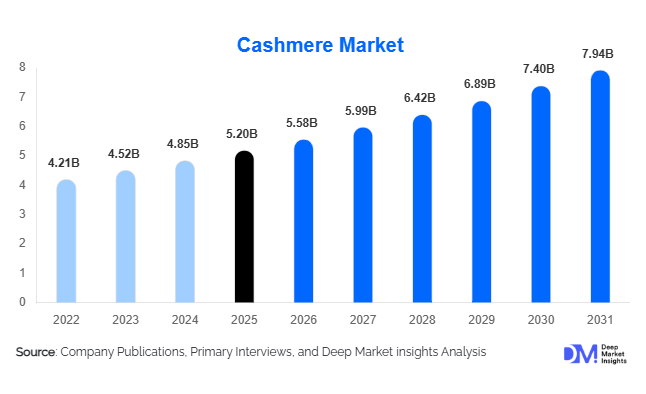
According to Deep Market Insights, the global cashmere market size was valued at USD 5.2 billion in 2025 and is projected to grow from USD 5.58 billion in 2026 to reach USD 7.94 billion by 2031, expanding at a CAGR of 7.3% during the forecast period (2026–2031). The cashmere market growth is primarily driven by rising global demand for luxury apparel, increasing consumer preference for premium natural fibers, and growing adoption of sustainable and traceable textile sourcing practices across the fashion industry.
Key Market Insights
- Sustainable and traceable cashmere sourcing is becoming a major purchasing criterion, particularly among luxury fashion consumers in Europe and North America.
- Luxury apparel continues to dominate global cashmere demand, with sweaters, scarves, and knitwear representing the largest product categories worldwide.
- Europe dominates the global cashmere market, led by Italy, France, and the United Kingdom due to strong luxury fashion manufacturing and premium retail consumption.
- Asia-Pacific is the fastest-growing regional market, supported by rising disposable incomes, expanding premium retail infrastructure, and increasing aspirational spending in China and India.
- Recycled cashmere and circular textile manufacturing are gaining momentum, driven by sustainability regulations and rising environmental awareness.
- Technological advancements in fiber processing and digital luxury retail are improving manufacturing efficiency, product traceability, and consumer engagement globally.
Cashmere Market Trends
Sustainable and Traceable Cashmere Gaining Momentum
The global cashmere industry is increasingly shifting toward sustainable and traceable sourcing models as consumers demand greater transparency regarding animal welfare, environmental impact, and ethical production practices. Luxury brands are investing heavily in blockchain-enabled traceability systems, regenerative grazing partnerships, and certified sustainable fiber sourcing programs to strengthen consumer trust and maintain premium positioning. Environmental concerns related to overgrazing and desertification in Mongolia and Inner Mongolia have accelerated industry-wide adoption of responsible livestock management practices. Several premium brands are also integrating carbon-neutral production initiatives and circular textile strategies to align with evolving ESG requirements. This sustainability-focused transition is reshaping supplier relationships, procurement strategies, and product differentiation across the cashmere value chain.
Growth of Accessible Luxury Cashmere Products
Cashmere products are increasingly expanding beyond ultra-luxury consumer segments into broader premium and accessible luxury categories. Direct-to-consumer business models, digital luxury retail platforms, and improved manufacturing efficiency are enabling brands to offer more affordable premium cashmere apparel without compromising product quality. Younger consumers, especially millennials and Gen Z demographics, are driving demand for lightweight knitwear, casual luxury apparel, and versatile wardrobe staples that combine comfort with status-oriented fashion. Brands are also introducing blended cashmere fabrics that improve durability and affordability while maintaining softness and thermal insulation. Social commerce, influencer marketing, and online luxury retail expansion are significantly improving market penetration across emerging economies and secondary urban markets globally.
Cashmere Market Drivers
Expansion of Global Luxury Fashion Industry
The continued growth of the global luxury fashion industry remains one of the strongest drivers supporting cashmere market expansion. Rising disposable income among affluent consumers in Asia-Pacific, North America, and the Middle East is fueling premium apparel demand across both established and emerging luxury markets. Cashmere products are increasingly positioned as essential premium wardrobe items due to their softness, exclusivity, insulation properties, and timeless aesthetic appeal. Luxury fashion houses continue to expand cashmere-based seasonal collections across men’s and women’s fashion segments, supporting strong long-term demand growth. Premium consumers are also demonstrating increased willingness to pay higher prices for authentic, sustainably sourced natural fibers.
Rising Consumer Preference for Sustainable Natural Fibers
Consumers globally are increasingly shifting away from synthetic textiles and fast fashion toward premium natural fibers that offer superior comfort, longevity, and sustainability credentials. Cashmere’s biodegradable nature, thermal insulation properties, and lightweight softness make it highly attractive within premium apparel and home textile categories. Governments and fashion regulators in Europe are also encouraging sustainable textile production through stricter environmental guidelines and circular economy initiatives. Luxury brands are responding by investing in recycled cashmere collections, eco-friendly dyeing technologies, and sustainable fiber certification systems. Growing consumer awareness regarding textile waste and environmental impact is therefore accelerating demand for responsibly produced cashmere products globally.
Cashmere Market Restraints
Raw Material Supply Volatility
The cashmere market remains highly dependent on raw fiber production concentrated in Mongolia and China, exposing the industry to supply chain vulnerabilities and price fluctuations. Climate variability, desertification, overgrazing, and livestock population instability continue to impact raw cashmere fiber availability and quality. Limited production capacity for ultra-fine Grade A cashmere further intensifies supply-demand imbalances, contributing to rising procurement costs for manufacturers. These raw material constraints can significantly affect operating margins, product pricing, and production planning across the value chain.
High Product Costs Limiting Mass Adoption
Pure cashmere products remain significantly more expensive than wool, cotton, and synthetic fiber alternatives due to limited raw material availability, labor-intensive processing, and premium brand positioning. Economic uncertainty, inflationary pressures, and reduced discretionary spending can therefore negatively impact demand within mid-premium and luxury apparel categories. Counterfeit cashmere products and low-quality blends also create reputational challenges for premium brands by reducing consumer confidence regarding authenticity and durability. These factors continue to restrict broader market penetration across price-sensitive consumer segments.
Cashmere Market Opportunities
Growth of Recycled Cashmere and Circular Fashion
The rising global emphasis on circular textile manufacturing is creating substantial opportunities for recycled cashmere products. Luxury brands and textile manufacturers are increasingly investing in fiber recycling technologies to reduce environmental impact, improve sustainability performance, and lower dependency on volatile raw fiber supplies. Recycled cashmere significantly reduces water consumption and greenhouse gas emissions compared to virgin fiber production. Several premium fashion houses are launching dedicated recycled cashmere collections to strengthen ESG positioning while maintaining product quality and luxury appeal. This trend is expected to create significant growth opportunities for sustainable textile processors, recycling technology providers, and eco-conscious fashion brands over the next decade.
Expansion of Premium Home Textile Applications
The increasing popularity of luxury home furnishing products is opening new growth avenues for the global cashmere market. Premium blankets, bedding products, throws, cushions, and upholstery fabrics are witnessing rising demand among high-income consumers seeking comfort-oriented luxury living experiences. Growth in luxury residential construction, boutique hospitality projects, and premium interior design trends is further supporting demand for cashmere-based home textile applications. Luxury hotels and wellness resorts are increasingly incorporating premium cashmere furnishings into guest experiences, creating additional revenue opportunities for manufacturers beyond traditional apparel segments.
Report Scope
| Report Metric | Details |
|---|---|
| Market Size in 2025 | USD 5.2 Billion |
| Market Size in 2026 | USD 5.58 Billion |
| Market Size in 2031 | USD 7.94 Billion |
| CAGR | 7.3% (2026-2031) |
| Base Year for Estimation | 2025 |
| Historical Data | 2022-2024 |
| Forecast Period | 2026-2031 |
| Report Coverage | Revenue Forecast, Competitive Landscape, Supply Chain Disruption, Growth Factors, Environment & Regulatory Landscape and Trends |
| Geographies Covered | North America, Europe, APAC, Middle East and Africa, LATAM |
| Countries Covered | U.S., Canada, U.K., Germany, France, Spain, Italy, Russia, Nordic, Benelux, Rest of Europe, China, Korea, Japan, India, Australia, Singapore, Taiwan, South East Asia, Rest of Asia-Pacific, UAE, Turky, Saudi Arabia, South Africa, Egypt, Nigeria, Rest of MEA, Brazil, Mexico, Argentina, Chile, Colombia, Rest of LATAM |
Explore more data points, trends and opportunities Download Free Sample Report
Product Type Insights
Cashmere apparel dominates the global market, accounting for the largest share of total revenue due to strong demand for sweaters, pullovers, knitwear, coats, and premium casualwear products. Sweaters and pullovers remain the leading product category because of their year-round fashion relevance and premium pricing potential. Cashmere accessories such as scarves, shawls, gloves, and hats continue witnessing steady demand growth due to their comparatively accessible price points and gifting appeal. The home textile segment is rapidly expanding as luxury consumers increasingly adopt cashmere blankets, cushions, and bedding products within premium interior design applications. Manufacturers are also introducing lightweight all-season cashmere apparel to broaden product applicability beyond winter-focused collections.
Fiber Composition Insights
100% pure cashmere products continue to dominate the premium luxury segment due to superior softness, insulation, and exclusivity. Consumers within ultra-premium markets increasingly prioritize authenticity and premium craftsmanship, enabling pure cashmere products to command significant pricing premiums. Cashmere-wool blends are gaining traction among accessible luxury consumers due to improved affordability and durability while maintaining desirable softness characteristics. Cashmere-silk and cashmere-cotton blends are also witnessing increasing adoption in lightweight luxury apparel applications suitable for year-round wear. Manufacturers are continuously innovating blended fiber technologies to balance performance, comfort, sustainability, and cost optimization across broader consumer segments.
Distribution Channel Insights
Offline retail channels continue to dominate the global cashmere market due to the importance of tactile product evaluation in luxury apparel purchasing decisions. Consumers often prefer physical interaction with cashmere products to assess softness, fit, texture, and craftsmanship before purchase. Luxury boutiques, department stores, and specialty fashion retailers therefore remain highly influential within premium cashmere sales. However, online retail channels are witnessing rapid growth driven by digital luxury commerce expansion, social media marketing, and direct-to-consumer business models. E-commerce platforms are increasingly integrating AI-powered personalization, virtual fitting tools, and sustainability transparency features to improve customer engagement and strengthen online premium apparel sales.
Consumer Insights
Women represent the largest consumer segment within the global cashmere market, supported by broader product diversity across knitwear, accessories, dresses, scarves, and luxury layering apparel. Female consumers also demonstrate higher engagement with seasonal luxury fashion trends and premium lifestyle spending. Millennials and Gen Z consumers are increasingly contributing to market growth through rising demand for accessible luxury products, minimalist premium fashion, and sustainable apparel collections. Older affluent demographics continue driving demand for ultra-premium pure cashmere products emphasizing exclusivity, durability, and timeless craftsmanship. Consumer preference is increasingly shifting toward versatile and lightweight cashmere products suitable for both professional and casual lifestyle applications.
Explore more data points, trends and opportunities Download Free Sample Report
Cashmere Market Segmentations
By Product Type
- Raw Cashmere Fiber
- Cashmere Yarn
- Cashmere Apparel
- Cashmere Accessories
- Cashmere Home Textiles
By Fiber Composition
- 100% Pure Cashmere
- Cashmere-Wool Blends
- Cashmere-Silk Blends
- Cashmere-Cotton Blends
- Cashmere-Synthetic Fiber Blends
By Distribution Channel
- Offline Retail
- Brand-Owned Stores
- Department Stores
- Luxury Multi-Brand Retailers
- Online Retail
- Direct-to-Consumer Platforms
By End-Use Industry
- Luxury Fashion Industry
- Premium Apparel Industry
- Home Furnishing Industry
- Corporate Gifting & Hospitality
- Travel & Aviation Luxury Products
Regional Insights
North America
North America remains one of the largest premium cashmere consumption regions globally, led by the United States and Canada. Strong luxury retail infrastructure, rising online premium apparel sales, and increasing consumer preference for sustainable natural fibers continue supporting regional market expansion. The United States represents one of the largest importers of premium cashmere apparel and accessories globally. Consumers across the region increasingly prioritize ethical sourcing, sustainability certifications, and long-lasting luxury apparel investments. Growth in direct-to-consumer luxury brands and digital fashion retail is further accelerating cashmere product accessibility within North America.
Europe
Europe dominates the global cashmere market, accounting for the largest regional market share due to the concentration of luxury fashion brands, premium textile manufacturing expertise, and affluent consumer bases. Italy serves as the global hub for luxury cashmere craftsmanship and high-end knitwear production, supported by advanced textile processing infrastructure and internationally recognized fashion houses. France, the United Kingdom, Germany, and Switzerland also represent major consumption markets driven by strong luxury retail spending and premium fashion demand. European consumers demonstrate high preference for sustainable and traceable cashmere products, encouraging widespread adoption of certified sourcing standards and circular textile manufacturing practices.
Asia-Pacific
Asia-Pacific is emerging as the fastest-growing regional market for cashmere products, supported by rapidly expanding middle-class wealth, premium retail penetration, and aspirational luxury consumption. China remains both the largest producer and one of the largest consumers of cashmere globally due to its extensive manufacturing ecosystem and rising domestic luxury demand. Mongolia continues to play a critical role in global raw fiber supply chains. India is witnessing rising demand for premium apparel among urban upper-middle-class consumers, while Japan and South Korea maintain strong demand for minimalist luxury knitwear and ultra-premium fashion products. Expanding e-commerce penetration and social commerce adoption are further accelerating regional market growth.
Latin America
Latin America represents a developing market for premium cashmere products, led primarily by Brazil and Mexico. Rising awareness regarding luxury fashion, improving online retail accessibility, and growing upper-income consumer populations are supporting gradual demand expansion across the region. Consumers increasingly favor premium imported knitwear and accessories, particularly within metropolitan luxury retail centers. International luxury brands are also expanding digital outreach and premium retail partnerships to strengthen regional market presence.
Middle East & Africa
The Middle East is emerging as an important luxury cashmere consumption market driven by high-income consumers and strong demand for premium fashion products in the UAE, Saudi Arabia, and Qatar. Luxury malls, designer boutiques, and expanding high-end hospitality sectors are supporting regional growth. Affluent consumers in Gulf countries demonstrate strong preference for exclusive premium apparel and winter luxury accessories. Africa continues to contribute indirectly through raw material supply chains and growing luxury retail investments in select urban markets such as South Africa.
Key Players in the Cashmere Market
- Loro Piana
- Brunello Cucinelli
- Ermenegildo Zegna
- Burberry Group
- Pringle of Scotland
- Malo Cashmere
- Ballantyne
- Autumn Cashmere
- N.Peal
- Falconeri