Global Brownie Mixes Market Size
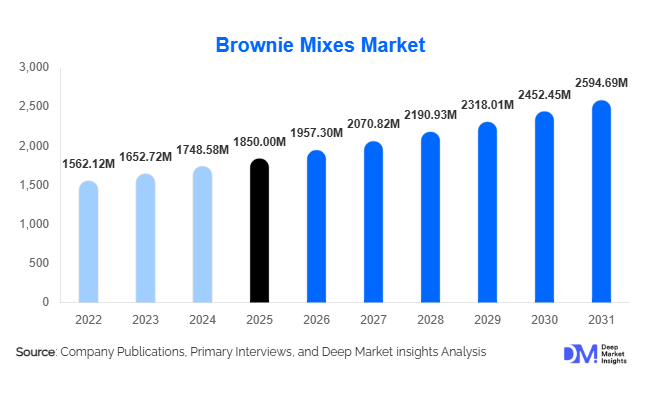
According to Deep Market Insights, the global brownie mixes market size was valued at USD 1,850 million in 2026 and is projected to grow from USD 1,957.30 million in 2026 to reach USD 2,594.69 million by 2031, expanding at a CAGR of 5.8% during the forecast period (2026–2031). The market growth is primarily driven by rising demand for convenient home baking solutions, increasing consumer preference for clean-label and functional dessert mixes, and the rapid expansion of online grocery and direct-to-consumer baking brands across global markets.
Key Market Insights
- Convenience-led baking continues to dominate consumer behavior, with brownie mixes gaining popularity due to easy preparation, consistency, and time-saving benefits.
- Health-oriented innovation is reshaping product development, with gluten-free, vegan, keto, and protein-enriched mixes gaining strong traction in premium segments.
- North America remains the largest regional market, driven by strong home baking culture and high penetration of packaged food products.
- Asia-Pacific is the fastest-growing region, supported by urbanization, rising disposable incomes, and growing adoption of Western dessert formats.
- E-commerce and D2C channels are transforming distribution, enabling niche brands to scale rapidly without traditional retail dependency.
- Foodservice demand is expanding steadily, particularly from cafés, bakeries, and QSR chains seeking standardized and cost-efficient dessert solutions.
Global Brownie Mixes Market Latest Trends
Shift Toward Functional and Health-Focused Baking Mixes
The market is witnessing a strong shift toward functional brownie mixes designed for health-conscious consumers. Demand for gluten-free, low-sugar, keto-friendly, and protein-enriched variants is increasing significantly across North America and Europe. Consumers are actively seeking indulgent yet healthier alternatives, pushing manufacturers to reformulate traditional products using natural sweeteners, plant-based flours, and clean-label ingredients. This trend is also enabling premiumization, allowing brands to command higher price points and improve margins.
Rapid Expansion of E-Commerce and Direct-to-Consumer Brands
Online retail is becoming one of the most influential growth drivers in the brownie mixes market. E-commerce platforms and D2C baking brands are reshaping purchasing behavior by offering wider product variety, subscription-based baking kits, and personalized recommendations. Social media marketing and influencer-driven baking content are significantly increasing product visibility. Emerging markets such as India and Southeast Asia are experiencing particularly strong online penetration, allowing brands to bypass traditional retail constraints and expand rapidly.
Global Brownie Mixes Market Drivers
Rising Demand for Convenient Home Baking Solutions
The growing preference for convenient cooking solutions is a primary driver of the brownie mixes market. Busy lifestyles, increasing dual-income households, and rising interest in at-home culinary experiences have boosted demand for easy-to-prepare baking mixes. Brownie mixes offer consistent quality with minimal preparation effort, making them highly attractive to both novice and experienced home bakers. Seasonal baking trends during festivals and celebrations further support recurring demand across global households.
Growing Preference for Premium and Clean-Label Products
Consumers are increasingly prioritizing ingredient transparency and product quality, driving demand for clean-label brownie mixes. Organic certification, non-GMO ingredients, and natural cocoa-based formulations are becoming key purchasing factors. This shift is particularly strong in developed markets where health awareness is high. Manufacturers are responding with premium product lines that emphasize sustainability, ethical sourcing, and nutritional enhancements, thereby expanding the value-added segment of the market.
Global Brownie Mixes Market Restraints
Rising Raw Material Price Volatility
The market is highly dependent on agricultural commodities such as cocoa, wheat, sugar, and dairy derivatives. Fluctuations in global supply chains, climate conditions, and geopolitical disruptions often lead to price instability. These cost pressures directly impact manufacturer margins, especially for mid-tier and small-scale producers who have limited pricing flexibility. Packaging material inflation further adds to overall production costs.
Strong Competition from Ready-to-Eat Desserts
The increasing availability of ready-to-eat bakery products and fresh desserts from cafés and supermarkets presents a significant challenge to brownie mix adoption. Many consumers prefer fully prepared desserts that eliminate cooking effort entirely. This competition is particularly strong in urban markets where food delivery services and bakery chains are widely accessible, limiting growth potential for traditional baking mix products.
Global Brownie Mixes Industry Key Opportunities
Expansion of Functional and Dietary-Specific Product Lines
The rising prevalence of dietary restrictions and health-focused lifestyles presents a major opportunity for manufacturers. Brownie mixes tailored for gluten-free, vegan, diabetic-friendly, and high-protein diets are gaining strong demand. Companies investing in functional nutrition and ingredient innovation can capture premium pricing opportunities and differentiate themselves in a competitive market landscape.
Growth in Emerging Markets and Urban Baking Culture
Emerging economies in Asia-Pacific, Latin America, and the Middle East are experiencing rapid urbanization and increasing exposure to Western-style desserts. This is driving strong demand for packaged baking solutions. Rising disposable incomes and expanding supermarket penetration are further supporting category growth. Localization of flavors and region-specific product adaptations are expected to significantly enhance market penetration.
Report Scope
| Report Metric | Details |
|---|---|
| Market Size in 2025 | USD 1850.00 Million |
| Market Size in 2026 | USD 1957.30 Million |
| Market Size in 2031 | USD 2594.69 Million |
| CAGR | 5.8% (2026-2031) |
| Base Year for Estimation | 2025 |
| Historical Data | 2022-2024 |
| Forecast Period | 2026-2031 |
| Report Coverage | Revenue Forecast, Competitive Landscape, Supply Chain Disruption, Growth Factors, Environment & Regulatory Landscape and Trends |
| Geographies Covered | North America, Europe, APAC, Middle East and Africa, LATAM |
| Countries Covered | U.S., Canada, U.K., Germany, France, Spain, Italy, Russia, Nordic, Benelux, Rest of Europe, China, Korea, Japan, India, Australia, Singapore, Taiwan, South East Asia, Rest of Asia-Pacific, UAE, Turky, Saudi Arabia, South Africa, Egypt, Nigeria, Rest of MEA, Brazil, Mexico, Argentina, Chile, Colombia, Rest of LATAM |
Explore more data points, trends and opportunities Download Free Sample Report
Product Type Insights
Conventional brownie mixes continue to dominate the global market, primarily driven by their affordability, strong brand penetration, ease of preparation, and consistent taste profiles that appeal to a broad consumer base. Their widespread retail availability and long-standing consumer familiarity further reinforce their leadership position across both developed and emerging markets. However, the product landscape is steadily diversifying as health and wellness trends reshape consumer preferences. Gluten-free and organic variants are witnessing strong adoption, especially in North America and Europe, where clean-label expectations, dietary sensitivities, and premiumization of everyday food products are key demand drivers. Vegan and protein-enriched brownie mixes are emerging as high-growth subsegments, supported by the increasing shift toward plant-based diets, fitness-oriented consumption, and functional nutrition. Keto and low-carb variants remain relatively niche but are gaining traction in premium retail channels, fueled by rising interest in specialized diets and weight management-oriented consumption patterns. Overall, continuous innovation across ingredients, nutritional profiles, and dietary positioning is intensifying competition while expanding the overall value of the category.
Distribution Channel Insights
Supermarkets and hypermarkets remain the dominant distribution channels, supported by strong product visibility, attractive promotional pricing, and the ability to offer wide brand assortments under one roof, which significantly influences impulse and planned purchases. These outlets continue to serve as the primary access point for mainstream consumers seeking convenience and trusted brands. At the same time, online retail has emerged as the fastest-growing channel, driven by increasing digital adoption, doorstep delivery convenience, broader product assortment availability, and the rapid expansion of direct-to-consumer strategies adopted by emerging baking brands. The growth of e-commerce is further supported by subscription models and targeted digital marketing that enhance consumer engagement. Specialty health food stores are gaining relevance in the premium and functional product segment, where consumers seek organic, gluten-free, and clean-label alternatives with higher product assurance. Foodservice channels are also expanding steadily as cafés, bakeries, and quick-service restaurants increasingly adopt standardized brownie mixes to ensure consistency, reduce preparation time, and maintain cost efficiency while scaling dessert offerings.
End-Use Insights
Household consumption represents the largest end-use segment, primarily driven by the rising culture of home baking, increased experimentation with desserts, and strong influence from social media platforms that promote easy-to-make recipes and at-home baking trends. The accessibility of baking mixes and the growing preference for convenient yet indulgent homemade desserts further strengthen this segment’s dominance. Foodservice is the fastest-growing end-use segment, as cafés, bakeries, and quick-service restaurants increasingly rely on brownie mixes to ensure consistent product quality, operational efficiency, and standardized preparation across multiple outlets, while also enabling menu innovation with minimal complexity. Industrial usage, though comparatively smaller, remains stable and is supported by demand from packaged dessert manufacturers and frozen bakery producers that require scalable, cost-efficient, and standardized ingredients to maintain uniformity in mass production environments.
Explore more data points, trends and opportunities Download Free Sample Report
Brownie Mixes Market Segmentations
By Product Type
- Conventional Brownie Mixes
- Gluten-Free Brownie Mixes
- Organic & Clean-Label Brownie Mixes
- Vegan Brownie Mixes
- Protein-Enriched / Functional Brownie Mixes
- Keto / Low-Carb Brownie Mixes
By Distribution Channel
- Supermarkets & Hypermarkets
- Convenience Stores
- Online Retail / E-commerce Platforms
- Specialty & Health Food Stores
- Foodservice / Institutional Supply (B2B)
By Packaging Type
- Box Packaging
- Pouch Packaging
- Bulk / Institutional Packs
By Flavor Type
- Classic Chocolate Fudge Brownie Mix
- Double Chocolate Brownie Mix
- Nut-Based (Walnut, Almond) Brownie Mix
- Caramel / Swirl Variants
- Seasonal & Specialty Flavors
By End Use
- Household / Residential Consumption
- Foodservice
- Industrial / Packaged Dessert Manufacturing
Regional Insights
North America
North America leads the global market, supported by a deeply rooted home baking culture, high consumer awareness, and extensive retail penetration of branded baking products. The United States accounts for the majority of regional demand, driven by strong consumption of convenience-based baking solutions and continuous product innovation across premium categories. Growth in the region is further reinforced by increasing demand for gluten-free, keto-friendly, and protein-enriched mixes, reflecting the strong influence of health-conscious consumption patterns and dietary customization. The expansion of e-commerce channels and well-established retail infrastructure further enhance product accessibility, while brand innovation and seasonal product launches continue to stimulate repeat purchases and category growth.
Europe
Europe holds a significant share of the global market, with key contributions from the United Kingdom, Germany, and France. The region’s growth is strongly influenced by clean-label preferences, organic food demand, and heightened awareness of ingredient transparency. Western Europe represents a mature market characterized by premium product adoption and strong preference for sustainable and ethically sourced ingredients. In contrast, Eastern Europe is witnessing steady growth driven by rising disposable incomes, increasing urbanization, and expanding penetration of packaged and convenience food products. The growing emphasis on artisanal-style baking at home, combined with strong retail modernization, continues to support sustained market expansion across the region.
Asia-Pacific
Asia-Pacific is the fastest-growing regional market, fueled by rapid urbanization, rising disposable incomes, and the increasing influence of Western dessert culture. Countries such as India and China serve as major growth engines, driven by expanding middle-class populations, growing preference for convenient baking solutions, and the rapid development of organized retail and online grocery platforms. The proliferation of e-commerce and quick-commerce ecosystems is significantly improving product accessibility across urban centers. Meanwhile, Japan and South Korea exhibit stable demand for premium and high-quality dessert mixes, supported by strong café culture and consumer preference for innovative and aesthetically appealing food experiences. Overall, the region’s growth is anchored in lifestyle shifts, digital retail expansion, and evolving culinary preferences.
Latin America
Latin America is gradually expanding, with Brazil and Mexico representing the key demand centers. Market growth is supported by increasing urbanization, evolving dietary habits, and rising exposure to global food and dessert trends through media and travel. The expanding middle-class population is driving higher adoption of convenient baking solutions, while modern retail expansion is improving product availability across urban and semi-urban areas. Premium imported baking mixes are gaining traction among urban consumers, particularly in major metropolitan regions where demand for indulgent and convenient dessert options is increasing steadily.
Middle East & Africa
The Middle East & Africa region is witnessing steady growth, supported by strong demand from high-income consumer bases in GCC countries and the rapid expansion of café and hospitality culture. The United Arab Emirates and Saudi Arabia remain key markets, driven by tourism, urban lifestyle development, and a growing preference for premium and convenience-oriented food products. In Africa, South Africa leads regional demand due to relatively developed retail infrastructure and increasing adoption of packaged and convenience-based bakery products. Across the region, growth is further supported by retail modernization, rising expatriate populations, and increasing exposure to international dessert trends.
Competitive Landscape
The global brownie mixes market is moderately consolidated, with the top 5 players accounting for approximately 44.8% of global market share in 2025. Major players compete on product innovation, pricing strategies, and distribution strength. The market is dominated by FMCG giants alongside strong specialty baking brands focusing on premium and clean-label segments. Increasing private-label penetration from retail chains is intensifying price competition, particularly in developed markets. Over recent years, companies have focused heavily on portfolio diversification, introducing functional, organic, and indulgence-focused brownie mix variants to capture evolving consumer preferences.
Key Players in the Global Brownie Mixes Market
- General Mills Inc.
- The Kraft Heinz Company
- Conagra Brands Inc.
- King Arthur Baking Company
- Dr. Oetker
- Nestlé S.A.
- Hershey Company
- Bob’s Red Mill Natural Foods
- Ghirardelli Chocolate Company
- Unilever
- Barry Callebaut
- Archer Daniels Midland Company
- Duncan Hines
- Betty Crocker
- Pillsbury