Birthday Cakes Market Size
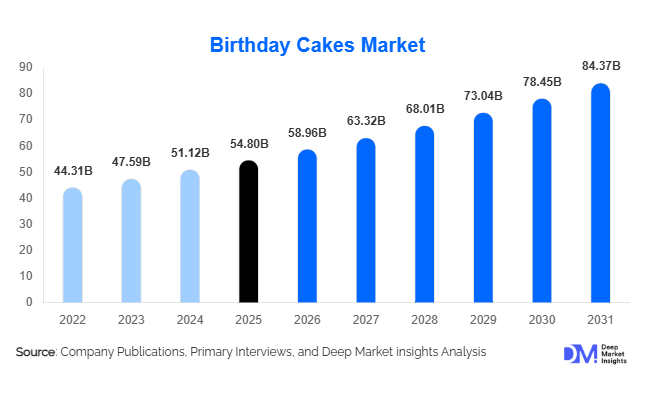
According to Deep Market Insights, the global birthday cakes market size was valued at USD 54.8 billion in 2025 and is projected to grow from USD 58.96 billion in 2026 to reach USD 84.37 billion by 2031, expanding at a CAGR of 7.4% during the forecast period (2026–2031). Growth in the birthday cakes market is primarily driven by rising celebration culture across both developed and emerging economies, increasing demand for customized and premium cakes, and rapid expansion of online bakery delivery platforms. Urbanization, higher disposable incomes, and evolving consumer preferences toward themed celebrations and experiential gifting continue to reshape purchasing behavior globally.
Key Market Insights
- Customization and personalization trends are transforming birthday cakes into experience-driven products, with demand for designer, photo, and theme-based cakes increasing globally.
- Online ordering and quick-commerce bakery delivery are expanding market accessibility, particularly in urban and tier-2 cities.
- Asia-Pacific dominates global demand, supported by large population bases and increasing celebration spending.
- Premium and artisanal cakes are the fastest-growing category, driven by millennials and Gen Z consumers.
- Health-conscious formulations, including eggless, vegan, and low-sugar cakes, are expanding consumer reach.
- Retail bakery chains and cloud kitchens are reshaping distribution channels through scalable production models.
What are the latest trends in the birthday cakes market?
Personalized and Theme-Based Cakes Becoming Mainstream
The birthday cakes market has transitioned from standardized bakery products to highly customized celebration solutions. Consumers increasingly demand cakes aligned with personal interests, including cartoon themes, corporate branding, gaming motifs, and luxury aesthetics. Social media platforms play a critical role in influencing cake design trends, encouraging visually appealing creations optimized for digital sharing. Bakeries are investing in edible printing technologies, fondant artistry, and 3D cake sculpting capabilities to meet rising expectations. Premium pricing associated with customized cakes has significantly improved profit margins for bakeries, making personalization a key revenue driver.
Technology-Driven Ordering and Delivery Ecosystems
Digital transformation is reshaping the birthday cakes industry through mobile applications, AI-based recommendation engines, and hyperlocal delivery networks. Online platforms enable consumers to schedule deliveries, customize flavors, and visualize designs before purchase. Same-day and midnight delivery services have emerged as major differentiators, particularly in urban markets. Cloud kitchens dedicated to celebration desserts are scaling rapidly, allowing brands to expand geographically without heavy retail infrastructure investments. Integration of digital payments and subscription-based celebration reminders is further increasing repeat purchases.
What are the key drivers in the birthday cakes market?
Rising Celebration Culture and Social Occasions
Global consumer spending on celebrations has expanded significantly, supported by lifestyle shifts emphasizing experiences and social bonding. Birthdays are increasingly celebrated across all age groups, including adults and seniors, expanding the addressable market. Corporate birthday celebrations and workplace culture have also contributed to institutional demand. Emerging economies are witnessing higher adoption of Western-style celebrations, further driving cake consumption volumes.
Growth of Organized Bakery Chains
The expansion of organized bakery franchises and premium dessert brands has improved product availability and quality consistency. Large bakery chains benefit from centralized production, efficient supply chains, and strong branding, allowing them to capture urban consumers seeking reliable quality. Franchise expansion models are enabling penetration into smaller cities, supporting overall market growth.
Premiumization and Product Innovation
Consumers increasingly prefer premium ingredients such as Belgian chocolate, organic dairy, exotic fruits, and gourmet fillings. Fusion flavors combining regional tastes with international styles are gaining popularity. Innovations such as pull-me cakes, pinata cakes, and interactive designs have significantly increased average selling prices, contributing positively to revenue growth.
What are the restraints for the global market?
Perishability and Supply Chain Constraints
Birthday cakes require controlled storage and rapid logistics due to limited shelf life. Transportation challenges, temperature sensitivity, and last-mile delivery risks increase operational costs. Smaller bakeries face difficulties maintaining consistent quality during expansion, limiting scalability.
Volatility in Raw Material Prices
Fluctuations in prices of sugar, dairy products, cocoa, and wheat directly impact bakery profit margins. Inflationary pressures often force bakeries to adjust pricing frequently, which may affect consumer demand in price-sensitive markets.
What are the key opportunities in the birthday cakes industry?
Expansion of Health-Conscious Cake Variants
Demand for vegan, gluten-free, sugar-free, and allergen-friendly cakes is growing rapidly as consumers prioritize health without compromising celebrations. Bakeries introducing functional ingredients such as plant-based proteins and natural sweeteners can tap into new consumer segments including diabetics and fitness-focused buyers.
Emerging Market Urbanization
Rapid urban expansion in countries such as India, Indonesia, Vietnam, and Brazil is creating strong demand for organized bakery products. Rising middle-class populations and increasing adoption of digital commerce platforms enable bakery brands to scale efficiently in previously underserved markets.
Corporate and Institutional Celebration Services
Businesses increasingly outsource celebration management, including employee birthdays and corporate events. Subscription-based cake delivery contracts present recurring revenue opportunities for bakery chains and cloud kitchens.
Report Scope
| Report Metric | Details |
|---|---|
| Market Size in 2025 | USD 54.8 Billion |
| Market Size in 2026 | USD 58.96 Billion |
| Market Size in 2031 | USD 84.37 Billion |
| CAGR | 7.4% (2026-2031) |
| Base Year for Estimation | 2025 |
| Historical Data | 2022-2024 |
| Forecast Period | 2026-2031 |
| Report Coverage | Revenue Forecast, Competitive Landscape, Supply Chain Disruption, Growth Factors, Environment & Regulatory Landscape and Trends |
| Geographies Covered | North America, Europe, APAC, Middle East and Africa, LATAM |
| Countries Covered | U.S., Canada, U.K., Germany, France, Spain, Italy, Russia, Nordic, Benelux, Rest of Europe, China, Korea, Japan, India, Australia, Singapore, Taiwan, South East Asia, Rest of Asia-Pacific, UAE, Turky, Saudi Arabia, South Africa, Egypt, Nigeria, Rest of MEA, Brazil, Mexico, Argentina, Chile, Colombia, Rest of LATAM |
Explore more data points, trends and opportunities Download Free Sample Report
Product Type Insights
The global birthday cakes market demonstrates significant diversification across product types, reflecting evolving consumer expectations surrounding celebration experiences, personalization, and premium dessert consumption. Among all product categories, customized designer cakes have emerged as the dominant segment, accounting for approximately 34% of global market share in 2025. The leadership of this segment is primarily driven by the growing cultural emphasis on personalization in celebrations, where consumers increasingly seek unique visual aesthetics, thematic designs, and tailored flavor combinations that reflect individual identity, age milestones, or social media trends. The expansion of social media platforms has played a transformative role in shaping consumer expectations, encouraging visually appealing cakes that serve not only as desserts but also as centerpiece experiences for celebrations.The leading segment driver for customized designer cakes lies in rising consumer willingness to pay premium prices for personalization and experiential value. Consumers perceive customized cakes as symbolic representations of celebrations rather than standard food purchases, enabling bakeries to command higher margins through artistic craftsmanship, edible printing technologies, and advanced decoration techniques such as fondant sculpting and hand-painted finishes. The proliferation of online customization tools has further accelerated segment expansion by allowing customers to design cakes digitally before purchase, thereby enhancing engagement and purchase confidence.Photo cakes represent another rapidly expanding category, fueled by advancements in edible printing technology and consumer demand for hyper-personalized celebration elements. These cakes are particularly popular among younger consumers and urban families seeking innovative presentation formats. The affordability and quick production timelines associated with photo cakes make them attractive options for last-minute celebrations, contributing to their widespread adoption across emerging markets.Fondant cakes, traditionally associated with premium celebrations, weddings, and milestone birthdays, are witnessing growing adoption beyond luxury segments. Improvements in fondant texture, flavor integration, and lighter formulations have addressed earlier consumer concerns regarding taste, enabling broader acceptance. The segment benefits from increasing demand for elaborate thematic designs, including cartoon characters, corporate branding, and artistic sculptural creations.Overall, product diversification reflects a broader shift toward experiential consumption, premiumization, and customization-driven purchasing behavior. Bakeries and manufacturers increasingly invest in innovation, design capabilities, and digital ordering platforms to meet evolving consumer expectations while maintaining operational scalability.
Flavor Insights
Flavor preferences within the birthday cakes market continue to evolve alongside changing consumer tastes, cultural influences, and premium dessert trends. Chocolate flavor remains the leading segment globally, accounting for nearly 29% of total market demand in 2025. The primary driver behind chocolate’s leadership lies in its cross-generational appeal and adaptability across both premium and mass-market offerings. Chocolate serves as a universally accepted flavor that minimizes purchase risk for consumers selecting cakes for group celebrations, where satisfying diverse taste preferences is essential.The leading segment driver for chocolate cakes is their versatility across formats and price categories. Chocolate pairs effectively with various fillings such as mousse, ganache, caramel, nuts, and fruit layers, enabling bakeries to continuously innovate while maintaining consumer familiarity. Additionally, premium cocoa sourcing, dark chocolate variants, and artisanal chocolate craftsmanship contribute to the expansion of high-value product offerings within this segment.Vanilla flavor maintains strong demand due to its neutrality and adaptability for customization. Vanilla cakes often serve as foundational bases for themed decorations, colored frosting, and layered flavor combinations. Their mild taste profile makes them particularly suitable for children’s celebrations and culturally diverse markets where less intense flavors are preferred. Furthermore, vanilla cakes are widely used for eggless and dietary-specific formulations, supporting demand growth in regions with specific dietary traditions.Fusion flavors are among the fastest-growing categories, reflecting ongoing premiumization trends within the global dessert industry. Varieties such as red velvet, blueberry cheesecake, tiramisu-inspired cakes, matcha-infused desserts, and coffee-flavored creations appeal strongly to urban consumers seeking novelty and sophistication. These flavors often command higher price points due to perceived exclusivity and gourmet positioning.Flavor innovation increasingly incorporates global culinary influences, enabling cross-cultural experimentation that expands consumer choice. Limited-edition flavors, collaboration-based recipes, and seasonal launches help brands maintain consumer engagement while encouraging repeat purchases. As consumer palates become more adventurous, bakeries continue investing in research and development to introduce differentiated flavor profiles that enhance brand competitiveness.
Distribution Channel Insights
Distribution dynamics within the birthday cakes market have undergone significant transformation as digital commerce reshapes purchasing behavior. Retail bakery chains remain the dominant distribution channel, accounting for approximately 41% of global sales in 2025. Their leadership is supported by strong brand recognition, physical product visibility, and consumer trust associated with freshness and quality assurance. Established bakery chains benefit from standardized production processes, consistent product quality, and strategic urban locations that attract walk-in customers.The leading segment driver for retail bakery dominance is consumer preference for immediate product inspection and assurance of freshness during celebratory purchases. Birthdays represent emotionally significant occasions, encouraging consumers to rely on trusted physical outlets where customization requests and consultations can occur directly with bakers. Additionally, in-store displays stimulate impulse purchases and upselling opportunities through visual merchandising.Online delivery platforms represent the fastest-growing distribution channel, expanding at double-digit growth rates globally. The growth of this segment is driven by convenience, digital customization interfaces, real-time order tracking, and flexible delivery scheduling. Consumers increasingly value the ability to order cakes remotely, particularly for surprise celebrations or long-distance gifting. Integration with mobile applications and digital payment systems has further simplified purchasing processes.Third-party food delivery aggregators and specialized bakery platforms have played a crucial role in expanding market reach for small and medium-sized bakeries. These platforms provide access to wider customer bases without requiring significant investment in physical storefront expansion. AI-driven recommendation systems and personalized marketing campaigns enhance customer engagement and encourage repeat ordering behavior.Supermarkets and hypermarkets also contribute significantly to market distribution by offering affordable ready-made cakes targeting price-sensitive consumers. While customization options remain limited within this channel, convenience and competitive pricing attract high-volume purchases, particularly in emerging economies.The convergence of offline and online channels is creating an omnichannel ecosystem where consumers seamlessly switch between physical store visits and digital ordering. Bakeries increasingly adopt hybrid models combining storefront presence with online platforms to maximize market penetration and customer convenience.
End-Use Insights
End-use analysis highlights the central role of household celebrations in sustaining global birthday cake demand. Household consumption accounts for nearly 62% of market share, reflecting the deeply rooted cultural importance of family-centered birthday celebrations across regions. The leading segment driver for household dominance is the emotional and social significance associated with birthdays, which continue to be celebrated primarily within family environments regardless of economic conditions.Increasing disposable incomes, smaller family units, and rising emphasis on experiential celebrations have encouraged households to invest in premium cakes even for intimate gatherings. Parents increasingly prioritize themed cakes for children’s birthdays, while adult celebrations emphasize aesthetic appeal and gourmet flavors, contributing to higher per-event spending.Commercial end-use segments, including offices, educational institutions, restaurants, and event organizers, are expanding rapidly. Workplace culture trends emphasizing employee engagement, recognition programs, and team celebrations are contributing to growing corporate cake demand. Companies frequently order customized cakes for employee birthdays, anniversaries, and organizational milestones, creating recurring revenue opportunities for bakeries.Event management companies and hospitality venues increasingly incorporate customized cakes into packaged celebration services, further expanding commercial demand. Growth in organized celebrations, particularly in urban areas, supports consistent order volumes and bulk purchasing patterns.The diversification of end-use applications demonstrates how birthday cakes have evolved from traditional household desserts into broader celebration products integrated across social, corporate, and institutional settings.
Explore more data points, trends and opportunities Download Free Sample Report
Birthday Cakes Market Segmentations
By Product Type
- Sponge Birthday Cakes
- Cream-Based Cakes
- Fondant & Designer Cakes
- Ice Cream Birthday Cakes
- Cheesecakes
- Vegan & Gluten-Free Cakes
- Photo & Customized Theme Cakes
By Flavor Type
- Chocolate
- Vanilla
- Fruit-Based Flavors
- Red Velvet
- Butterscotch
- Fusion & Specialty Flavors
By Distribution Channel
- Online Bakery Platforms & Apps
- Retail & Independent Bakeries
- Supermarkets & Hypermarkets
- Café & QSR Chains
- Home-Based Bakers & Cloud Kitchens
By End-User
- Household Consumers
- Commercial Party & Event Organizers
- Corporate Celebrations
- Hotels, Restaurants & Hospitality Sector
Regional Insights
Asia-Pacific
Asia-Pacific holds the largest share of the global birthday cakes market, accounting for nearly 38% of total demand in 2025. The region’s leadership is supported by large population bases, rapid urbanization, expanding middle-class income levels, and increasing westernization of celebration practices. China and India represent the primary growth engines, driven by demographic scale and rising adoption of modern retail and digital commerce platforms.Regional growth is strongly influenced by changing lifestyle patterns, increased exposure to global food trends, and the rapid expansion of online bakery startups. In India, demand for eggless cakes has grown significantly due to dietary preferences and cultural considerations, encouraging innovation among bakeries to develop high-quality alternatives without compromising taste or texture. The expansion of food delivery applications and social media-driven marketing has accelerated consumer awareness of premium cake options.Southeast Asian markets, including Indonesia, Thailand, and Vietnam, are experiencing rising adoption of premium and customized cakes as disposable incomes increase and younger populations embrace celebration-centric lifestyles. Urban consumers increasingly associate birthdays with experiential spending, driving demand for designer cakes and fusion flavors. Rapid growth in organized retail infrastructure and digital payments further strengthens regional market expansion.Additionally, favorable demographic trends, including a large youth population and growing urban households, support sustained long-term growth. Increasing female workforce participation and busy lifestyles encourage reliance on ready-made celebration solutions, reinforcing demand for professionally baked cakes.
North America
North America accounts for approximately 24% of the global birthday cakes market, led primarily by the United States and supported by Canada’s stable consumer demand. Regional growth is driven by high consumer spending power, strong franchise bakery networks, and continuous product innovation within premium dessert categories.A key regional growth driver is the deeply embedded celebration culture that emphasizes themed parties and customized experiences. Consumers frequently invest in personalized cakes reflecting hobbies, entertainment franchises, and milestone achievements. High adoption of online ordering and same-day delivery services further strengthens market accessibility and convenience.The presence of established bakery franchises and specialty dessert brands ensures consistent product availability and innovation cycles. Health-conscious consumer trends are also shaping market evolution, with growing demand for gluten-free, vegan, low-sugar, and organic cake options. Technological integration, including AI-driven customization platforms and automated production systems, enhances operational efficiency and scalability.Additionally, strong gifting culture and corporate celebrations contribute to recurring demand across commercial segments, ensuring stable regional growth despite market maturity.
Europe
Europe represents a mature yet high-value market characterized by strong artisanal baking traditions and premium patisserie culture. Countries such as Germany, the United Kingdom, France, and Italy demonstrate consistent demand driven by quality-focused consumers who prioritize craftsmanship and ingredient authenticity.Regional growth is supported by rising demand for premium desserts made with organic, locally sourced, and sustainable ingredients. European consumers increasingly favor smaller, high-quality cakes over mass-produced options, enabling artisanal bakeries to maintain competitive advantages. Vegan and plant-based cakes are particularly popular across Western Europe, reflecting broader sustainability and ethical consumption trends.The expansion of café culture and boutique bakeries across urban centers supports market innovation and product differentiation. Seasonal celebrations and regional festivals also contribute to year-round cake consumption beyond birthdays alone, strengthening overall demand stability.Regulatory emphasis on food quality standards and transparency further enhances consumer trust, encouraging premium purchasing behavior and supporting higher average selling prices across the region.
Middle East & Africa
The Middle East & Africa region is witnessing accelerating growth driven by urbanization, rising disposable incomes, and increasing adoption of western-style celebrations. The Middle East, particularly the United Arab Emirates and Saudi Arabia, demonstrates strong demand for luxury designer cakes characterized by elaborate decorations and premium ingredients.Regional growth drivers include high per-capita celebration spending, strong gifting traditions, and expanding hospitality sectors. Luxury malls, café chains, and premium bakeries play a significant role in shaping consumer preferences toward visually sophisticated cakes suitable for social gatherings and large celebrations.In Africa, market growth is supported by expanding urban bakery infrastructure in countries such as South Africa, Kenya, and Nigeria. Rising youth populations and improving retail ecosystems are encouraging adoption of modern celebration practices. Affordable customized cakes are gaining popularity as local bakeries introduce accessible pricing strategies to attract middle-income consumers.Improvements in cold-chain logistics, retail expansion, and entrepreneurial bakery startups are expected to further accelerate regional market development over the forecast period.
Latin America
Latin America demonstrates strong cultural alignment with celebration-driven consumption patterns, making birthday cakes an integral component of social gatherings. Brazil and Mexico dominate regional demand due to large populations and deeply rooted family celebration traditions.Regional growth is fueled by expanding supermarket bakery sections and increasing availability of affordable customized cake options. Consumers in the region prioritize value-driven purchases while maintaining demand for decorative and themed cakes. Economic recovery trends and rising urbanization contribute to improved consumer spending on celebratory products.The growing influence of social media and digital ordering platforms is encouraging younger consumers to explore personalized cake designs, driving gradual premiumization across urban markets. Local flavor integration, including tropical fruit varieties and culturally inspired recipes, further strengthens consumer engagement and supports regional differentiation within the global market.Overall, Latin America’s market expansion is supported by strong emotional connections to family celebrations, improving retail accessibility, and increasing innovation among regional bakery operators.
Key Players in the Birthday Cakes Market
- Finsbury Food Group Plc
- Grupo Bimbo S.A.B. de C.V.
- Flowers Foods Inc.
- McKee Foods Corporation
- Monginis Foods Pvt. Ltd.
- Baskin Robbins (Ice Cream Cakes Division)
- Dairy Queen
- Tous les Jours
- Paris Baguette
- 85°C Bakery Cafe
- Krispy Kreme Inc.
- Nothing Bundt Cakes
- Le Pain Quotidien
- Red Ribbon Bakeshop
- Perkins Restaurant & Bakery