Birds Eye Chilli Market Size
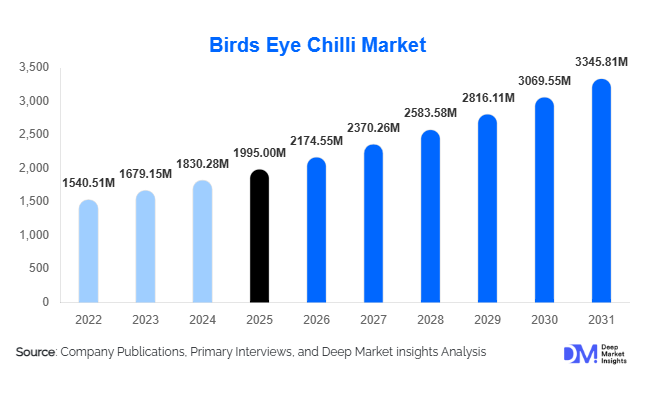
According to Deep Market Insights, the global Birds Eye Chilli market size was valued at USD 1,995 million in 2025 and is projected to grow from USD 2,174.55 million in 2026 to reach USD 3,345.81 million by 2031, expanding at a CAGR of 9.0% during the forecast period (2026–2031). The Birds Eye Chilli market growth is primarily driven by rising global demand for spicy cuisines, expanding processed food consumption, increasing popularity of ethnic flavor profiles, and growing utilization of natural spice ingredients across food manufacturing industries.Birds Eye Chilli, known for its intense pungency and high capsaicin concentration, has become a critical ingredient in sauces, seasoning blends, instant foods, processed meat products, frozen meals, and gourmet condiments. The market is witnessing strong demand from foodservice operators and packaged food manufacturers aiming to satisfy changing consumer taste preferences for hotter and more authentic culinary experiences.
Key Market Insights
- Demand for premium and ultra-hot chilli products is increasing globally, driven by rising popularity of spicy snacks, gourmet sauces, and ethnic cuisines.
- Asia-Pacific dominates the global Birds Eye Chilli market, supported by large-scale cultivation and export operations across Thailand, India, Vietnam, and China.
- Organic Birds Eye Chilli products are witnessing rapid growth, fueled by increasing consumer preference for clean-label and pesticide-free spices.
- Food processing remains the leading end-use industry, particularly across instant foods, sauces, seasoning blends, and frozen meal applications.
- E-commerce and specialty spice retailing are expanding rapidly, enabling premium chilli brands to access international consumers directly.
- Advanced processing technologies, including freeze-drying and automated sorting systems, are improving export quality and shelf stability.
What are the latest trends in the Birds Eye Chilli market?
Rising Popularity of Premium Hot Sauces and Gourmet Spices
The global food industry is witnessing rising demand for premium spicy condiments and gourmet seasoning products incorporating Birds Eye Chilli. Consumers are increasingly seeking intense heat profiles and authentic Asian, African, and Latin American flavors. This trend has encouraged food manufacturers and artisanal brands to launch fermented chilli sauces, infused oils, smoked chilli blends, and premium seasoning formulations using Birds Eye Chilli as a key ingredient. Gourmet food retailers and specialty spice brands are expanding their premium chilli portfolios to capitalize on growing consumer interest in experimental and high-heat culinary experiences. Restaurant chains and fast-food operators are also introducing limited-edition spicy menu offerings to attract younger demographics seeking bolder flavors.
Growing Adoption of Freeze-Drying and Advanced Processing Technologies
Advanced chilli processing technologies are becoming increasingly important in the Birds Eye Chilli market. Freeze-drying, automated grading, and precision dehydration technologies are improving shelf life, color retention, flavor consistency, and export quality. These technologies are particularly valuable for premium export markets in Europe, North America, and Japan where food safety and quality standards are highly stringent. Companies are also investing in capsaicin extraction systems and advanced packaging solutions to strengthen value-added product offerings. Smart traceability systems and digital supply chain monitoring are gaining traction among exporters seeking compliance with international regulatory standards and organic certification requirements.
What are the key drivers in the Birds Eye Chilli market?
Expansion of Global Processed Food Industry
The rapid growth of the global processed food sector remains one of the strongest growth drivers for the Birds Eye Chilli market. Birds Eye Chilli is widely used in sauces, instant noodles, snack foods, ready-to-eat meals, processed meats, frozen foods, and seasoning blends. Rising urbanization, changing dietary patterns, and increasing demand for convenience foods are significantly increasing commercial consumption of chilli ingredients globally. Food manufacturers are increasingly incorporating high-heat chilli variants into products to differentiate flavor profiles and cater to changing consumer preferences.
Increasing Demand for Ethnic and Spicy Foods
Global consumers are increasingly embracing Asian, Mexican, Thai, African, and fusion cuisines, contributing substantially to market growth. Younger consumers, particularly millennials and Gen Z demographics, are actively seeking intense flavor experiences and spicy food challenges, boosting demand for Birds Eye Chilli-based ingredients. Restaurant chains and foodservice operators are rapidly expanding spicy product portfolios, further supporting commercial demand. The growth of international tourism and multicultural food consumption trends is also strengthening long-term demand for authentic spice ingredients.
What are the restraints for the global market?
Climate Volatility and Agricultural Supply Risks
Birds Eye Chilli cultivation remains highly vulnerable to changing climatic conditions, irregular rainfall patterns, droughts, pest outbreaks, and temperature fluctuations. Production instability often creates significant raw material price volatility and inconsistent export supply. Farmers in major producing countries frequently face challenges related to water scarcity and crop diseases, impacting yield quality and profitability. These agricultural risks continue to create supply-side uncertainties for processors and exporters.
Strict International Food Safety Regulations
Export-oriented chilli producers must comply with stringent pesticide residue limits, aflatoxin regulations, microbial safety standards, and traceability requirements imposed by Europe, North America, and Japan. Small-scale exporters and farmers in developing countries often struggle with certification compliance and quality assurance investments. Shipment rejections and regulatory non-compliance can significantly increase operational costs and affect export competitiveness. Maintaining consistent quality standards remains a key challenge for global market participants.
What are the key opportunities in the Birds Eye Chilli industry?
Expansion of Organic and Sustainable Chilli Farming
The growing consumer preference for organic, pesticide-free, and sustainably sourced spices is creating major opportunities within the Birds Eye Chilli market. Premium organic chilli products command significantly higher margins, particularly in Europe, North America, and Japan. Governments and agricultural cooperatives in India, Thailand, and Vietnam are increasingly supporting organic farming practices and traceable supply chain systems to strengthen export competitiveness. Sustainable cultivation certifications and regenerative agriculture initiatives are also helping exporters secure long-term contracts with multinational food manufacturers and premium retail brands.
Nutraceutical and Functional Food Applications
The increasing utilization of capsaicin-based ingredients in nutraceuticals and functional foods presents strong growth opportunities for market participants. Birds Eye Chilli contains high levels of capsaicin, antioxidants, and vitamins, making it valuable for metabolism boosters, dietary supplements, pain relief products, and immunity-support formulations. Pharmaceutical companies and wellness brands are investing in advanced extraction technologies to develop natural health ingredients derived from chilli peppers. Rising consumer awareness regarding plant-based wellness products and natural functional ingredients is expected to support long-term market expansion.
Report Scope
| Report Metric | Details |
|---|---|
| Market Size in 2025 | USD 1995.00 Million |
| Market Size in 2026 | USD 2174.55 Million |
| Market Size in 2031 | USD 3345.81 Million |
| CAGR | 9% (2026-2031) |
| Base Year for Estimation | 2025 |
| Historical Data | 2022-2024 |
| Forecast Period | 2026-2031 |
| Report Coverage | Revenue Forecast, Competitive Landscape, Supply Chain Disruption, Growth Factors, Environment & Regulatory Landscape and Trends |
| Geographies Covered | North America, Europe, APAC, Middle East and Africa, LATAM |
| Countries Covered | U.S., Canada, U.K., Germany, France, Spain, Italy, Russia, Nordic, Benelux, Rest of Europe, China, Korea, Japan, India, Australia, Singapore, Taiwan, South East Asia, Rest of Asia-Pacific, UAE, Turky, Saudi Arabia, South Africa, Egypt, Nigeria, Rest of MEA, Brazil, Mexico, Argentina, Chile, Colombia, Rest of LATAM |
Explore more data points, trends and opportunities Download Free Sample Report
Product Type Insights
The global Birds Eye Chilli market is segmented into fresh Birds Eye Chilli, dried Birds Eye Chilli, powdered and crushed chilli products, and premium processed variants including freeze-dried and smoked chillies. Among these, fresh Birds Eye Chilli continues to dominate the global market and is projected to account for nearly 34% of total market share in 2025. The dominance of the fresh segment is primarily attributed to strong household consumption patterns, extensive utilization across restaurants and street food vendors, and rising consumer preference for natural and minimally processed ingredients. Fresh Birds Eye Chillies are highly valued for their intense pungency, vibrant color, strong aroma, and authentic flavor profile, making them a preferred ingredient in Asian, African, and Latin American cuisines. Increasing global popularity of spicy food preparations and the expansion of ethnic foodservice establishments are further accelerating fresh chilli demand across both developed and developing economies.Premium processed variants such as freeze-dried, smoked, and specialty gourmet Birds Eye Chilli products are emerging rapidly within high-income consumer segments and export-oriented markets. Freeze-drying technologies help preserve the original aroma, nutritional composition, and flavor intensity of chillies while extending product shelf life substantially. Smoked chilli products are gaining popularity among gourmet food consumers seeking unique flavor experiences and artisanal culinary products. Rising premiumization trends across the global spice industry, combined with growing consumer interest in specialty ingredients and international cuisines, are expected to generate lucrative opportunities for premium chilli manufacturers over the forecast period.
Application Insights
Based on application, the Birds Eye Chilli market is categorized into culinary flavoring, heat enhancement, nutraceutical applications, functional foods, pharmaceutical applications, and specialty industrial uses. Culinary flavoring remains the dominant application segment globally and continues to account for the largest share of market revenue. The segment is primarily supported by rapidly increasing worldwide consumption of spicy cuisines and ethnic food products. Birds Eye Chilli is extensively used across sauces, marinades, curries, soups, instant foods, processed meats, snacks, and seasoning blends to enhance flavor complexity and heat intensity. The growing globalization of food culture and increasing popularity of Asian, Mexican, African, and fusion cuisines are significantly expanding the commercial utilization of chilli-based ingredients across foodservice and retail industries.The primary growth driver for the culinary flavoring segment is the continuous expansion of the global processed and convenience food industry combined with rising consumer demand for bold and spicy flavor profiles. Consumers, particularly younger demographics, are increasingly experimenting with intense flavors and international cuisines, encouraging food manufacturers to introduce chilli-based product innovations. Rapid urban lifestyles, rising demand for ready-to-eat meals, and increased consumption of restaurant-prepared foods are further strengthening demand for Birds Eye Chilli across mainstream food applications.Pharmaceutical and cosmetic applications are also gradually expanding due to the therapeutic properties associated with capsaicin compounds. Capsaicin-based topical formulations are increasingly used in pain relief creams, muscle recovery products, and wellness-oriented skincare formulations. The growing trend toward plant-based active ingredients within cosmetics and pharmaceutical sectors is expected to create additional growth opportunities for chilli extract manufacturers in the coming years.
Distribution Channel Insights
The Birds Eye Chilli market is distributed through supermarkets and hypermarkets, specialty stores, traditional retail outlets, foodservice distributors, online retail platforms, and direct-to-consumer channels. Supermarkets and hypermarkets continue to dominate the global distribution landscape and are estimated to account for approximately 28% of total market share in 2025. Organized retail chains provide consumers with convenient access to packaged chilli products, premium spice brands, imported seasonings, and private-label offerings. Large retail networks also support product visibility, brand recognition, and efficient distribution of value-added chilli products across urban markets.The leading growth driver for supermarkets and hypermarkets is the continued expansion of organized retail infrastructure and increasing consumer preference for one-stop grocery shopping experiences. Rising urbanization, growing middle-class populations, and increasing penetration of modern retail formats across emerging economies are further strengthening the dominance of this segment. Consumers increasingly prefer purchasing branded and packaged spice products from organized retailers due to perceived quality assurance, food safety standards, and product variety.Direct-to-consumer spice brands are leveraging social media marketing, influencer collaborations, and subscription-based business models to strengthen customer engagement and expand global reach. Premium artisanal chilli brands are increasingly utilizing digital platforms to build brand identity and target health-conscious and gourmet food consumers. This shift toward personalized and premium spice consumption is expected to reshape competitive dynamics within the global chilli distribution landscape over the forecast period.
End-Use Industry Insights
The global Birds Eye Chilli market serves multiple end-use industries including food processing, hospitality and foodservice, nutraceuticals, pharmaceuticals, cosmetics and personal care, and retail household consumption. Among these, the food processing industry remains the largest end-use segment and is expected to contribute nearly 31% of total global market value in 2025. Birds Eye Chilli is widely incorporated into sauces, seasoning blends, instant noodles, frozen foods, snacks, processed meats, canned foods, and ready-to-eat meals. The large-scale expansion of the global convenience food industry continues to generate substantial commercial demand for chilli ingredients with consistent heat intensity and flavor quality.The nutraceutical industry is emerging as one of the fastest-growing end-use sectors due to increasing utilization of capsaicin extracts in dietary supplements, wellness products, and metabolism-enhancing formulations. Rising global interest in preventive healthcare, natural ingredients, and plant-based wellness products is significantly boosting demand for chilli-derived nutraceutical compounds. Manufacturers are increasingly investing in research and development activities to expand the commercial applications of capsaicin-based ingredients across functional health products.Cosmetics and personal care manufacturers are additionally exploring chilli-based ingredients for topical skincare products, anti-aging formulations, and wellness-oriented cosmetic applications. Capsaicin compounds are increasingly associated with circulation enhancement and warming effects, creating opportunities for their incorporation into therapeutic skincare and beauty products. This diversification of end-use applications is expected to strengthen long-term market growth prospects for Birds Eye Chilli producers and processors globally.
Explore more data points, trends and opportunities Download Free Sample Report
Birds Eye Chilli Market Segmentations
By Product Type
- Fresh Birds Eye Chilli
- Dried Birds Eye Chilli
- Frozen Birds Eye Chilli
- Crushed/Flakes Birds Eye Chilli
- Powdered Birds Eye Chilli
- Paste & Puree
By Cultivation Method
- Open Field Cultivation
- Greenhouse Cultivation
- Hydroponic Cultivation
- Vertical Farming Cultivation
By Processing Type
- Raw/Unprocessed
- Sun-Dried
- Machine-Dried
- Freeze-Dried
By Application
- Culinary Flavoring
- Heat Enhancement
- Preservative Function
- Nutraceutical Ingredient
Distribution Channel
- Direct/B2B Sales
- Supermarkets & Hypermarkets
- Convenience Stores
- Foodservice Distributors
By End Use Industry
- Food Processing Industry
- Sauces & Condiments
- Spice & Seasoning Blends
- Ready-to-Eat Foods
Regional Insights
North America
North America accounted for approximately 19% of the global Birds Eye Chilli market share in 2025, led primarily by the United States. The region continues to experience strong growth driven by increasing popularity of ethnic cuisines, premium hot sauces, gourmet seasonings, and spicy snack products. Consumers across the United States are increasingly adopting Asian, Mexican, and African food flavors, significantly boosting demand for high-heat chilli varieties. The growing presence of international restaurant chains and rising consumption of convenience foods containing spicy ingredients are further supporting regional market expansion.Canada is also witnessing increasing demand for organic and sustainably sourced spice products among health-conscious consumers. Growing multicultural populations and rising exposure to international cuisines are encouraging higher household consumption of chilli-based ingredients across major urban centers. Expansion of e-commerce grocery platforms and premium food retailing is additionally supporting wider product accessibility throughout the region.
Europe
Europe represented nearly 18% of the global Birds Eye Chilli market in 2025, with Germany, the United Kingdom, France, Italy, and the Netherlands emerging as major importing countries. Rising multicultural food consumption patterns and increasing demand for authentic Asian and African flavors are significantly contributing to regional market growth. European consumers are increasingly exploring spicy international cuisines, resulting in higher demand for premium chilli products across restaurants, packaged foods, and retail spice categories.Food manufacturers across Europe are increasingly incorporating Birds Eye Chilli ingredients into sauces, ready meals, snacks, and frozen foods to address evolving consumer preferences for stronger and more adventurous flavor profiles. Rising demand for vegan, plant-based, and clean-label food products is also supporting utilization of natural spice ingredients within food manufacturing industries. Additionally, expansion of specialty food stores and gourmet culinary retailing is creating new opportunities for premium chilli exporters targeting European markets.
Asia-Pacific
Asia-Pacific dominates the global Birds Eye Chilli market and is projected to account for approximately 46% of total market share in 2025. Thailand, India, Vietnam, and China remain the leading cultivation, processing, and export hubs globally. The region benefits from highly favorable climatic conditions, extensive agricultural expertise, large-scale chilli farming operations, and strong domestic consumption of spicy foods. Birds Eye Chilli remains deeply integrated into traditional culinary cultures across many Asian countries, supporting consistently high regional demand.Thailand continues to maintain a strong competitive position due to its advanced chilli processing industry and well-established integration with international food supply chains. India is rapidly increasing export volumes supported by low cultivation costs, expanding irrigation infrastructure, government-backed agricultural reforms, and rising investment in food processing capabilities. China continues to witness strong domestic demand from foodservice, instant food, and snack industries, while Vietnam is emerging as a fast-growing exporter through investments in freeze-drying technologies and cold-chain logistics infrastructure.
Latin America
Latin America is gradually emerging as a promising regional market led by Brazil, Peru, and Colombia. The region is experiencing increasing demand for spicy processed foods, premium sauces, and ethnic cuisine products. Expansion of urban foodservice industries and rising consumption of packaged foods are supporting stronger chilli utilization across both retail and commercial sectors.Peru is strengthening its position as a supplier of specialty chilli products due to favorable climatic conditions, growing export capabilities, and increasing global recognition of Latin American cuisine. Brazil continues to experience expanding demand from processed food manufacturers and restaurant chains, while Colombia is witnessing gradual growth in commercial chilli farming activities aimed at export diversification.
Middle East & Africa
The Middle East & Africa region is witnessing steadily increasing demand for Birds Eye Chilli due to rapid expansion of foodservice industries, rising processed food consumption, and strong regional preference for spicy cuisines. The UAE and Saudi Arabia are emerging as important import hubs for premium chilli products, international food ingredients, and specialty seasonings. Growing tourism activities, rising expatriate populations, and expanding restaurant industries are significantly contributing to regional demand growth.African countries including Nigeria, Kenya, and South Africa are expanding commercial chilli cultivation to capitalize on rising export opportunities and growing global demand for specialty spice products. Investments in irrigation systems, food processing infrastructure, and agricultural modernization programs are expected to support long-term regional market expansion. Increasing participation of regional producers in international spice trade networks is also likely to strengthen export competitiveness over the forecast period.
Key Players in the Birds Eye Chilli Market
- McCormick & Company
- Olam Group
- Everest Food Products
- MDH Spices
- Ajinomoto Co., Inc.
- Kerry Group
- Sensient Technologies
- The Spice Hunter
- Bart Ingredients
- DS Group
- SHS Group
- Nedspice Group
- Pacific Spice Company
- Mahashian Di Hatti Pvt. Ltd.
- Synthite Industries