Bird Feeder Market Size
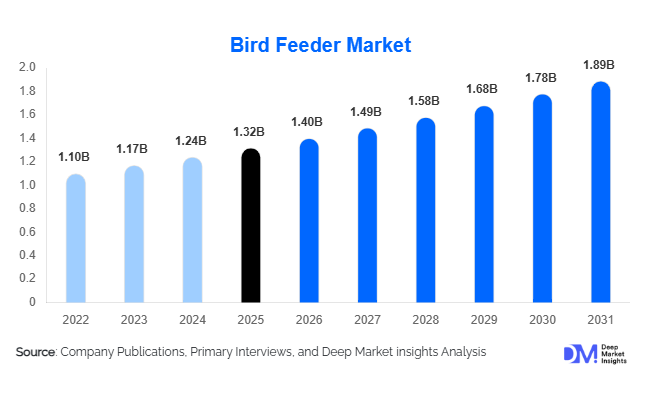
According to Deep Market Insights, the global bird feeder market size was valued at USD 1.32 billion in 2025 and is projected to grow from USD 1.40 billion in 2026 to reach USD 1.89 billion by 2031, expanding at a CAGR of 6.2% during the forecast period (2026–2031). The bird feeder market growth is primarily driven by increasing participation in backyard birdwatching, rising consumer spending on outdoor living and garden décor, and growing environmental awareness surrounding biodiversity conservation. The market is also benefiting from the emergence of smart bird feeders equipped with AI-enabled cameras, mobile applications, and species recognition systems that enhance consumer engagement and create premium product categories.
Key Market Insights
- Smart and AI-enabled bird feeders are rapidly transforming the market, integrating mobile connectivity, species recognition, and live-streaming features for tech-oriented consumers.
- North America dominates the global market, supported by strong birdwatching participation, backyard culture, and high household spending on outdoor recreation products.
- Asia-Pacific is emerging as the fastest-growing regional market, driven by urban gardening trends, rising middle-class income, and increasing biodiversity awareness.
- Sustainable and eco-friendly bird feeders are gaining popularity, with growing demand for recycled plastics, bamboo composites, and FSC-certified wood materials.
- E-commerce channels continue to reshape global sales, enabling niche manufacturers and premium brands to directly reach consumers worldwide.
- Premium decorative feeders are increasingly positioned as lifestyle and landscaping products, combining outdoor aesthetics with wildlife conservation functionality.
Bird Feeder Market Trends
Smart Bird Feeders Redefining Consumer Engagement
The bird feeder industry is undergoing a technological transformation with the increasing adoption of smart and camera-enabled feeding systems. Consumers are showing strong interest in feeders equipped with AI-powered bird species recognition, motion-triggered cameras, live video streaming, and app-controlled monitoring systems. These products provide interactive wildlife experiences while also creating subscription and digital ecosystem opportunities for manufacturers. Younger consumers and tech-savvy households are particularly attracted to connected feeders that combine outdoor recreation with smart home functionality. Several companies are introducing cloud-based bird identification libraries, solar-powered charging systems, and mobile analytics that allow users to track bird activity and migration patterns. This trend is significantly increasing average selling prices within the premium segment and accelerating product innovation across the industry.
Sustainability and Eco-Friendly Materials Gaining Importance
Environmental awareness and biodiversity conservation initiatives are strongly influencing purchasing decisions in the bird feeder market. Consumers are increasingly favoring products manufactured using recycled plastics, reclaimed wood, bamboo composites, and corrosion-resistant sustainable metals. Brands are positioning bird feeders as tools for supporting urban biodiversity and wildlife conservation while simultaneously promoting sustainable manufacturing practices. European and North American consumers are particularly responsive to eco-friendly packaging, recyclable materials, and low-carbon production methods. Companies are also incorporating weather-resistant coatings and long-life designs to improve product durability and reduce replacement frequency. Sustainability-focused branding is becoming a key competitive differentiator, especially among premium feeder manufacturers targeting environmentally conscious households.
Bird Feeder Market Drivers
Growing Popularity of Birdwatching and Backyard Wildlife Observation
One of the strongest drivers of the bird feeder market is the increasing global participation in birdwatching and backyard wildlife engagement. Birdwatching has evolved from a niche hobby into a mainstream recreational activity embraced across multiple age groups. Consumers are increasingly seeking outdoor wellness activities that support relaxation, mental well-being, and environmental connection. Backyard bird feeding allows households to interact with nature conveniently within residential settings, significantly increasing demand for feeders, bird seed products, and wildlife accessories. This trend strengthened considerably after the pandemic period, when outdoor home-based hobbies gained long-term popularity. Suburban households in North America and Europe remain major contributors to sustained market demand.
Expansion of Outdoor Living and Landscaping Expenditures
Rising investments in outdoor living spaces, garden enhancement, and backyard landscaping are significantly supporting bird feeder sales globally. Consumers increasingly integrate decorative feeders into patios, gardens, balconies, and landscape designs as both functional wildlife tools and aesthetic outdoor accessories. Premium glass, metal, and handcrafted feeders are benefiting from growing interest in visually appealing outdoor décor products. Hospitality companies, eco-resorts, retirement communities, and botanical gardens are also adopting bird-friendly infrastructure as part of experiential landscaping strategies. The growing preference for nature-inspired home environments is expected to sustain long-term demand for decorative and luxury feeder categories.
Bird Feeder Market Restraints
Disease Transmission Concerns and Wildlife Safety Risks
Bird disease transmission remains a key concern affecting the market. Improperly maintained bird feeders can contribute to the spread of avian diseases such as salmonellosis and avian influenza among wild bird populations. Wildlife organizations and government agencies periodically issue advisories recommending temporary suspension of feeding activities during outbreaks, which can negatively impact product demand. In addition, consumers increasingly expect bird-safe designs that reduce overcrowding and contamination risks, placing additional pressure on manufacturers to improve hygiene-focused product engineering and educational initiatives.
Seasonal Demand Volatility and Raw Material Costs
The bird feeder market continues to face seasonal purchasing fluctuations, particularly in North America and Europe where demand peaks during winter and spring bird migration periods. This seasonality creates inventory management and production planning challenges for manufacturers and retailers. Furthermore, fluctuating prices of metals, plastics, electronic components, and packaging materials continue to affect industry profit margins. Smart feeder manufacturers are especially vulnerable to semiconductor and camera component cost volatility, while rising freight and logistics expenses have increased operational costs across global supply chains.
Bird Feeder Market Opportunities
Expansion of Smart Wildlife Ecosystems
The rapid growth of connected outdoor devices presents major opportunities for bird feeder manufacturers. Smart feeders are increasingly evolving into integrated wildlife ecosystems supported by AI analytics, subscription-based bird identification services, and cloud-connected monitoring platforms. Companies capable of combining hardware, mobile applications, and data-driven consumer engagement are expected to achieve premium market positioning and recurring revenue streams. Integration with smart home systems and voice assistants may further accelerate consumer adoption over the coming years.
Growth of Urban Biodiversity and Eco-Landscaping Programs
Governments and municipalities worldwide are investing in urban biodiversity, green infrastructure, and ecological landscaping projects to improve environmental sustainability and public well-being. Bird feeders are increasingly incorporated into public parks, educational institutions, botanical gardens, and community wildlife initiatives. This trend is creating new institutional procurement opportunities beyond residential consumers. Commercial landscaping firms and hospitality operators are also integrating bird-friendly infrastructure into residential developments, wellness resorts, and tourism destinations, expanding the market into broader commercial applications.
Report Scope
| Report Metric | Details |
|---|---|
| Market Size in 2025 | USD 1.32 Billion |
| Market Size in 2026 | USD 1.40 Billion |
| Market Size in 2031 | USD 1.89 Billion |
| CAGR | 6.2% (2026-2031) |
| Base Year for Estimation | 2025 |
| Historical Data | 2022-2024 |
| Forecast Period | 2026-2031 |
| Report Coverage | Revenue Forecast, Competitive Landscape, Supply Chain Disruption, Growth Factors, Environment & Regulatory Landscape and Trends |
| Geographies Covered | North America, Europe, APAC, Middle East and Africa, LATAM |
| Countries Covered | U.S., Canada, U.K., Germany, France, Spain, Italy, Russia, Nordic, Benelux, Rest of Europe, China, Korea, Japan, India, Australia, Singapore, Taiwan, South East Asia, Rest of Asia-Pacific, UAE, Turky, Saudi Arabia, South Africa, Egypt, Nigeria, Rest of MEA, Brazil, Mexico, Argentina, Chile, Colombia, Rest of LATAM |
Explore more data points, trends and opportunities Download Free Sample Report
Product Type Insights
Tube feeders dominate the global bird feeder market due to their affordability, low maintenance requirements, and compatibility with multiple seed types. These feeders are especially popular in North America because they effectively attract songbirds while minimizing seed waste. Hopper feeders continue to maintain strong demand among residential consumers seeking larger seed storage capacity and weather protection. Smart bird feeders equipped with AI-powered cameras and app-based monitoring systems represent the fastest-growing product segment, supported by rising consumer interest in connected outdoor experiences. Decorative and luxury feeders are also expanding steadily as consumers increasingly integrate bird feeding into outdoor landscaping and premium garden décor projects.
Material Type Insights
Plastic bird feeders account for the largest market share due to low production costs, lightweight designs, and weather resistance. However, premium metal and recycled composite feeders are gaining popularity among environmentally conscious consumers seeking durability and sustainability. Wooden feeders remain highly preferred for ornamental landscaping and rustic outdoor aesthetics, particularly across Europe and North America. Glass and ceramic feeders continue to occupy niche premium categories where visual appeal and decorative design strongly influence purchasing decisions.
Distribution Channel Insights
E-commerce platforms dominate bird feeder distribution globally by enabling consumers to compare designs, prices, and smart features conveniently. Direct-to-consumer online sales are growing rapidly as manufacturers strengthen digital marketing strategies and subscription-based bird seed replenishment programs. Specialty garden stores and wildlife-focused retailers continue to perform strongly within premium and decorative feeder categories, where personalized guidance and product demonstrations influence purchasing decisions. Home improvement retailers and farm supply stores also remain important distribution channels, particularly in suburban and rural markets.
End-Use Insights
Residential consumers represent the largest end-use segment in the bird feeder market, accounting for the majority of global sales due to widespread backyard feeding activities. Suburban households dominate consumption because of larger outdoor spaces and stronger spending on landscaping products. Hospitality and eco-tourism applications are emerging as fast-growing commercial segments, with resorts and eco-lodges increasingly integrating bird feeders into nature-based guest experiences. Wildlife conservation organizations, educational institutions, and botanical gardens are also increasing procurement of durable commercial-grade feeders for research, biodiversity programs, and environmental education initiatives.
Technology Insights
Conventional bird feeders continue to dominate overall sales volumes due to affordability and widespread consumer familiarity. However, smart connected feeders are experiencing the highest growth rates globally. AI-enabled species recognition, cloud-connected video streaming, solar-powered charging, and app-based monitoring systems are rapidly reshaping product innovation strategies. Companies are increasingly investing in advanced imaging technology, weatherproof electronics, and anti-squirrel systems to strengthen competitive positioning in the premium smart feeder category.
Explore more data points, trends and opportunities Download Free Sample Report
Bird Feeder Market Segmentations
By Product Type
- Hopper Feeders
- Tube Feeders
- Platform/Tray Feeders
- Window Feeders
- Suet Feeders
- Nectar Feeders
- Squirrel-Proof Feeders
- Smart/Camera-Integrated Bird Feeders
- Decorative/Premium Feeders
By Material Type
- Plastic Feeders
- Metal Feeders
- Wooden Feeders
- Glass Feeders
- Ceramic Feeders
- Recycled Composite Feeders
By Distribution Channel
- E-commerce Platforms
- Specialty Garden Stores
- Pet Stores
- Home Improvement Retailers
- Hypermarkets & Supermarkets
- Direct-to-Consumer Online Sales
By End User
- Residential Consumers
- Commercial Landscaping Companies
- Hospitality Sector
- Wildlife Conservation Organizations
- Educational Institutions
- Bird Watching Clubs & Hobbyists
By Technology
- Conventional Feeders
- Smart Wi-Fi Enabled Feeders
- AI Species Recognition Feeders
- Solar-Powered Feeders
- App-Controlled Feeders
Regional Insights
North America
North America remains the largest regional market, accounting for approximately 43% of global revenue in 2025. The United States dominates regional demand due to widespread birdwatching participation, strong backyard culture, and high spending on outdoor recreational products. Consumers across the region increasingly prefer premium decorative feeders and smart AI-enabled products. Canada also maintains stable demand supported by suburban gardening trends and wildlife conservation awareness. North America remains the leading innovation hub for connected bird feeding technologies and premium outdoor wildlife products.
Europe
Europe accounts for nearly 29% of the global bird feeder market, led by the United Kingdom, Germany, France, and Nordic countries. Strong environmental awareness and established bird conservation traditions continue to support market expansion across the region. European consumers increasingly prioritize sustainable materials, recyclable packaging, and eco-friendly feeder designs. Decorative and handcrafted feeders perform particularly well due to the influence of landscaping aesthetics and outdoor garden culture. Regulations promoting biodiversity and wildlife-friendly urban planning are also contributing to long-term demand growth.
Asia-Pacific
Asia-Pacific represents the fastest-growing regional market, supported by rising disposable income, urban gardening trends, and increasing awareness of biodiversity conservation. China is emerging as both a major manufacturing center and a rapidly expanding consumer market due to strong e-commerce penetration and smart technology adoption. Japan maintains steady demand for compact premium feeders suitable for urban residential environments. India is gradually developing into an important growth market as urban households increasingly engage in balcony gardening and bird conservation activities. Rising middle-class spending and social media-driven interest in nature-related hobbies are expected to accelerate regional growth further.
Latin America
Latin America continues to experience gradual market expansion, particularly in Brazil and Mexico where eco-tourism development and backyard gardening trends are increasing consumer interest in bird feeding products. Nectar feeders and tropical bird-specific designs are gaining popularity due to the region’s rich bird diversity. While the regional market remains comparatively smaller than North America and Europe, growing environmental awareness and rising urban middle-class spending are expected to create long-term opportunities.
Middle East & Africa
The Middle East & Africa region currently represents a smaller share of the global market but is witnessing increasing demand for luxury landscaping and decorative outdoor products. Gulf countries such as the UAE and Saudi Arabia are investing heavily in premium residential landscaping and green infrastructure projects, indirectly supporting bird feeder adoption. South Africa remains the largest African market due to active birdwatching communities and established wildlife tourism industries. Institutional demand from parks, resorts, and eco-tourism facilities is expected to strengthen regional market growth over the forecast period.
Key Players in the Bird Feeder Market
- Droll Yankees
- Perky-Pet
- Woodlink Ltd.
- Aspects Inc.
- Brome Bird Care
- Nature Anywhere
- Birds Choice
- First Nature
- Songbird Essentials
- Stokes Select
- Kettle Moraine
- More Birds
- Gardman
- Wild Birds Unlimited
- Netvue Technologies