Bath Linen and Accessories Market Size
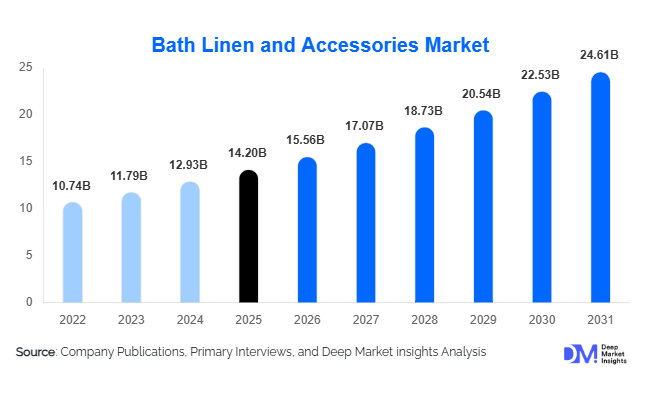
According to Deep Market Insights, the global bath linen and accessories market size was valued at USD 14.2 billion in 2025 and is projected to grow from USD 15.56 billion in 2026 to reach USD 24.61 billion by 2031, expanding at a CAGR of 9.7% during the forecast period (2026–2031). The bath linen and accessories market growth is primarily driven by increasing global housing development, expansion of the hospitality sector, and rising consumer preference for premium home textiles that enhance comfort and bathroom aesthetics.
Bath linens, including towels, bathrobes, bath mats, and washcloths, are essential household textile products widely used across residential, hospitality, healthcare, and wellness sectors. The market has evolved from basic utility textiles to lifestyle-oriented products emphasizing softness, durability, moisture absorption, and aesthetic design. Increasing disposable income, urbanization, and rising consumer awareness regarding hygiene are encouraging households to upgrade bathroom textiles more frequently.
In addition, hospitality and tourism expansion across emerging economies is generating large-scale institutional demand for high-quality bath linens with durability and high absorbency. Hotels, spas, and resorts require frequent replacement of towels and bathrobes due to heavy laundering cycles, further supporting stable market demand. Sustainability trends are also shaping product innovation, with manufacturers introducing organic cotton, bamboo fiber, and recycled textiles to appeal to environmentally conscious consumers. The rapid growth of e-commerce platforms has improved product accessibility and accelerated global distribution, enabling brands to reach new consumer segments and drive market expansion.
Key Market Insights
- Premium and luxury bath linen products are gaining popularity globally, driven by consumer demand for spa-like bathroom experiences at home.
- Cotton-based bath textiles dominate the market, particularly Turkish and Egyptian cotton products known for high absorbency and softness.
- North America remains the largest market due to high household spending on home décor and strong retail distribution networks.
- Asia-Pacific is the fastest-growing region, supported by rising middle-class income and expanding hospitality infrastructure.
- E-commerce channels are reshaping product distribution, enabling direct-to-consumer brands to expand globally.
- Sustainable materials and eco-friendly textile processing technologies are becoming key differentiators among manufacturers.
What are the latest trends in the bath linen and accessories market?
Growing Demand for Sustainable and Eco-Friendly Bath Textiles
Sustainability has emerged as a major trend in the bath linen and accessories market. Consumers are increasingly seeking eco-friendly home textile products manufactured using organic cotton, bamboo fiber, and recycled polyester. These materials reduce environmental impact while maintaining product performance in terms of softness and absorbency. Textile manufacturers are investing in water-efficient dyeing technologies, biodegradable packaging, and sustainable fiber sourcing to align with global environmental regulations and consumer expectations. Retailers are also expanding eco-certified product ranges that highlight sustainable production methods and traceable supply chains.
Rise of Smart and Functional Bath Linen Innovations
Technological innovations in textile manufacturing are transforming traditional bath linens into high-performance products. Quick-dry fabrics, antimicrobial treatments, and enhanced absorbency technologies are being integrated into towels and bathrobes to improve hygiene and convenience. Zero-twist cotton yarns and advanced weaving techniques are also improving product durability while maintaining a plush feel. Smart textiles with moisture-control properties are gaining attention, particularly in hospitality and wellness applications where performance and longevity are critical. These innovations are helping manufacturers differentiate products in a competitive market.
What are the key drivers in the bath linen and accessories market?
Expansion of the Global Hospitality Industry
The rapid growth of hotels, resorts, spas, and vacation rentals is a key driver of bath linen demand. Hospitality establishments require large quantities of towels, bathrobes, and bath mats due to frequent laundering cycles and hygiene standards. With global tourism steadily expanding, hotel chains are investing in high-quality bath linens that enhance guest comfort and brand reputation. This institutional demand creates recurring procurement cycles, supporting long-term growth in the bath linen market.
Rising Consumer Spending on Home Décor and Lifestyle Products
Consumers are increasingly investing in bathroom upgrades and premium home textiles as part of broader home improvement trends. Bath linens are no longer viewed solely as functional items but as integral components of interior design and lifestyle comfort. Coordinated bathroom textile sets, designer bath mats, and luxury towels are gaining popularity among consumers seeking aesthetically pleasing bathroom spaces. Rising disposable income and urban housing development are further supporting this trend.
What are the restraints for the global market?
Volatility in Raw Material Prices
The bath linen industry is highly dependent on cotton, which is the primary raw material used in towel manufacturing. Fluctuations in global cotton prices can significantly affect production costs and profit margins for manufacturers. Climate variability, supply chain disruptions, and global trade policies often influence cotton availability and pricing, creating uncertainty in the market.
Intense Competition and Product Commoditization
The bath linen market is highly competitive, with numerous regional textile manufacturers offering similar products at competitive prices. Basic bath towels and washcloths often face commoditization, making it difficult for manufacturers to differentiate products without strong branding or innovation. Price competition among low-cost producers can also pressure profit margins for established companies.
What are the key opportunities in the bath linen and accessories industry?
Premium and Luxury Bath Linen Segments
The growing demand for premium home textile products represents a major opportunity for manufacturers. Luxury bath linens made from high-quality materials such as Egyptian cotton, Turkish cotton, and bamboo fibers command higher margins and attract affluent consumers. Designer collections, branded collaborations, and limited-edition products are helping companies expand into premium market segments.
Growth of Institutional and Hospitality Supply Contracts
The hospitality industry offers significant long-term opportunities for bath linen suppliers. Large hotel chains, resorts, and spas require durable and high-performance bath linens capable of withstanding frequent washing cycles. Manufacturers that develop hospitality-grade towels with high GSM ratings and enhanced durability can secure recurring supply contracts, creating stable revenue streams.
Report Scope
| Report Metric | Details |
|---|---|
| Market Size in 2025 | USD 14.2 Billion |
| Market Size in 2026 | USD 15.56 Billion |
| Market Size in 2031 | USD 24.61 Billion |
| CAGR | 9.7% (2026-2031) |
| Base Year for Estimation | 2025 |
| Historical Data | 2022-2024 |
| Forecast Period | 2026-2031 |
| Report Coverage | Revenue Forecast, Competitive Landscape, Supply Chain Disruption, Growth Factors, Environment & Regulatory Landscape and Trends |
| Geographies Covered | North America, Europe, APAC, Middle East and Africa, LATAM |
| Countries Covered | U.S., Canada, U.K., Germany, France, Spain, Italy, Russia, Nordic, Benelux, Rest of Europe, China, Korea, Japan, India, Australia, Singapore, Taiwan, South East Asia, Rest of Asia-Pacific, UAE, Turky, Saudi Arabia, South Africa, Egypt, Nigeria, Rest of MEA, Brazil, Mexico, Argentina, Chile, Colombia, Rest of LATAM |
Explore more data points, trends and opportunities Download Free Sample Report
Product Type Insights
Bath towels represent the largest product segment in the bath linen and accessories market, accounting for approximately 44% of global revenue. Their dominance is attributed to universal daily usage and regular replacement cycles in both residential and institutional sectors. Premium bath towels featuring high GSM ratings, improved absorbency, and soft cotton fibers are gaining popularity among consumers seeking luxury bathroom experiences. Bath mats and rugs represent another significant segment, particularly in households emphasizing bathroom aesthetics and safety. Bathrobes are widely used in hospitality and spa environments, where comfort and durability are essential. The increasing availability of coordinated bath linen sets, including towels, washcloths, and bath mats, is also supporting growth by encouraging consumers to purchase bundled bathroom textile collections.
Application Insights
The residential segment accounts for the largest share of bath linen demand, representing more than 60% of global consumption. Nearly every household requires bath towels, washcloths, and bath mats, making residential demand highly stable. However, the hospitality industry is the fastest-growing application segment due to increasing tourism and hotel construction worldwide. Hotels and resorts require large quantities of high-quality bath linens to maintain guest comfort and hygiene standards. Healthcare institutions such as hospitals and rehabilitation centers also contribute steady demand, particularly for antimicrobial and durable textile products designed for frequent laundering. The wellness and spa sector represents an emerging application segment, where premium bathrobes and luxury towels are widely used to enhance customer experiences.
Distribution Channel Insights
Offline retail channels, including supermarkets, department stores, and specialty home textile retailers, remain the dominant distribution channels for bath linens, accounting for more than half of global sales. Consumers often prefer to evaluate fabric quality, softness, and thickness before purchasing bath towels or bathrobes. However, online retail platforms are growing rapidly as e-commerce expands worldwide. Digital marketplaces allow consumers to compare prices, read reviews, and access a wider variety of products than traditional retail stores. Direct-to-consumer brands are also leveraging online platforms to sell premium bath linens directly to customers while maintaining higher profit margins. Subscription-based home textile services and curated lifestyle brands are emerging as new distribution models within the market.
End-Use Insights
Residential consumers dominate bath linen demand globally, driven by household replacement cycles and increasing interest in bathroom décor upgrades. Hospitality establishments, including hotels, resorts, and vacation rentals, represent the fastest-growing end-use segment due to rising global tourism and hospitality infrastructure investments. Wellness facilities such as spas and fitness centers also generate growing demand for premium towels and bathrobes used during spa treatments and wellness programs. Healthcare facilities require durable and hygienic bath linens designed for high-temperature washing cycles and strict sanitation standards. The rapid growth of vacation rental platforms is also expanding institutional demand, as hosts frequently purchase high-quality towels and bathrobes to improve guest satisfaction and ratings.
Explore more data points, trends and opportunities Download Free Sample Report
Bath Linen and Accessories Market Segmentations
By Product Type
- Bath Towels
- Hand Towels
- Face Towels / Washcloths
- Bath Sheets
- Bath Mats & Rugs
- Bathrobes
- Shower Curtains (Textile)
- Bathroom Linen Sets
By Material Type
- Cotton (Egyptian, Turkish, Organic)
- Bamboo Fiber
- Microfiber / Polyester Blends
- Linen Fiber
- Modal / Rayon Blends
- Recycled / Sustainable Fibers
By Distribution Channel
- Online Retail
- Supermarkets & Hypermarkets
- Department Stores
- Specialty Home Textile Stores
- Brand Websites / Direct-to-Consumer
By End-Use
- Residential / Household
- Hospitality (Hotels & Resorts)
- Healthcare Facilities
- Spas & Wellness Centers
- Institutional / Commercial Establishments
Regional Insights
North America
North America represents the largest market for bath linens, accounting for approximately 36% of global revenue. The United States is the dominant country within the region due to high consumer spending on home décor and strong demand from hospitality chains. American consumers frequently replace bath linens and show strong interest in premium and organic textile products. E-commerce penetration is also high in the region, enabling direct-to-consumer brands to expand rapidly.
Europe
Europe accounts for around 27% of the global market and is characterized by strong demand for sustainable home textile products. Countries such as Germany, the United Kingdom, France, and Italy are major consumers of premium bath linens. European consumers often prioritize organic cotton products and environmentally responsible manufacturing practices, encouraging manufacturers to develop eco-friendly product lines.
Asia-Pacific
Asia-Pacific is the fastest-growing regional market, driven by rising disposable incomes and rapid urbanization in countries such as China and India. China represents a major consumer and manufacturing hub for bath linens, while India is a leading exporter of cotton towels and home textile products. Growing middle-class populations and increasing housing development are supporting strong regional demand.
Latin America
Latin America is witnessing steady growth in bath linen demand, particularly in Brazil and Mexico. Rising urbanization and expanding retail infrastructure are improving access to home textile products. The hospitality sector is also expanding in tourist destinations, supporting demand for institutional bath linens.
Middle East & Africa
The Middle East and Africa region is experiencing rising demand due to the rapid expansion of tourism infrastructure and luxury hospitality projects. Countries such as the UAE and Saudi Arabia are investing heavily in hotels and resorts, increasing demand for premium bath linens. South Africa and Turkey also serve as important textile manufacturing and export hubs within the region.
Key Players in the Bath Linen and Accessories Market
- Welspun India
- Trident Group
- Springs Global
- WestPoint Home
- Loftex China
- Avanti Linens
- Venus Group
- 1888 Mills
- Standard Textile
- Grace Textile Mills
- Nine Space
- Kassatex
- Utopia Deals
- Orahome
- Iris Hantverk