Global Bagels Market Size
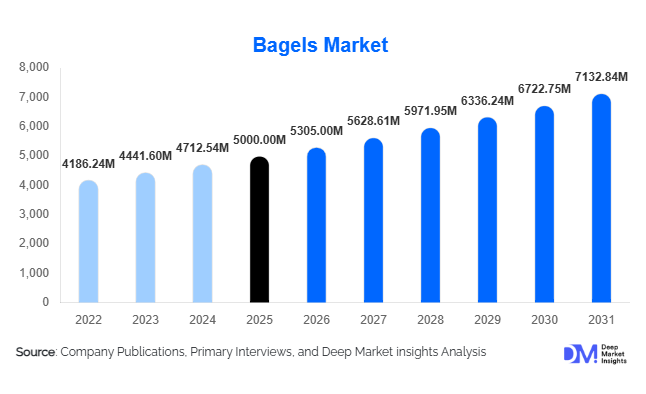
According to Deep Market Insights, the global bagels market size was valued at USD 5,000 million in 2025 and is projected to grow from USD 5,305.00 million in 2026 to reach USD 7,132.84 million by 2031, expanding at a CAGR of 6.1% during the forecast period (2026–2031). The bagels market growth is primarily driven by rising demand for convenient breakfast foods, expansion of café and quick-service restaurant culture, increasing adoption of Western-style bakery products across emerging economies, and strong growth in frozen and packaged bakery distribution channels globally.
Key Market Insights
- Convenience-driven breakfast consumption is a key demand driver, with bagels increasingly replacing traditional morning meal options in urban households.
- Foodservice and café chains are the dominant consumption hubs, integrating bagels into breakfast menus, snack offerings, and premium bakery categories.
- North America remains the largest market, supported by strong cultural consumption patterns and established retail bakery infrastructure.
- Asia-Pacific is the fastest-growing region, driven by urbanization, rising disposable income, and Western dietary influence.
- Health-oriented variants such as whole grain and gluten-free bagels are gaining traction, reflecting shifting consumer preferences toward functional foods.
- Frozen bagels and online grocery channels are reshaping global distribution, enabling wider export penetration and improved shelf life.
bagels market latest trends
Rising Demand for Health-Oriented and Functional Bagels
Consumers are increasingly shifting toward healthier bakery options, leading to strong demand for whole wheat, multigrain, gluten-free, and high-protein bagels. Clean-label ingredients, reduced sugar formulations, and fortified bakery products are gaining popularity across North America and Europe. This trend is also influencing product innovation, with manufacturers introducing seed-based, oat-based, and alternative flour bagels to cater to diet-conscious consumers. Functional bakery products are increasingly being positioned as both indulgent and nutritious, expanding their appeal across broader demographics.
Expansion of Café Culture and Premium Bakery Consumption
The rapid expansion of café chains and specialty bakery outlets is significantly boosting bagel consumption. Bagels are increasingly featured in premium breakfast menus, gourmet sandwiches, and fusion food offerings. Urban consumers are driving demand for artisanal and freshly baked variants, particularly in metropolitan cities across Asia-Pacific and Europe. Social media influence and experiential dining trends are further elevating bagels as a lifestyle food product rather than just a basic breakfast item.
bagels market drivers
Growth of Convenience-Based Food Consumption
Busy urban lifestyles are driving strong demand for ready-to-eat and easy-to-prepare breakfast products. Bagels, due to their portability and versatility, are becoming a preferred choice for on-the-go consumption. The rise of dual-income households and time-constrained consumers is further accelerating demand for packaged and frozen bakery products globally.
Expansion of Foodservice and Quick-Service Restaurants
QSR chains, cafés, and bakery outlets are major contributors to bagel demand. Global chains are incorporating bagels into breakfast combos, snack menus, and premium offerings. This institutional demand ensures consistent volume growth, especially in urbanized markets. The increasing presence of international café brands in emerging economies is further strengthening consumption patterns.
Growth of Frozen Bakery and E-commerce Channels
Improved cold chain infrastructure and rising online grocery adoption are enabling wider distribution of frozen bagels. Consumers now have access to global bakery brands through digital platforms, significantly expanding market reach. Subscription-based breakfast delivery services and direct-to-consumer bakery models are also emerging as strong growth drivers.
global market restraints
Intense Competition from Alternative Breakfast Products
The bagels market faces strong competition from alternative bakery and breakfast products such as croissants, muffins, cereal bars, and regional traditional foods. This limits product differentiation and creates pricing pressure, particularly in saturated developed markets.
Raw Material Price Volatility and Cost Pressure
Fluctuating prices of wheat, dairy, and packaging materials significantly impact production costs and profit margins. Smaller manufacturers face challenges in absorbing cost fluctuations, leading to inconsistent pricing strategies and reduced profitability in competitive markets.
bagels industry key opportunities
Health-Focused Product Innovation
The growing demand for functional foods presents a strong opportunity for innovation in high-fiber, low-carb, gluten-free, and protein-rich bagels. Manufacturers investing in clean-label and fortified bakery products can capture premium pricing segments and expand consumer reach among health-conscious demographics.
Expansion in Emerging Markets
Rapid urbanization and rising disposable income in Asia-Pacific, Latin America, and the Middle East are creating new demand for Western-style bakery products. Increasing café culture and QSR penetration in countries such as India, China, and Brazil provide significant expansion opportunities for global and regional manufacturers.
Digital Retail and Direct-to-Consumer Growth
The rise of online grocery platforms and direct bakery delivery models is transforming distribution structures. Brands leveraging e-commerce, subscription models, and quick commerce platforms can significantly improve margins while expanding consumer reach in urban markets.
Report Scope
| Report Metric | Details |
|---|---|
| Market Size in 2025 | USD 5000.00 Million |
| Market Size in 2026 | USD 5305.00 Million |
| Market Size in 2031 | USD 7132.84 Million |
| CAGR | 6.1% (2026-2031) |
| Base Year for Estimation | 2025 |
| Historical Data | 2022-2024 |
| Forecast Period | 2026-2031 |
| Report Coverage | Revenue Forecast, Competitive Landscape, Supply Chain Disruption, Growth Factors, Environment & Regulatory Landscape and Trends |
| Geographies Covered | North America, Europe, APAC, Middle East and Africa, LATAM |
| Countries Covered | U.S., Canada, U.K., Germany, France, Spain, Italy, Russia, Nordic, Benelux, Rest of Europe, China, Korea, Japan, India, Australia, Singapore, Taiwan, South East Asia, Rest of Asia-Pacific, UAE, Turky, Saudi Arabia, South Africa, Egypt, Nigeria, Rest of MEA, Brazil, Mexico, Argentina, Chile, Colombia, Rest of LATAM |
Explore more data points, trends and opportunities Download Free Sample Report
Product Type Insights
Flavored bagels continue to dominate the global bagels market, accounting for the largest revenue share across both retail and foodservice channels due to strong consumer preference for diverse taste profiles and innovative flavor combinations. Popular variants including cheese, cinnamon raisin, garlic, onion, chocolate chip, blueberry, and savory herb-infused bagels are widely consumed in cafés, quick-service restaurants, and household breakfast occasions. The leading driver for this segment is the increasing consumer demand for convenient yet indulgent breakfast and snacking products that offer variety and premium eating experiences. Manufacturers are continuously introducing seasonal and limited-edition flavors to strengthen consumer engagement and brand differentiation.Whole wheat and multigrain bagels are witnessing substantial growth as health-conscious consumers increasingly seek fiber-rich, nutrient-dense, and functional bakery products. Rising awareness regarding digestive health, weight management, and clean-label consumption is encouraging demand for healthier bagel alternatives. Gluten-free and alternative flour bagels made from almond flour, oat flour, rice flour, and other specialty grains are expanding rapidly within niche but high-value consumer segments, particularly across North America and Europe where dietary intolerance awareness and wellness-oriented purchasing behavior remain strong. In addition, stuffed and premium gourmet bagels are gaining popularity in artisanal bakery outlets and café chains due to increasing consumer willingness to pay for premium bakery experiences and innovative fillings such as cream cheese blends, smoked meats, and plant-based ingredients.Mini and snack-sized bagels are increasingly being adopted for institutional catering, school meals, travel foodservice, and on-the-go snacking applications. The growth of portable meal formats and rising demand for portion-controlled bakery products are further supporting this category. Manufacturers are also investing in frozen bagel innovations to improve shelf life, maintain freshness, and facilitate long-distance distribution across international markets.
Application Insights
Foodservice remains the dominant application segment within the global bagels market, supported by the widespread integration of bagels into breakfast menus, café offerings, sandwich applications, and premium snack concepts. The leading driver for this segment is the rapid global expansion of café chains, quick-service restaurants, and urban grab-and-go dining formats that increasingly rely on versatile bakery products to attract consumers seeking convenient meal solutions. Bagels are widely utilized in breakfast sandwiches, deli-style meals, gourmet café menus, and premium brunch offerings due to their adaptability and strong consumer familiarity.Retail consumption also maintains a strong market presence, particularly through supermarkets, hypermarkets, and convenience stores offering packaged, frozen, and ready-to-eat bagel products. Household consumption is expanding steadily as consumers increasingly adopt easy-to-prepare breakfast options suitable for busy lifestyles. The availability of frozen and packaged bagels with extended shelf life has further strengthened retail penetration across developed and emerging markets. In addition, the rising popularity of meal kits, subscription breakfast boxes, and ready-to-cook food packages is creating new consumption avenues for bagel manufacturers.Premium café dining, co-working café culture, and urban food ecosystems are significantly expanding the role of bagels beyond traditional breakfast consumption. Corporate catering solutions, airline meal services, institutional catering, and hospitality applications are also contributing to broader commercial adoption. Manufacturers are increasingly partnering with foodservice operators to launch customized and region-specific bagel variants tailored to evolving consumer preferences.
Distribution Channel Insights
Supermarkets and hypermarkets continue to dominate the global bagels distribution landscape due to their extensive product assortments, high consumer footfall, and strong promotional capabilities. The leading driver for this segment is the growing consumer preference for one-stop retail purchasing combined with the availability of fresh, frozen, packaged, and premium bakery products under a single retail environment. Large retail chains also support product visibility through in-store bakery sections, discount campaigns, and private-label offerings that enhance accessibility across diverse consumer groups.Foodservice distribution channels remain highly influential, particularly in urban consumption centers where cafés, restaurants, bakeries, and quick-service chains maintain strong demand for bagel products. Online retail and quick commerce platforms represent the fastest-growing distribution channels as digital grocery shopping, app-based food delivery, and rapid delivery infrastructure continue to expand globally. Increasing consumer demand for convenience, subscription-based bakery delivery services, and contactless purchasing experiences is accelerating growth across e-commerce platforms.Bakery cafés and specialty stores are strengthening their market presence through artisanal positioning, premium ingredients, and handcrafted product offerings that appeal to affluent and experience-driven consumers. In parallel, frozen bakery supply chains are playing an increasingly important role in supporting international trade, cross-border distribution, and long-distance transportation of bagel products while maintaining product quality and freshness. Cold chain investments and advanced packaging technologies are further improving global distribution efficiency.
End Use Insights
Household consumption accounts for a significant share of the global bagels market, supported by rising demand for convenient breakfast products, frozen bakery solutions, and packaged ready-to-eat foods. Consumers increasingly prefer bagels as versatile meal options that can be consumed during breakfast, lunch, or snacking occasions. The leading driver for household consumption is the growing demand for time-efficient meal solutions among urban consumers and working professionals seeking convenience without compromising taste or quality.The foodservice sector represents the fastest-growing end-use segment, fueled by expanding café chains, quick-service restaurants, institutional catering operations, and hospitality establishments integrating bagels into standardized menus. Hotels, airlines, hospitals, educational institutions, and corporate cafeterias are increasingly utilizing bagels within breakfast programs and grab-and-go meal formats due to their operational convenience and broad consumer acceptance.Export-driven demand is also expanding steadily as developed bakery markets increasingly supply frozen and packaged bagels to emerging economies where Western-style café culture and premium bakery consumption are gaining traction. Growing tourism activity, international travel, and multicultural food exposure are further contributing to the adoption of bagels across global foodservice environments.
Explore more data points, trends and opportunities Download Free Sample Report
Bagels Market Segmentations
By Product Type
- Plain Bagels
- Flavored Bagels
- Whole Wheat & Multigrain Bagels
- Gluten-Free Bagels
- Stuffed/Filled Bagels
- Mini & Snack-Sized Bagels
By Ingredient Type
- Wheat-Based Bagels
- Whole Grain Bagels
- Sourdough Bagels
- Alternative Flour Bagels
By Distribution Channel
- Supermarkets & Hypermarkets
- Convenience Stores
- Bakery Cafés & Specialty Stores
- Foodservice
- Online Retail & Quick Commerce
By End Use
- Household Consumption
- Foodservice Industry
- Institutional Catering
By Packaging Type
- Fresh Packaged Bagels
- Frozen Bagels
- Shelf-Stable Packaged Bagels
Regional Insights
North America
North America dominates the global bagels market, led primarily by the United States and Canada where bagels are deeply integrated into mainstream breakfast and café consumption patterns. The region benefits from advanced bakery manufacturing infrastructure, strong retail penetration, extensive frozen food distribution networks, and widespread consumer familiarity with bagel products. A major growth driver in North America is the increasing demand for premium artisanal, gluten-free, and health-focused bakery products supported by evolving dietary preferences and high consumer spending on convenience foods. The rapid expansion of café chains, specialty bakeries, and online grocery delivery services further strengthens regional market growth. Product innovation in flavored, frozen, organic, and gourmet bagels remains particularly strong across the region.
Europe
Europe demonstrates stable and consistent growth within the global bagels market, with the United Kingdom, Germany, and France representing key consumption centers. Rising consumer preference for premium bakery products, artisanal baked goods, and Western-style breakfast offerings continues to support regional demand. A leading growth driver in Europe is the increasing emphasis on healthy eating, clean-label bakery products, and organic food consumption, which is accelerating demand for multigrain, whole wheat, and gluten-free bagel varieties. Expanding café culture, tourism activity, and premium foodservice dining experiences are also contributing to wider bagel adoption across urban European markets.
Asia-Pacific
Asia-Pacific is the fastest-growing regional market, driven by rapid urbanization, rising disposable incomes, changing dietary habits, and the growing influence of Western food culture across China, India, Japan, South Korea, and Southeast Asia. The primary driver for regional growth is the aggressive expansion of international café chains, quick-service restaurants, and premium bakery outlets targeting younger urban consumers seeking modern breakfast and snack alternatives. Increasing smartphone penetration, food delivery applications, and online retail accessibility are further accelerating market expansion. Metropolitan cities across the region are witnessing rising demand for premium bakery products, frozen convenience foods, and café-style dining experiences that strongly support bagel consumption growth.
Latin America
Latin America is experiencing gradual yet promising growth within the bagels market, particularly in Brazil and Mexico where urbanization and exposure to international food trends continue to rise. Expanding middle-class populations, changing consumer lifestyles, and increasing demand for convenient bakery products are supporting market development. A major regional growth driver is the increasing penetration of international café chains, bakery franchises, and modern retail infrastructure introducing Western-style breakfast products to local consumers. Growing tourism activity and rising youth consumption of premium snack products are also contributing to expanding bagel demand across urban centers.
Middle East & Africa
The Middle East & Africa region is witnessing steady growth due to rising tourism activity, hospitality sector expansion, and increasing expatriate populations driving demand for international bakery products. The United Arab Emirates and Saudi Arabia represent key growth markets supported by premium hotels, international café brands, and modern retail developments. South Africa remains a major regional hub for bakery consumption and café culture. The leading growth driver in the region is the rapid expansion of tourism and hospitality infrastructure, which is increasing demand for premium breakfast offerings and Western-style bakery products across hotels, airports, cafés, and foodservice establishments. Rising urbanization, improving retail accessibility, and growing youth preference for convenient ready-to-eat foods are further strengthening regional market potential.
Key Players in the Bagels Market
- Grupo Bimbo
- Kraft Heinz Company
- Panera Bread
- Dunkin’
- Flowers Foods
- Sara Lee Frozen Bakery
- Campbell Soup Company