United States Quick Commerce Market Size & Outlook, 2026-2034
Last Updated : 31 July, 2026 |
Study Period : 2022-2034 |
Format : PDF, Excel |
Author : Anna Morgan
United States Quick Commerce Market Insights
- According to Deep Market Insights analysis, the United States Quick Commerce Market size was USD 56.28 Billion in 2025 and is projected to reach USD 121.71 Billion by 2034.
- The United States market is projected to grow at a CAGR of 8.96% between 2026 and 2034.
- By segment, Grocery emerged as the largest Product Category in terms of market size in 2025.
- Pharmacy is anticipated to remain the most attractive Product Category segment, recording the fastest growth during the forecast period.
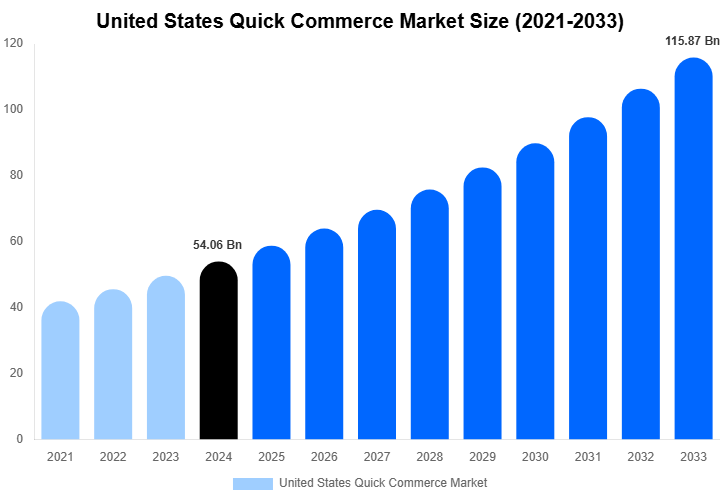
Source: DMI Analysis Company Publications, Primary Interviews.

Other Key Findings
- United States contributed 28.46% to the global Quick Commerce Market size in 2025.
- By 2034, United States is forecasted to remain the largest global market for Quick Commerce Market.
- In North America, United States is projected to capture the leading share of market size by 2034.
- Among North America markets, Canada is expected to post the fastest growth, reaching USD 48.25 Billion by 2034.
United States Quick Commerce Market Dynamics
- The United States quick commerce market is driven by increasing demand for convenience-based shopping, rising adoption of online grocery services, growing smartphone usage, expanding digital payments, and increasing preference for instant delivery solutions. Consumers increasingly use quick commerce platforms for groceries, beverages, prepared foods, household essentials, personal care products, and everyday necessities.
- Quick commerce platforms, supermarkets, grocery retailers, convenience stores, food delivery companies, dark store operators, logistics providers, and online marketplaces strengthen market accessibility through digital platforms and localized fulfillment networks. Companies increasingly improve delivery speed, product assortment, customer loyalty programs, and personalized shopping experiences.
- Market participants invest in artificial intelligence, automated fulfillment centers, predictive analytics, warehouse robotics, route optimization technologies, and supply chain management systems to strengthen competitive differentiation. Innovation increasingly focuses on faster delivery, smart inventory management, sustainable packaging, private-label products, and integrated retail ecosystems.
- Companies collaborate with retailers, technology providers, logistics companies, restaurants, consumer brands, and e-commerce platforms to strengthen market expansion. Continued investment in digital commerce infrastructure, automation, last-mile logistics, and consumer convenience reinforces competitiveness across the United States quick commerce industry.
Key Market Insights
- Instant delivery strengthens demand.
- Digital grocery expands adoption.
- Automation improves competitiveness.
- E-commerce integration supports growth.
United States Quick Commerce Market Product Category 2026-2034 (USD Billion)
| Product Category | 2022 | 2023 | 2024 | 2025 | 2026 | 2027 | 2028 | 2029 | 2030 | 2031 | 2032 | 2033 | 2034 |
|---|---|---|---|---|---|---|---|---|---|---|---|---|---|
| Grocery | XX.x | XX.x | XX.x | 24.63 | XX.x | XX.x | XX.x | XX.x | XX.x | XX.x | XX.x | XX.x | XX.x |
| Pharmacy | XX.x | XX.x | XX.x | XX.x | XX.x | XX.x | XX.x | XX.x | XX.x | XX.x | XX.x | XX.x | XX.x |
| Food | XX.x | XX.x | XX.x | XX.x | XX.x | XX.x | XX.x | XX.x | XX.x | XX.x | XX.x | XX.x | XX.x |
| Other Essentials | XX.x | XX.x | XX.x | XX.x | XX.x | XX.x | XX.x | XX.x | XX.x | XX.x | XX.x | XX.x | XX.x |
| Total | XX.x | XX.x | XX.x | 56.28 | XX.x | XX.x | XX.x | XX.x | XX.x | XX.x | XX.x | XX.x | XX.x |
Source: DMI Analysis Company Publications, Primary Interviews.
United States Quick Commerce Market Delivery Model 2026-2034 (USD Billion)
| Delivery Model | 2022 | 2023 | 2024 | 2025 | 2026 | 2027 | 2028 | 2029 | 2030 | 2031 | 2032 | 2033 | 2034 |
|---|---|---|---|---|---|---|---|---|---|---|---|---|---|
| Dark Stores | XX.x | XX.x | XX.x | XX.x | XX.x | XX.x | XX.x | XX.x | XX.x | XX.x | XX.x | XX.x | XX.x |
| Partner Retail | XX.x | XX.x | XX.x | XX.x | XX.x | XX.x | XX.x | XX.x | XX.x | XX.x | XX.x | XX.x | XX.x |
| Total | XX.x | XX.x | XX.x | XX.x | XX.x | XX.x | XX.x | XX.x | XX.x | XX.x | XX.x | XX.x | XX.x |
Source: DMI Analysis Company Publications, Primary Interviews.
United States Quick Commerce Market Payment Method 2026-2034 (USD Billion)
| Payment Method | 2022 | 2023 | 2024 | 2025 | 2026 | 2027 | 2028 | 2029 | 2030 | 2031 | 2032 | 2033 | 2034 |
|---|---|---|---|---|---|---|---|---|---|---|---|---|---|
| Online Payment | XX.x | XX.x | XX.x | XX.x | XX.x | XX.x | XX.x | XX.x | XX.x | XX.x | XX.x | XX.x | XX.x |
| Cash On Delivery | XX.x | XX.x | XX.x | XX.x | XX.x | XX.x | XX.x | XX.x | XX.x | XX.x | XX.x | XX.x | XX.x |
| Total | XX.x | XX.x | XX.x | XX.x | XX.x | XX.x | XX.x | XX.x | XX.x | XX.x | XX.x | XX.x | XX.x |
Source: DMI Analysis Company Publications, Primary Interviews.
Report Summary
| Report Scope | Details |
|---|---|
| Base Year for Study | 2025 |
| Study Period | 2022-2034 |
| Historical Period | 2022-2024 |
| Forecast Period | 2026-2034 |
| Market Size In 2025 | USD 56.28 Billion |
| Market Size In 2034 | USD 121.71 Billion |
| Largest segment | Grocery |
| Units | Revenue in USD Billion |
| CAGR | 8.96% (2026-2034) |
| Report Coverage | Revenue Forecast, Competitive Landscape, Growth Factors, Environment & Regulatory Landscape and Trends |