India Quick Commerce Market Size & Outlook, 2026-2034
Last Updated : 31 July, 2026 |
Study Period : 2022-2034 |
Format : PDF, Excel |
Author : Anna Morgan
India Quick Commerce Market Insights
- As per Deep Market Insights insights, the India Quick Commerce Market stood at USD 7.85 Billion in 2025 and is anticipated to grow to USD 18.41 Billion by 2034.
- The India market is expected to advance at a CAGR of 9.83% from 2026 through 2034.
- In 2025, Grocery accounted for the highest share of the Product Category market size.
- During the forecast period, Grocery is set to register the highest growth, making it the most lucrative Product Category segment.
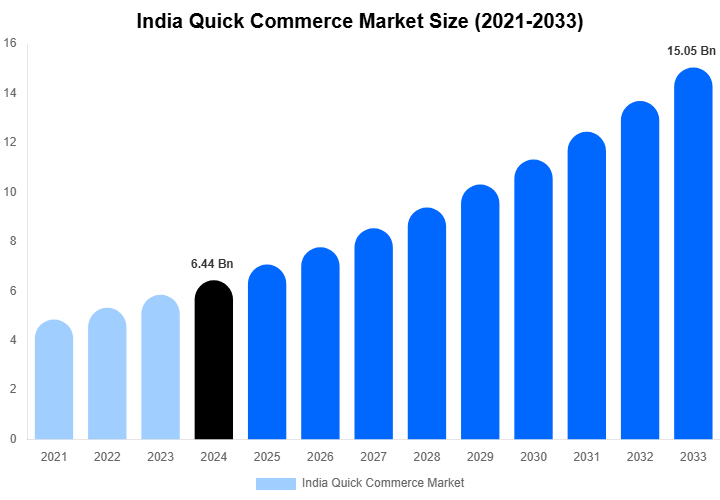
Source: DMI Analysis Company Publications, Primary Interviews.

Other Key Findings
- In 2025, India represented 3.97% of the overall global Quick Commerce Market size.
- United States is projected to lead the global Quick Commerce Market size by 2034.
- Across Asia Pacific, China is anticipated to hold the dominant position in market size by 2034.
- China is forecasted to expand at the fastest pace in Asia Pacific, attaining USD 34.3 Billion by 2034.
India Quick Commerce Market Dynamics
- India's quick commerce market is driven by increasing urbanization, rising smartphone penetration, growing digital payment adoption, expanding e-commerce usage, and increasing demand for instant delivery of groceries and daily essentials. Consumers increasingly use quick commerce platforms for fresh produce, packaged foods, beverages, personal care products, household essentials, medicines, and ready-to-eat meals due to convenience and time-saving benefits.
- Quick commerce platforms, online grocery companies, supermarkets, convenience retailers, dark store operators, logistics providers, and consumer brands strengthen market accessibility through mobile applications, hyperlocal delivery networks, and micro-fulfillment centers. Companies increasingly improve delivery coverage, product assortment, affordability, customer loyalty programs, and digital shopping experiences.
- Market participants invest in artificial intelligence-based demand forecasting, automated inventory systems, warehouse management technologies, route optimization software, and last-mile delivery solutions to strengthen operational efficiency. Innovation increasingly focuses on faster delivery models, private-label products, sustainable packaging, subscription services, and personalized consumer recommendations.
- Companies collaborate with grocery retailers, logistics providers, technology firms, restaurants, pharmaceutical companies, and consumer goods brands to strengthen quick commerce expansion. Continued investment in digital infrastructure, urban delivery networks, automation, and consumer convenience reinforces competitiveness across India's quick commerce industry.
Key Market Insights
- Digital adoption strengthens demand.
- Urban consumers drive expansion.
- Hyperlocal delivery improves competitiveness.
- Technology innovation supports growth.
India Quick Commerce Market Product Category 2026-2034 (USD Billion)
| Product Category | 2022 | 2023 | 2024 | 2025 | 2026 | 2027 | 2028 | 2029 | 2030 | 2031 | 2032 | 2033 | 2034 |
|---|---|---|---|---|---|---|---|---|---|---|---|---|---|
| Grocery | XX.x | XX.x | XX.x | 3.14 | XX.x | XX.x | XX.x | XX.x | XX.x | XX.x | XX.x | XX.x | XX.x |
| Pharmacy | XX.x | XX.x | XX.x | XX.x | XX.x | XX.x | XX.x | XX.x | XX.x | XX.x | XX.x | XX.x | XX.x |
| Food | XX.x | XX.x | XX.x | XX.x | XX.x | XX.x | XX.x | XX.x | XX.x | XX.x | XX.x | XX.x | XX.x |
| Other Essentials | XX.x | XX.x | XX.x | XX.x | XX.x | XX.x | XX.x | XX.x | XX.x | XX.x | XX.x | XX.x | XX.x |
| Total | XX.x | XX.x | XX.x | 7.85 | XX.x | XX.x | XX.x | XX.x | XX.x | XX.x | XX.x | XX.x | XX.x |
Source: DMI Analysis Company Publications, Primary Interviews.
India Quick Commerce Market Delivery Model 2026-2034 (USD Billion)
| Delivery Model | 2022 | 2023 | 2024 | 2025 | 2026 | 2027 | 2028 | 2029 | 2030 | 2031 | 2032 | 2033 | 2034 |
|---|---|---|---|---|---|---|---|---|---|---|---|---|---|
| Dark Stores | XX.x | XX.x | XX.x | XX.x | XX.x | XX.x | XX.x | XX.x | XX.x | XX.x | XX.x | XX.x | XX.x |
| Partner Retail | XX.x | XX.x | XX.x | XX.x | XX.x | XX.x | XX.x | XX.x | XX.x | XX.x | XX.x | XX.x | XX.x |
| Total | XX.x | XX.x | XX.x | XX.x | XX.x | XX.x | XX.x | XX.x | XX.x | XX.x | XX.x | XX.x | XX.x |
Source: DMI Analysis Company Publications, Primary Interviews.
India Quick Commerce Market Payment Method 2026-2034 (USD Billion)
| Payment Method | 2022 | 2023 | 2024 | 2025 | 2026 | 2027 | 2028 | 2029 | 2030 | 2031 | 2032 | 2033 | 2034 |
|---|---|---|---|---|---|---|---|---|---|---|---|---|---|
| Online Payment | XX.x | XX.x | XX.x | XX.x | XX.x | XX.x | XX.x | XX.x | XX.x | XX.x | XX.x | XX.x | XX.x |
| Cash On Delivery | XX.x | XX.x | XX.x | XX.x | XX.x | XX.x | XX.x | XX.x | XX.x | XX.x | XX.x | XX.x | XX.x |
| Total | XX.x | XX.x | XX.x | XX.x | XX.x | XX.x | XX.x | XX.x | XX.x | XX.x | XX.x | XX.x | XX.x |
Source: DMI Analysis Company Publications, Primary Interviews.
Inside This Report
This section examines India's quick commerce market through digital retail transformation, consumer behavior, logistics innovation, and competitive developments.
- Country market landscape: Reviews India's quick commerce ecosystem.
- Consumer and retail trends: Explores online grocery adoption, convenience shopping, digital payments, and changing lifestyles.
- Technology and service innovation: Covers dark stores, micro-fulfillment centers, AI forecasting, inventory management, and delivery optimization.
- Competitive and industry developments: Highlights partnerships, platform expansion, logistics investments, and retail innovation.
Report Summary
| Report Scope | Details |
|---|---|
| Base Year for Study | 2025 |
| Study Period | 2022-2034 |
| Historical Period | 2022-2024 |
| Forecast Period | 2026-2034 |
| Market Size In 2025 | USD 7.85 Billion |
| Market Size In 2034 | USD 18.41 Billion |
| Largest segment | Grocery |
| Units | Revenue in USD Billion |
| CAGR | 9.83% (2026-2034) |
| Report Coverage | Revenue Forecast, Competitive Landscape, Growth Factors, Environment & Regulatory Landscape and Trends |