United Arab Emirates Protein Supplements Market Size & Outlook, 2025-2033
United Arab Emirates Protein Supplements Market Insights
- Deep Market Insights analysis indicates that the United Arab Emirates Protein Supplements Market size, valued at USD 1689.23 Million in 2024, is expected to expand to USD 4521.78 Million by 2033.
- The United Arab Emirates market is forecasted to expand at a CAGR of 11.56% spanning 2026–2033.
- Protein Powders (Whey, Casein, Plant-Based) held the leading position among Product Type segments in 2024, based on market size.
- Protein Bars is projected to post the fastest growth rate, sustaining its position as the most attractive Product Type segment during the forecast horizon.
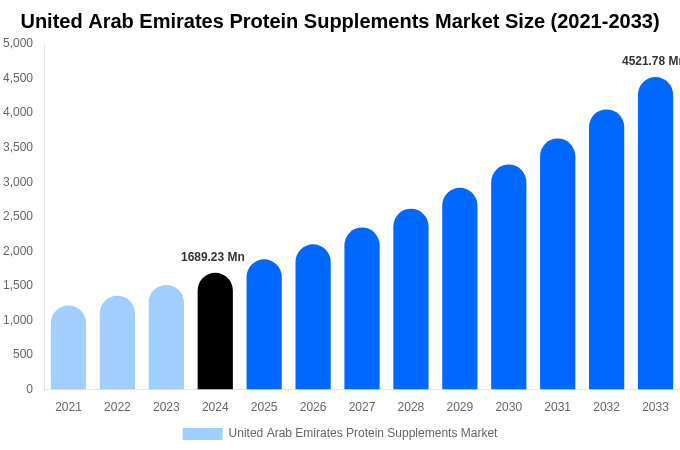
Source: DMI Analysis Company Publications, Primary Interviews.

Other Key Findings
- As of 2024, United Arab Emirates held 5.99% of the global Protein Supplements Market size.
- By 2033, United States is anticipated to capture the largest share of the global Protein Supplements Market.
- In Middle East and Africa, United Arab Emirates is expected to lead the regional Protein Supplements Market size by 2033.
- Turkey will remain the fastest-growing market in Middle East and Africa, reaching USD 616.46 Million by 2033.
Report Summary
| Report Scope | Details |
|---|---|
| Base Year for Study | 2024 |
| Study Period | 2021-2033 |
| Historical Period | 2021-2023 |
| Forecast Period | 2025-2033 |
| Market Size In 2024 | USD 1689.23 Million |
| Market Size In 2033 | USD 4521.78 Million |
| Largest segment | Protein Powders (Whey, Casein, Plant-Based) |
| Units | Revenue in USD Million |
| CAGR | 11.56% (2025-2033) |
| Segmnetation Covered | |
| Product Type |
|
| Application |
|
| Distribution Channel |
|
| End User |
|
| Report Coverage | Revenue Forecast, Competitive Landscape, Growth Factors, Environment & Regulatory Landscape and Trends |
United Arab Emirates Protein Supplements Market Product Type 2025-2033 (USD Million)
| Product Type | 2021 | 2022 | 2023 | 2024 | 2025 | 2026 | 2027 | 2028 | 2029 | 2030 | 2031 | 2032 | 2033 |
|---|---|---|---|---|---|---|---|---|---|---|---|---|---|
| Protein Powders (Whey, Casein, Plant-Based) | XX.x | XX.x | XX.x | 722.99 | XX.x | XX.x | XX.x | XX.x | XX.x | XX.x | XX.x | XX.x | XX.x |
| Protein Bars | XX.x | XX.x | XX.x | XX.x | XX.x | XX.x | XX.x | XX.x | XX.x | XX.x | XX.x | XX.x | XX.x |
| Ready-to-Drink (RTD) Protein Beverages | XX.x | XX.x | XX.x | XX.x | XX.x | XX.x | XX.x | XX.x | XX.x | XX.x | XX.x | XX.x | XX.x |
| Capsules & Tablets | XX.x | XX.x | XX.x | XX.x | XX.x | XX.x | XX.x | XX.x | XX.x | XX.x | XX.x | XX.x | XX.x |
| Total | XX.x | XX.x | XX.x | XX.x | XX.x | XX.x | XX.x | XX.x | XX.x | XX.x | XX.x | XX.x | XX.x |
Source: DMI Analysis Company Publications, Primary Interviews.
United Arab Emirates Protein Supplements Market Application 2025-2033 (USD Million)
| Application | 2021 | 2022 | 2023 | 2024 | 2025 | 2026 | 2027 | 2028 | 2029 | 2030 | 2031 | 2032 | 2033 |
|---|---|---|---|---|---|---|---|---|---|---|---|---|---|
| Sports Nutrition | XX.x | XX.x | XX.x | 591.23 | XX.x | XX.x | XX.x | XX.x | XX.x | XX.x | XX.x | XX.x | XX.x |
| Weight Management | XX.x | XX.x | XX.x | XX.x | XX.x | XX.x | XX.x | XX.x | XX.x | XX.x | XX.x | XX.x | XX.x |
| Functional Foods & Wellness | XX.x | XX.x | XX.x | XX.x | XX.x | XX.x | XX.x | XX.x | XX.x | XX.x | XX.x | XX.x | XX.x |
| Clinical Nutrition | XX.x | XX.x | XX.x | XX.x | XX.x | XX.x | XX.x | XX.x | XX.x | XX.x | XX.x | XX.x | XX.x |
| Beauty & Collagen Supplements | XX.x | XX.x | XX.x | XX.x | XX.x | XX.x | XX.x | XX.x | XX.x | XX.x | XX.x | XX.x | XX.x |
| Total | XX.x | XX.x | XX.x | XX.x | XX.x | XX.x | XX.x | XX.x | XX.x | XX.x | XX.x | XX.x | XX.x |
Source: DMI Analysis Company Publications, Primary Interviews.
United Arab Emirates Protein Supplements Market Distribution Channel 2025-2033 (USD Million)
| Distribution Channel | 2021 | 2022 | 2023 | 2024 | 2025 | 2026 | 2027 | 2028 | 2029 | 2030 | 2031 | 2032 | 2033 |
|---|---|---|---|---|---|---|---|---|---|---|---|---|---|
| Online Retail / D2C Platforms | XX.x | XX.x | XX.x | 591.4 | XX.x | XX.x | XX.x | XX.x | XX.x | XX.x | XX.x | XX.x | XX.x |
| Specialty Stores / Health Stores | XX.x | XX.x | XX.x | XX.x | XX.x | XX.x | XX.x | XX.x | XX.x | XX.x | XX.x | XX.x | XX.x |
| Pharmacies | XX.x | XX.x | XX.x | XX.x | XX.x | XX.x | XX.x | XX.x | XX.x | XX.x | XX.x | XX.x | XX.x |
| Supermarkets & Hypermarkets | XX.x | XX.x | XX.x | XX.x | XX.x | XX.x | XX.x | XX.x | XX.x | XX.x | XX.x | XX.x | XX.x |
| Gyms and Fitness Centers | XX.x | XX.x | XX.x | XX.x | XX.x | XX.x | XX.x | XX.x | XX.x | XX.x | XX.x | XX.x | XX.x |
| Total | XX.x | XX.x | XX.x | XX.x | XX.x | XX.x | XX.x | XX.x | XX.x | XX.x | XX.x | XX.x | XX.x |
Source: DMI Analysis Company Publications, Primary Interviews.
United Arab Emirates Protein Supplements Market End User 2025-2033 (USD Million)
| End User | 2021 | 2022 | 2023 | 2024 | 2025 | 2026 | 2027 | 2028 | 2029 | 2030 | 2031 | 2032 | 2033 |
|---|---|---|---|---|---|---|---|---|---|---|---|---|---|
| Adults (25–45 Years) | XX.x | XX.x | XX.x | 796.98 | XX.x | XX.x | XX.x | XX.x | XX.x | XX.x | XX.x | XX.x | XX.x |
| Teenagers (13–24 Years) | XX.x | XX.x | XX.x | XX.x | XX.x | XX.x | XX.x | XX.x | XX.x | XX.x | XX.x | XX.x | XX.x |
| Women | XX.x | XX.x | XX.x | XX.x | XX.x | XX.x | XX.x | XX.x | XX.x | XX.x | XX.x | XX.x | XX.x |
| Seniors (50+ Years) | XX.x | XX.x | XX.x | XX.x | XX.x | XX.x | XX.x | XX.x | XX.x | XX.x | XX.x | XX.x | XX.x |
| Total | XX.x | XX.x | XX.x | XX.x | XX.x | XX.x | XX.x | XX.x | XX.x | XX.x | XX.x | XX.x | XX.x |
Source: DMI Analysis Company Publications, Primary Interviews.