Asia Pacific Plant-based Milk Market Size & Outlook, 2026-2034
Last Updated : 24 July, 2026 |
Study Period : 2022-2034 |
Format : PDF, Excel |
Author : Hannah Blake
Asia Pacific Plant-based Milk Market Insights
- According to Deep Market Insights analysis, the Asia Pacific Plant-based Milk Market size stood at USD 3584.07 Million in 2025 and is forecasted to reach USD 6935.07 Million by 2034.
- The market is projected to grow at a CAGR of 7.62% between 2026 and 2034.
- By segment, Almond was the leading Product in terms of market size in 2025.
- Oat is expected to be the most lucrative Product segment, exhibiting the fastest growth throughout the forecast period.
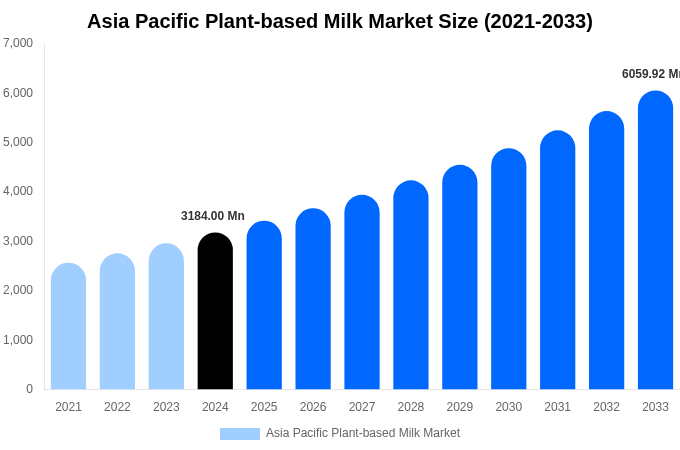
Source: DMI Analysis Company Publications, Primary Interviews.

Other Key Findings
- Asia Pacific held 15.35% share of the global Plant-based Milk Market size in 2025.
- United States is expected to remain the largest contributor to the global market size by 2034.
- By 2034, Korea is anticipated to record the highest growth in Asia Pacific, with the market size expected to reach USD 459.91 Million.
Asia Pacific Plant-Based Milk Market Dynamics
- Diverse dietary habits and rising health awareness encourage consumers across Asia Pacific to explore plant-based milk as part of balanced nutrition. Manufacturers develop products using soy, oat, almond, coconut, rice, and other locally relevant ingredients to address varying consumer preferences across regional markets.
- Expanding supermarket networks, convenience stores, e-commerce platforms, and specialty retailers strengthen product accessibility throughout developed and emerging economies. Digital commerce supports rapid product launches, personalized marketing initiatives, and broader consumer engagement across multiple purchasing channels.
- Manufacturers continue investing in fortified nutrition, localized flavor development, and advanced production technologies to improve product quality and consumer appeal. Innovation increasingly emphasizes clean-label ingredients, reduced sugar formulations, and beverage versatility suitable for household and foodservice applications.
- Growing café culture and expanding hospitality industries contribute to wider commercial adoption of plant-based milk across restaurants, coffee shops, and hotels. Beverage suppliers strengthen partnerships with foodservice operators to support menu diversification and meet evolving consumer expectations.
Key Industry Insights
- Soy beverages maintain strong consumer familiarity across many Asia Pacific markets.
- E-commerce continues expanding packaged beverage accessibility.
- Convenience stores play an important beverage retail role.
- Functional nutrition remains a growing consumer priority.
Asia Pacific Plant-based Milk Market Country 2026-2034 (USD Million)
| Asia Pacific | 2022 | 2023 | 2024 | 2025 | 2026 | 2027 | 2028 | 2029 | 2030 | 2031 | 2032 | 2033 | 2034 |
|---|---|---|---|---|---|---|---|---|---|---|---|---|---|
| China | XX.x | XX.x | XX.x | 1366.96 | XX.x | XX.x | XX.x | XX.x | XX.x | XX.x | XX.x | XX.x | XX.x |
| India | XX.x | XX.x | XX.x | XX.x | XX.x | XX.x | XX.x | XX.x | XX.x | XX.x | XX.x | XX.x | XX.x |
| Japan | XX.x | XX.x | XX.x | XX.x | XX.x | XX.x | XX.x | XX.x | XX.x | XX.x | XX.x | XX.x | XX.x |
| Korea | XX.x | XX.x | XX.x | XX.x | XX.x | XX.x | XX.x | XX.x | XX.x | XX.x | XX.x | XX.x | XX.x |
| Taiwan | XX.x | XX.x | XX.x | XX.x | XX.x | XX.x | XX.x | XX.x | XX.x | XX.x | XX.x | XX.x | XX.x |
| Australia | XX.x | XX.x | XX.x | XX.x | XX.x | XX.x | XX.x | XX.x | XX.x | XX.x | XX.x | XX.x | XX.x |
| Singapore | XX.x | XX.x | XX.x | XX.x | XX.x | XX.x | XX.x | XX.x | XX.x | XX.x | XX.x | XX.x | XX.x |
| South East Asia | XX.x | XX.x | XX.x | XX.x | XX.x | XX.x | XX.x | XX.x | XX.x | XX.x | XX.x | XX.x | XX.x |
| Total | XX.x | XX.x | XX.x | 3,584.07 | XX.x | XX.x | XX.x | XX.x | XX.x | XX.x | XX.x | XX.x | XX.x |
Source: DMI Analysis Company Publications, Primary Interviews.
Asia Pacific Plant-based Milk Market Product 2026-2034 (USD Million)
| Product | 2022 | 2023 | 2024 | 2025 | 2026 | 2027 | 2028 | 2029 | 2030 | 2031 | 2032 | 2033 | 2034 |
|---|---|---|---|---|---|---|---|---|---|---|---|---|---|
| Almond | XX.x | XX.x | XX.x | 1125.4 | XX.x | XX.x | XX.x | XX.x | XX.x | XX.x | XX.x | XX.x | XX.x |
| Oat | XX.x | XX.x | XX.x | XX.x | XX.x | XX.x | XX.x | XX.x | XX.x | XX.x | XX.x | XX.x | XX.x |
| Soy | XX.x | XX.x | XX.x | XX.x | XX.x | XX.x | XX.x | XX.x | XX.x | XX.x | XX.x | XX.x | XX.x |
| Coconut | XX.x | XX.x | XX.x | XX.x | XX.x | XX.x | XX.x | XX.x | XX.x | XX.x | XX.x | XX.x | XX.x |
| Rice | XX.x | XX.x | XX.x | XX.x | XX.x | XX.x | XX.x | XX.x | XX.x | XX.x | XX.x | XX.x | XX.x |
| Others | XX.x | XX.x | XX.x | XX.x | XX.x | XX.x | XX.x | XX.x | XX.x | XX.x | XX.x | XX.x | XX.x |
| Total | XX.x | XX.x | XX.x | 3,584.07 | XX.x | XX.x | XX.x | XX.x | XX.x | XX.x | XX.x | XX.x | XX.x |
Source: DMI Analysis Company Publications, Primary Interviews.
Asia Pacific Plant-based Milk Market Nature 2026-2034 (USD Million)
| Nature | 2022 | 2023 | 2024 | 2025 | 2026 | 2027 | 2028 | 2029 | 2030 | 2031 | 2032 | 2033 | 2034 |
|---|---|---|---|---|---|---|---|---|---|---|---|---|---|
| Organic | XX.x | XX.x | XX.x | XX.x | XX.x | XX.x | XX.x | XX.x | XX.x | XX.x | XX.x | XX.x | XX.x |
| Conventional | XX.x | XX.x | XX.x | XX.x | XX.x | XX.x | XX.x | XX.x | XX.x | XX.x | XX.x | XX.x | XX.x |
| Total | XX.x | XX.x | XX.x | XX.x | XX.x | XX.x | XX.x | XX.x | XX.x | XX.x | XX.x | XX.x | XX.x |
Source: DMI Analysis Company Publications, Primary Interviews.
Asia Pacific Plant-based Milk Market Flavor 2026-2034 (USD Million)
| Flavor | 2022 | 2023 | 2024 | 2025 | 2026 | 2027 | 2028 | 2029 | 2030 | 2031 | 2032 | 2033 | 2034 |
|---|---|---|---|---|---|---|---|---|---|---|---|---|---|
| Flavored | XX.x | XX.x | XX.x | XX.x | XX.x | XX.x | XX.x | XX.x | XX.x | XX.x | XX.x | XX.x | XX.x |
| Non Flavored | XX.x | XX.x | XX.x | XX.x | XX.x | XX.x | XX.x | XX.x | XX.x | XX.x | XX.x | XX.x | XX.x |
| Total | XX.x | XX.x | XX.x | XX.x | XX.x | XX.x | XX.x | XX.x | XX.x | XX.x | XX.x | XX.x | XX.x |
Source: DMI Analysis Company Publications, Primary Interviews.
Asia Pacific Plant-based Milk Market Distribution Channel 2026-2034 (USD Million)
| Distribution Channel | 2022 | 2023 | 2024 | 2025 | 2026 | 2027 | 2028 | 2029 | 2030 | 2031 | 2032 | 2033 | 2034 |
|---|---|---|---|---|---|---|---|---|---|---|---|---|---|
| Supermarkets and Hypermarkets | XX.x | XX.x | XX.x | 1263.38 | XX.x | XX.x | XX.x | XX.x | XX.x | XX.x | XX.x | XX.x | XX.x |
| Convenience Stores | XX.x | XX.x | XX.x | XX.x | XX.x | XX.x | XX.x | XX.x | XX.x | XX.x | XX.x | XX.x | XX.x |
| Specialty Stores | XX.x | XX.x | XX.x | XX.x | XX.x | XX.x | XX.x | XX.x | XX.x | XX.x | XX.x | XX.x | XX.x |
| Online | XX.x | XX.x | XX.x | XX.x | XX.x | XX.x | XX.x | XX.x | XX.x | XX.x | XX.x | XX.x | XX.x |
| Others | XX.x | XX.x | XX.x | XX.x | XX.x | XX.x | XX.x | XX.x | XX.x | XX.x | XX.x | XX.x | XX.x |
| Total | XX.x | XX.x | XX.x | 3,584.06 | XX.x | XX.x | XX.x | XX.x | XX.x | XX.x | XX.x | XX.x | XX.x |
Source: DMI Analysis Company Publications, Primary Interviews.
Inside This Report
This section examines the Asia Pacific plant-based milk market through evolving consumer preferences, retail expansion, manufacturing innovation, digital commerce, and foodservice developments. It explains how beverage manufacturers respond to diverse regional dietary patterns by strengthening product portfolios, distribution networks, and commercial partnerships across the region.
- Regional market landscape: Reviews commercial developments across Asia Pacific beverage markets.
- Consumer and purchasing trends: Explores changing dietary habits and wellness-oriented lifestyles.
- Product innovation and distribution: Covers localized formulations and expanding retail channels.
- Competitive and industry developments: Highlights manufacturing capabilities and foodservice collaborations.
Report Summary
| Report Scope | Details |
|---|---|
| Base Year for Study | 2025 |
| Study Period | 2022-2034 |
| Historical Period | 2022-2024 |
| Forecast Period | 2026-2034 |
| Market Size In 2025 | USD 3584.07 Million |
| Market Size In 2034 | USD 6935.07 Million |
| Largest segment | Almond |
| Units | Revenue in USD Million |
| CAGR | 7.62% (2026-2034) |
| Report Coverage | Revenue Forecast, Competitive Landscape, Growth Factors, Environment & Regulatory Landscape and Trends |