Korea Organic Hair Color Market Size & Outlook, 2026-2034
Last Updated : 31 July, 2026 |
Study Period : 2022-2034 |
Format : PDF, Excel |
Author : Anna Morgan
Korea Organic Hair Color Market Insights
- As per Deep Market Insights insights, the Korea Organic Hair Color Market stood at USD 18.09 Million in 2025 and is anticipated to grow to USD 42.17 Million by 2034.
- The Korea market is expected to advance at a CAGR of 9.91% from 2026 through 2034.
- In 2025, Permanent accounted for the highest share of the Product Type market size.
- During the forecast period, Temporary is set to register the highest growth, making it the most lucrative Product Type segment.
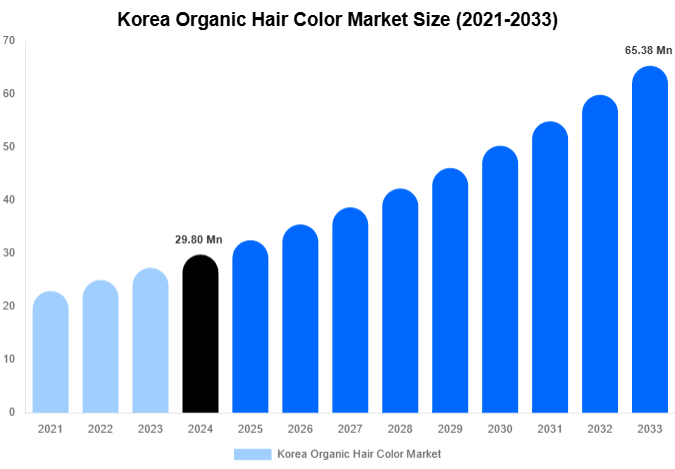
Source: DMI Analysis Company Publications, Primary Interviews.

Other Key Findings
- In 2025, Korea accounted for 0.95% of the global Organic Hair Color Market size.
- By 2034, United States is expected to lead the global Organic Hair Color Market in terms of market size.
- Within Asia Pacific, China is projected to dominate the regional Organic Hair Color Market size by 2034.
- Korea is identified as the fastest-growing market in Asia Pacific, anticipated to reach USD 42.34 Million by 2034.
South Korea Organic Hair Color Market Dynamics
- South Korea's organic hair color market is driven by growing demand for premium natural cosmetics, increasing consumer awareness regarding chemical-free beauty products, expanding K-beauty innovation, and rising preference for botanical hair care. Consumers increasingly purchase organic hair color products formulated with herbal ingredients, plant extracts, natural pigments, and ammonia-free formulations that deliver effective coloring while maintaining hair health.
- Organic hair color manufacturers, beauty retailers, salons, pharmacies, supermarkets, online platforms, and cosmetic brands strengthen market accessibility through digital-first retail strategies. Companies increasingly improve premium botanical formulations, long-lasting color performance, eco-friendly packaging, and personalized beauty solutions.
- Manufacturers invest in botanical extraction technologies, natural pigment research, dermatological testing, ammonia-free coloring technologies, sustainable production, and advanced formulation science to strengthen competitive differentiation. Innovation increasingly emphasizes vegan products, clean-label cosmetics, herbal hair dyes, and multifunctional hair care formulations.
- Market participants collaborate with botanical ingredient suppliers, cosmetic laboratories, salons, retailers, research institutions, and beauty technology companies to strengthen product innovation and commercial expansion. Continued investment in K-beauty innovation, sustainable cosmetics, premium formulations, and natural ingredients reinforces competitiveness across South Korea's organic hair color industry.
Key Market Insights
- K-beauty innovation strengthens demand.
- Botanical ingredients expand adoption.
- Premium formulations improve competitiveness.
- Sustainable beauty supports growth.
Korea Organic Hair Color Market Product Type 2026-2034 (USD Million)
| Product Type | 2022 | 2023 | 2024 | 2025 | 2026 | 2027 | 2028 | 2029 | 2030 | 2031 | 2032 | 2033 | 2034 |
|---|---|---|---|---|---|---|---|---|---|---|---|---|---|
| Permanent | XX.x | XX.x | XX.x | 9.32 | XX.x | XX.x | XX.x | XX.x | XX.x | XX.x | XX.x | XX.x | XX.x |
| Semi-Permanent | XX.x | XX.x | XX.x | XX.x | XX.x | XX.x | XX.x | XX.x | XX.x | XX.x | XX.x | XX.x | XX.x |
| Temporary | XX.x | XX.x | XX.x | XX.x | XX.x | XX.x | XX.x | XX.x | XX.x | XX.x | XX.x | XX.x | XX.x |
| Total | XX.x | XX.x | XX.x | 18.09 | XX.x | XX.x | XX.x | XX.x | XX.x | XX.x | XX.x | XX.x | XX.x |
Source: DMI Analysis Company Publications, Primary Interviews.
Korea Organic Hair Color Market Distribution Channel 2026-2034 (USD Million)
| Distribution Channel | 2022 | 2023 | 2024 | 2025 | 2026 | 2027 | 2028 | 2029 | 2030 | 2031 | 2032 | 2033 | 2034 |
|---|---|---|---|---|---|---|---|---|---|---|---|---|---|
| Salons/Professional | XX.x | XX.x | XX.x | 9.8 | XX.x | XX.x | XX.x | XX.x | XX.x | XX.x | XX.x | XX.x | XX.x |
| Retail Stores | XX.x | XX.x | XX.x | XX.x | XX.x | XX.x | XX.x | XX.x | XX.x | XX.x | XX.x | XX.x | XX.x |
| E-commerce | XX.x | XX.x | XX.x | XX.x | XX.x | XX.x | XX.x | XX.x | XX.x | XX.x | XX.x | XX.x | XX.x |
| Total | XX.x | XX.x | XX.x | 18.09 | XX.x | XX.x | XX.x | XX.x | XX.x | XX.x | XX.x | XX.x | XX.x |
Source: DMI Analysis Company Publications, Primary Interviews.
Korea Organic Hair Color Market Ingredient Claim 2026-2034 (USD Million)
| Ingredient Claim | 2022 | 2023 | 2024 | 2025 | 2026 | 2027 | 2028 | 2029 | 2030 | 2031 | 2032 | 2033 | 2034 |
|---|---|---|---|---|---|---|---|---|---|---|---|---|---|
| Plant-Based | XX.x | XX.x | XX.x | 8.31 | XX.x | XX.x | XX.x | XX.x | XX.x | XX.x | XX.x | XX.x | XX.x |
| Ammonia-Free | XX.x | XX.x | XX.x | XX.x | XX.x | XX.x | XX.x | XX.x | XX.x | XX.x | XX.x | XX.x | XX.x |
| Certified Organic | XX.x | XX.x | XX.x | XX.x | XX.x | XX.x | XX.x | XX.x | XX.x | XX.x | XX.x | XX.x | XX.x |
| Total | XX.x | XX.x | XX.x | 18.09 | XX.x | XX.x | XX.x | XX.x | XX.x | XX.x | XX.x | XX.x | XX.x |
Source: DMI Analysis Company Publications, Primary Interviews.
Inside This Report
This section examines South Korea's organic hair color market through beauty innovation, botanical formulations, consumer preferences, and competitive developments.
- Country market landscape: Reviews South Korea's organic hair color ecosystem.
- Consumer and beauty trends: Explores clean beauty, vegan cosmetics, and herbal hair care.
- Product innovation and applications: Covers herbal hair dyes, permanent colors, semi-permanent colors, and salon products.
- Competitive and industry developments: Highlights innovation, partnerships, and digital retail expansion.
Report Summary
| Report Scope | Details |
|---|---|
| Base Year for Study | 2025 |
| Study Period | 2022-2034 |
| Historical Period | 2022-2024 |
| Forecast Period | 2026-2034 |
| Market Size In 2025 | USD 18.09 Million |
| Market Size In 2034 | USD 42.17 Million |
| Largest segment | Permanent |
| Units | Revenue in USD Million |
| CAGR | 9.91% (2026-2034) |
| Report Coverage | Revenue Forecast, Competitive Landscape, Growth Factors, Environment & Regulatory Landscape and Trends |