India Organic Hair Color Market Size & Outlook, 2026-2034
Last Updated : 31 July, 2026 |
Study Period : 2022-2034 |
Format : PDF, Excel |
Author : Anna Morgan
India Organic Hair Color Market Insights
- As highlighted in Deep Market Insights analysis, the India Organic Hair Color Market, worth USD 65.14 Million in 2025, is forecasted to achieve USD 143.94 Million by 2034.
- The India market is anticipated to grow at a CAGR of 9.16% during the period 2026–2034.
- By 2025, Permanent represented the largest share of the Product Type market size.
- Semi-Permanent is expected to remain the key growth driver within Product Type, registering the fastest CAGR during the forecast period.
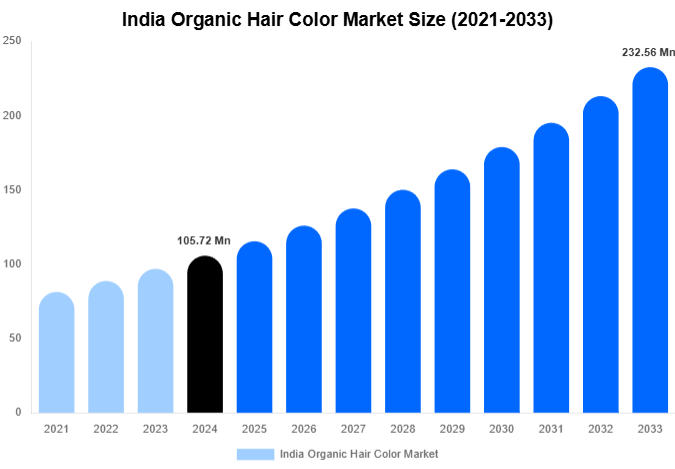
Source: DMI Analysis Company Publications, Primary Interviews.

Other Key Findings
- India contributed 3.4% to the global Organic Hair Color Market size in 2025.
- By 2034, United States is forecasted to remain the largest global market for Organic Hair Color Market.
- In Asia Pacific, China is projected to capture the leading share of market size by 2034.
- Among Asia Pacific markets, Korea is expected to post the fastest growth, reaching USD 42.34 Million by 2034.
India Organic Hair Color Market Dynamics
- India's organic hair color market is driven by increasing consumer preference for herbal and Ayurvedic beauty products, rising awareness regarding chemical-free hair care, growing demand for natural personal care solutions, and expanding premium beauty product consumption. Consumers increasingly adopt organic hair colors formulated with henna, indigo, amla, bhringraj, aloe vera, herbal extracts, and plant-based pigments that provide effective hair coloring while supporting scalp and hair health.
- Organic hair color manufacturers, Ayurvedic companies, beauty retailers, supermarkets, pharmacies, salons, specialty cosmetic stores, and online marketplaces strengthen market accessibility through omnichannel distribution. Companies increasingly improve botanical formulations, affordable premium products, sustainable packaging, and customized hair color solutions.
- Manufacturers invest in herbal extraction technologies, botanical pigment development, ammonia-free coloring systems, Ayurvedic formulation research, sustainable manufacturing processes, and dermatological testing to strengthen competitive differentiation. Innovation increasingly emphasizes vegan formulations, herbal hair dyes, gray hair coverage, clean-label ingredients, and multifunctional hair care products.
- Market participants collaborate with botanical ingredient suppliers, Ayurvedic manufacturers, cosmetic companies, salons, retailers, and research institutions to strengthen innovation and commercial expansion. Continued investment in herbal cosmetics, natural beauty products, clean-label formulations, and sustainable production reinforces competitiveness across India's organic hair color industry.
Key Market Insights
- Ayurvedic products strengthen demand.
- Herbal ingredients expand adoption.
- Chemical-free formulations improve competitiveness.
- Premium natural beauty supports growth.
India Organic Hair Color Market Product Type 2026-2034 (USD Million)
| Product Type | 2022 | 2023 | 2024 | 2025 | 2026 | 2027 | 2028 | 2029 | 2030 | 2031 | 2032 | 2033 | 2034 |
|---|---|---|---|---|---|---|---|---|---|---|---|---|---|
| Permanent | XX.x | XX.x | XX.x | 29.32 | XX.x | XX.x | XX.x | XX.x | XX.x | XX.x | XX.x | XX.x | XX.x |
| Semi-Permanent | XX.x | XX.x | XX.x | XX.x | XX.x | XX.x | XX.x | XX.x | XX.x | XX.x | XX.x | XX.x | XX.x |
| Temporary | XX.x | XX.x | XX.x | XX.x | XX.x | XX.x | XX.x | XX.x | XX.x | XX.x | XX.x | XX.x | XX.x |
| Total | XX.x | XX.x | XX.x | 65.14 | XX.x | XX.x | XX.x | XX.x | XX.x | XX.x | XX.x | XX.x | XX.x |
Source: DMI Analysis Company Publications, Primary Interviews.
India Organic Hair Color Market Distribution Channel 2026-2034 (USD Million)
| Distribution Channel | 2022 | 2023 | 2024 | 2025 | 2026 | 2027 | 2028 | 2029 | 2030 | 2031 | 2032 | 2033 | 2034 |
|---|---|---|---|---|---|---|---|---|---|---|---|---|---|
| Salons/Professional | XX.x | XX.x | XX.x | 31.4 | XX.x | XX.x | XX.x | XX.x | XX.x | XX.x | XX.x | XX.x | XX.x |
| Retail Stores | XX.x | XX.x | XX.x | XX.x | XX.x | XX.x | XX.x | XX.x | XX.x | XX.x | XX.x | XX.x | XX.x |
| E-commerce | XX.x | XX.x | XX.x | XX.x | XX.x | XX.x | XX.x | XX.x | XX.x | XX.x | XX.x | XX.x | XX.x |
| Total | XX.x | XX.x | XX.x | 65.13 | XX.x | XX.x | XX.x | XX.x | XX.x | XX.x | XX.x | XX.x | XX.x |
Source: DMI Analysis Company Publications, Primary Interviews.
India Organic Hair Color Market Ingredient Claim 2026-2034 (USD Million)
| Ingredient Claim | 2022 | 2023 | 2024 | 2025 | 2026 | 2027 | 2028 | 2029 | 2030 | 2031 | 2032 | 2033 | 2034 |
|---|---|---|---|---|---|---|---|---|---|---|---|---|---|
| Plant-Based | XX.x | XX.x | XX.x | 29.46 | XX.x | XX.x | XX.x | XX.x | XX.x | XX.x | XX.x | XX.x | XX.x |
| Ammonia-Free | XX.x | XX.x | XX.x | XX.x | XX.x | XX.x | XX.x | XX.x | XX.x | XX.x | XX.x | XX.x | XX.x |
| Certified Organic | XX.x | XX.x | XX.x | XX.x | XX.x | XX.x | XX.x | XX.x | XX.x | XX.x | XX.x | XX.x | XX.x |
| Total | XX.x | XX.x | XX.x | 65.13 | XX.x | XX.x | XX.x | XX.x | XX.x | XX.x | XX.x | XX.x | XX.x |
Source: DMI Analysis Company Publications, Primary Interviews.
Inside This Report
This section examines India's organic hair color market through Ayurvedic trends, botanical innovation, consumer preferences, and competitive strategies.
- Country market landscape: Reviews India's organic hair color ecosystem.
- Consumer and beauty trends: Explores herbal cosmetics, natural ingredients, and clean-label preferences.
- Product innovation and applications: Covers henna-based colors, herbal dyes, permanent colors, and salon products.
- Competitive and industry developments: Highlights innovation, partnerships, and retail expansion.
Report Summary
| Report Scope | Details |
|---|---|
| Base Year for Study | 2025 |
| Study Period | 2022-2034 |
| Historical Period | 2022-2024 |
| Forecast Period | 2026-2034 |
| Market Size In 2025 | USD 65.14 Million |
| Market Size In 2034 | USD 143.94 Million |
| Largest segment | Permanent |
| Units | Revenue in USD Million |
| CAGR | 9.16% (2026-2034) |
| Report Coverage | Revenue Forecast, Competitive Landscape, Growth Factors, Environment & Regulatory Landscape and Trends |