Asia Pacific Motorcycle Market Size & Outlook, 2026-2034
Last Updated : 27 July, 2026 |
Study Period : 2022-2034 |
Format : PDF, Excel |
Author : Anna Morgan
Asia Pacific Motorcycle Market Insights
- As highlighted in Deep Market Insights analysis, the Asia Pacific Motorcycle Market, valued at USD 11180.43 Billion in 2025, is estimated to achieve USD 19028.4 Billion by 2034.
- The market is estimated to grow at a CAGR of 6.07% spanning 2026 to 2034.
- By market size, Scooters led the Type category in 2025.
- The Type segment led by Sport is estimated to post the fastest growth, sustaining its position as the most lucrative during the forecast timeframe.
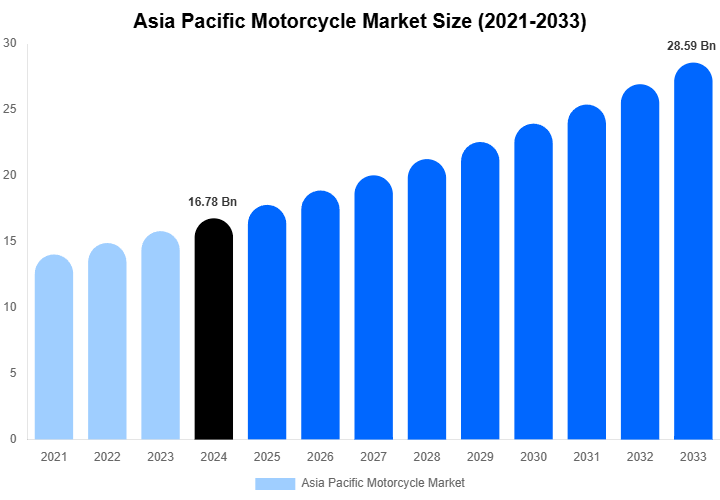
Source: DMI Analysis Company Publications, Primary Interviews.

Other Key Findings
- Asia Pacific represented 15.29% of the global Motorcycle Market size in 2025.
- By 2034, United States is estimated to hold the largest position in the global market in terms of size.
- Taiwan is estimated to remain the fastest-growing market in Asia Pacific, advancing to USD 972.89 Billion by 2034.
Asia Pacific Motorcycle Market Dynamics
- Asia Pacific's motorcycle market continues expanding through increasing commuter transportation demand, rapid urbanization, growing electric motorcycle adoption, and rising consumer preference for affordable mobility. Consumers increasingly purchase commuter motorcycles, premium motorcycles, electric models, and connected vehicles supporting efficiency, affordability, and modern transportation needs.
- Authorized dealerships, multi-brand retailers, online marketplaces, rural distribution networks, aftermarket service providers, and direct-to-consumer brands strengthen accessibility through expanding omnichannel distribution. Manufacturers increasingly improve financing programs, digital engagement, customer support, and ownership services to strengthen market competitiveness.
- Manufacturers invest in electric motorcycles, connected technologies, lightweight engineering, advanced safety systems, fuel-efficient engines, sustainable manufacturing, and premium product development to strengthen competitive differentiation. Innovation also emphasizes rider comfort, predictive maintenance, environmentally responsible production, and digital mobility integration supporting changing consumer expectations.
- Motorcycle manufacturers collaborate with dealerships, technology providers, logistics companies, component suppliers, charging infrastructure developers, financial institutions, and mobility service providers to strengthen operational efficiency and market expansion. Continued investment in electrification, premium engineering, and connected mobility reinforces competitiveness across Asia Pacific's motorcycle industry.
Key Industry Insights
- Commuter motorcycles drive demand.
- Electric mobility accelerates innovation.
- Connected technologies improve ownership.
- Financing expands accessibility.
Asia Pacific Motorcycle Market Country 2026-2034 (USD Billion)
| Asia Pacific | 2022 | 2023 | 2024 | 2025 | 2026 | 2027 | 2028 | 2029 | 2030 | 2031 | 2032 | 2033 | 2034 |
|---|---|---|---|---|---|---|---|---|---|---|---|---|---|
| China | XX.x | XX.x | XX.x | 4278.75 | XX.x | XX.x | XX.x | XX.x | XX.x | XX.x | XX.x | XX.x | XX.x |
| India | XX.x | XX.x | XX.x | XX.x | XX.x | XX.x | XX.x | XX.x | XX.x | XX.x | XX.x | XX.x | XX.x |
| Japan | XX.x | XX.x | XX.x | XX.x | XX.x | XX.x | XX.x | XX.x | XX.x | XX.x | XX.x | XX.x | XX.x |
| Korea | XX.x | XX.x | XX.x | XX.x | XX.x | XX.x | XX.x | XX.x | XX.x | XX.x | XX.x | XX.x | XX.x |
| Taiwan | XX.x | XX.x | XX.x | XX.x | XX.x | XX.x | XX.x | XX.x | XX.x | XX.x | XX.x | XX.x | XX.x |
| Australia | XX.x | XX.x | XX.x | XX.x | XX.x | XX.x | XX.x | XX.x | XX.x | XX.x | XX.x | XX.x | XX.x |
| Singapore | XX.x | XX.x | XX.x | XX.x | XX.x | XX.x | XX.x | XX.x | XX.x | XX.x | XX.x | XX.x | XX.x |
| South East Asia | XX.x | XX.x | XX.x | XX.x | XX.x | XX.x | XX.x | XX.x | XX.x | XX.x | XX.x | XX.x | XX.x |
| Total | XX.x | XX.x | XX.x | 11,180.43 | XX.x | XX.x | XX.x | XX.x | XX.x | XX.x | XX.x | XX.x | XX.x |
Source: DMI Analysis Company Publications, Primary Interviews.
Asia Pacific Motorcycle Market Type 2026-2034 (USD Billion)
| Type | 2022 | 2023 | 2024 | 2025 | 2026 | 2027 | 2028 | 2029 | 2030 | 2031 | 2032 | 2033 | 2034 |
|---|---|---|---|---|---|---|---|---|---|---|---|---|---|
| Scooters | XX.x | XX.x | XX.x | 4548.2 | XX.x | XX.x | XX.x | XX.x | XX.x | XX.x | XX.x | XX.x | XX.x |
| Sport | XX.x | XX.x | XX.x | XX.x | XX.x | XX.x | XX.x | XX.x | XX.x | XX.x | XX.x | XX.x | XX.x |
| Cruiser | XX.x | XX.x | XX.x | XX.x | XX.x | XX.x | XX.x | XX.x | XX.x | XX.x | XX.x | XX.x | XX.x |
| Off-road | XX.x | XX.x | XX.x | XX.x | XX.x | XX.x | XX.x | XX.x | XX.x | XX.x | XX.x | XX.x | XX.x |
| Total | XX.x | XX.x | XX.x | 11,180.43 | XX.x | XX.x | XX.x | XX.x | XX.x | XX.x | XX.x | XX.x | XX.x |
Source: DMI Analysis Company Publications, Primary Interviews.
Asia Pacific Motorcycle Market Engine 2026-2034 (USD Billion)
| Engine | 2022 | 2023 | 2024 | 2025 | 2026 | 2027 | 2028 | 2029 | 2030 | 2031 | 2032 | 2033 | 2034 |
|---|---|---|---|---|---|---|---|---|---|---|---|---|---|
| ≤125cc | XX.x | XX.x | XX.x | 5856.31 | XX.x | XX.x | XX.x | XX.x | XX.x | XX.x | XX.x | XX.x | XX.x |
| 125–500cc | XX.x | XX.x | XX.x | XX.x | XX.x | XX.x | XX.x | XX.x | XX.x | XX.x | XX.x | XX.x | XX.x |
| >500cc | XX.x | XX.x | XX.x | XX.x | XX.x | XX.x | XX.x | XX.x | XX.x | XX.x | XX.x | XX.x | XX.x |
| Total | XX.x | XX.x | XX.x | 11,180.43 | XX.x | XX.x | XX.x | XX.x | XX.x | XX.x | XX.x | XX.x | XX.x |
Source: DMI Analysis Company Publications, Primary Interviews.
Asia Pacific Motorcycle Market Powertrain 2026-2034 (USD Billion)
| Powertrain | 2022 | 2023 | 2024 | 2025 | 2026 | 2027 | 2028 | 2029 | 2030 | 2031 | 2032 | 2033 | 2034 |
|---|---|---|---|---|---|---|---|---|---|---|---|---|---|
| ICE | XX.x | XX.x | XX.x | XX.x | XX.x | XX.x | XX.x | XX.x | XX.x | XX.x | XX.x | XX.x | XX.x |
| Electric | XX.x | XX.x | XX.x | XX.x | XX.x | XX.x | XX.x | XX.x | XX.x | XX.x | XX.x | XX.x | XX.x |
| Total | XX.x | XX.x | XX.x | XX.x | XX.x | XX.x | XX.x | XX.x | XX.x | XX.x | XX.x | XX.x | XX.x |
Source: DMI Analysis Company Publications, Primary Interviews.
Inside This Report
This section examines Asia Pacific's motorcycle market through evolving mobility preferences, electrification, technological innovation, and competitive strategies. It highlights how manufacturers strengthen competitiveness by expanding electric motorcycle portfolios, improving connected technologies, and enhancing omnichannel dealership capabilities across commuter and premium segments.
- Regional market landscape: Reviews Asia Pacific's motorcycle ecosystem.
- Consumer and purchasing trends: Explores commuter and premium riding preferences.
- Product innovation and distribution: Covers electric motorcycles and dealership expansion.
- Competitive and industry developments: Highlights electrification and connected mobility.
Report Summary
| Report Scope | Details |
|---|---|
| Base Year for Study | 2025 |
| Study Period | 2022-2034 |
| Historical Period | 2022-2024 |
| Forecast Period | 2026-2034 |
| Market Size In 2025 | USD 11180.43 Billion |
| Market Size In 2034 | USD 19028.4 Billion |
| Largest segment | Scooters |
| Units | Revenue in USD Billion |
| CAGR | 6.07% (2026-2034) |
| Report Coverage | Revenue Forecast, Competitive Landscape, Growth Factors, Environment & Regulatory Landscape and Trends |