Japan Functional Beverages Market Size & Outlook, 2026-2034
Last Updated : 14 August, 2026 |
Study Period : 2022-2034 |
Format : PDF, Excel |
Author : Deep Market Insights
Japan Functional Beverages Market Insights
- According to Deep Market Insights analysis, the Japan Functional Beverages Market size was USD 4.41 Billion in 2025 and is projected to reach USD 8.49 Billion by 2034.
- The Japan market is projected to grow at a CAGR of 7.56% between 2026 and 2034.
- By segment, Energy Drinks emerged as the largest By Type in terms of market size in 2025.
- Dairy-Based Functional Drinks is anticipated to remain the most attractive By Type segment, recording the fastest growth during the forecast period.
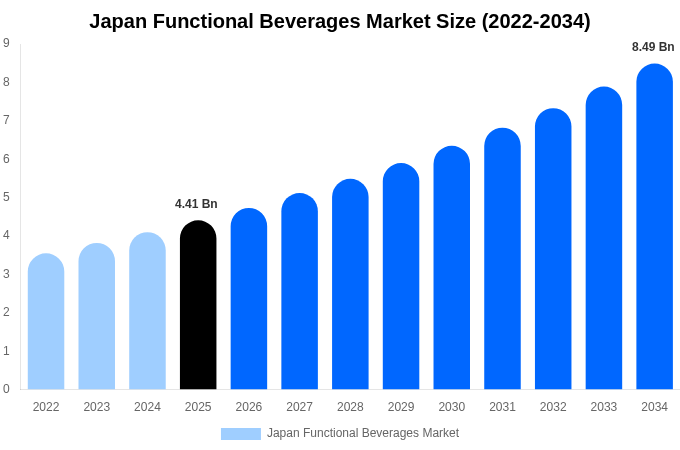
Source: DMI Analysis Company Publications, Primary Interviews.

Other Key Findings
- Japan accounted for 2.85% of the global Functional Beverages Market size in 2025.
- By 2034, United States is expected to remain the top global market in terms of size.
- Within Asia Pacific, China is forecasted to dominate the regional Functional Beverages Market size by 2034.
- India will be the fastest-growing market in Asia Pacific, projected to achieve USD 10.04 Billion by 2034.
Japan Functional Beverages Market Dynamics
- Japan's functional beverages market continues expanding as consumers increasingly seek drinks that combine hydration with health and wellness benefits. Demand is supported by strong health awareness, an established functional-food culture, aging demographics, and consumer interest in convenient daily nutrition.
- Probiotic drinks, energy beverages, sports and hydration drinks, fortified waters, vitamin beverages, plant-based beverages, and beverages positioned around digestive, immune, metabolic, and beauty benefits represent key categories. Consumers increasingly prioritize scientifically supported ingredients, low-sugar formulations, convenience, taste, and targeted health benefits.
- Beverage manufacturers invest in functional ingredients, probiotics, vitamins, minerals, botanical extracts, electrolytes, and innovative formulations. Innovation focuses on sugar reduction, convenient packaging, targeted wellness claims, improved taste, and products designed for specific consumer needs.
- Sustainability initiatives emphasize recyclable bottles, lightweight packaging, reduced plastic use, efficient production, responsible ingredient sourcing, and lower-impact distribution.
Key Industry Insights
- Japan's established functional-food culture supports market adoption.
- Aging consumers increase demand for targeted wellness products.
- Low-sugar and health-oriented formulations create opportunities.
- Convenient single-serve formats support everyday consumption.
Japan Functional Beverages Market By Type 2026-2034 (USD Billion)
| By Type | 2022 | 2023 | 2024 | 2025 | 2026 | 2027 | 2028 | 2029 | 2030 | 2031 | 2032 | 2033 | 2034 |
|---|---|---|---|---|---|---|---|---|---|---|---|---|---|
| Energy Drinks | XX.x | XX.x | XX.x | 1.8 | XX.x | XX.x | XX.x | XX.x | XX.x | XX.x | XX.x | XX.x | XX.x |
| Sports Drinks | XX.x | XX.x | XX.x | XX.x | XX.x | XX.x | XX.x | XX.x | XX.x | XX.x | XX.x | XX.x | XX.x |
| Fortified Juices | XX.x | XX.x | XX.x | XX.x | XX.x | XX.x | XX.x | XX.x | XX.x | XX.x | XX.x | XX.x | XX.x |
| Dairy-Based Functional Drinks | XX.x | XX.x | XX.x | XX.x | XX.x | XX.x | XX.x | XX.x | XX.x | XX.x | XX.x | XX.x | XX.x |
| Others | XX.x | XX.x | XX.x | XX.x | XX.x | XX.x | XX.x | XX.x | XX.x | XX.x | XX.x | XX.x | XX.x |
| Total | XX.x | XX.x | XX.x | 4.41 | XX.x | XX.x | XX.x | XX.x | XX.x | XX.x | XX.x | XX.x | XX.x |
Source: DMI Analysis Company Publications, Primary Interviews.
Japan Functional Beverages Market By Function 2026-2034 (USD Billion)
| By Function | 2022 | 2023 | 2024 | 2025 | 2026 | 2027 | 2028 | 2029 | 2030 | 2031 | 2032 | 2033 | 2034 |
|---|---|---|---|---|---|---|---|---|---|---|---|---|---|
| Hydration | XX.x | XX.x | XX.x | 1.9 | XX.x | XX.x | XX.x | XX.x | XX.x | XX.x | XX.x | XX.x | XX.x |
| Energy | XX.x | XX.x | XX.x | XX.x | XX.x | XX.x | XX.x | XX.x | XX.x | XX.x | XX.x | XX.x | XX.x |
| Immunity | XX.x | XX.x | XX.x | XX.x | XX.x | XX.x | XX.x | XX.x | XX.x | XX.x | XX.x | XX.x | XX.x |
| Digestive Health | XX.x | XX.x | XX.x | XX.x | XX.x | XX.x | XX.x | XX.x | XX.x | XX.x | XX.x | XX.x | XX.x |
| Weight Management | XX.x | XX.x | XX.x | XX.x | XX.x | XX.x | XX.x | XX.x | XX.x | XX.x | XX.x | XX.x | XX.x |
| Total | XX.x | XX.x | XX.x | 4.40 | XX.x | XX.x | XX.x | XX.x | XX.x | XX.x | XX.x | XX.x | XX.x |
Source: DMI Analysis Company Publications, Primary Interviews.
Japan Functional Beverages Market By Distribution Channel 2026-2034 (USD Billion)
| By Distribution Channel | 2022 | 2023 | 2024 | 2025 | 2026 | 2027 | 2028 | 2029 | 2030 | 2031 | 2032 | 2033 | 2034 |
|---|---|---|---|---|---|---|---|---|---|---|---|---|---|
| Supermarkets/Hypermarkets | XX.x | XX.x | XX.x | 1.76 | XX.x | XX.x | XX.x | XX.x | XX.x | XX.x | XX.x | XX.x | XX.x |
| Convenience Stores | XX.x | XX.x | XX.x | XX.x | XX.x | XX.x | XX.x | XX.x | XX.x | XX.x | XX.x | XX.x | XX.x |
| Online | XX.x | XX.x | XX.x | XX.x | XX.x | XX.x | XX.x | XX.x | XX.x | XX.x | XX.x | XX.x | XX.x |
| Others | XX.x | XX.x | XX.x | XX.x | XX.x | XX.x | XX.x | XX.x | XX.x | XX.x | XX.x | XX.x | XX.x |
| Total | XX.x | XX.x | XX.x | 4.40 | XX.x | XX.x | XX.x | XX.x | XX.x | XX.x | XX.x | XX.x | XX.x |
Source: DMI Analysis Company Publications, Primary Interviews.
Inside This Report
This section explores Japan's functional beverages industry through probiotic drinks, energy beverages, sports drinks, fortified water, vitamin beverages, plant-based beverages, and targeted wellness drinks.
- Regional/Country market landscape: Reviews Japan's functional beverage ecosystem.
- Consumer trends: Explores digestive health, immunity, hydration, energy, beauty, low sugar, and convenience.
- Product innovation and distribution: Covers functional ingredients, probiotics, vitamins, minerals, botanical extracts, single-serve packaging, supermarkets, convenience stores, pharmacies, and e-commerce.
- Competitive and industry developments: Highlights premiumization, scientific positioning, sugar reduction, targeted nutrition, packaging innovation, sustainability, and commercialization.
Report Summary
| Report Scope | Details |
|---|---|
| Base Year for Study | 2025 |
| Study Period | 2022-2034 |
| Historical Period | 2022-2024 |
| Forecast Period | 2026-2034 |
| Market Size In 2025 | USD 4.41 Billion |
| Market Size In 2034 | USD 8.49 Billion |
| Largest segment | Energy Drinks |
| Units | Revenue in USD Billion |
| CAGR | 7.56% (2026-2034) |
| Report Coverage | Revenue Forecast, Competitive Landscape, Growth Factors, Environment & Regulatory Landscape and Trends |