Yacht Market Size
According to Deep Market Insights, the global yacht market size was valued at USD 9,850 million in 2025 and is projected to grow from USD 10,509.95 million in 2026 to reach USD 14,535.26 million by 2031, expanding at a CAGR of 6.7% during the forecast period (2026–2031). The yacht market growth is primarily driven by the increasing number of high-net-worth individuals, rising demand for luxury marine tourism, and growing adoption of advanced yacht technologies, including hybrid propulsion and smart onboard systems.
Key Market Insights
- Motor yachts dominate the global market, accounting for over 70% share due to their performance, convenience, and luxury features.
- Europe leads global yacht manufacturing, with countries such as Italy and the Netherlands serving as major production hubs.
- Asia-Pacific is the fastest-growing region, supported by rising affluence and expanding marina infrastructure.
- Charter and fractional ownership models are expanding rapidly, making yacht experiences more accessible to a broader consumer base.
- Sustainability trends are reshaping product development, with increasing investments in hybrid and electric yachts.
- Technological integration, including AI navigation systems and smart onboard automation, is enhancing user experience and operational efficiency.
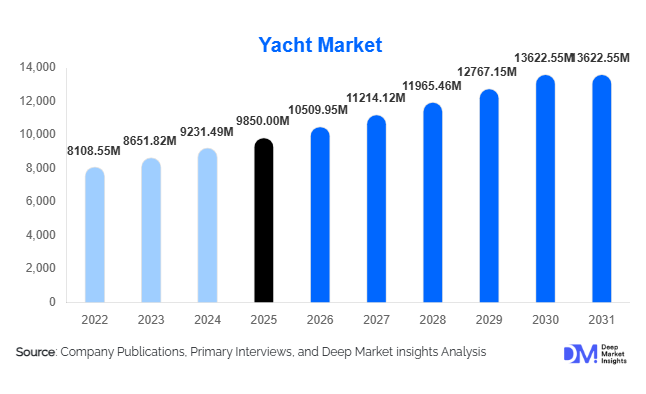
What are the latest trends in the yacht market?
Sustainable and Hybrid Yacht Adoption
The yacht industry is undergoing a significant transformation toward sustainability, driven by stricter environmental regulations and increasing consumer awareness. Hybrid propulsion systems, electric engines, and alternative fuels such as hydrogen are gaining traction across both private and commercial yacht segments. Manufacturers are investing heavily in lightweight materials, energy-efficient hull designs, and renewable energy integration, such as solar panels. These innovations not only reduce carbon emissions but also improve fuel efficiency and operational costs. European shipbuilders are leading this transition, with several new yacht models featuring hybrid propulsion as a standard offering. Sustainability is increasingly becoming a key differentiator, particularly among environmentally conscious buyers and charter operators.
Growth of Yacht Charter and Shared Ownership
The expansion of yacht charter services and fractional ownership models is reshaping the market landscape. These models allow consumers to experience luxury yachting without the high upfront costs and maintenance responsibilities associated with ownership. Charter services are particularly popular in regions such as the Mediterranean and Caribbean, where marine tourism is well-established. Digital platforms are enhancing accessibility by offering seamless booking, customization, and itinerary planning. This trend is attracting younger and first-time users, significantly expanding the market base beyond traditional ultra-high-net-worth individuals.
What are the key drivers in the yacht market?
Rising High-Net-Worth Population
The global increase in high-net-worth and ultra-high-net-worth individuals is a major driver of yacht market growth. Wealth expansion in regions such as North America, Asia-Pacific, and the Middle East has led to increased spending on luxury assets, including yachts. These consumers seek exclusivity, customization, and premium experiences, driving demand for high-end vessels and bespoke yacht designs.
Expansion of Marine Tourism
The rapid growth of marine tourism and experiential travel is significantly boosting demand for yachts, particularly in the charter segment. Tourists are increasingly opting for private and personalized travel experiences, including yacht cruises and luxury marine excursions. Coastal economies are investing in marina infrastructure and tourism development, further supporting market expansion. This trend is particularly strong in Europe, Southeast Asia, and the Caribbean.
What are the restraints for the global market?
High Ownership and Maintenance Costs
Yacht ownership involves substantial capital investment along with recurring expenses such as maintenance, crew salaries, docking fees, and insurance. These high costs limit the market to affluent consumers and restrict broader adoption. Even in the charter segment, operational expenses can impact pricing and profitability.
Stringent Environmental Regulations
Increasing environmental regulations related to emissions, fuel usage, and marine ecosystem protection present challenges for yacht manufacturers and operators. Compliance with these regulations requires significant investment in research and development, which can increase production costs and affect pricing strategies.
What are the key opportunities in the yacht market?
Emerging Market Demand
Emerging economies such as China, India, and the UAE present significant growth opportunities due to rising disposable incomes and increasing interest in luxury lifestyles. Governments in these regions are investing in marina infrastructure and promoting marine tourism, creating a favorable environment for yacht market expansion. First-time buyers in these markets are expected to drive future demand.
Technological Innovation and Smart Yachts
Advancements in digital technology, including IoT-enabled systems, AI-based navigation, and smart onboard automation, are creating new opportunities for innovation. These technologies enhance safety, efficiency, and user experience, making yachts more appealing to tech-savvy consumers. Integration of advanced entertainment systems and connectivity solutions is also becoming a key selling point.
Report Scope
| Report Metric | Details |
|---|---|
| Market Size in 2025 | USD 9850 Million |
| Market Size in 2026 | USD 10509.95 Million |
| Market Size in 2031 | USD 14535.26 Million |
| CAGR | 6.7% (2026-2031) |
| Base Year for Estimation | 2025 |
| Historical Data | 2022-2024 |
| Forecast Period | 2026-2031 |
| Report Coverage | Revenue Forecast, Competitive Landscape, Supply Chain Disruption, Growth Factors, Environment & Regulatory Landscape and Trends |
| Geographies Covered | North America, Europe, APAC, Middle East and Africa, LATAM |
| Countries Covered | U.S., Canada, U.K., Germany, France, Spain, Italy, Russia, Nordic, Benelux, Rest of Europe, China, Korea, Japan, India, Australia, Singapore, Taiwan, South East Asia, Rest of Asia-Pacific, UAE, Turky, Saudi Arabia, South Africa, Egypt, Nigeria, Rest of MEA, Brazil, Mexico, Argentina, Chile, Colombia, Rest of LATAM |
Explore more data points, trends and opportunities Download Free Sample Report
Product Type Insights
Motor yachts continue to dominate the global yacht market, accounting for approximately 72% of total market share in 2025. This leadership is primarily driven by their superior speed, ease of navigation, and ability to incorporate advanced luxury features such as smart automation systems, spacious interiors, and long-range cruising capabilities. The growing preference for convenience and performance among high-net-worth individuals has further strengthened demand for motor yachts, particularly in North America and Europe. Additionally, the rising popularity of yacht charters has significantly contributed to this segment’s growth, as motor yachts are better suited for short-term luxury experiences and group travel.
Sailing yachts, although representing a smaller portion of the market, maintain steady demand among niche consumer segments that prioritize sustainability, traditional sailing experiences, and fuel efficiency. These yachts are particularly popular in eco-conscious markets and among experienced sailors. Furthermore, the increasing integration of hybrid and electric propulsion technologies is influencing both motor and sailing yacht segments. Premium yacht manufacturers are actively investing in energy-efficient designs and alternative propulsion systems, which is expected to gradually reshape product innovation and competitive positioning across the market.
Application Insights
The private use segment leads the yacht market with approximately 64% share, driven by strong demand from ultra-high-net-worth individuals seeking exclusivity, privacy, and personalized luxury experiences. The rise in global wealth, particularly in emerging economies, has significantly contributed to the growth of this segment. Private yacht ownership is often associated with status and lifestyle, further reinforcing its dominance.
Commercial applications, including yacht charters, tourism services, and event hosting, are witnessing the fastest growth within the market. The increasing demand for experiential travel, coupled with the rising popularity of luxury vacations, has positioned yacht charters as a key growth driver. Charter services are expanding rapidly in regions such as the Mediterranean, Caribbean, and Southeast Asia. Additionally, yachts are increasingly being used for corporate events, weddings, and exclusive gatherings, creating new revenue streams for operators and enhancing utilization rates of existing fleets.
Distribution Channel Insights
Direct sales through manufacturers remain the dominant distribution channel, particularly for new yacht purchases, as buyers prefer highly customized vessels tailored to their specific requirements. Specialized yacht brokers also play a critical role in facilitating transactions, offering expertise in valuation, negotiation, and customization, especially for high-value and pre-owned yachts.
Digital platforms are emerging as a transformative force in the distribution landscape, particularly in the charter and fractional ownership segments. Online booking systems, virtual yacht tours, and AI-driven recommendation engines are enhancing customer engagement and simplifying the purchasing process. These platforms are attracting younger, tech-savvy consumers and expanding market accessibility. Additionally, digital marketing strategies and social media influence are playing an increasingly important role in shaping consumer preferences and driving demand.
End-Use Insights
The luxury tourism industry remains the primary end-use segment, driven by increasing demand for premium and personalized travel experiences. The global yacht charter industry is growing at over 7% annually, supported by rising interest in marine tourism and experiential travel. Coastal destinations across Europe, the Caribbean, and the Asia-Pacific are witnessing increased yacht activity, supported by investments in marina infrastructure and tourism development.
Corporate and event-based usage is emerging as a significant secondary end-use segment, with yachts being utilized for high-profile business meetings, brand promotions, and private celebrations. Additionally, new applications are emerging within the hospitality sector, including floating hotels and luxury cruise extensions. Export-driven demand remains a critical factor, with European manufacturers supplying a substantial share of yachts to North America, the Middle East, and Asia-Pacific markets, further reinforcing global trade dynamics within the industry.
Explore more data points, trends and opportunities Download Free Sample Report
Yacht Market Segmentations
By Product Type
- Motor Yachts
- Sailing Yachts
By Size
- Small Yachts
- Medium Yachts
- Large Yachts
- Superyachts
- Megayachts
By Propulsion Type
- Internal Combustion Engine (ICE)
- Hybrid Yachts
- Fully Electric Yachts
By Application
- Private Use
- Commercial Use
By Distribution Channel
- Direct Manufacturer Sales
- Yacht Brokers
- Online Platforms & Digital Channels
By Ownership Model
- Individual Ownership
- Fractional Ownership
- Charter/Leasing Models
Regional Insights
North America
North America accounts for approximately 28% of the global yacht market share, with the United States representing the largest and most mature market. Regional growth is driven by a high concentration of high-net-worth individuals, a well-established recreational boating culture, and extensive marina and coastal infrastructure. The presence of advanced financing options and a strong secondary yacht market further supports demand. Additionally, increasing interest in yacht charters and luxury marine tourism is expanding the customer base beyond traditional ownership models. Technological adoption, including smart yacht systems and digital booking platforms, is also contributing to sustained growth in the region.
Europe
Europe leads the global yacht market with around 42% share, supported by its strong manufacturing ecosystem and long-standing maritime heritage. Countries such as Italy, Germany, and the Netherlands serve as key production hubs, with Italy alone contributing nearly 18% of global yacht production. Regional growth is driven by continuous innovation in yacht design, strong export capabilities, and a well-developed marine tourism industry in the Mediterranean. Additionally, stringent environmental regulations are encouraging the adoption of sustainable technologies, positioning Europe as a leader in hybrid and electric yacht development. The presence of world-renowned yacht builders further strengthens the region’s competitive advantage.
Asia-Pacific
Asia-Pacific is the fastest-growing region, with a CAGR exceeding 8.5%, driven by rising disposable incomes, rapid urbanization, and increasing luxury consumption. China is a key growth market, with significant investments in marina infrastructure and government initiatives aimed at promoting marine tourism. India is emerging as a promising market, supported by a growing affluent population and increasing interest in luxury lifestyle products. Australia remains a mature market with strong demand for recreational boating. Regional growth is also fueled by increasing tourism activity in Southeast Asia, particularly in destinations such as Thailand and Indonesia, where yacht charters are gaining popularity.
Latin America
Latin America holds approximately 8% of the global yacht market, with Brazil and Mexico leading regional demand. Growth in this region is primarily driven by expanding tourism infrastructure, increasing interest in luxury recreational activities, and a gradual rise in high-net-worth individuals. Coastal development projects and government initiatives to promote marine tourism are supporting market expansion. However, economic volatility and limited marina infrastructure in certain areas continue to pose challenges, resulting in slower growth compared to other regions.
Middle East & Africa
The Middle East & Africa region accounts for around 12% of the global market share, with the UAE and Saudi Arabia serving as key demand centers. Regional growth is driven by high-income populations, strong demand for ultra-luxury assets, and significant government investments in tourism and marina infrastructure. The UAE, in particular, has positioned itself as a global hub for luxury yachting, supported by world-class facilities and favorable regulatory policies. In Africa, coastal tourism and the development of luxury travel experiences are gradually contributing to market growth. The increasing adoption of superyachts and megayachts among ultra-high-net-worth individuals is further boosting demand in this region.
Key Players in the Yacht Market
- Azimut Benetti Group
- Ferretti Group
- Sanlorenzo
- Sunseeker International
- Princess Yachts
- Lürssen
- Feadship
- Heesen Yachts
- Oceanco
- Beneteau Group
- Bavaria Yachts
- Gulf Craft
- Horizon Yacht
- Christensen Shipyards
- Westport Yachts