Taurine Supplements Market Size
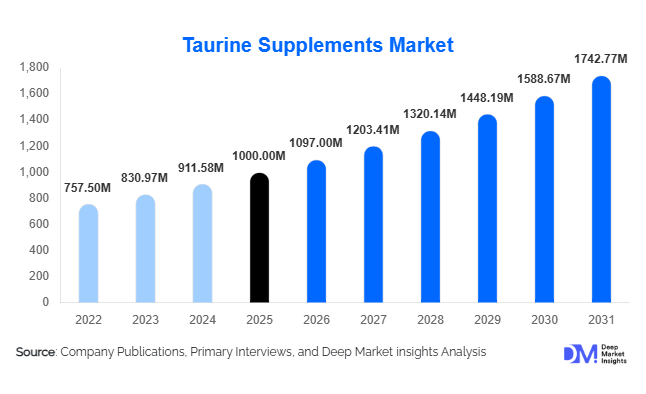
According to Deep Market Insights, the global taurine supplements market size was valued at USD 1,000 million in 2025 and is projected to grow from USD 1097.00 million in 2026 to reach USD 1,742.77 million by 2031, expanding at a CAGR of 9.7% during the forecast period (2026–2031). The taurine supplements market growth is primarily driven by rising demand for sports and performance nutrition, increasing adoption of preventive healthcare supplements, and expanding clinical validation of taurine’s role in cardiovascular, metabolic, and neurological health.
Key Market Insights
- Sports and performance nutrition remains the largest application segment, accounting for over one-third of global taurine supplement demand.
- Capsules dominate formulation preferences due to dosage accuracy, stability, and consumer familiarity.
- North America leads global consumption, supported by high supplement penetration and premium product adoption.
- Asia-Pacific is the fastest-growing region, driven by expanding middle-class populations in China and India.
- Online retail channels account for the largest share, supported by DTC brands, subscriptions, and influencer marketing.
- Clean-label, vegan, and pharmaceutical-grade taurine formulations are reshaping competitive differentiation.
What are the latest trends in the taurine supplements market?
Mainstreaming of Taurine Beyond Sports Nutrition
Taurine supplements are increasingly transitioning from niche athletic products into mainstream wellness solutions. While sports nutrition remains dominant, taurine is now widely positioned for heart health, metabolic balance, cognitive support, and longevity. General wellness consumers are adopting taurine as part of daily supplementation routines, particularly in combination with magnesium, B-complex vitamins, and omega-based formulations. This trend is expanding taurine’s addressable market beyond core fitness users into aging populations and preventive healthcare segments.
Innovation in Delivery Formats
Manufacturers are investing heavily in alternative delivery formats such as gummies, liquid shots, flavored powders, and ready-to-mix sachets. These formats improve compliance, taste, and convenience, particularly among younger consumers and first-time supplement users. Sugar-free, low-calorie, and functional blends tailored for energy, focus, and recovery are gaining rapid traction. Advances in microencapsulation and bioavailability-enhancing technologies are further improving product efficacy and consumer appeal.
What are the key drivers in the taurine supplements market?
Expansion of Sports & Performance Nutrition
The global fitness and sports nutrition industry continues to expand beyond professional athletes to include recreational users, women, and older demographics. Taurine’s proven benefits in muscle endurance, hydration, fatigue reduction, and electrolyte balance make it a core ingredient in pre-workout, intra-workout, and recovery formulations. Increasing gym memberships, home fitness adoption, and endurance sports participation are directly contributing to sustained taurine supplement demand.
Rising Cardiovascular and Metabolic Health Awareness
The growing prevalence of hypertension, obesity, and type-2 diabetes has increased demand for preventive and supportive supplementation. Taurine is increasingly incorporated into heart-health and metabolic wellness products due to its role in lipid metabolism, insulin sensitivity, and vascular function. Healthcare professionals and consumers alike are recognizing taurine as a complementary nutritional intervention, supporting long-term market growth.
What are the restraints for the global market?
Regulatory Restrictions on Dosage and Claims
Taurine supplements face varying regulatory frameworks across regions, particularly in Europe, where dosage limits and health claim approvals are tightly controlled. These restrictions increase compliance costs, extend product approval timelines, and limit aggressive marketing strategies. Regulatory uncertainty can slow innovation and regional expansion for manufacturers.
Raw Material and Energy Cost Volatility
Taurine production relies on energy-intensive chemical synthesis or fermentation processes. Fluctuations in raw material prices, energy costs, and supply chain disruptions can impact manufacturing economics and compress profit margins, particularly for mass-market and private-label brands competing on price.
What are the key opportunities in the taurine supplements industry?
Medical and Therapeutic Nutrition Applications
Increasing clinical research supporting taurine’s therapeutic benefits presents opportunities for medical nutrition and prescription-adjacent supplements. Products targeting cardiovascular health, diabetes management, neurological support, and aging populations offer higher-margin opportunities. Manufacturers investing in clinical trials, pharmaceutical-grade purity, and hospital distribution channels are well-positioned to capture this growing segment.
Rapid Growth in Asia-Pacific and Emerging Markets
Asia-Pacific represents the most attractive growth opportunity, with rising disposable incomes, expanding sports culture, and increasing acceptance of amino-acid-based supplementation. Localized formulations, vegetarian certifications, and region-specific dosage formats can help global players penetrate high-growth markets such as China, India, and Southeast Asia.
Report Scope
| Report Metric | Details |
|---|---|
| Market Size in 2025 | USD 1000 Million |
| Market Size in 2026 | USD 1097 Million |
| Market Size in 2031 | USD 1742.77 Million |
| CAGR | 9.7% (2026-2031) |
| Base Year for Estimation | 2025 |
| Historical Data | 2022-2024 |
| Forecast Period | 2026-2031 |
| Report Coverage | Revenue Forecast, Competitive Landscape, Supply Chain Disruption, Growth Factors, Environment & Regulatory Landscape and Trends |
| Geographies Covered | North America, Europe, APAC, Middle East and Africa, LATAM |
| Countries Covered | U.S., Canada, U.K., Germany, France, Spain, Italy, Russia, Nordic, Benelux, Rest of Europe, China, Korea, Japan, India, Australia, Singapore, Taiwan, South East Asia, Rest of Asia-Pacific, UAE, Turky, Saudi Arabia, South Africa, Egypt, Nigeria, Rest of MEA, Brazil, Mexico, Argentina, Chile, Colombia, Rest of LATAM |
Explore more data points, trends and opportunities Download Free Sample Report
Formulation Type Insights
Capsules account for approximately 34% of the global taurine supplements market, making them the leading formulation type worldwide. Their dominance is driven by precise dosage control, superior stability, longer shelf life, and widespread acceptance among medical, aging, and general wellness consumers. Capsules are particularly favored in pharmaceutical-grade and clinically positioned taurine supplements, where standardized dosing and compliance with regulatory guidelines are critical. Additionally, capsules enable easier formulation of high-purity and combination products, reinforcing their leadership across North America and Europe.
Gummies and liquid formats, while currently accounting for a smaller share of total volume, are the fastest-growing formulation categories. Their growth is supported by rising demand from younger consumers, first-time supplement users, and lifestyle-oriented demographics seeking convenience, palatability, and on-the-go consumption. Sugar-free, low-calorie, and functional gummies, along with ready-to-drink liquid shots, are increasingly being positioned as daily wellness and energy-support solutions, contributing to accelerated adoption.
Application Insights
Sports and performance nutrition leads the taurine supplements market with an estimated 37% share in 2025, making it the largest application segment globally. This leadership is driven by taurine’s scientifically supported benefits in muscle endurance, fatigue reduction, hydration balance, and recovery optimization. High-frequency consumption, elevated dosage requirements, and strong brand loyalty among athletes and fitness consumers further reinforce this segment’s dominance. The continued expansion of recreational fitness, endurance sports, and home-based training is sustaining long-term demand within this category.
Energy and cognitive health supplements incorporating taurine are also gaining traction, especially in urban and high-stress environments. Demand is being driven by working professionals, students, and shift workers seeking sustained energy, mental focus, and reduced fatigue without reliance on high stimulant doses. This application is expanding taurine’s relevance beyond physical performance into mental and lifestyle wellness.
Distribution Channel Insights
Online retail channels dominate the taurine supplements market, accounting for nearly 39% of global sales. This channel’s leadership is driven by the rapid expansion of direct-to-consumer (DTC) brands, subscription-based purchasing models, and global e-commerce marketplaces. Online platforms provide pricing transparency, access to product reviews, personalized recommendations, and a wider range of formulations, making them particularly attractive to younger and digitally native consumers.
Pharmacies and drug stores continue to play a critical role, especially for medical users, aging populations, and clinically positioned taurine supplements. Trust in pharmacist recommendations, regulatory oversight, and the availability of pharmaceutical-grade products support sustained demand through this channel. Specialty nutrition and sports stores remain highly influential for brand-building and athlete-focused products. These outlets provide in-person guidance, product trials, and targeted marketing, making them essential for sports nutrition brands seeking visibility among performance-driven consumers.
Consumer Group Insights
General wellness consumers represent the largest consumer group, accounting for approximately 32% of total taurine supplement demand. Growth in this segment is driven by increasing preventive healthcare awareness, daily supplementation habits, and taurine’s positioning as a multifunctional amino acid supporting heart health, energy, and longevity. Athletes and bodybuilders remain a high-volume segment due to higher daily intake levels and frequent usage patterns. Their demand is closely linked to gym memberships, competitive sports participation, and structured training programs.
Aging populations and medical users are emerging as high-value consumer groups, particularly in developed economies. These consumers favor premium, clinically validated, and physician-recommended taurine supplements, supporting higher average selling prices. Pet and veterinary supplementation is gaining traction as a niche but fast-growing application, especially in feline nutrition, where taurine is an essential nutrient. Increasing pet humanization and premium pet food trends are accelerating adoption in this segment.
Explore more data points, trends and opportunities Download Free Sample Report
Taurine Supplements Market Segmentations
By Formulation Type
- Capsules
- Powder
- Gummies
- Liquid
By Application
- Sports & Performance Nutrition
- Cardiovascular & Metabolic Health
- Energy & Cognitive Health
- General Wellness
- Pet & Veterinary Supplements
By Distribution Channel
- Online Retail
- Pharmacies & Drug Stores
- Specialty Nutrition & Sports Stores
- Supermarkets & Hypermarkets
- Direct-to-Consumer (D2C)
By Consumer Group
- General Wellness Consumers
- Athletes & Bodybuilders
- Aging & Medical Users
- Pet Owners & Veterinary Users
Regional Insights
North America
North America accounts for approximately 34% of the global taurine supplements market, led by the United States. Regional growth is driven by high supplement consumption rates, a deeply entrenched sports nutrition culture, and strong consumer willingness to pay for premium and clean-label products. The region also leads in clinical-grade and pharmaceutical-quality taurine formulations, supported by advanced healthcare infrastructure, strong DTC brand ecosystems, and widespread awareness of preventive supplementation.
Europe
Europe represents around 22% of global demand, with Germany, the U.K., and France as key markets. Growth is driven by aging populations, preventive healthcare adoption, and strong trust in scientifically validated supplements. Although regulatory constraints on dosage and health claims limit aggressive marketing, Europe’s emphasis on pharmaceutical-quality standards and physician-led recommendations supports stable, long-term demand for taurine supplements.
Asia-Pacific
Asia-Pacific holds nearly 29% market share and is the fastest-growing region, with a CAGR exceeding 11%. Growth is driven by rising disposable incomes, expanding middle-class populations, and increasing participation in fitness and wellness activities. China and Japan dominate volume demand due to established amino acid consumption patterns, while India is emerging as a high-growth market supported by affordability-driven supplementation, expanding gym culture, and growing e-commerce penetration.
Latin America
Latin America accounts for approximately 8% of global demand, led by Brazil and Mexico. Regional growth is supported by increasing sports participation, rising health awareness among younger populations, and expanding online supplement retail channels. Improving access to international brands and localized formulations is further strengthening market expansion.
Middle East & Africa
The Middle East & Africa region contributes around 7% of the global taurine supplements market. Growth is driven by rising disposable incomes, premium supplement adoption in the UAE and Saudi Arabia, and increasing awareness of sports and lifestyle nutrition. South Africa serves as a regional hub for supplement manufacturing and distribution, while demand for imported, high-quality products continues to rise across urban centers.
Key Players in the Taurine Supplements Market
- Kyowa Hakko Bio
- Ajinomoto Co., Inc.
- Taisho Pharmaceutical
- NOW Foods
- GNC Holdings
- Thorne HealthTech
- Amway
- Nature’s Way
- Swanson Health
- BulkSupplements
- Solgar
- Nutricost
- Olimp Laboratories
- Vitaco Health Group
- Black Skull Pharma