Single Cell Protein (SCP) Products Market Size
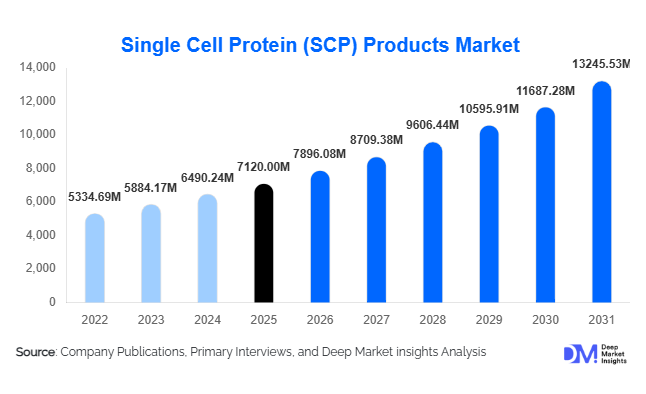
According to Deep Market Insights, the global single cell protein (SCP) products market size was valued at USD 7,120 million in 2025 and is projected to grow from USD 7,896.08 million in 2026 to reach USD 13,245.53 million by 2031, expanding at a CAGR of 10.9% during the forecast period (2026–2031). The market growth is primarily driven by rising global demand for sustainable and alternative protein sources, increasing pressure on traditional livestock systems, and rapid expansion of aquaculture and functional food industries. SCP, derived from microorganisms such as algae, bacteria, fungi, and yeast, is gaining prominence as a high-efficiency protein solution requiring minimal land, water, and energy compared to conventional protein production.
Key Market Insights
- SCP products are gaining traction as a sustainable protein alternative, particularly in animal feed and functional food applications.
- Animal feed dominates the market, accounting for nearly 60% share, driven by aquaculture expansion and fishmeal replacement demand.
- Asia-Pacific leads the global market, supported by strong production capacity and rising protein consumption in China and India.
- Europe is the fastest-growing region, driven by stringent sustainability regulations and alternative protein adoption.
- Powder form SCP products dominate due to longer shelf life and ease of integration into food and feed formulations.
- Technological advancements in fermentation and carbon capture are improving yield efficiency and reducing production costs.
What are the latest trends in the single cell protein products market?
Shift Toward Carbon-to-Protein Technologies
One of the most transformative trends in the SCP market is the development of carbon-to-protein technologies. Companies are leveraging industrial emissions such as CO₂, methane, and syngas as feedstock for microbial fermentation, enabling the production of high-protein biomass while reducing carbon footprints. This approach aligns with global decarbonization goals and circular economy principles, attracting strong investment from both governments and private players. As regulatory frameworks increasingly favor low-emission production systems, carbon-based SCP is expected to emerge as a key innovation frontier in the industry.
Expansion of SCP in Human Food Applications
Traditionally concentrated in animal nutrition, SCP is increasingly entering the human food segment. Algae-based proteins such as spirulina and chlorella are widely used in dietary supplements, while fungi-based proteins are gaining popularity in meat alternatives. Advances in taste, texture, and nutritional optimization are making SCP more appealing to consumers. The growing demand for plant-based and functional foods is further accelerating this trend, with food manufacturers integrating SCP into protein bars, beverages, and fortified foods to enhance nutritional value.
What are the key drivers in the single cell protein products market?
Rising Demand for Sustainable Protein Sources
The global shift toward sustainable food systems is a major driver for SCP adoption. Traditional protein sources such as meat and soy are associated with high environmental impact, including deforestation, water usage, and greenhouse gas emissions. SCP offers a low-impact alternative, making it highly attractive to governments, industries, and environmentally conscious consumers.
Growth in Aquaculture and Animal Feed Industries
The rapid expansion of aquaculture is significantly boosting demand for SCP products. With fishmeal prices fluctuating and sustainability concerns increasing, SCP provides a reliable and scalable protein substitute. Livestock and pet food industries are also incorporating SCP to improve nutritional quality and reduce dependency on conventional feed ingredients.
What are the restraints for the global market?
High Production Costs
Despite technological advancements, SCP production remains capital-intensive, particularly due to fermentation infrastructure and downstream processing costs. This creates pricing challenges in comparison to traditional protein sources, especially in cost-sensitive markets.
Regulatory and Consumer Acceptance Barriers
Regulatory approvals for certain microbial proteins can be complex and time-consuming. Additionally, consumer perception of microbial-based proteins, particularly bacteria-derived SCP, may limit adoption in human food applications, posing a challenge for market expansion.
What are the key opportunities in the single cell protein products industry?
Integration with Circular Economy Models
The use of waste streams such as agricultural residues, food waste, and industrial emissions for SCP production presents a significant opportunity. This not only reduces raw material costs but also enhances sustainability, making SCP an integral component of circular bioeconomy strategies.
Expansion in Emerging Markets
Developing regions in Asia-Pacific and Africa present strong growth potential due to rising population, increasing protein demand, and government initiatives to improve food security. SCP offers a scalable and cost-effective solution to address protein shortages in these regions.
Report Scope
| Report Metric | Details |
|---|---|
| Market Size in 2025 | USD 7120.00 Million |
| Market Size in 2026 | USD 7896.08 Million |
| Market Size in 2031 | USD 13245.53 Million |
| CAGR | 10.3% (2026-2031) |
| Base Year for Estimation | 2025 |
| Historical Data | 2022-2024 |
| Forecast Period | 2026-2031 |
| Report Coverage | Revenue Forecast, Competitive Landscape, Supply Chain Disruption, Growth Factors, Environment & Regulatory Landscape and Trends |
| Geographies Covered | North America, Europe, APAC, Middle East and Africa, LATAM |
| Countries Covered | U.S., Canada, U.K., Germany, France, Spain, Italy, Russia, Nordic, Benelux, Rest of Europe, China, Korea, Japan, India, Australia, Singapore, Taiwan, South East Asia, Rest of Asia-Pacific, UAE, Turky, Saudi Arabia, South Africa, Egypt, Nigeria, Rest of MEA, Brazil, Mexico, Argentina, Chile, Colombia, Rest of LATAM |
Explore more data points, trends and opportunities Download Free Sample Report
Product Type Insights
The global single-cell protein (SCP) market is characterized by a diverse range of microbial sources, each offering distinct advantages in terms of nutritional composition, scalability, and application suitability. Among these, algae-based SCP products currently dominate the market, accounting for approximately 38% share. This leadership position is primarily driven by the superior nutritional profile of algae, particularly species such as spirulina and chlorella, which are rich in essential amino acids, vitamins, minerals, and antioxidants. The growing consumer preference for plant-based, clean-label, and sustainable protein sources has further accelerated the adoption of algae-derived SCP, especially in dietary supplements, functional foods, and nutraceutical applications. Additionally, algae cultivation systems are increasingly being optimized through advanced photobioreactor technologies, enhancing yield efficiency and reducing production costs, thereby strengthening the segment’s market position.Bacteria-based SCP is gaining significant traction, emerging as one of the most promising segments due to its exceptional production efficiency and scalability. The key growth driver for this segment lies in its ability to utilize unconventional carbon sources such as methane, methanol, and carbon dioxide, making it highly aligned with circular economy principles and carbon recycling initiatives. Advances in industrial biotechnology and gas fermentation technologies are enabling large-scale production of bacterial SCP with minimal land and water requirements. As industries increasingly focus on sustainability and resource optimization, bacteria-based SCP is expected to witness robust adoption across both feed and industrial applications.Fungi-based SCP is another rapidly evolving segment, particularly gaining momentum in the alternative protein and plant-based meat industries. The leading driver for fungi-based SCP is its ability to mimic the fibrous texture and mouthfeel of animal meat, making it highly suitable for meat substitutes and hybrid protein products. Mycoprotein, derived from filamentous fungi, has gained considerable attention due to its high protein content, low fat levels, and environmental sustainability. With the global surge in veganism, flexitarian diets, and demand for meat alternatives, fungi-based SCP is expected to expand significantly, supported by continuous product innovation and increasing consumer acceptance.
Application Insights
In terms of application, animal feed remains the dominant segment, holding nearly 60% of the global market share. The leading driver for this segment is the rapidly growing demand for high-quality, sustainable, and cost-effective protein sources in livestock and aquaculture industries. Traditional protein sources such as fishmeal and soybean meal are facing supply constraints, price volatility, and environmental concerns, prompting a shift toward alternative protein solutions like SCP. In aquaculture, in particular, SCP offers a viable substitute for fishmeal due to its high protein content, balanced amino acid profile, and improved digestibility, thereby enhancing feed efficiency and growth performance in aquatic species.Human food applications represent the fastest-growing segment within the SCP market. The primary growth driver here is the rising global demand for alternative proteins driven by increasing health awareness, environmental concerns, and changing dietary patterns. SCP is being increasingly incorporated into functional foods, protein supplements, fortified beverages, and meat alternatives. Its versatility, coupled with its ability to be produced sustainably with minimal environmental impact, positions SCP as a key ingredient in the future of food innovation. The growing popularity of high-protein diets and the expanding market for sports nutrition products are further fueling demand in this segment.Biotechnology applications, although currently a smaller segment, are witnessing steady growth. The leading driver for this segment is the expanding use of SCP in the production of enzymes, bioactive compounds, and pharmaceutical ingredients. SCP microorganisms serve as efficient biofactories for producing high-value compounds, including vitamins, amino acids, and therapeutic proteins. With advancements in genetic engineering and synthetic biology, the scope of SCP in biotechnology is expected to broaden, creating new opportunities in industrial and medical applications.
Distribution Channel Insights
The distribution landscape of the SCP market is predominantly characterized by direct business-to-business (B2B) sales, which account for approximately 65% of total distribution. The leading driver for this channel is the bulk procurement requirements of large-scale feed manufacturers, food processors, and industrial users. Direct sales enable SCP producers to establish long-term supply agreements, ensure consistent product quality, and optimize logistics costs. This channel is particularly critical in the animal feed segment, where large volumes and standardized formulations are essential.Retail and online distribution channels, while currently smaller in comparison, are expanding steadily as SCP gains traction in consumer-facing applications. The primary driver for growth in these channels is the increasing availability of SCP-based products such as dietary supplements, protein powders, and functional foods targeted at health-conscious consumers. E-commerce platforms are playing a pivotal role in this expansion by providing greater accessibility, wider product variety, and enhanced consumer awareness. Digital marketing strategies, influencer endorsements, and direct-to-consumer models are further accelerating the adoption of SCP products in the retail segment.As consumer awareness continues to grow and product innovation intensifies, the distribution landscape is expected to evolve, with a gradual shift toward more diversified and omnichannel strategies. This transition will enable SCP manufacturers to capture a broader customer base and enhance market penetration across both developed and emerging economies.
End-Use Industry Insights
The animal nutrition industry remains the largest end-use sector for SCP, with a market size exceeding USD 3,500 million in 2026. The leading driver for this segment is the urgent need for sustainable and high-performance protein ingredients in livestock and aquaculture feed. SCP offers a reliable alternative to conventional feed proteins, addressing challenges related to supply chain disruptions, environmental sustainability, and cost fluctuations. Its ability to improve feed conversion ratios and animal health further strengthens its position in this segment.The food and beverage industry is also experiencing rapid growth in SCP utilization, particularly within plant-based and functional food segments. The leading driver for this segment is the rising consumer demand for high-protein, low-fat, and environmentally friendly food products. SCP’s versatility allows it to be incorporated into a wide range of applications, including meat analogs, dairy alternatives, snacks, and beverages. With a projected growth rate exceeding 12% CAGR, this segment is expected to play a crucial role in shaping the future of the SCP market.Emerging applications in pharmaceuticals and nutraceuticals are further expanding the market scope. The primary driver for this segment is the increasing demand for bioactive compounds, immune-boosting ingredients, and high-quality protein supplements. SCP’s rich nutritional profile and potential health benefits make it an attractive ingredient in these applications. Ongoing research and development activities are expected to unlock new functionalities and therapeutic uses, driving long-term growth in this segment.
Explore more data points, trends and opportunities Download Free Sample Report
Single Cell Protein (SCP) Products Market Segmentations
By Microorganism Type
- Algae-Based SCP
- Yeast-Based SCP
- Bacteria-Based SCP
- Fungi-Based SCP
By Production Substrate
- Agricultural Waste
- Industrial Emissions
- Food Waste
- Algal Cultivation Systems
By Product Form
- Powder
- Paste/Liquid
- Tablets/Capsules
By Application
- Animal Feed
- Human Food
- Biotechnology Applications
By Distribution Channel
- Direct B2B Sales
- Retail Stores
- Online Platforms
Regional Insights
Asia-Pacific
Asia-Pacific dominates the global SCP market, accounting for approximately 34% share, with key contributions from China, India, and Japan. The region’s leadership is driven by a combination of strong industrial capabilities, expanding aquaculture and livestock industries, and increasing demand for affordable protein sources. China, in particular, plays a pivotal role as both a major producer and consumer of SCP, supported by robust manufacturing infrastructure, government initiatives promoting alternative proteins, and significant investments in biotechnology. India is emerging as a high-growth market, driven by rapid expansion in aquaculture, rising population, and increasing awareness of protein-rich diets. Additionally, favorable climatic conditions and availability of low-cost raw materials support SCP production in the region. Japan contributes through technological innovation and advanced fermentation techniques. Overall, the key regional growth driver is the need to ensure food security for a large and growing population while addressing sustainability challenges.
North America
North America holds around 27% of the global SCP market, driven by advanced research infrastructure, strong presence of biotechnology companies, and high consumer awareness regarding sustainable food systems. The United States leads the region in terms of innovation, particularly in fermentation technologies, synthetic biology, and commercialization of alternative proteins. Significant investments in startups and research institutions are accelerating the development of next-generation SCP products. The region also benefits from a well-established regulatory framework that supports innovation while ensuring product safety. Another major growth driver is the increasing adoption of plant-based diets and the rising demand for high-protein functional foods, which is encouraging food manufacturers to incorporate SCP into their product portfolios.
Europe
Europe accounts for approximately 25% market share, supported by stringent environmental regulations and strong consumer preference for sustainable and ethically produced food products. Countries such as Germany, the Netherlands, and the United Kingdom are at the forefront of SCP innovation and adoption. The leading driver for regional growth is the European Union’s commitment to reducing greenhouse gas emissions and promoting circular economy practices. SCP production aligns well with these objectives, as it requires fewer natural resources and generates lower environmental impact compared to traditional protein sources. Additionally, increasing investments in research and development, along with supportive government policies and funding programs, are fostering innovation in SCP technologies. High consumer acceptance of alternative proteins further strengthens market growth in the region.
Latin America
Latin America represents an emerging market for SCP, with Brazil leading regional demand. The primary growth driver in this region is the large and expanding livestock industry, which requires significant volumes of protein-rich feed. SCP offers a cost-effective and sustainable alternative to conventional feed ingredients, making it particularly attractive in this context. Additionally, the region’s abundant agricultural resources provide ample opportunities for utilizing agro-industrial by-products as substrates for SCP production. Growing awareness of sustainable farming practices and increasing export demand for high-quality animal products are further contributing to market growth. As investments in biotechnology and infrastructure increase, Latin America is expected to become a more prominent player in the global SCP market.
Middle East & Africa
The Middle East and Africa region is witnessing gradual but steady growth in the SCP market, supported by increasing investments in food security and alternative protein technologies. The key driver for regional growth is the need to reduce dependence on food imports and enhance domestic production capabilities in the face of limited arable land and water resources. Countries in the Gulf region are investing heavily in innovative food production systems, including SCP, to address these challenges. South Africa is emerging as a significant contributor, supported by its relatively advanced industrial base and growing interest in sustainable agriculture. Additionally, rising population, urbanization, and increasing awareness of nutrition are driving demand for affordable and high-quality protein sources, further supporting market expansion in the region.
Key Players in the Single Cell Protein Products Market
- Corbion NV
- Koninklijke DSM NV
- Alltech Inc.
- Calysta Inc.
- Unibio Group
- Solar Foods Oy
- Novozymes A/S
- Lesaffre Group
- Lallemand Inc.
- Cyanotech Corporation
- Euglena Co., Ltd.
- Archer Daniels Midland (ADM)
- Tate & Lyle PLC
- Angel Yeast Co., Ltd.
- Fuji Chemical Industries