Shoe Polish Market Size
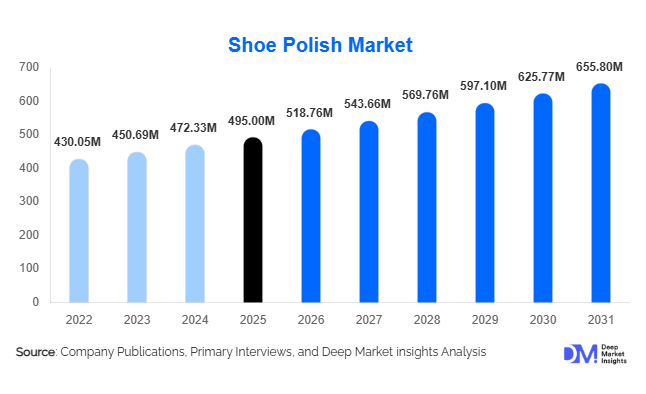
According to Deep Market Insights, the global shoe polish market size was valued at USD 495 million in 2025 and is projected to grow from USD 518.76 million in 2026 to reach USD 655.80 million by 2031, expanding at a CAGR of 4.8% during the forecast period (2026–2031). Growth in the shoe polish market is being driven by increasing ownership of premium leather footwear, rising consumer awareness regarding footwear maintenance, and growing demand for specialty shoe-care products across both developed and emerging economies. While the shift toward casual and athletic footwear has moderated demand in some mature markets, premium leather footwear, military applications, and luxury shoe-care products continue to provide a stable demand base. Manufacturers are increasingly introducing environmentally friendly formulations, bio-based waxes, conditioning agents, and sustainable packaging solutions to attract environmentally conscious consumers. Furthermore, the expansion of e-commerce channels has enabled premium and niche brands to penetrate global markets more effectively, supporting overall market growth.
Key Market Insights
- Wax-based shoe polish remains the dominant product category, accounting for approximately 38% of global market revenue due to its superior shine, protection, and water-resistant properties.
- Genuine leather footwear applications represent the largest demand segment, contributing nearly 58% of total shoe polish consumption worldwide.
- Asia-Pacific dominates the global shoe polish market, accounting for approximately 39% of total revenue, supported by large footwear manufacturing industries and rising middle-class populations.
- India is emerging as the fastest-growing national market, driven by expanding leather exports, urbanization, and increasing demand for formal footwear.
- Sustainable and bio-based shoe-care products are gaining popularity, particularly across Europe and North America, as consumers increasingly seek environmentally responsible alternatives.
- E-commerce platforms are reshaping market accessibility, enabling premium shoe-care brands to expand their global customer base while improving consumer awareness regarding footwear maintenance.
Shoe Polish Market Trends
Premiumization of Footwear Care Products
The global footwear industry has witnessed increasing consumer spending on premium leather shoes, luxury footwear collections, and handcrafted footwear products. This trend has directly supported demand for premium shoe polishes incorporating high-quality ingredients such as carnauba wax, beeswax, mink oil, and conditioning compounds. Consumers are increasingly viewing shoe-care products as investments that extend footwear lifespan and preserve aesthetic value. Premium brands are introducing advanced formulations that combine conditioning, waterproofing, polishing, and color restoration within a single product. Luxury shoe-care kits are becoming particularly popular among professional consumers, collectors, and enthusiasts seeking superior footwear maintenance solutions. This premiumization trend is expected to remain a major contributor to industry growth over the forecast period.
Sustainable and Eco-Friendly Formulations Gaining Market Share
Environmental awareness is driving innovation across the shoe polish industry. Manufacturers are increasingly replacing petroleum-based solvents with bio-based ingredients and natural waxes. Demand for low-VOC formulations, recyclable packaging, refillable containers, and biodegradable applicators is growing significantly across developed markets. European regulations regarding chemical safety and sustainability are accelerating the adoption of environmentally friendly products. Several leading manufacturers have launched eco-certified shoe-care product lines that appeal to younger consumers and environmentally conscious buyers. Sustainability is becoming a major differentiator in premium product categories and is expected to influence purchasing decisions more strongly in the coming years.
Shoe Polish Market Drivers
Growing Ownership of Premium Leather Footwear
The increasing popularity of luxury footwear, formal business shoes, premium boots, and collectible leather footwear is creating sustained demand for shoe-care products globally. Consumers investing in high-value footwear are more likely to purchase shoe polish regularly to preserve appearance, extend product life, and maintain resale value. Growth in premium footwear sales across North America, Europe, China, and the Middle East is directly supporting market expansion. Professional workers, executives, and luxury consumers continue to represent key customer groups driving recurring demand for premium shoe-care solutions.
Expansion of E-Commerce and Direct-to-Consumer Sales Channels
The rapid growth of online retail has significantly improved accessibility to premium shoe-care products. Consumers can now access specialized formulations, luxury brands, and niche products that were previously unavailable through traditional retail channels. E-commerce platforms have also facilitated educational content regarding leather maintenance and footwear preservation, increasing awareness and driving purchase frequency. Direct-to-consumer business models allow manufacturers to maintain stronger margins while building customer loyalty through subscription programs and premium product bundles.
Shoe Polish Market Restraints
Growing Preference for Casual and Athletic Footwear
The global shift toward casual dress codes and increased adoption of sneakers, synthetic footwear, and athleisure products has reduced the frequency of traditional shoe polishing in several developed markets. Many consumers no longer require routine leather shoe maintenance, limiting overall market expansion. This trend is particularly evident among younger demographics and remote-working professionals who increasingly favor casual footwear over formal leather shoes.
Declining Formal Workplace Dress Requirements
Relaxed corporate dress standards across North America and Europe have reduced demand for formal leather footwear in office environments. As fewer employees wear traditional business shoes daily, consumption frequency of shoe polish products has declined. Manufacturers are responding by diversifying into broader footwear care categories and specialty products designed for non-traditional footwear materials.
Shoe Polish Market Opportunities
Sustainable Shoe-Care Solutions
The increasing focus on sustainability presents significant opportunities for manufacturers to develop environmentally friendly shoe-care products. Consumers are actively seeking products that utilize renewable raw materials, biodegradable packaging, and low-emission production processes. Brands that successfully combine sustainability with premium performance are expected to capture higher-value market segments and strengthen customer loyalty. Eco-friendly product innovation also enables companies to comply with evolving environmental regulations while differentiating themselves within a competitive market landscape.
Emerging Market Expansion and Institutional Demand
Rapid urbanization, industrialization, and workforce formalization across Asia-Pacific, Africa, and Latin America are creating substantial growth opportunities for shoe polish manufacturers. Government institutions, military organizations, security agencies, hospitality operators, and corporate facilities continue to require polished footwear as part of professional standards. Long-term procurement contracts within these sectors provide stable revenue streams and support volume growth. Emerging economies such as India, Indonesia, Vietnam, and Nigeria are expected to become increasingly important growth markets during the forecast period.
Report Scope
| Report Metric | Details |
|---|---|
| Market Size in 2025 | USD 495 Million |
| Market Size in 2026 | USD 518.76 Million |
| Market Size in 2031 | USD 655.80 Million |
| CAGR | 4.8% (2026-2031) |
| Base Year for Estimation | 2025 |
| Historical Data | 2022-2024 |
| Forecast Period | 2026-2031 |
| Report Coverage | Revenue Forecast, Competitive Landscape, Supply Chain Disruption, Growth Factors, Environment & Regulatory Landscape and Trends |
| Geographies Covered | North America, Europe, APAC, Middle East and Africa, LATAM |
| Countries Covered | U.S., Canada, U.K., Germany, France, Spain, Italy, Russia, Nordic, Benelux, Rest of Europe, China, Korea, Japan, India, Australia, Singapore, Taiwan, South East Asia, Rest of Asia-Pacific, UAE, Turky, Saudi Arabia, South Africa, Egypt, Nigeria, Rest of MEA, Brazil, Mexico, Argentina, Chile, Colombia, Rest of LATAM |
Explore more data points, trends and opportunities Download Free Sample Report
Product Type Insights
Wax-based shoe polish remains the largest product segment, accounting for approximately 38% of global market revenue in 2025. This dominance is primarily driven by its superior performance characteristics, including long-lasting shine, strong surface protection, and high water resistance, making it the preferred choice for leather footwear maintenance across both household and institutional users. Wax-based products are particularly favored in military and formal professional environments where footwear appearance standards are strictly maintained, ensuring consistent repeat consumption and stable demand cycles.
Cream-based shoe polish represents the second-largest segment, supported by its dual functionality of polishing and conditioning. It is widely preferred for restoring leather softness, improving flexibility, and addressing surface scuffs, making it especially popular among premium footwear owners. Liquid shoe polish continues to expand steadily due to its convenience, quick application, and appeal to urban consumers with fast-paced lifestyles. Meanwhile, specialty shoe-care products—including waterproofing solutions, suede and nubuck cleaners, eco-friendly formulations, and vegan leather care products—are witnessing above-average growth. This growth is strongly supported by rising demand for material-specific solutions and increasing consumer awareness regarding footwear preservation, particularly in premium and sustainable footwear segments.
Footwear Material Insights
Genuine leather footwear applications dominate the market, accounting for approximately 58% of global shoe polish demand. This segment leads due to the inherent requirement for regular polishing, conditioning, and protection to maintain durability and aesthetic appeal. Leather footwear consumers typically engage in repeat purchases, making this segment the most consistent revenue contributor for manufacturers.
The leadership of the leather segment is driven by sustained demand for formal footwear in professional settings, luxury footwear consumption, and the continued relevance of leather in premium fashion markets. Synthetic leather footwear is emerging as a significant secondary segment, supported by advancements in material quality and growing affordability. Suede and nubuck footwear care products are expanding within premium fashion categories, while vegan leather maintenance products are gaining traction due to rising ethical consumerism and sustainability preferences, particularly in Europe and North America.
Distribution Channel Insights
Supermarkets and hypermarkets account for approximately 32% of global shoe polish sales, maintaining their position as the leading distribution channel due to high product visibility, impulse purchasing behavior, and strong penetration across urban and semi-urban regions. These channels are particularly effective for economy and mid-range product categories.
The growth leadership of this channel is supported by expanding retail infrastructure in emerging economies and the availability of multiple brands under one roof, allowing consumers to compare and select based on price and brand preference. Footwear specialty stores continue to perform strongly in premium segments, offering expert guidance and curated product selections. Online retail channels are the fastest-growing distribution segment, driven by increasing digital penetration, convenience-oriented consumer behavior, and the availability of niche premium and international brands. Institutional sales channels—including government agencies, military organizations, hotels, and corporate facilities—provide stable bulk demand and long-term procurement contracts, making them strategically important for leading manufacturers.
End User Insights
Household consumers dominate the global shoe polish market, accounting for approximately 68% of total demand. This segment drives consistent consumption through routine footwear maintenance of formal shoes, boots, and luxury leather footwear. Growth in this segment is strongly linked to rising ownership of premium footwear, increasing consumer awareness regarding product longevity, and expanding middle-class populations in emerging markets.
Commercial users, including hotels, shoe repair services, professional shoe-care providers, and footwear retailers, represent a fast-growing segment driven by increasing demand for outsourced footwear maintenance services and premium customer experience offerings. Government and defense organizations also contribute significantly to demand, supported by large-scale procurement for military personnel, police forces, and security agencies, where footwear presentation standards are strictly enforced and require durable, high-performance shoe-care products.
Explore more data points, trends and opportunities Download Free Sample Report
Shoe Polish Market Segmentations
By Product Type
- Wax-Based Shoe Polish
- Cream-Based Shoe Polish
- Liquid Shoe Polish
- Paste Shoe Polish
- Specialty Shoe Care Products (Waterproofing, Suede Care, Eco-Friendly, Vegan Leather Care)
By Footwear Material
- Genuine Leather Footwear
- Synthetic Leather Footwear
- Suede & Nubuck Footwear
- Patent Leather Footwear
- Vegan Leather Footwear
By End User
- Household Consumers
- Commercial Users (Hotels, Shoe Repair Shops, Retailers)
- Government & Defense (Military, Police, Security Services)
By Distribution Channel
- Supermarkets & Hypermarkets
- Footwear Specialty Stores
- Online Retail / E-Commerce
- Institutional Sales (Government & Corporate Procurement)
Regional Insights
Asia-Pacific
Asia-Pacific holds approximately 39% of the global shoe polish market, making it the largest regional market. China leads regional demand with approximately 14% global share, driven by its dominance in footwear manufacturing and large-scale export-oriented production. India contributes around 8% of global revenue and is the fastest-growing national market due to expanding leather exports, rapid urbanization, increasing formal workforce participation, and rising disposable incomes.
The region’s growth is further supported by strong footwear production hubs in Vietnam and Indonesia, while Japan and South Korea drive demand for premium shoe-care products aligned with high-quality footwear consumption. Key regional growth drivers include expanding middle-class populations, rising formal employment, growing export-oriented leather industries, and increasing adoption of premium lifestyle products across urban centers.
Europe
Europe accounts for approximately 28% of global market revenue and remains a highly mature yet premium-driven market. Germany, France, Italy, Spain, and the United Kingdom collectively represent the majority of regional demand. The region’s leadership in premium shoe polish consumption is strongly influenced by long-standing cultural traditions of leather footwear care and high penetration of luxury footwear brands.
Regional growth is driven by increasing consumer preference for sustainable and eco-certified shoe-care products, stringent environmental regulations promoting low-VOC formulations, and strong demand for premium and artisanal footwear maintenance solutions. Additionally, Europe’s luxury fashion industry, particularly in Italy and France, continues to support high-value consumption of premium shoe-care products. The growing trend of sustainable fashion and circular economy practices is further accelerating demand for bio-based and recyclable shoe polish products.
North America
North America represents approximately 18% of global shoe polish demand, with the United States contributing nearly 15% of global revenue. Market growth is supported by high penetration of premium footwear, increasing consumer awareness of leather care, and strong e-commerce adoption. The region shows strong demand for premium conditioning products and specialty formulations targeted at luxury footwear owners and sneaker customization enthusiasts.
Growth in North America is driven by rising disposable incomes, expansion of premium footwear brands, and increasing consumer inclination toward footwear maintenance as part of lifestyle grooming. The region also benefits from strong online retail infrastructure, influencer-driven product awareness, and growing interest in leather restoration and shoe customization culture, particularly in urban centers across the U.S. and Canada.
Latin America
Latin America is led by Brazil and Mexico, which together account for the majority of regional demand. The region is experiencing steady growth supported by increasing urbanization, expanding middle-class populations, and gradual improvement in formal footwear adoption in professional sectors. Domestic footwear manufacturing industries also contribute to baseline demand for shoe-care products.
Growth in this region is further driven by rising consumer awareness regarding footwear maintenance, expansion of retail distribution networks, and increasing availability of mid-range and economy shoe polish products. Premium segment adoption is gradually increasing as consumers shift toward higher-quality leather footwear and branded fashion products, particularly in urban centers.
Middle East & Africa
The Middle East & Africa region accounts for approximately 7% of global market demand, with Saudi Arabia and the UAE leading consumption due to high purchasing power and strong luxury retail ecosystems. South Africa remains the largest market in Sub-Saharan Africa, supported by established retail infrastructure and growing formal footwear usage.
Regional growth is driven by increasing demand for luxury footwear, expansion of corporate and hospitality sectors requiring formal dress standards, and rising influence of global fashion trends. In the Middle East, strong tourism and hospitality industries further support demand for premium shoe-care products. Across Africa, improving urbanization, expanding retail penetration, and rising formal employment are gradually increasing adoption of shoe polish products, particularly in major metropolitan areas.
Key Players in the Shoe Polish Market
- SC Johnson (KIWI)
- Saphir
- Collonil
- Tarrago Brands
- Griffin Shoe Care
- Cherry Blossom
- Angelus Shoe Polish
- Fiebing's
- Moneysworth & Best
- Cadillac Shoe Care
- Lincoln Shoe Polish
- Bickmore
- Meltonian
- Lexol
- URAD