Premium Luggage Market Size
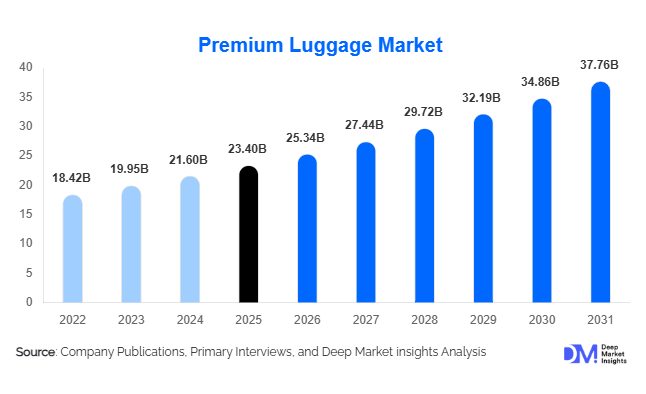
According to Deep Market Insights, the global premium luggage market size was valued at USD 23.4 billion in 2025 and is projected to grow from USD 25.34 billion in 2026 to reach USD 37.76 billion by 2031, expanding at a CAGR of 8.3% during the forecast period (2026–2031). The premium luggage market growth is primarily driven by rising global travel activity, increasing consumer preference for luxury travel accessories, growing demand for lightweight and durable luggage products, and rapid adoption of smart luggage technologies. Expanding international tourism, premiumization trends in consumer spending, and the rise of affluent middle-class populations in Asia-Pacific and the Middle East are further strengthening market expansion globally.
Key Market Insights
- Hard-sided premium luggage dominates the market, driven by increasing demand for durable, lightweight, and impact-resistant travel solutions.
- Smart luggage adoption is accelerating globally, supported by integration of GPS tracking, biometric locks, USB charging, and IoT-enabled travel features.
- Asia-Pacific leads the global premium luggage market, fueled by rising outbound tourism, luxury consumption growth, and expanding aviation infrastructure.
- North America remains a major premium luggage demand hub, driven by strong business travel activity and high consumer spending on luxury accessories.
- Sustainable luggage manufacturing is becoming a major industry trend, with brands investing in recycled polycarbonate, vegan leather, and carbon-neutral production.
- Direct-to-consumer and e-commerce channels are reshaping distribution, enabling premium luggage brands to improve margins and enhance customer personalization.
Premium Luggage Market Trends
Smart and Connected Luggage Technologies Gaining Momentum
The premium luggage industry is witnessing strong growth in demand for technologically advanced travel products. Smart luggage equipped with GPS tracking, biometric authentication, digital locking systems, Bluetooth connectivity, and USB charging ports is increasingly preferred by frequent travelers and business professionals. Consumers are prioritizing convenience, security, and connectivity while traveling, encouraging manufacturers to invest heavily in product innovation. Brands are also integrating mobile app ecosystems that allow users to monitor luggage location, battery levels, and travel history in real time. The growing penetration of IoT technologies within consumer accessories is expected to significantly transform the premium luggage landscape over the coming years.
Sustainable and Eco-Friendly Luggage Manufacturing Expanding Rapidly
Sustainability has emerged as one of the most influential trends within the premium luggage market. Consumers are increasingly seeking environmentally responsible travel products manufactured using recycled plastics, vegan leather, biodegradable fabrics, and low-emission production processes. Premium brands are adopting circular manufacturing strategies, introducing repair and refurbishment programs, and reducing packaging waste to strengthen ESG positioning. European and North American consumers, in particular, are demonstrating strong preference for sustainable premium luggage products. Several manufacturers are also investing in carbon-neutral production facilities and renewable energy integration to improve long-term environmental compliance and brand perception.
Premium Luggage Market Drivers
Growth in Global Tourism and Air Passenger Traffic
The rapid recovery of international tourism and business travel is significantly driving demand for premium luggage worldwide. Rising global air passenger traffic, increasing frequency of international trips, and expansion of low-cost and premium airline connectivity are creating strong demand for high-quality travel accessories. Business travelers and luxury tourists increasingly prefer premium luggage due to superior durability, enhanced security, and premium aesthetics. Airport modernization projects and growth in premium airline travel segments are also positively influencing premium luggage purchases globally.
Rising Premiumization and Luxury Consumer Spending
Consumers are increasingly viewing luggage as a lifestyle and fashion product rather than a purely functional item. The growing influence of luxury branding, celebrity endorsements, and aspirational travel lifestyles is accelerating demand for premium luggage products across developed and emerging markets. Millennials and Gen Z consumers are particularly inclined toward premium and designer luggage products featuring personalization, sustainability, and advanced materials. Rising disposable incomes in countries such as China, India, the UAE, and Southeast Asian nations are further strengthening global market growth.
Premium Luggage Market Restraints
High Product Pricing and Economic Uncertainty
Premium luggage products remain discretionary luxury purchases, making the market highly sensitive to economic downturns and inflationary pressures. Consumers often postpone high-value purchases during periods of reduced travel spending or financial instability. Premium luggage pricing, particularly in aluminum and luxury designer categories, continues to limit broader consumer penetration in price-sensitive markets.
Counterfeit Products and Intense Market Competition
The growing availability of counterfeit luggage products through online marketplaces and informal retail channels continues to challenge premium brands globally. Counterfeit products negatively affect brand value, pricing power, and consumer trust. Additionally, increasing competition from direct-to-consumer startups and emerging luxury brands has intensified marketing costs and customer acquisition expenses for established market leaders.
Premium Luggage Market Opportunities
Expansion of Sustainable Luxury Travel Products
The growing consumer preference for environmentally responsible travel products presents major opportunities for premium luggage manufacturers. Brands investing in recycled polycarbonate, eco-friendly textiles, carbon-neutral manufacturing, and sustainable supply chains are gaining significant competitive advantages. Governments and institutional investors are also increasingly prioritizing ESG-focused businesses, encouraging manufacturers to accelerate sustainability initiatives. Sustainable premium luggage products are expected to achieve higher adoption among younger luxury consumers and environmentally conscious travelers globally.
Rising Demand from Emerging Luxury Travel Markets
Emerging economies including India, China, Indonesia, Saudi Arabia, Vietnam, and Brazil are creating substantial growth opportunities for premium luggage brands. Rising middle-class affluence, increasing passport ownership, and expanding outbound tourism are driving luxury travel spending across these markets. Premium luggage manufacturers are increasingly investing in airport retail stores, localized e-commerce platforms, and luxury retail partnerships to strengthen market penetration. The rapid expansion of international aviation infrastructure across Asia-Pacific and the Middle East is further supporting long-term demand growth.
Report Scope
| Report Metric | Details |
|---|---|
| Market Size in 2025 | USD 23.4 Billion |
| Market Size in 2026 | USD 25.34 Billion |
| Market Size in 2031 | USD 37.76 Billion |
| CAGR | 8.3% (2026-2031) |
| Base Year for Estimation | 2025 |
| Historical Data | 2022-2024 |
| Forecast Period | 2026-2031 |
| Report Coverage | Revenue Forecast, Competitive Landscape, Supply Chain Disruption, Growth Factors, Environment & Regulatory Landscape and Trends |
| Geographies Covered | North America, Europe, APAC, Middle East and Africa, LATAM |
| Countries Covered | U.S., Canada, U.K., Germany, France, Spain, Italy, Russia, Nordic, Benelux, Rest of Europe, China, Korea, Japan, India, Australia, Singapore, Taiwan, South East Asia, Rest of Asia-Pacific, UAE, Turky, Saudi Arabia, South Africa, Egypt, Nigeria, Rest of MEA, Brazil, Mexico, Argentina, Chile, Colombia, Rest of LATAM |
Explore more data points, trends and opportunities Download Free Sample Report
Product Type Insights
Hard-sided premium luggage represents the largest product segment globally, accounting for nearly 39% of total market revenues in 2025. Consumers increasingly prefer hard-shell luggage due to superior durability, enhanced protection, lightweight construction, and premium aesthetics. Polycarbonate and aluminum-based luggage products remain highly popular among business travelers and luxury tourists. Soft-sided premium luggage continues to maintain strong demand among travelers prioritizing flexibility and expandable storage capacity. Smart luggage products are witnessing the fastest growth, driven by increasing integration of digital locking systems, GPS tracking, biometric authentication, and USB charging features. Luxury travel bags, including premium duffels and garment carriers, are also gaining traction among affluent travelers seeking premium lifestyle-oriented travel accessories.
Material Insights
Polycarbonate remains the dominant material segment within the premium luggage market, accounting for approximately 36% of global revenues in 2025. The material offers superior strength-to-weight ratio, impact resistance, and design flexibility, making it highly preferred for premium hard-shell luggage. Aluminum luggage continues to gain popularity in ultra-premium segments due to its luxury appeal, durability, and premium craftsmanship. Sustainable and recycled materials are witnessing rapid growth as consumers increasingly prioritize eco-friendly products. Ballistic nylon and leather products continue to maintain strong demand in premium business luggage and executive travel categories due to their durability and premium appearance.
Distribution Channel Insights
E-commerce and direct-to-consumer channels collectively dominate the premium luggage market, accounting for nearly 34% of global sales in 2025. Consumers increasingly prefer online purchasing due to wider product selection, personalized customization options, transparent pricing, and digital convenience. Premium luggage brands are investing heavily in direct-to-consumer strategies to improve customer engagement and strengthen profitability. Airport retail and duty-free channels remain highly important for luxury luggage sales, particularly among international travelers and premium airline passengers. Luxury department stores and branded flagship stores continue to support high-value customer experiences and premium brand positioning globally.
End-User Insights
Business travelers remain the largest end-user segment within the premium luggage market, accounting for nearly 37% of global demand in 2025. Rising corporate travel activity, increasing executive mobility, and expansion of multinational business operations continue to drive strong demand for lightweight carry-on luggage and smart travel accessories. Luxury tourists represent one of the fastest-growing segments due to increasing expenditure on premium travel experiences and lifestyle-oriented products. High-net-worth individuals continue to support demand for ultra-premium and designer luggage products. Additionally, digital nomads and remote professionals are emerging as important consumer segments, driving demand for multifunctional backpacks, hybrid carry-ons, and tech-enabled travel products.
Price Range Insights
The luxury premium price category ranging between USD 700 and USD 1,500 accounted for approximately 31% of global market revenues in 2025. Consumers within this segment prioritize premium craftsmanship, advanced materials, durability, and luxury branding. Ultra-luxury luggage products priced above USD 1,500 continue to gain popularity among affluent travelers seeking exclusivity, designer collaborations, and customized products. Entry-premium luggage products are witnessing strong demand growth among younger consumers seeking affordable access to premium travel brands. Mid-premium products continue to balance affordability and premium quality, making them attractive across emerging consumer markets.
Explore more data points, trends and opportunities Download Free Sample Report
Premium Luggage Market Segmentations
By Product Type
- Hard-Sided Premium Luggage
- Soft-Sided Premium Luggage
- Smart Premium Luggage
- Luxury Travel Bags
- Premium Backpacks & Business Cases
- Premium Luggage Sets
By Material
- Polycarbonate
- Aluminum
- Leather
- Ballistic Nylon
- ABS Composite
- Carbon Fiber
- Sustainable/Recycled Materials
By Price Range
- Entry Premium (USD 150–300)
- Mid Premium (USD 300–700)
- Luxury Premium (USD 700–1,500)
- Ultra-Luxury (Above USD 1,500)
By Distribution Channel
- Brand-Owned Retail Stores
- Department Stores
- Specialty Travel Retailers
- Airport Retail/Duty-Free
- E-commerce Platforms
- Direct-to-Consumer Websites
- Luxury Fashion Boutiques
By End User
- Business Travelers
- Leisure Travelers
- Luxury Tourists
- Corporate Travel Programs
- High-Net-Worth Individuals (HNWIs)
- Digital Nomads & Remote Professionals
Regional Insights
Asia-Pacific
Asia-Pacific dominates the global premium luggage market, accounting for nearly 36% of total revenues in 2025. China remains the largest regional market due to its expanding affluent population, strong luxury retail ecosystem, and rapidly growing outbound tourism sector. Japan and South Korea continue to demonstrate strong demand for technologically advanced and lightweight luggage products. India is emerging as one of the fastest-growing premium luggage markets globally, supported by increasing air passenger traffic, rising disposable income, and rapid growth in luxury consumer spending. Southeast Asian countries are also witnessing increasing premium luggage demand due to expanding middle-class travel activity and tourism infrastructure development.
North America
North America accounted for approximately 28% of global premium luggage revenues in 2025, led primarily by the United States. High disposable incomes, strong business travel activity, and growing consumer preference for luxury lifestyle accessories continue to support regional market growth. U.S. consumers are increasingly prioritizing smart luggage products featuring GPS tracking, anti-theft systems, and sustainable materials. Canada is also witnessing steady growth driven by rising international travel frequency and premium tourism demand. The region remains highly important for direct-to-consumer luggage brands and digital retail innovation.
Europe
Europe remains a highly mature premium luggage market supported by strong luxury fashion ecosystems and high international travel frequency. Germany, France, Italy, and the United Kingdom represent the largest demand centers within the region. France and Italy benefit strongly from luxury heritage branding and designer collaborations, while Germany demonstrates high demand for durable business travel luggage. Sustainability-focused consumer preferences are particularly strong across European markets, encouraging premium luggage manufacturers to invest in recycled materials and environmentally responsible production systems.
Latin America
Latin America represents a smaller but steadily growing premium luggage market. Brazil and Mexico remain the leading regional demand centers due to rising urban middle-class populations and expanding luxury retail penetration. Premium travel consumption is increasing gradually across the region, particularly among affluent international travelers and younger consumers influenced by global fashion and travel trends.
Middle East & Africa
The Middle East & Africa region is witnessing rapid growth within the premium luggage market, particularly across the UAE and Saudi Arabia. Luxury tourism investments, airport expansion projects, and rising high-net-worth populations continue to support premium luggage demand. Dubai remains one of the world’s leading luxury retail and travel hubs, significantly contributing to regional sales. South Africa also demonstrates growing demand due to rising international tourism and increasing adoption of premium travel accessories.
Key Players in the Premium Luggage Market
- Samsonite International
- TUMI
- Rimowa
- Delsey Paris
- Victorinox
- Briggs & Riley
- Away
- VIP Industries
- Travelpro
- Antler
- Globe-Trotter
- Bric's
- Montblanc
- Louis Vuitton
- FPM Milano