Outdoor Footwear Market Size
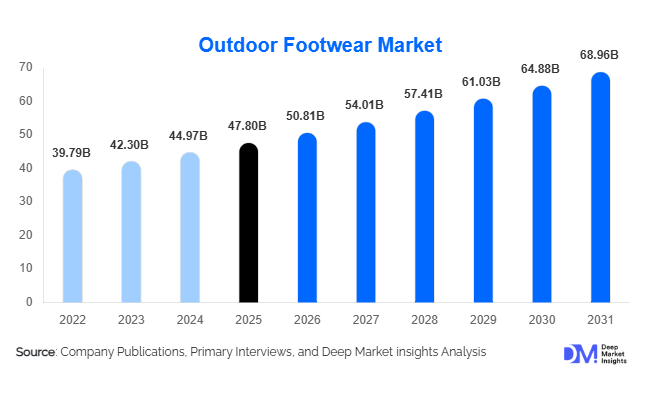
According to Deep Market Insights, the global outdoor footwear market size was valued at USD 47.8 billion in 2025 and is projected to grow from USD 50.81 billion in 2026 to reach USD 68.96 billion by 2031, expanding at a CAGR of 6.3% during the forecast period (2026–2031). The outdoor footwear market growth is primarily driven by increasing participation in hiking, trekking, trail running, camping, and adventure tourism activities worldwide. Growing consumer preference for performance-oriented footwear featuring enhanced comfort, durability, waterproofing, and traction technologies is accelerating product adoption across recreational and professional user groups. In addition, rising health awareness, expanding outdoor recreation infrastructure, and the growing popularity of outdoor lifestyle fashion are creating sustained demand across developed and emerging economies.
Key Market Insights
- Hiking shoes remain the largest product category, accounting for nearly 31% of global outdoor footwear demand due to their versatility across recreational and everyday outdoor activities.
- Synthetic material-based footwear dominates the market, supported by lightweight construction, superior durability, weather resistance, and lower production costs compared to traditional leather alternatives.
- North America dominates the global market, accounting for approximately 35% of total revenue, led by strong outdoor recreation participation in the United States and Canada.
- Asia-Pacific is the fastest-growing regional market, driven by increasing disposable incomes, expanding domestic tourism, and growing interest in outdoor fitness activities.
- Sustainability is becoming a major purchasing factor, with consumers increasingly preferring footwear manufactured using recycled materials, bio-based polymers, and environmentally responsible production processes.
- Technology integration is transforming product innovation, including advanced cushioning systems, waterproof membranes, carbon-plated trail running footwear, and smart wearable-compatible footwear platforms.
Outdoor Footwear Market Trends
Outdoor Lifestyle Fashion Driving Market Expansion
Outdoor footwear is increasingly being adopted beyond traditional recreational settings and has become an important part of everyday lifestyle fashion. Consumers are incorporating hiking shoes, trail runners, and outdoor-inspired footwear into casual urban wardrobes due to their comfort, durability, and performance-oriented design. This trend has significantly expanded the addressable consumer base for manufacturers beyond dedicated outdoor enthusiasts. Premium outdoor brands are increasingly collaborating with fashion designers, lifestyle retailers, and streetwear labels to introduce hybrid footwear products that combine outdoor functionality with contemporary aesthetics. The growing popularity of "gorpcore" fashion and outdoor-inspired apparel trends continues to support strong sales growth across North America, Europe, and Asia-Pacific.
Sustainable Footwear Manufacturing Becoming Mainstream
Environmental sustainability has become a central focus for outdoor footwear manufacturers. Leading brands are investing heavily in recycled rubber compounds, bio-based foams, recycled polyester uppers, and low-carbon manufacturing technologies. Consumers increasingly evaluate products based on environmental impact, durability, and end-of-life recyclability. Many manufacturers are implementing footwear take-back programs, repair services, and circular economy initiatives to improve sustainability credentials. Regulatory pressure in Europe and increasing consumer awareness globally are expected to further accelerate sustainable material adoption throughout the forecast period.
Outdoor Footwear Market Drivers
Growing Participation in Outdoor Recreation Activities
The increasing popularity of hiking, trekking, trail running, camping, and adventure tourism remains one of the strongest growth drivers for the outdoor footwear market. Governments across North America, Europe, and Asia-Pacific continue investing in national parks, trail networks, eco-tourism infrastructure, and outdoor recreation facilities. Rising awareness regarding physical fitness, mental well-being, and nature-based leisure activities is encouraging consumers to participate in outdoor sports more frequently. This trend has created sustained demand for specialized footwear designed for diverse terrains and environmental conditions.
Premiumization and Performance-Oriented Consumer Preferences
Consumers are increasingly willing to invest in premium outdoor footwear that offers advanced performance characteristics such as waterproof membranes, enhanced grip systems, lightweight materials, superior cushioning, and ergonomic designs. Technical innovations have enabled manufacturers to introduce products that improve comfort, reduce fatigue, and enhance safety during extended outdoor activities. Premium segments continue to outperform mass-market categories, particularly among experienced hikers, trail runners, and adventure travelers seeking high-performance products.
Outdoor Footwear Market Restraints
Volatility in Raw Material Costs
Outdoor footwear manufacturing depends heavily on raw materials such as leather, synthetic polymers, EVA foams, specialty textiles, adhesives, and rubber compounds. Fluctuations in commodity prices, transportation expenses, and supply chain disruptions can significantly impact production costs and profit margins. Manufacturers often face challenges in maintaining competitive pricing while preserving product quality and technological differentiation.
Market Saturation in Developed Economies
Mature markets such as the United States, Germany, France, and the United Kingdom exhibit relatively high outdoor footwear penetration levels. Intense competition among established global brands increases marketing expenditures and customer acquisition costs. Product differentiation is becoming increasingly important as manufacturers compete for market share in highly developed regions where replacement purchases account for a significant proportion of total demand.
Outdoor Footwear Market Opportunities
Expansion of Adventure Tourism Worldwide
The rapid growth of adventure tourism presents significant opportunities for outdoor footwear manufacturers. Governments and tourism organizations are promoting trekking, mountain tourism, hiking trails, eco-tourism destinations, and outdoor sports facilities across emerging markets. Countries such as India, Vietnam, Indonesia, Peru, Chile, and several African nations are witnessing increasing adventure travel participation, creating new demand for specialized footwear products. Manufacturers can capitalize on this trend through destination-specific product development and partnerships with tourism operators.
Smart Footwear and Digital Integration
The integration of wearable technologies into outdoor footwear represents a significant long-term growth opportunity. Smart insoles, gait monitoring systems, GPS-enabled performance tracking, and connected outdoor equipment ecosystems are creating new premium product categories. Professional athletes, endurance runners, military users, and outdoor enthusiasts increasingly seek performance analytics that enhance safety, efficiency, and training outcomes. Partnerships between footwear manufacturers and wearable technology providers are expected to accelerate innovation in this segment.
Report Scope
| Report Metric | Details |
|---|---|
| Market Size in 2025 | USD 47.8 Billion |
| Market Size in 2026 | USD 50.81 Billion |
| Market Size in 2031 | USD 68.96 Billion |
| CAGR | 6.3% (2026-2031) |
| Base Year for Estimation | 2025 |
| Historical Data | 2022-2024 |
| Forecast Period | 2026-2031 |
| Report Coverage | Revenue Forecast, Competitive Landscape, Supply Chain Disruption, Growth Factors, Environment & Regulatory Landscape and Trends |
| Geographies Covered | North America, Europe, APAC, Middle East and Africa, LATAM |
| Countries Covered | U.S., Canada, U.K., Germany, France, Spain, Italy, Russia, Nordic, Benelux, Rest of Europe, China, Korea, Japan, India, Australia, Singapore, Taiwan, South East Asia, Rest of Asia-Pacific, UAE, Turky, Saudi Arabia, South Africa, Egypt, Nigeria, Rest of MEA, Brazil, Mexico, Argentina, Chile, Colombia, Rest of LATAM |
Explore more data points, trends and opportunities Download Free Sample Report
Product Type Insights
Hiking shoes represent the largest product segment, accounting for approximately 31% of the global outdoor footwear market in 2025. Their leadership position is supported by broad consumer adoption across recreational hiking, travel, camping, and everyday outdoor use. Compared with traditional hiking boots, hiking shoes offer lighter weight, enhanced comfort, and greater versatility, making them attractive to both experienced outdoor participants and casual users. Trail running footwear is emerging as one of the fastest-growing categories due to increasing participation in endurance sports and outdoor fitness activities. Mountaineering boots and climbing footwear continue to serve specialized high-value segments characterized by premium pricing and strong brand loyalty. Outdoor sandals and amphibious footwear are also experiencing growing demand in warm-weather recreational markets and water-based outdoor activities.
Application Insights
Hiking remains the dominant application segment, representing approximately 34% of global outdoor footwear demand. The popularity of hiking continues to expand across all age groups due to increasing wellness awareness and growing accessibility of hiking infrastructure. Trekking and backpacking applications generate significant demand for durable and technical footwear capable of supporting extended outdoor expeditions. Trail running is among the fastest-growing application segments, benefiting from rising participation in endurance events and outdoor fitness programs. Mountaineering, hunting, camping, and adventure tourism applications collectively contribute substantial demand for specialized footwear products that prioritize safety, performance, and environmental adaptability.
Distribution Channel Insights
Sporting goods retailers remain the leading distribution channel, accounting for approximately 28% of global market sales. Consumers continue to value physical product testing, professional guidance, and footwear fitting services before making purchases. Specialty outdoor retailers maintain strong market positions by offering expert advice and premium product portfolios tailored to outdoor enthusiasts. E-commerce has become one of the fastest-growing channels, driven by expanding direct-to-consumer strategies and increasing digital engagement among younger consumers. Brand-owned retail stores continue to play a critical role in strengthening customer relationships and showcasing new product innovations. Online marketplaces and omnichannel retail strategies are further improving product accessibility across both developed and emerging markets.
User Type Insights
Men represent the largest consumer segment, accounting for approximately 58% of total market revenue due to historically higher participation rates in hiking, trekking, hunting, and mountaineering activities. However, women's outdoor footwear is among the fastest-growing segments as female participation in outdoor recreation, trail running, and adventure tourism continues to rise globally. Manufacturers are increasingly introducing women-specific designs focused on fit optimization, comfort, and performance enhancement. The youth segment is also expanding steadily, supported by growing family participation in outdoor recreation and educational outdoor programs that encourage active lifestyles among younger consumers.
Explore more data points, trends and opportunities Download Free Sample Report
Outdoor Footwear Market Segmentations
By Product Type
- Hiking Shoes
- Hiking Boots
- Trail Running Shoes
- Trekking Footwear
- Mountaineering Boots
- Climbing & Approach Shoes
- Outdoor Sandals
- Water Hiking & Amphibious Footwear
- Hunting Footwear
- Winter Outdoor Footwear
By Activity Type
- Hiking
- Trekking & Backpacking
- Trail Running
- Mountaineering
- Rock Climbing
- Camping
- Hunting
- Adventure Tourism
- Water-Based Outdoor Activities
By Distribution Channel
- Sporting Goods Retailers
- Specialty Outdoor Stores
- Brand-Owned Retail Stores
- E-commerce & Direct-to-Consumer Platforms
- Multi-Brand Online Marketplaces
- Department Stores & Hypermarkets
By User Type
- Men
- Women
- Children & Youth
By Material Type
- Leather
- Synthetic Materials
- Textile & Mesh-Based Materials
- Rubber-Based Materials
- Hybrid Material Construction
- Sustainable & Recycled Materials
Regional Insights
North America
North America accounts for approximately 35% of global outdoor footwear market revenue, making it the largest regional market. The United States alone contributes nearly 28% of global demand due to its strong outdoor recreation culture, extensive national park system, and high participation rates in hiking, camping, trail running, and adventure sports. Canada also represents a significant market, supported by favorable geography and widespread outdoor lifestyle adoption. Premium footwear categories perform particularly well across the region due to strong consumer purchasing power and high demand for technologically advanced products.
Europe
Europe accounts for approximately 29% of global market revenue and remains one of the most mature outdoor footwear markets worldwide. Germany, France, the United Kingdom, Italy, Austria, Switzerland, and the Nordic countries drive regional demand. Hiking, alpine tourism, mountaineering, and sustainability-focused purchasing behavior support strong demand for premium and environmentally responsible footwear products. European consumers demonstrate particularly high interest in recycled materials, ethical sourcing practices, and durable product designs.
Asia-Pacific
Asia-Pacific accounts for approximately 25% of global revenue and represents the fastest-growing regional market, with forecast growth exceeding 8% annually through 2031. China remains the largest market within the region, followed by Japan, Australia, South Korea, and India. Rising disposable incomes, expanding domestic tourism, growing participation in outdoor activities, and increasing adoption of health-conscious lifestyles are driving strong market expansion. Government investments in tourism infrastructure and outdoor recreation facilities further support long-term growth prospects.
Latin America
Latin America represents approximately 6% of global market demand. Brazil, Argentina, Chile, Colombia, and Peru serve as major growth markets due to increasing adventure tourism activity and rising participation in outdoor recreation. Expanding eco-tourism initiatives and growing consumer awareness regarding health and wellness are expected to support continued market development across the region.
Middle East & Africa
The Middle East and Africa account for approximately 5% of global outdoor footwear demand. South Africa remains the largest market in the region, supported by established outdoor recreation and adventure tourism industries. The United Arab Emirates and Saudi Arabia are emerging growth markets due to increasing tourism diversification initiatives, rising disposable incomes, and expanding interest in outdoor fitness activities. Government investments in tourism and recreation infrastructure are expected to contribute to future market growth.