Lettuce Seeds Market Size
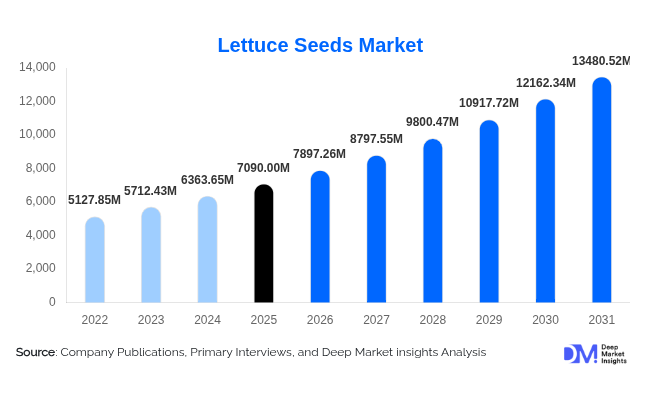
According to Deep Market Insights, the global lettuce seeds market size was valued at USD 7,090.00 million in 2025 and is projected to grow from USD 7,897.26 million in 2026 to reach USD 13,480.52 million by 2031, expanding at a CAGR of 11.4% during the forecast period (2026–2031). The lettuce seeds market growth is primarily driven by rising global consumption of fresh leafy vegetables, increasing adoption of hybrid and disease-resistant seed varieties, and the rapid expansion of protected and indoor farming systems across developed and emerging economies.
Key Market Insights
- Hybrid lettuce seeds dominate global demand, driven by higher yield stability, uniform growth, and improved disease resistance.
- Iceberg and romaine lettuce seeds account for the largest share, supported by strong demand from foodservice and quick-service restaurant chains.
- North America leads global consumption, while Asia-Pacific remains the fastest-growing regional market.
- Protected cultivation is expanding rapidly, particularly in greenhouses and vertical farms where lettuce is a primary crop.
- Disease-resistant and heat-tolerant traits are increasingly preferred due to climate variability.
- Direct-to-farm sales channels dominate distribution, reflecting strong B2B relationships between seed companies and growers.
What are the latest trends in the lettuce seeds market?
Rising Adoption of Hybrid and Trait-Enhanced Seeds
The lettuce seeds market is witnessing a strong shift toward hybrid and trait-enhanced varieties that offer improved productivity, predictable harvest cycles, and resistance to common diseases such as downy mildew and lettuce mosaic virus. Growers are increasingly prioritizing seeds that reduce crop loss risks and input costs, particularly in regions facing erratic weather patterns. Seed companies are investing heavily in advanced breeding programs and genomic selection techniques to develop proprietary traits, enabling differentiation and premium pricing. This trend is particularly prominent in commercial farming and protected cultivation environments, where uniformity and yield consistency are critical.
Growth of Indoor and Controlled-Environment Farming
Indoor farming, hydroponics, and vertical agriculture are reshaping demand dynamics in the lettuce seeds market. Lettuce is among the most widely cultivated crops in controlled environments due to its short growth cycle and high market turnover. Seed varieties optimized for artificial lighting, compact growth, and rapid maturity are gaining traction. Urban agriculture initiatives and food security programs are further accelerating adoption, particularly in Asia-Pacific, the Middle East, and North America. As controlled-environment agriculture scales, demand for specialized lettuce seed varieties is expected to rise steadily.
What are the key drivers in the lettuce seeds market?
Increasing Global Consumption of Fresh and Healthy Foods
Rising health consciousness and changing dietary preferences are driving global demand for fresh vegetables, particularly leafy greens such as lettuce. Lettuce is widely consumed across salads, sandwiches, and ready-to-eat meals, supporting consistent year-round demand. This consumption trend directly fuels demand for high-quality lettuce seeds, especially in regions with strong retail and foodservice sectors. As plant-based diets gain popularity, lettuce continues to benefit from its perception as a low-calorie, nutrient-rich food.
Expansion of Protected Cultivation and Greenhouse Farming
The expansion of greenhouse and net-house farming is a key growth driver for the lettuce seeds market. Protected cultivation allows growers to produce lettuce year-round with higher yields and better quality control. This has increased demand for hybrid and specialty lettuce seeds that perform optimally under controlled conditions. Governments and private investors are supporting greenhouse expansion to enhance food security, further strengthening seed demand.
What are the restraints for the global market?
High Cost of Hybrid and Specialty Seeds
Hybrid and trait-enhanced lettuce seeds are priced significantly higher than open-pollinated varieties, which can limit adoption among smallholder and price-sensitive farmers. In developing regions, cost constraints remain a barrier to widespread adoption of advanced seed technologies, potentially slowing market penetration.
Regulatory and Certification Challenges
Seed registration, certification, and phytosanitary regulations vary widely across countries, increasing compliance costs and time-to-market for seed producers. These regulatory complexities can restrict the introduction of new varieties, particularly in emerging markets.
What are the key opportunities in the lettuce seeds industry?
Growth Opportunities in Emerging Markets
Asia-Pacific, Latin America, and the Middle East present strong growth opportunities due to urbanization, rising incomes, and increasing investment in domestic vegetable production. Governments in these regions are promoting modern farming practices, including greenhouse cultivation, which is expected to significantly boost demand for high-performance lettuce seeds.
Development of Climate-Resilient Seed Varieties
Climate change is increasing the need for heat-tolerant, drought-resistant, and fast-growing lettuce varieties. Seed companies that successfully commercialize climate-resilient traits can gain a competitive advantage, particularly in regions experiencing extreme weather conditions.
Report Scope
| Report Metric | Details |
|---|---|
| Market Size in 2025 | USD 7090.00 Million |
| Market Size in 2026 | USD 7897.26 Million |
| Market Size in 2031 | USD 13480.52 Million |
| CAGR | 11.4% (2026-2031) |
| Base Year for Estimation | 2025 |
| Historical Data | 2022-2024 |
| Forecast Period | 2026-2031 |
| Report Coverage | Revenue Forecast, Competitive Landscape, Supply Chain Disruption, Growth Factors, Environment & Regulatory Landscape and Trends |
| Geographies Covered | North America, Europe, APAC, Middle East and Africa, LATAM |
| Countries Covered | U.S., Canada, U.K., Germany, France, Spain, Italy, Russia, Nordic, Benelux, Rest of Europe, China, Korea, Japan, India, Australia, Singapore, Taiwan, South East Asia, Rest of Asia-Pacific, UAE, Turky, Saudi Arabia, South Africa, Egypt, Nigeria, Rest of MEA, Brazil, Mexico, Argentina, Chile, Colombia, Rest of LATAM |
Explore more data points, trends and opportunities Download Free Sample Report
Product Type Insights
By lettuce type, iceberg lettuce seeds account for the largest share of the global market, representing approximately 34% of total demand in 2025. The segment’s dominance is primarily driven by its extensive use in quick-service restaurants, fast-food chains, and large-scale foodservice operations, where iceberg lettuce is favored for its long shelf life, crisp texture, and consistent appearance. Its suitability for mass production and processing further supports widespread adoption among commercial growers.
Romaine lettuce seeds follow closely, supported by growing consumer preference for salads, wraps, and fresh-cut produce. Romaine lettuce benefits from its perceived nutritional value, versatility in culinary applications, and increasing inclusion in health-focused menus across retail and foodservice channels. Leaf and butterhead lettuce seeds are gaining popularity due to their adaptability to home gardening, hydroponic systems, and indoor farming environments. These varieties are favored for their shorter growth cycles, aesthetic appeal, and suitability for urban and controlled-environment agriculture.
Seed Type Insights
By seed type, hybrid lettuce seeds dominate the global market with an estimated 62% share in 2025. The leading driver for this segment is the superior agronomic performance of hybrid seeds, including higher yields, uniform crop quality, improved disease resistance, and better tolerance to climate variability. These advantages make hybrids the preferred choice for commercial growers seeking predictable output and profitability.
Open-pollinated seeds continue to be used in traditional farming systems and small-scale operations due to their lower cost and seed-saving potential. However, their market share is gradually declining as commercial producers increasingly transition to hybrid varieties to meet quality standards and rising productivity demands.
Application Insights
Commercial farming represents the largest application segment, accounting for nearly 76% of global lettuce seed demand. The primary driver of this segment is large-scale vegetable production supplying retail chains, foodservice operators, and export markets. Rising global consumption of fresh and processed lettuce, coupled with contract farming and organized retail expansion, continues to support strong demand from commercial growers.
Home gardening is a steadily expanding segment, driven by urbanization, increased consumer interest in self-grown produce, and the popularity of kitchen gardens and balcony farming. The segment has also benefited from e-commerce seed availability and growing awareness of healthy eating habits.
Distribution Channel Insights
Direct-to-farm sales dominate the lettuce seeds market, accounting for approximately 45% of total distribution. The key driver for this channel is the direct engagement between seed companies and commercial growers, enabling customized seed solutions, technical support, and long-term supply agreements.
Agricultural retail stores play a significant role in serving small and medium-scale farmers by providing easy access to seeds, advisory services, and complementary agricultural inputs.
Online and e-commerce channels are expanding rapidly, particularly among home gardeners and tech-savvy growers. Growth in this channel is driven by convenience, wider product selection, and increasing digital adoption in the agricultural sector.
Explore more data points, trends and opportunities Download Free Sample Report
Lettuce Seeds Market Segmentations
By Lettuce Type
- Iceberg (Crisphead) Lettuce Seeds
- Romaine (Cos) Lettuce Seeds
- Butterhead Lettuce Seeds
- Leaf Lettuce Seeds (Green & Red)
- Stem (Celtuce) Lettuce Seeds
By Seed Type
- Hybrid Lettuce Seeds
- Open-Pollinated Lettuce Seeds
By Farming Method
- Conventional Lettuce Seeds
- Organic Lettuce Seeds
Cultivation Environment
- Open Field Cultivation
- Protected Cultivation (Greenhouse, Net House, Vertical Farms)
By Application
- Commercial Farming
- Home Gardening
- Institutional & Research Cultivation
By Distribution Channel
- Direct-to-Farm Sales
- Agricultural Retail Stores
- Online & E-commerce Channels
Regional Insights
North America
North America accounts for approximately 29% of the global lettuce seeds market in 2025, led by the United States. Regional growth is driven by high per-capita lettuce consumption, advanced farming practices, and widespread adoption of hybrid seeds. Additionally, increasing investments in greenhouse farming, vertical agriculture, and year-round lettuce production are significantly boosting seed demand across the region.
Europe
Europe represents around 24% of global lettuce seed demand, with major contributions from Spain, Italy, the Netherlands, and France. Growth in the region is supported by export-oriented lettuce production, strong seed quality regulations, and a focus on sustainable and traceable agriculture. The widespread adoption of protected cultivation and organic farming practices further drives demand for high-quality and disease-resistant seeds.
Asia-Pacific
Asia-Pacific is the fastest-growing regional market, expanding at a CAGR of over 9%. China, Japan, and India are key contributors, driven by rapid urbanization, rising disposable incomes, and increasing consumption of fresh vegetables. Growth is further supported by the expansion of protected farming, greenhouse cultivation, and government initiatives promoting modern agricultural practices.
Latin America
Latin America is experiencing steady growth, led by countries such as Mexico and Chile. Regional expansion is driven by export-focused lettuce production, favorable climatic conditions, and increasing adoption of hybrid seeds, which are helping improve crop yields, uniformity, and international market competitiveness.
Middle East & Africa
The Middle East & Africa region is witnessing rising demand for lettuce seeds due to food security initiatives, population growth, and increasing investments in greenhouse and controlled-environment agriculture. Countries such as the UAE and Saudi Arabia are actively promoting domestic vegetable production, driving demand for high-performance lettuce seed varieties suitable for arid climates.
Key Players in the Lettuce Seeds Market
- Bayer CropScience
- Syngenta Group
- Limagrain
- Enza Zaden
- Rijk Zwaan
- BASF (Nunhems)
- Sakata Seed Corporation
- Takii & Co.
- Vilmorin-Mikado
- East-West Seed
- Bejo Zaden
- Advanta Seeds
- KWS Group
- UPL (Advanta)
- Longping High-Tech