LED Ring Light Market Size
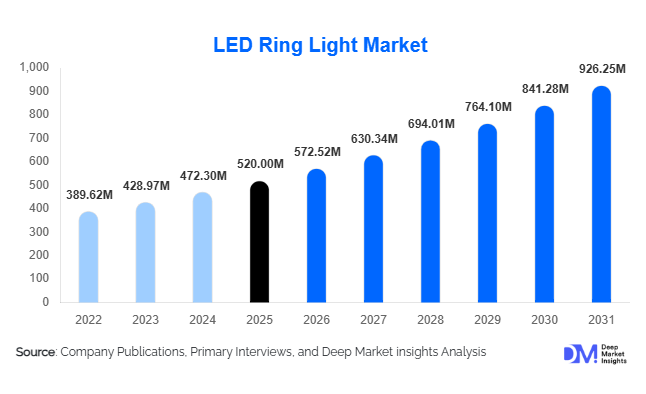
According to Deep Market Insights, the global LED ring light market size was valued at USD 520 million in 2025 and is projected to grow from USD 572.52 million in 2026 to reach USD 926.25 million by 2031, expanding at a CAGR of 10.1% during the forecast period (2026–2031). The LED ring light market growth is primarily driven by the rapid expansion of digital content creation, increasing adoption of remote work tools, and rising demand for professional-grade lighting across consumer and commercial applications.
Key Market Insights
- Content creation is the dominant application, accounting for over 35% of global demand, driven by social media platforms and influencer economies.
- Asia-Pacific leads the global market with approximately 42% share, supported by strong manufacturing capabilities and rising domestic consumption.
- Online distribution channels dominate, contributing nearly 60% of total sales due to e-commerce expansion and direct-to-consumer models.
- USB-powered and portable ring lights are gaining traction, especially among mobile content creators and remote professionals.
- Smart and RGB-enabled lighting solutions are emerging as premium segments, enabling product differentiation and higher margins.
- Healthcare and e-commerce photography applications are expanding, creating new high-value demand segments.
What are the latest trends in the LED ring light market?
Rise of Smart and App-Controlled Lighting
Manufacturers are increasingly integrating smart features such as Bluetooth connectivity, mobile app control, and voice assistant compatibility into LED ring lights. These innovations allow users to adjust brightness, color temperature, and lighting modes remotely, enhancing convenience and user experience. Smart lighting solutions are particularly appealing to professional content creators and tech-savvy consumers who seek precision and customization. Additionally, integration with smart home ecosystems is enabling ring lights to become part of connected environments, supporting automated lighting setups for studios and home offices.
Growing Popularity of RGB and Multi-Functional Lighting
RGB LED ring lights are gaining significant popularity due to their ability to create dynamic visual effects. These lights are widely used in live streaming, gaming, and social media content to enhance aesthetic appeal. Multi-functional devices that combine lighting with smartphone holders, tripods, and wireless charging features are also trending. This convergence of functionality is attracting consumers who prioritize compact, all-in-one solutions, particularly in space-constrained environments. The trend is further supported by the increasing demand for visually engaging and differentiated content across digital platforms.
What are the key drivers in the LED ring light market?
Expansion of the Global Creator Economy
The rapid growth of social media platforms and monetization opportunities has fueled demand for high-quality visual content. Content creators, influencers, educators, and small businesses rely heavily on LED ring lights to improve production quality. This democratization of content creation has significantly expanded the consumer base, driving sustained market growth.
Adoption of Remote Work and Virtual Communication
The shift toward hybrid and remote work models has increased the need for professional lighting solutions in home offices. LED ring lights enhance video conferencing quality, making them essential tools for corporate professionals, educators, and freelancers. This trend is expected to persist, supporting long-term demand.
Technological Advancements in LED Lighting
Continuous innovation in LED technology has improved energy efficiency, durability, and lighting quality. Features such as adjustable brightness, color temperature control, and portability have made ring lights more versatile and accessible. These advancements have expanded their applications across industries, from beauty and healthcare to e-commerce and photography.
What are the restraints for the global market?
Intense Price Competition and Market Fragmentation
The LED ring light market is highly fragmented, with numerous low-cost manufacturers offering similar products. This has led to aggressive pricing strategies, reducing profit margins for established players. Commoditization of basic products makes differentiation challenging and increases competitive pressure.
Availability of Alternative Lighting Solutions
Competing technologies such as softbox lighting, LED panels, and advanced smartphone camera lighting reduce dependence on ring lights. As alternative solutions become more affordable and accessible, they may limit market growth, particularly among casual users.
What are the key opportunities in the LED ring light industry?
Expansion in Emerging Markets
Emerging economies such as India, Brazil, and Indonesia present significant growth opportunities due to increasing smartphone penetration and internet access. The rising number of content creators in these regions is driving demand for affordable lighting solutions. Manufacturers can capitalize on this trend by offering cost-effective products tailored to local preferences.
Growth in Professional and Niche Applications
LED ring lights are increasingly being adopted in healthcare, particularly in dental and dermatology practices, where consistent lighting is essential for diagnostics. Similarly, the growth of e-commerce is driving demand for product photography lighting solutions. These niche applications offer higher margins and long-term growth potential.
Report Scope
| Report Metric | Details |
|---|---|
| Market Size in 2025 | USD 520 Million |
| Market Size in 2026 | USD 572.52 Million |
| Market Size in 2031 | USD 926.25 Million |
| CAGR | 10.1% (2026-2031) |
| Base Year for Estimation | 2025 |
| Historical Data | 2022-2024 |
| Forecast Period | 2026-2031 |
| Report Coverage | Revenue Forecast, Competitive Landscape, Supply Chain Disruption, Growth Factors, Environment & Regulatory Landscape and Trends |
| Geographies Covered | North America, Europe, APAC, Middle East and Africa, LATAM |
| Countries Covered | U.S., Canada, U.K., Germany, France, Spain, Italy, Russia, Nordic, Benelux, Rest of Europe, China, Korea, Japan, India, Australia, Singapore, Taiwan, South East Asia, Rest of Asia-Pacific, UAE, Turky, Saudi Arabia, South Africa, Egypt, Nigeria, Rest of MEA, Brazil, Mexico, Argentina, Chile, Colombia, Rest of LATAM |
Explore more data points, trends and opportunities Download Free Sample Report
Product Type Insights
Dimmable LED ring lights dominate the global market, accounting for approximately 32% of total revenue in 2025. The leadership of this segment is primarily driven by its versatility and cost-to-performance advantage. Adjustable brightness and color temperature capabilities make these lights suitable for a wide range of applications, including content creation, beauty tutorials, photography, and virtual meetings. This flexibility allows both amateur and professional users to optimize lighting conditions without investing in high-end studio setups, significantly boosting adoption. Additionally, falling component costs have enabled manufacturers to incorporate dimming features even in mid-range products, further strengthening this segment’s dominance.
Smart and RGB-enabled LED ring lights are emerging as the fastest-growing product categories, supported by increasing demand for customizable lighting environments. These products cater to gamers, live streamers, and social media influencers who prioritize visually engaging content. Integration with mobile applications, voice assistants, and pre-set lighting modes is enabling premium pricing and differentiation. Meanwhile, professional studio ring lights, although smaller in volume, contribute disproportionately to revenue due to higher price points and usage in commercial studios, healthcare settings, and high-end photography. This segment benefits from demand for precision lighting, high lumen output, and superior color rendering.
Application Insights
Content creation remains the largest application segment, contributing over 35% of the global market in 2025. The segment’s dominance is fueled by the rapid expansion of social media ecosystems, including short-form video platforms, live streaming, and digital marketing. The need for high-quality, shadow-free illumination to enhance visual appeal and audience engagement has made LED ring lights an essential tool for creators. Increasing monetization opportunities across platforms are further incentivizing investment in professional-grade lighting equipment.
Photography and videography applications continue to grow steadily, supported by freelance professionals, small studios, and commercial production houses. LED ring lights are particularly valued for portrait photography and close-up shots due to their ability to provide uniform lighting. The beauty and cosmetics segment is another key contributor, driven by makeup artists, salons, and influencers who rely on consistent lighting for tutorials and client services. Emerging applications in healthcare, particularly in dermatology and dental practices, are gaining traction due to the need for accurate visual diagnostics. Additionally, e-commerce product photography is becoming a significant growth area as online sellers seek cost-effective lighting solutions to improve product presentation and conversion rates.
Distribution Channel Insights
Online retail dominates the LED ring light market, accounting for nearly 60% of total sales. The leading position of this segment is driven by the widespread adoption of e-commerce platforms, which offer competitive pricing, extensive product variety, and global accessibility. Direct-to-consumer (D2C) channels have enabled manufacturers to improve margins while building brand visibility through digital marketing and influencer collaborations. The convenience of doorstep delivery, coupled with user reviews and product comparisons, has significantly influenced purchasing decisions, particularly among younger and tech-savvy consumers.
Offline channels, including electronics stores, specialty lighting retailers, and professional equipment suppliers, continue to play a crucial role in the premium segment. These channels provide hands-on product experience, technical guidance, and after-sales support, which are important for professional users and institutional buyers. However, their share is gradually declining as digital channels expand. Social media platforms are increasingly acting as indirect distribution channels, with influencer endorsements and live product demonstrations driving impulse purchases and shaping consumer preferences.
End-Use Industry Insights
Individual consumers represent the largest end-use segment, driven by the rapid proliferation of social media users and independent content creators. This segment benefits from low entry barriers, affordable product availability, and increasing awareness of lighting’s impact on content quality. The segment is growing at a steady pace, supported by rising adoption in emerging markets and among younger demographics.
The beauty and cosmetics industry is a major growth driver, with demand exceeding USD 120 million in 2025. Professional makeup artists, beauty influencers, and salons rely heavily on LED ring lights for consistent and high-quality illumination. Healthcare applications, particularly in dental and dermatology practices, are emerging as high-growth segments with double-digit CAGR, driven by the need for precise and shadow-free lighting in diagnostics and procedures. Corporate and commercial usage is also expanding, supported by the widespread adoption of virtual communication tools and remote work environments. Additionally, export-driven demand from Asia-Pacific manufacturers continues to play a critical role in global supply, ensuring availability and price competitiveness across regions.
Explore more data points, trends and opportunities Download Free Sample Report
LED Ring Light Market Segmentations
By Product Type
- Standard LED Ring Lights
- Dimmable LED Ring Lights
- Smart LED Ring Lights
- RGB LED Ring Lights
- Clip-on / Portable Ring Lights
- Professional Studio Ring Lights
By Application
- Content Creation
- Photography
- Videography
- Beauty & Cosmetics
- Healthcare (Dental & Dermatology)
- E-commerce Product Photography
By Distribution Channel
- Online Retail
- Electronics & Specialty Stores
By End-Use Industry
- Individual Consumers
- Professional Studios
- Beauty & Cosmetics Industry
- Healthcare
- Corporate & Commercial
Regional Insights
North America
North America accounts for approximately 28% of the global LED ring light market, with the United States contributing nearly 22% of global revenue. The region’s growth is driven by a highly developed creator economy, widespread adoption of remote work, and strong demand for premium and technologically advanced lighting solutions. High disposable income levels enable consumers to invest in feature-rich products, including smart and RGB-enabled ring lights. The presence of established content creators, professional studios, and corporate users further strengthens demand. Additionally, advanced e-commerce infrastructure and fast delivery networks support high online sales penetration. Increasing use of LED ring lights in healthcare, particularly telemedicine and cosmetic procedures, is also contributing to regional growth.
Asia-Pacific
Asia-Pacific dominates the global market with a 42% share in 2025, driven by both high production capacity and rapidly expanding consumer demand. China serves as the global manufacturing hub, benefiting from economies of scale, established supply chains, and cost-efficient production. India is the fastest-growing market in the region, with a CAGR exceeding 12%, fueled by a booming digital content ecosystem, increasing smartphone penetration, and affordable internet access. Countries such as Japan and South Korea contribute through high adoption of advanced and premium lighting solutions, particularly in the professional and entertainment industries. The region also benefits from strong export activity, supplying LED ring lights to North America and Europe at competitive prices.
Europe
Europe holds around 18% of the global market, with Germany, the United Kingdom, and France as key contributors. Growth in this region is driven by strong demand from professional photography, media production, and corporate sectors. Increasing adoption of digital marketing and remote working tools is further supporting demand for LED ring lights. European consumers show a preference for high-quality, energy-efficient, and durable products, encouraging manufacturers to focus on premium offerings. Additionally, regulatory emphasis on energy efficiency and product safety standards is shaping product development and market entry strategies. The region is also witnessing rising demand in the beauty and wellness industries, particularly in urban centers.
Latin America
Latin America accounts for approximately 6% of the global market, with Brazil and Mexico leading demand. The region’s growth is driven by increasing social media penetration, rising smartphone usage, and expanding digital economies. Content creation is becoming a viable income source for many individuals, boosting demand for affordable lighting solutions. Price sensitivity remains a key factor, encouraging the adoption of budget and mid-range products. E-commerce platforms are playing a crucial role in market expansion by improving product accessibility. Additionally, growing interest in beauty and lifestyle content is supporting demand in the cosmetics segment.
Middle East & Africa
The Middle East & Africa region represents around 6% of the global market, led by the UAE, Saudi Arabia, and South Africa. Growth in this region is supported by increasing digitalization, rising influencer culture, and strong demand in the beauty and fashion industries. High-income populations in the Middle East are driving demand for premium lighting solutions, particularly among content creators and luxury brands. Government investments in digital infrastructure and smart city initiatives are further supporting market growth. In Africa, improving internet connectivity and smartphone adoption are gradually expanding the user base, particularly among young consumers and small businesses engaged in online commerce.