Integrated Pest Management (IPM) Market Size
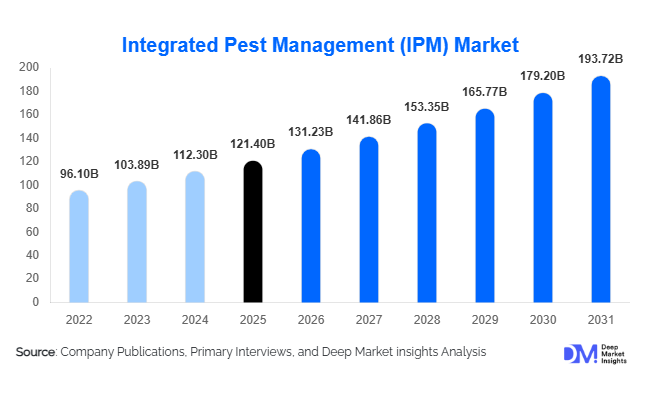
According to Deep Market Insights, the global integrated pest management (IPM) market size was valued at USD 121.4 Billion in 2025 and is projected to grow from USD 131.23 Billion in 2026 to reach USD 193.72 Billion by 2031, expanding at a CAGR of 8.1% during the forecast period (2026–2031). The IPM market growth is primarily driven by increasing regulatory restrictions on chemical pesticides, rising awareness of sustainable agriculture practices, and growing demand for residue-free food products across global markets.
Key Market Insights
- Biological pest control solutions are rapidly gaining traction, driven by environmental concerns and stricter pesticide regulations.
- Agriculture remains the dominant application segment, accounting for more than half of global demand due to increasing crop protection needs.
- Asia-Pacific leads the global market, supported by large agricultural output and strong government initiatives promoting IPM adoption.
- Precision agriculture technologies are transforming IPM systems, integrating AI, IoT, and remote sensing for real-time pest monitoring.
- Demand from food processing and storage industries is rising, driven by hygiene standards and export compliance requirements.
- Export-oriented agriculture is a key growth driver, especially in emerging economies aiming to meet international residue standards.
What are the latest trends in the integrated pest management (IPM) market?
Shift Toward Biological and Eco-Friendly Pest Control
The IPM market is witnessing a strong transition toward biological control methods such as microbial pesticides, beneficial insects, and natural predators. This shift is driven by increasing concerns over environmental sustainability and human health risks associated with chemical pesticides. Governments across Europe and North America are enforcing strict regulations on pesticide usage, accelerating the adoption of eco-friendly alternatives. Additionally, organic farming practices are expanding globally, further strengthening the demand for biological IPM solutions. Companies are investing in research and development to enhance the effectiveness and scalability of biopesticides, making them more competitive with traditional chemical options.
Integration of Digital and Precision Agriculture Technologies
Technological advancements are reshaping IPM practices, with the integration of AI, IoT, and remote sensing tools. Farmers are increasingly using smart pest monitoring systems that provide real-time data and predictive analytics, enabling targeted interventions. Drone-based surveillance and automated traps are improving detection accuracy and reducing labor costs. These innovations not only enhance pest control efficiency but also reduce unnecessary pesticide usage, aligning with sustainability goals. Digital platforms offering advisory services and data-driven insights are also gaining popularity, particularly among large-scale commercial farms.
What are the key drivers in the integrated pest management (IPM) market?
Rising Demand for Sustainable Agriculture
The global push toward sustainable agriculture is a major driver of the IPM market. Consumers are increasingly demanding food products that are free from harmful chemical residues, prompting farmers to adopt environmentally friendly pest control methods. Governments and international organizations are promoting sustainable farming practices through subsidies, training programs, and regulatory frameworks, further boosting IPM adoption.
Increasing Pest Resistance to Chemical Pesticides
The growing resistance of pests to conventional pesticides has reduced their effectiveness, forcing farmers to adopt integrated approaches. IPM combines multiple control strategies, reducing reliance on a single method and improving long-term pest management outcomes. This trend is particularly significant in regions with intensive agricultural practices, where pesticide resistance is a critical challenge.
Growth in Export-Oriented Agriculture
Export markets require strict compliance with pesticide residue limits, driving the adoption of IPM practices. Countries focusing on agricultural exports are investing in IPM systems to meet international standards and maintain competitiveness. This is especially evident in emerging economies, where export-driven agriculture is a key economic driver.
What are the restraints for the global market?
High Initial Implementation Costs
Implementing IPM systems requires investment in monitoring tools, training, and advisory services, which can be a barrier for small-scale farmers. The cost of adopting advanced technologies such as IoT-based systems and drones further adds to the financial burden, limiting widespread adoption in developing regions.
Lack of Awareness and Technical Expertise
Despite its benefits, IPM adoption is hindered by limited awareness and technical knowledge among farmers. Many still rely on conventional chemical methods due to familiarity and immediate results. Bridging this knowledge gap through education and training programs is essential for market growth.
What are the key opportunities in the integrated pest management (IPM) industry?
Expansion of Precision IPM Technologies
The integration of precision agriculture technologies presents a significant growth opportunity for the IPM market. AI-driven pest prediction models, IoT-enabled monitoring systems, and drone-based surveillance tools are enabling more efficient and targeted pest control. These technologies reduce input costs, improve crop yields, and support sustainable farming practices. Companies investing in digital IPM platforms can capture high-value segments, particularly in large-scale commercial agriculture.
Government-Led Sustainable Agriculture Initiatives
Government policies promoting sustainable agriculture are creating favorable conditions for IPM adoption. Programs focused on reducing chemical pesticide usage, encouraging organic farming, and supporting farmer education are driving market growth. Public-private partnerships are also playing a key role in expanding IPM solutions in emerging economies, offering opportunities for market participants to scale operations.
Diversification into Non-Agricultural Applications
The adoption of IPM in non-agricultural sectors such as food processing, healthcare, and urban infrastructure is opening new revenue streams. These industries require effective pest control solutions to meet hygiene and safety standards, making IPM an attractive option. The growing emphasis on sustainable practices in urban environments further supports this trend.
Report Scope
| Report Metric | Details |
|---|---|
| Market Size in 2025 | USD 121.4 Billion |
| Market Size in 2026 | USD 131.23 Billion |
| Market Size in 2031 | USD 193.72 Billion |
| CAGR | 8.1% (2026-2031) |
| Base Year for Estimation | 2025 |
| Historical Data | 2022-2024 |
| Forecast Period | 2026-2031 |
| Report Coverage | Revenue Forecast, Competitive Landscape, Supply Chain Disruption, Growth Factors, Environment & Regulatory Landscape and Trends |
| Geographies Covered | North America, Europe, APAC, Middle East and Africa, LATAM |
| Countries Covered | U.S., Canada, U.K., Germany, France, Spain, Italy, Russia, Nordic, Benelux, Rest of Europe, China, Korea, Japan, India, Australia, Singapore, Taiwan, South East Asia, Rest of Asia-Pacific, UAE, Turky, Saudi Arabia, South Africa, Egypt, Nigeria, Rest of MEA, Brazil, Mexico, Argentina, Chile, Colombia, Rest of LATAM |
Explore more data points, trends and opportunities Download Free Sample Report
Product Type Insights
The product type segment within the Integrated Pest Management (IPM) market is evolving rapidly, with biopesticides emerging as the dominant category and accounting for a substantial share of the overall market. This dominance is primarily driven by the increasing global emphasis on sustainability, environmental protection, and the reduction of chemical residues in food systems. Biopesticides, which include microbial pesticides, biochemical pesticides, and plant-incorporated protectants, offer a safer and more environmentally friendly alternative to conventional chemical pesticides. Their ability to target specific pests while minimizing harm to beneficial organisms and ecosystems has significantly enhanced their adoption across both developed and developing regions. Furthermore, favorable regulatory frameworks in regions such as North America and Europe, which encourage the use of low-toxicity crop protection products, have further strengthened the growth trajectory of this segment.In parallel, monitoring and detection tools such as pheromone traps, remote sensing technologies, and digital pest surveillance systems are gaining significant traction. These tools play a crucial role in enabling early pest detection and real-time decision-making, thereby reducing unnecessary pesticide applications and improving overall crop health. The growing adoption of precision agriculture technologies has accelerated the demand for such monitoring solutions, as farmers increasingly rely on data-driven insights to optimize pest management strategies. Digital sensors, artificial intelligence-based analytics, and cloud-based platforms are transforming traditional pest management practices into more proactive and predictive systems.Another notable trend is the increasing integration of products with advisory and support services. Companies are now offering comprehensive IPM solutions that combine pest control products with agronomic consulting, digital tools, and field support. This integrated approach not only improves the effectiveness of pest management strategies but also enhances farmer confidence and adoption rates. As agricultural systems become more complex and climate variability introduces new pest challenges, the demand for holistic and adaptive solutions is expected to rise significantly, further reinforcing the growth of the product type segment.
Application Insights
In terms of application, agriculture continues to dominate the IPM market, contributing over 55% of the global market share. This strong dominance is attributed to the critical role of pest management in ensuring crop productivity, food security, and economic stability. Farmers across the globe are increasingly adopting IPM practices to reduce crop losses caused by pests while minimizing environmental impact. The growing global population and the corresponding increase in food demand have intensified the need for efficient and sustainable agricultural practices, thereby driving the adoption of IPM solutions in this segment.Beyond agriculture, public health applications are gaining momentum, particularly in regions affected by vector-borne diseases such as malaria, dengue, and Zika virus. IPM strategies are increasingly being employed in vector control programs to manage mosquito populations and reduce disease transmission. These programs often involve a combination of biological control agents, habitat management, and targeted chemical interventions, making IPM a highly effective and sustainable approach to public health pest management.The commercial and residential segments are also witnessing steady growth, driven by rising awareness of the health risks associated with chemical pesticides and the increasing preference for eco-friendly pest control solutions. Urbanization and the expansion of smart cities have further contributed to the demand for IPM in residential and commercial settings, where maintaining hygiene and pest-free environments is essential. Businesses in sectors such as food services, retail, and hospitality are increasingly adopting IPM practices to comply with health regulations and enhance customer satisfaction. As awareness continues to grow and technologies become more accessible, the application scope of IPM is expected to expand further across diverse sectors.
Distribution Channel Insights
The distribution landscape of the IPM market is characterized by a mix of traditional and emerging channels, each playing a crucial role in ensuring product accessibility and adoption. Direct sales and agricultural cooperatives remain the dominant distribution channels, particularly in rural and agrarian economies. These channels have established strong relationships with farmers and provide not only products but also technical guidance and support, which are essential for the effective implementation of IPM strategies. Agricultural cooperatives, in particular, serve as important intermediaries that facilitate knowledge transfer and collective purchasing, thereby reducing costs and improving access to high-quality inputs.A key driver for the leading distribution channels is the need for personalized advisory and technical support, which is critical for the successful adoption of IPM practices. Unlike conventional pest control methods, IPM requires a more nuanced understanding of pest ecology, crop cycles, and environmental conditions. Direct engagement with farmers through sales representatives and cooperative networks enables companies to provide tailored solutions and build long-term trust, thereby driving sustained market growth.Strategic partnerships between product manufacturers, technology providers, and service companies are also playing a significant role in optimizing distribution efficiency. These collaborations enable the development of integrated solutions that combine products with digital tools and field support, thereby offering a comprehensive value proposition to end-users. As digital infrastructure continues to improve and farmers become more tech-savvy, the role of digital distribution channels is expected to expand significantly, complementing traditional channels and driving overall market growth.
End-Use Industry Insights
The end-use industry landscape of the IPM market is dominated by the agriculture and farming sector, which accounts for approximately 58% of total demand. This dominance is driven by the critical need to protect crops from pest damage and ensure consistent agricultural output. Farmers are increasingly recognizing the benefits of IPM in reducing input costs, improving soil health, and enhancing long-term sustainability. The adoption of IPM practices in agriculture is further supported by government policies, certification programs, and market incentives that promote sustainable farming practices.The food processing and storage industry represents one of the fastest-growing end-use segments, driven by stringent hygiene standards and the need to prevent contamination during storage and transportation. IPM solutions are increasingly being implemented in warehouses, processing facilities, and distribution centers to ensure compliance with food safety regulations and maintain product quality. The rising demand for packaged and processed foods, particularly in urban areas, is further driving the adoption of IPM in this segment.In addition, sectors such as healthcare and hospitality are increasingly adopting IPM practices to maintain clean and safe environments. Hospitals, hotels, and restaurants are particularly sensitive to pest infestations, which can pose serious health risks and damage brand reputation. IPM offers a proactive and environmentally responsible approach to pest control, making it an attractive option for these industries. Urban municipalities are also investing in IPM for vector control and public sanitation, reflecting the growing recognition of its benefits in urban pest management. As awareness continues to grow across industries, the end-use landscape of the IPM market is expected to become increasingly diversified.
Explore more data points, trends and opportunities Download Free Sample Report
Integrated Pest Management (IPM) Market Segmentations
By Pest Type
- Insects
- Weeds
- Pathogens
- Nematodes
- Rodents & Vertebrates
By Control Method
- Biological Control
- Cultural Control
- Mechanical & Physical Control
- Chemical Control (Selective/Reduced-Risk)
- Genetic Control
By Application
- Agriculture
- Commercial Buildings
- Residential
- Industrial Facilities
- Public Health
By Technology Integration
- Conventional IPM
- Precision IPM
By End-Use Industry
- Agriculture & Farming
- Food Processing & Storage
- Hospitality & Retail
- Healthcare
- Urban Infrastructure & Municipalities
Regional Insights
Asia-Pacific
Asia-Pacific leads the global IPM market, accounting for approximately 32% of the market share in 2025, and is also the fastest-growing region. The dominance of this region is largely attributed to its vast agricultural base and the presence of major agrarian economies such as China and India. The region’s growth is driven by increasing government initiatives promoting sustainable farming practices, including subsidies for biopesticides and training programs for farmers. Additionally, the rising adoption of export-oriented agriculture has necessitated compliance with international food safety standards, thereby encouraging the use of IPM solutions. Rapid population growth and increasing food demand are further intensifying the need for efficient pest management strategies. The expansion of precision agriculture technologies, coupled with improving digital infrastructure, is also enabling farmers in the region to adopt advanced monitoring and control solutions, thereby accelerating market growth.
North America
North America holds around 28% of the global IPM market share, with the United States being the primary contributor. The region is characterized by advanced agricultural practices, high levels of technology adoption, and a strong regulatory framework that promotes sustainable pest management. One of the key drivers of growth in this region is the increasing demand for organic and residue-free food products, which has led to a significant shift toward biopesticides and integrated pest management strategies. Additionally, the presence of well-established research institutions and strong industry-academia collaborations is fostering innovation in IPM technologies. The widespread adoption of precision agriculture tools, such as drones and IoT-based monitoring systems, is further enhancing the effectiveness and efficiency of pest management practices in the region.
Europe
Europe accounts for approximately 24% of the global IPM market and is known for its strong commitment to environmental sustainability and stringent regulatory standards. Countries such as Germany, France, and the Netherlands are at the forefront of IPM adoption, driven by policies that restrict the use of chemical pesticides and promote eco-friendly alternatives. The European Union’s regulatory framework, including directives aimed at reducing pesticide risks, has been a major driver of market growth. Additionally, the well-established organic farming sector in Europe is creating significant demand for IPM solutions. Increasing consumer awareness regarding food safety and environmental impact is also encouraging farmers and food producers to adopt sustainable pest management practices. The integration of digital technologies and data-driven farming approaches is further supporting the growth of the IPM market in this region.
Latin America
Latin America holds around 10% of the global IPM market share, with countries such as Brazil and Argentina playing a significant role. The region’s growth is primarily driven by its strong focus on export-oriented agriculture, particularly in crops such as soybeans, coffee, and fruits. To meet international quality and safety standards, farmers are increasingly adopting biological pest control methods and integrated pest management practices. Favorable climatic conditions, which support year-round agricultural activities, also contribute to the need for effective pest management solutions. Additionally, increasing investments in agricultural technology and infrastructure are facilitating the adoption of advanced IPM solutions. Government initiatives aimed at promoting sustainable agriculture and reducing environmental impact are further supporting market growth in the region.
Middle East & Africa
The Middle East & Africa region accounts for approximately 6% of the global IPM market and is witnessing steady growth driven by increasing investments in agriculture and food security initiatives. The region faces unique challenges, including arid climatic conditions, water scarcity, and limited arable land, which necessitate the use of efficient and sustainable pest management practices. Governments and international organizations are increasingly promoting IPM as a means to enhance agricultural productivity and resilience. The growing adoption of greenhouse farming and controlled environment agriculture is also driving the demand for IPM solutions, as these systems require precise and effective pest control methods. Additionally, rising awareness of sustainable farming practices and the need to reduce reliance on chemical pesticides are contributing to the gradual expansion of the IPM market in this region.
Key Players in the Integrated Pest Management (IPM) Market
- Bayer AG
- Syngenta Group
- BASF SE
- Corteva Agriscience
- FMC Corporation
- UPL Limited
- Sumitomo Chemical
- ADAMA Ltd.
- Koppert Biological Systems
- Certis Biologicals
- Biobest Group
- Valent BioSciences
- Marrone Bio Innovations
- Nufarm Limited
- Isagro S.p.A.