Custom Suits Market Size
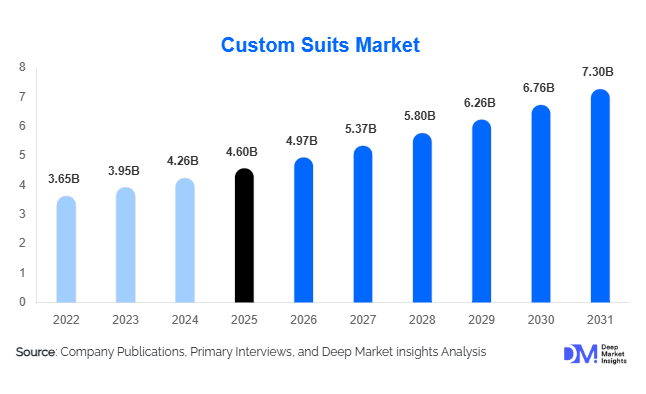
According to Deep Market Insights, the global custom suits market size was valued at USD 4.6 billion in 2025 and is projected to grow from USD 4.97 billion in 2026 to reach USD 7.30 billion by 2031, expanding at a CAGR of 8.0% during the forecast period (2026–2031). The custom suits market is experiencing sustained growth as consumers increasingly prioritize personalization, superior fit, premium craftsmanship, and exclusive fashion experiences. Rising disposable incomes, expanding luxury apparel consumption, and the growing acceptance of tailored clothing among younger professionals are contributing significantly to market expansion. Technological advancements such as AI-powered body scanning, virtual fitting solutions, and digital tailoring platforms are further accelerating adoption by making custom garments more accessible and scalable. Additionally, growing demand from corporate professionals, luxury consumers, wedding customers, and women executives is supporting long-term market growth across both developed and emerging economies.
Key Market Insights
- Made-to-measure suits account for nearly 58% of the global market, offering an optimal balance between affordability and personalization.
- Business and corporate wear remains the largest application segment, representing approximately 41% of total market demand globally.
- North America dominates the custom suits market, accounting for nearly 31% of global revenue due to strong luxury apparel spending and professional dress culture.
- Asia-Pacific is the fastest-growing region, supported by rising affluent populations in China, India, and Southeast Asia.
- Digital tailoring platforms and AI-enabled measurement technologies are transforming customer acquisition and reducing operational costs.
- Sustainable and premium fabrics are gaining popularity, driven by growing consumer awareness regarding quality, longevity, and responsible fashion.
Custom Suits Market Trends
Digital Tailoring and AI-Powered Customization Accelerating Market Transformation
The custom suits industry is undergoing a digital transformation through the adoption of AI-powered measurement tools, virtual fitting technologies, 3D visualization platforms, and mobile body-scanning applications. Traditionally, custom tailoring required multiple physical fittings and extensive manual measurements. However, advancements in digital tailoring now enable consumers to obtain accurate measurements remotely while visualizing garment styles, fabrics, and customization options before purchase. Online-first custom suit providers are leveraging machine learning algorithms to improve sizing accuracy, reduce returns, and streamline production. These technologies are particularly appealing to younger professionals seeking convenience without compromising personalization. As digital infrastructure continues to improve globally, technology-driven tailoring platforms are expected to capture an increasing share of market demand.
Sustainable Luxury and Premium Fabric Adoption Growing Rapidly
Consumer preferences are increasingly shifting toward sustainable luxury apparel, creating significant opportunities within the custom suits market. Customers are becoming more selective about clothing purchases, preferring fewer garments with superior quality, durability, and ethical sourcing. This trend has encouraged tailoring companies to expand offerings of organic cotton, recycled wool, traceable cashmere, and environmentally certified fabrics. Luxury consumers increasingly view custom suits as long-term wardrobe investments compared to disposable fast-fashion alternatives. In response, manufacturers and tailoring houses are investing in transparent supply chains, sustainable textile sourcing, and low-waste production processes. The combination of sustainability and personalization is emerging as a major differentiator among premium tailoring brands globally.
Custom Suits Market Drivers
Growing Consumer Preference for Personalized Fashion
Personalization has become one of the strongest drivers of growth within the apparel industry. Consumers increasingly seek garments that reflect their personal style, body shape, and lifestyle preferences. Custom suits offer flexibility in fabric selection, fit adjustments, design details, and finishing options that are not available through traditional ready-to-wear products. The rise of social media, personal branding, and appearance-conscious professional cultures has further accelerated demand for individualized clothing solutions. As consumers place greater value on exclusivity and self-expression, demand for tailored apparel continues to strengthen globally.
Expansion of Global Luxury Consumer Base
The steady increase in high-net-worth individuals and affluent middle-class consumers has significantly boosted demand for premium apparel categories, including custom suits. Luxury fashion spending remains particularly strong across North America, Europe, China, India, the Middle East, and Southeast Asia. Custom suits provide consumers with a combination of exclusivity, craftsmanship, and superior quality, making them highly attractive within the luxury apparel segment. Growing wealth accumulation and rising discretionary spending are expected to continue supporting market growth throughout the forecast period.
Custom Suits Market Restraints
Premium Pricing Limits Mass Market Adoption
Despite growing demand, custom suits remain significantly more expensive than mass-produced ready-to-wear garments. Premium fabrics, skilled labor requirements, multiple fittings, and lower production volumes contribute to higher final prices. This pricing structure restricts market penetration among budget-conscious consumers and limits adoption in developing economies. While made-to-measure solutions have improved affordability, custom tailoring continues to be viewed as a premium purchase rather than an everyday apparel option.
Shortage of Skilled Tailors and Pattern Makers
The global tailoring industry faces a growing shortage of experienced craftspeople capable of delivering high-quality bespoke and made-to-measure garments. Aging workforces, declining vocational participation, and limited training programs have created labor shortages across major tailoring hubs. As experienced artisans retire, manufacturers face increasing challenges in maintaining production quality and scaling operations. Labor constraints are also contributing to longer lead times and rising production costs.
Custom Suits Market Opportunities
Wedding and Occasion Wear Expansion
The global wedding economy is becoming an increasingly important growth driver for the custom suits market. Consumers are spending more on weddings, destination ceremonies, and special occasions, creating strong demand for personalized formalwear. Custom suits offer unique styling options, superior fit, and premium fabrics that appeal to consumers seeking memorable event attire. Emerging markets such as India, China, and Southeast Asia are witnessing particularly strong growth in wedding-related custom tailoring demand.
Women's Tailoring and Inclusive Fashion Growth
Women's custom tailoring remains significantly underpenetrated compared to menswear, creating substantial opportunities for market participants. Increasing numbers of female executives, entrepreneurs, politicians, and professionals are driving demand for tailored business attire. Additionally, growing interest in gender-inclusive fashion is expanding the addressable customer base. Companies investing in specialized fitting systems, dedicated womenswear collections, and inclusive tailoring services are well-positioned to capture future growth opportunities.
Report Scope
| Report Metric | Details |
|---|---|
| Market Size in 2025 | USD 4.6 Billion |
| Market Size in 2026 | USD 4.97 Billion |
| Market Size in 2031 | USD 7.30 Billion |
| CAGR | 8% (2026-2031) |
| Base Year for Estimation | 2025 |
| Historical Data | 2022-2024 |
| Forecast Period | 2026-2031 |
| Report Coverage | Revenue Forecast, Competitive Landscape, Supply Chain Disruption, Growth Factors, Environment & Regulatory Landscape and Trends |
| Geographies Covered | North America, Europe, APAC, Middle East and Africa, LATAM |
| Countries Covered | U.S., Canada, U.K., Germany, France, Spain, Italy, Russia, Nordic, Benelux, Rest of Europe, China, Korea, Japan, India, Australia, Singapore, Taiwan, South East Asia, Rest of Asia-Pacific, UAE, Turky, Saudi Arabia, South Africa, Egypt, Nigeria, Rest of MEA, Brazil, Mexico, Argentina, Chile, Colombia, Rest of LATAM |
Explore more data points, trends and opportunities Download Free Sample Report
Customization Type Insights
Made-to-measure suits dominate the global custom suits market, accounting for approximately 58% of total revenue in 2025. The segment benefits from offering a balance between personalization and affordability, making it accessible to a wider consumer base than traditional bespoke tailoring. Bespoke suits continue to represent the premium end of the market, attracting affluent consumers seeking handcrafted garments and superior craftsmanship. Digital customization platforms are emerging as one of the fastest-growing segments, leveraging AI-powered measurement technologies and online ordering systems to improve convenience and scalability. As digital tailoring technologies mature, online customization is expected to gain increasing market share across both developed and emerging regions.
Suit Category Insights
Business and corporate suits remain the largest suit category, contributing approximately 41% of global market demand. Professionals working in finance, consulting, legal services, government, and executive management continue to represent the industry's core customer base. Wedding and ceremonial suits are among the fastest-growing segments, driven by increasing spending on premium events and destination weddings. Luxury fashion suits cater to affluent consumers seeking exclusivity and designer craftsmanship, while premium casual tailored suits are gaining popularity among younger professionals embracing smart-casual dressing trends. Entertainment, media, and celebrity styling applications are also contributing to growth in high-end custom tailoring.
Distribution Channel Insights
Tailoring boutiques account for approximately 45% of global custom suit sales and remain the dominant distribution channel. Physical consultations, personalized fitting experiences, and direct customer engagement continue to be critical components of the custom tailoring process. Luxury brand stores represent a significant premium segment, particularly in major fashion capitals and affluent urban markets. Meanwhile, online customization platforms are expanding rapidly by offering digital measurement tools, virtual consultations, and AI-driven fit recommendations. Omnichannel tailoring providers that combine physical showrooms with digital ordering platforms are increasingly gaining market share by delivering convenience alongside personalized service.
End User Insights
Corporate professionals represent the largest end-user segment, accounting for approximately 38% of global demand. Executives, consultants, lawyers, financial professionals, and entrepreneurs continue to rely on tailored apparel as a symbol of professionalism and personal branding. Wedding consumers constitute the fastest-growing end-user category, supported by rising global wedding expenditures and increasing demand for personalized event attire. Luxury consumers and high-net-worth individuals remain a key revenue source for bespoke tailoring houses, while younger fashion-conscious professionals are increasingly adopting custom tailoring as a premium lifestyle choice. Government officials, diplomats, and entertainment industry professionals also contribute to sustained market demand.
Price Tier Insights
The mid-premium segment accounts for approximately 37% of total market revenue and remains the most attractive category for both consumers and manufacturers. Customers in this segment seek enhanced fit, premium fabrics, and customization options without entering the ultra-luxury price range. Luxury custom suits continue to generate substantial revenue through affluent clientele, while entry-premium offerings are helping expand market accessibility among first-time buyers. Ultra-luxury bespoke tailoring remains a niche but highly profitable segment driven by exclusivity, craftsmanship, and heritage tailoring brands.
Explore more data points, trends and opportunities Download Free Sample Report
Custom Suits Market Segmentations
By Customization Type
- Bespoke Suits
- Made-to-Measure (MTM) Suits
- Digitally Customized / AI-Assisted Tailored Suits
By Suit Category
- Business & Corporate Suits
- Wedding & Ceremony Suits
- Luxury Fashion Suits
- Diplomatic & Government Formalwear
- Entertainment & Celebrity Styling Suits
- Premium Casual Tailored Suits
By Fabric Type
- Wool & Wool Blends
- Cotton
- Linen
- Silk & Satin
- Cashmere & Premium Luxury Fibers
- Sustainable/Recycled Fabrics
- Performance Fabrics
By Distribution Channel
- Tailoring Boutiques
- Luxury Brand Stores
- Online Customization Platforms
- Omnichannel Tailoring Networks
- Traveling Tailor / Trunk Show Networks
By End User
- Corporate Professionals
- Wedding Consumers
- Government & Diplomats
- Entertainment Industry
- Luxury Consumers & HNWIs
- Fashion-Conscious Young Professionals
Regional Insights
North America
North America accounted for approximately 31% of global custom suits market revenue in 2025, making it the largest regional market. The United States alone contributes nearly 26% of global demand, supported by strong luxury apparel spending, executive dressing culture, and a large base of affluent consumers. Corporate professionals remain the primary customer group, while wedding and luxury fashion applications continue to expand. Canada contributes additional demand through premium retail and professional apparel consumption. The region also leads adoption of digital tailoring technologies and omnichannel customization platforms.
Europe
Europe accounted for approximately 29% of global market revenue and remains a global center for tailoring craftsmanship. The United Kingdom continues to benefit from its heritage bespoke tailoring industry, particularly through London's luxury tailoring districts. Italy remains a leading market due to its reputation for premium fabrics, tailoring expertise, and luxury fashion exports. Germany and France contribute significantly through strong professional apparel demand and luxury consumer spending. Sustainability initiatives and premium fashion consumption continue to support market growth across the region.
Asia-Pacific
Asia-Pacific represents approximately 28% of global demand and is projected to be the fastest-growing region throughout the forecast period. China has emerged as one of the largest luxury apparel markets globally, supported by increasing disposable incomes and expanding affluent populations. India is experiencing rapid growth due to strong wedding demand, urbanization, and the increasing adoption of premium business attire. Japan maintains steady demand through its appreciation for craftsmanship and premium quality, while South Korea continues to benefit from luxury fashion trends and rising professional apparel spending.
Latin America
Latin America accounts for approximately 5% of global market demand, with Brazil and Mexico representing the region's largest markets. Rising urbanization, expanding middle-class populations, and growing exposure to global fashion trends are supporting gradual market growth. While custom tailoring remains concentrated among affluent consumers, increasing awareness of personalized apparel is expected to drive future adoption.
Middle East & Africa
The Middle East and Africa region contributes approximately 7% of global revenue. The United Arab Emirates and Saudi Arabia represent the largest markets, supported by luxury retail expansion, affluent consumer bases, and increasing demand for premium formalwear. Government officials, business leaders, and luxury consumers continue to drive demand. South Africa remains the largest market in Sub-Saharan Africa, benefiting from established tailoring infrastructure and growing premium apparel consumption.