Animal Protein Market Size
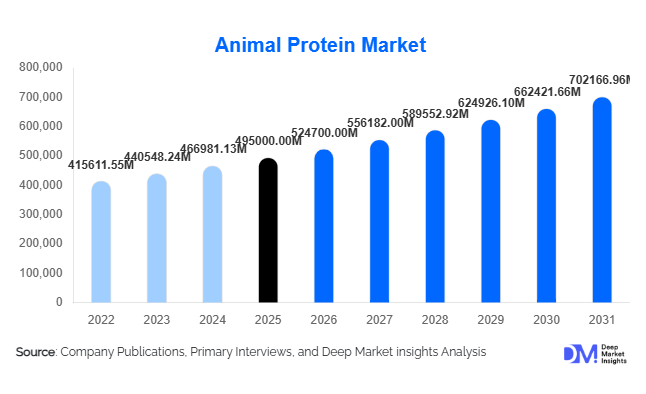
According to Deep Market Insights, the global animal protein market size was valued at USD 495,000 million in 2025 and is projected to grow from USD 524,700 million in 2026 to reach USD 702,166.96 million by 2031, expanding at a CAGR of 6.0% during the forecast period (2026–2031). The animal protein market growth is primarily driven by rising global protein consumption, increasing demand for processed and convenience foods, and expanding applications in functional nutrition and food processing industries. Growing urbanization, higher disposable incomes in emerging economies, and advancements in livestock production technologies are further accelerating market expansion globally.
Key Market Insights
- Meat protein remains the dominant segment, accounting for nearly half of global consumption due to affordability and widespread dietary preference.
- Asia-Pacific leads the global market, supported by rising population, urbanization, and increasing protein intake in China and India.
- Processed and value-added protein products are gaining traction, driven by convenience food demand and busy consumer lifestyles.
- Poultry-based protein is the fastest-growing source, owing to lower production costs and health perception advantages.
- Technological advancements in livestock and processing are improving productivity and supply chain efficiency.
- Sustainability and traceability trends are influencing purchasing decisions, particularly in developed markets.
What are the latest trends in the animal protein market?
Shift Toward Functional and High-Quality Protein Products
The market is witnessing a strong shift toward functional protein products, particularly in dairy and processed segments such as whey protein isolates, hydrolyzed proteins, and fortified food products. Consumers are increasingly seeking protein sources that offer additional health benefits such as muscle recovery, weight management, and immune support. This trend is particularly prominent among fitness-focused consumers, aging populations, and urban professionals. Manufacturers are responding by introducing protein-enriched beverages, snacks, and ready-to-consume products that align with clean-label and high-nutrition requirements. Premiumization is also driving demand for organic, antibiotic-free, and grass-fed animal protein products, especially in North America and Europe.
Expansion of Processed and Convenience Protein Foods
Convenience-driven consumption patterns are reshaping the animal protein landscape, with growing demand for ready-to-eat and frozen meat products. Urbanization and time-constrained lifestyles are fueling the popularity of processed foods such as sausages, deli meats, frozen poultry, and packaged seafood. Innovations in packaging, cold chain logistics, and preservation technologies are enhancing shelf life and accessibility. Additionally, foodservice chains and quick-service restaurants are expanding their protein-based menus, further supporting demand for processed animal protein. Emerging markets are also witnessing rapid adoption of packaged protein products as modern retail infrastructure expands.
What are the key drivers in the animal protein market?
Rising Global Protein Consumption
Increasing awareness of the importance of protein in daily nutrition is a major driver of the animal protein market. Consumers across both developed and developing economies are incorporating higher protein intake into their diets to support health, fitness, and overall well-being. This trend is particularly strong among younger demographics and urban populations, driving sustained demand for meat, dairy, and egg-based products.
Growth of Processed Food Industry
The rapid expansion of the processed and packaged food sector is significantly boosting demand for animal protein ingredients. Protein isolates, concentrates, and processed meat products are widely used in ready-to-eat meals, snacks, and functional foods. The growing penetration of supermarkets, hypermarkets, and online grocery platforms is further accelerating the consumption of protein-rich packaged products globally.
Technological Advancements in Production
Advancements in animal husbandry, feed optimization, and processing technologies are improving efficiency and output in the animal protein industry. Automation, genetic improvements, and precision farming techniques are enabling producers to meet rising demand while maintaining cost efficiency. These innovations are also enhancing product quality and consistency across global supply chains.
What are the restraints for the global market?
Rising Competition from Alternative Proteins
The increasing popularity of plant-based and alternative protein sources is posing a challenge to traditional animal protein markets. Changing consumer preferences toward vegan and flexitarian diets, driven by environmental and ethical concerns, are gradually shifting demand away from conventional animal-based products. This trend is particularly evident in developed markets, where alternative protein innovation is rapidly expanding.
Environmental and Regulatory Pressures
Stringent regulations related to animal welfare, emissions, and food safety are creating operational challenges for industry participants. Livestock production is associated with greenhouse gas emissions, leading to increased scrutiny and regulatory interventions, particularly in Europe and North America. Compliance with these regulations often results in higher production costs, affecting overall profitability.
What are the key opportunities in the animal protein industry?
Expansion in Emerging Markets
Emerging economies such as China, India, Brazil, and Southeast Asian countries present significant growth opportunities due to rising incomes, urbanization, and changing dietary patterns. Increasing consumption of meat and dairy products in these regions is driving demand for animal protein. Investments in cold chain infrastructure and local processing facilities are further enabling market expansion.
Sustainable and Traceable Production Practices
There is growing demand for sustainably produced animal protein, creating opportunities for companies to adopt eco-friendly farming practices and transparent supply chains. Technologies such as blockchain and precision farming are enabling traceability and efficiency, helping companies meet regulatory requirements and consumer expectations.
Growth in Functional Nutrition and Nutraceuticals
The expanding nutraceutical and clinical nutrition markets are creating new avenues for animal protein applications. Protein-based supplements, medical nutrition products, and fortified foods are gaining popularity among health-conscious consumers and aging populations. This trend is expected to drive demand for high-quality protein isolates and specialized formulations.
Report Scope
| Report Metric | Details |
|---|---|
| Market Size in 2025 | USD 495000 Million |
| Market Size in 2026 | USD 524700 Million |
| Market Size in 2031 | USD 702166.96 Million |
| CAGR | 6% (2026-2031) |
| Base Year for Estimation | 2025 |
| Historical Data | 2022-2024 |
| Forecast Period | 2026-2031 |
| Report Coverage | Revenue Forecast, Competitive Landscape, Supply Chain Disruption, Growth Factors, Environment & Regulatory Landscape and Trends |
| Geographies Covered | North America, Europe, APAC, Middle East and Africa, LATAM |
| Countries Covered | U.S., Canada, U.K., Germany, France, Spain, Italy, Russia, Nordic, Benelux, Rest of Europe, China, Korea, Japan, India, Australia, Singapore, Taiwan, South East Asia, Rest of Asia-Pacific, UAE, Turky, Saudi Arabia, South Africa, Egypt, Nigeria, Rest of MEA, Brazil, Mexico, Argentina, Chile, Colombia, Rest of LATAM |
Explore more data points, trends and opportunities Download Free Sample Report
Product Type Insights
The global animal protein market is characterized by a diversified product portfolio, with meat protein continuing to dominate the landscape, accounting for approximately 48% of the total market share in 2025. This leadership position is primarily driven by the sustained global demand for poultry, beef, and pork across both developed and emerging economies. Among these, poultry has emerged as the fastest-growing and most consumed sub-segment due to its affordability, shorter production cycles, lower feed conversion ratios, and increasing perception as a healthier alternative to red meat. The rapid expansion of quick-service restaurants and processed meat consumption has further strengthened poultry demand globally.Egg protein is gaining notable traction, particularly in nutraceutical and pharmaceutical applications. Known for its high biological value and complete amino acid profile, egg protein is increasingly used in dietary supplements and specialized nutrition products. Its versatility and cost-effectiveness also make it a preferred ingredient in food processing industries.Marine protein, derived from fish and seafood, is witnessing steady growth supported by increasing global seafood consumption and advancements in aquaculture practices. Rising health consciousness and the growing popularity of omega-3-rich diets are key factors driving this segment. Furthermore, the expansion of fish protein hydrolysates in pharmaceuticals and nutraceuticals is contributing to the overall market expansion.
Application Insights
The food and beverages segment remains the dominant application area in the global animal protein market, contributing over 60% of the total market share. This dominance is largely attributed to the extensive utilization of animal protein across a wide range of products, including processed meat, dairy items, ready-to-eat meals, and protein-enriched foods. Increasing consumer preference for high-protein diets, coupled with the rising demand for convenience foods, has significantly driven the incorporation of animal protein into mainstream food products.Pharmaceutical and nutraceutical applications are emerging as high-growth segments within the market. The rising prevalence of lifestyle-related diseases, aging populations, and growing awareness regarding preventive healthcare are fueling demand for protein-based supplements and clinical nutrition products. Protein hydrolysates and bioactive peptides derived from animal sources are increasingly being incorporated into therapeutic and wellness formulations.Although relatively niche, the personal care segment is witnessing gradual growth with the incorporation of collagen and protein-based ingredients in skincare and cosmetic products. These ingredients are valued for their anti-aging, moisturizing, and skin-repair properties, contributing to their increasing adoption in premium personal care formulations.
Distribution Channel Insights
The distribution landscape of the animal protein market is predominantly led by direct business-to-business (B2B) supply channels, which account for approximately 55% of the total distribution share. This dominance is driven by large-scale procurement by food manufacturers, processors, and industrial users who require bulk quantities of protein ingredients for further processing and product development. The efficiency of supply chains, long-term contracts, and cost advantages associated with bulk purchasing significantly support the growth of this channel.A primary driver for the leading B2B segment is the increasing industrialization of food production and the expansion of large food processing companies globally. These companies rely heavily on consistent and high-quality protein supplies to meet growing consumer demand, thereby reinforcing the importance of direct supplier relationships.The foodservice and HoReCa (Hotels, Restaurants, and Catering) segment also represents a vital distribution channel, supported by the expansion of the global hospitality industry. Rising disposable incomes, urbanization, and changing lifestyles have increased dining-out trends, thereby driving demand for animal protein across restaurants and quick-service chains.
End-Use Industry Insights
The food and beverage industry continues to be the primary end-use sector for animal protein, supported by robust global demand for protein-rich diets. This segment is projected to grow steadily at a CAGR exceeding 6%, driven by increasing population, rising disposable incomes, and evolving dietary patterns. The growing popularity of high-protein diets, particularly among health-conscious consumers, is further boosting demand within this sector.The nutraceutical and pharmaceutical industries are emerging as high-growth areas, supported by increasing consumer awareness regarding health and wellness. Protein-based supplements, clinical nutrition products, and therapeutic formulations are witnessing rising demand, particularly among aging populations and fitness enthusiasts.Export-driven demand from major producing countries such as the United States and Brazil continues to play a significant role in shaping the global market. These countries benefit from advanced production capabilities, large-scale operations, and strong international trade networks, enabling them to meet global demand efficiently.
Explore more data points, trends and opportunities Download Free Sample Report
Animal Protein Market Segmentations
By Protein Type
- Meat Protein
- Dairy Protein
- Egg Protein
- Marine Protein
By Source
- Bovine
- Poultry
- Porcine
- Marine
- Others
By Form
- Liquid Protein
- Powdered Protein
- Frozen/Chilled Protein
- Ready-to-Consume Processed Protein
By Processing Level
- Raw/Primary Processed
- Processed
- Protein Isolates & Concentrates
- Hydrolyzed Proteins
By Application
- Food & Beverages
- Animal Feed
- Pharmaceuticals & Nutraceuticals
- Personal Care & Cosmetics
By Distribution Channel
- Direct/B2B Supply
- Retail
- Online Channels
- Foodservice & HoReCa
Regional Insights
Asia-Pacific
Asia-Pacific leads the global animal protein market, accounting for approximately 35% of the market share in 2025, and is also the fastest-growing region with a projected CAGR exceeding 7% during the forecast period. China remains the largest contributor, driven by its substantial consumption of pork and poultry, while India is experiencing rapid growth due to increasing demand for dairy and poultry products.Another significant driver is the expansion of organized retail and e-commerce platforms, which are improving access to a wide range of animal protein products. Government initiatives aimed at strengthening food security, along with investments in livestock and aquaculture infrastructure, are further supporting regional market growth. The increasing penetration of international food chains and changing consumer lifestyles are also contributing to the rising demand for processed and ready-to-eat protein products.
North America
North America holds approximately 28% of the global animal protein market, with the United States serving as the dominant contributor. The region benefits from high per capita meat consumption, advanced processing technologies, and well-established supply chains.Export capabilities also play a crucial role in regional growth, as North America is a major supplier of meat and dairy products to global markets. Technological advancements in animal farming, coupled with efficient logistics and cold chain infrastructure, further enhance the region’s competitive advantage. The rising demand for protein supplements and functional foods is also contributing to market expansion.
Europe
Europe accounts for approximately 20% of the global market share, with key contributions from countries such as Germany, France, and the United Kingdom. The region is characterized by a strong emphasis on quality, sustainability, and regulatory compliance in animal protein production.Additionally, the rising demand for organic and premium meat and dairy products is supporting market growth. Consumers in Europe are increasingly willing to pay higher prices for products that align with their values regarding health, sustainability, and ethical sourcing. The expansion of functional foods and nutraceutical applications is also contributing to the region’s steady growth.
Latin America
Latin America is a key player in the global animal protein market, led by countries such as Brazil and Argentina, which are among the world’s largest exporters of meat. The region benefits from favorable climatic conditions, abundant natural resources, and cost-effective production capabilities.Investments in modernizing agricultural practices, improving supply chain infrastructure, and enhancing production efficiency are further supporting growth. Additionally, trade agreements and international partnerships are enabling Latin American producers to expand their global footprint.
Middle East & Africa
The Middle East and Africa region represents an emerging market for animal protein, characterized by increasing demand and a growing reliance on imports. Gulf countries such as Saudi Arabia and the United Arab Emirates are major consumers, driven by high income levels and strong demand for meat and dairy products.In Africa, gradual economic development and improvements in agricultural practices are supporting the expansion of the animal protein market. The increasing adoption of modern retail formats and the growth of the foodservice sector are also contributing to rising demand. Despite challenges such as supply constraints and infrastructure limitations, the region presents significant long-term growth opportunities.
Key Players in the Animal Protein Market
- Tyson Foods Inc.
- JBS S.A.
- Cargill Inc.
- BRF S.A.
- Hormel Foods Corporation
- Marfrig Global Foods
- Smithfield Foods Inc.
- Danish Crown
- Fonterra Co-operative Group
- Lactalis Group
- Nestlé S.A.
- Maple Leaf Foods
- Perdue Farms
- Sanderson Farms
- CP Foods