Agave Spirits Market Size
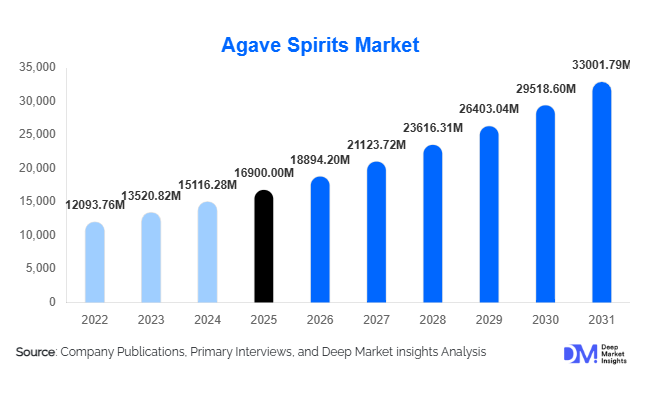
According to Deep Market Insights, the global agave spirits market size was valued at USD 16,900 million in 2025 and is projected to grow from USD 18,894.20 million in 2026 to reach USD 33,001.79 million by 2031, expanding at a CAGR of 11.8% during the forecast period (2026–2031). The agave spirits market growth is primarily driven by strong premiumization trends, rising global cocktail culture, and increasing consumer preference for artisanal and plant-based alcoholic beverages. Expanding exports from Mexico, coupled with growing demand across North America, Europe, and Asia-Pacific, continue to strengthen the global footprint of tequila, mezcal, and other agave-based spirits.
Key Market Insights
- Premium and ultra-premium agave spirits are driving market value growth, with consumers increasingly opting for aged and artisanal variants.
- Tequila dominates the market, accounting for over 65% of global revenue due to strong export demand and brand recognition.
- North America leads consumption, particularly the United States, supported by a strong cocktail culture and high disposable income.
- Asia-Pacific is the fastest-growing region, driven by urbanization, rising middle-class wealth, and westernized consumption habits.
- Supply constraints of agave plants are influencing pricing dynamics, reinforcing premium positioning of products.
- E-commerce and online retail channels are rapidly expanding, transforming distribution strategies globally.
What are the latest trends in the agave spirits market?
Premiumization and Craft Production Expansion
The agave spirits market is witnessing a strong shift toward premium and craft offerings. Consumers are increasingly drawn to small-batch, artisanal spirits that emphasize authenticity, terroir, and traditional production techniques. This trend has significantly boosted demand for aged tequila variants such as añejo and extra añejo, as well as handcrafted mezcal. Distillers are investing in storytelling, heritage branding, and unique flavor profiles to differentiate their products. Limited-edition releases and single-origin agave spirits are also gaining traction, particularly among affluent consumers seeking exclusivity. This premiumization trend is expected to continue driving value growth, even as volume growth stabilizes in mature markets.
Rise of Ready-to-Drink (RTD) Agave Cocktails
The increasing demand for convenience and on-the-go consumption is fueling the growth of ready-to-drink (RTD) agave-based cocktails. Products such as canned margaritas and tequila-based mixes are gaining popularity, particularly among younger consumers. These offerings combine convenience with premium ingredients, aligning with evolving lifestyle preferences. Beverage companies are expanding their RTD portfolios with low-ABV, flavored, and organic variants to cater to health-conscious consumers. The RTD segment is also benefiting from strong retail and e-commerce distribution, making it one of the fastest-growing sub-segments within the agave spirits market.
What are the key drivers in the agave spirits market?
Growing Global Cocktail Culture
The rapid expansion of cocktail culture worldwide is a major driver for agave spirits demand. Drinks such as margaritas and palomas have become staples in bars and restaurants, increasing the consumption of tequila and mezcal. The hospitality sector continues to play a crucial role, with on-trade channels accounting for a significant share of total consumption. Mixologists are experimenting with agave spirits in innovative cocktails, further enhancing their global appeal and driving repeat consumption across urban markets.
Shift Toward Natural and Plant-Based Alcoholic Beverages
Consumers are increasingly seeking alcoholic beverages perceived as natural, clean, and minimally processed. Agave spirits align well with this trend, as they are derived from plant-based raw materials and often produced using traditional methods. This perception of authenticity and purity is particularly appealing to younger consumers, who prioritize transparency and sustainability in their purchasing decisions. Organic certification and eco-friendly production practices are further strengthening this driver.
What are the restraints for the global market?
Agave Supply Volatility and Price Fluctuations
Agave plants require a long maturation period of 6–8 years, making supply highly sensitive to agricultural cycles and environmental conditions. Fluctuations in agave availability often lead to significant price volatility, impacting production costs and profit margins for manufacturers. This supply-demand imbalance remains a critical challenge for the industry.
Regulatory Constraints and Denomination of Origin
Production of key agave spirits such as tequila and mezcal is restricted to specific regions in Mexico under strict denomination of origin regulations. While these regulations preserve authenticity and quality, they limit production scalability and create barriers for new entrants. Compliance with these standards also increases operational complexity for global players.
What are the key opportunities in the agave spirits industry?
Expansion into Emerging Markets
Asia-Pacific and parts of Europe present significant growth opportunities for agave spirits. Rising disposable incomes, urbanization, and increasing exposure to Western drinking culture are driving demand in countries such as China, India, Japan, and Germany. Companies can capitalize on this trend through localized marketing strategies, strategic distribution partnerships, and tailored product offerings. As awareness of tequila and mezcal continues to grow, these regions are expected to become major contributors to global market expansion.
Innovation in Product Formats and Sustainability
Innovation in product formats, including flavored spirits, low-ABV variants, and RTD cocktails, offers significant growth potential. Additionally, sustainability-focused initiatives such as organic farming, water conservation, and eco-friendly packaging are becoming key differentiators. Consumers are increasingly favoring brands that demonstrate environmental responsibility, creating opportunities for companies to build strong brand loyalty through sustainable practices.
Report Scope
| Report Metric | Details |
|---|---|
| Market Size in 2025 | USD 16900.00 Million |
| Market Size in 2026 | USD 18894.20 Million |
| Market Size in 2031 | USD 33001.79 Million |
| CAGR | 11.8% (2026-2031) |
| Base Year for Estimation | 2025 |
| Historical Data | 2022-2024 |
| Forecast Period | 2026-2031 |
| Report Coverage | Revenue Forecast, Competitive Landscape, Supply Chain Disruption, Growth Factors, Environment & Regulatory Landscape and Trends |
| Geographies Covered | North America, Europe, APAC, Middle East and Africa, LATAM |
| Countries Covered | U.S., Canada, U.K., Germany, France, Spain, Italy, Russia, Nordic, Benelux, Rest of Europe, China, Korea, Japan, India, Australia, Singapore, Taiwan, South East Asia, Rest of Asia-Pacific, UAE, Turky, Saudi Arabia, South Africa, Egypt, Nigeria, Rest of MEA, Brazil, Mexico, Argentina, Chile, Colombia, Rest of LATAM |
Explore more data points, trends and opportunities Download Free Sample Report
Product Type Insights
The global agave spirits market is predominantly led by tequila, which continues to maintain its dominant position with an estimated 68% share of the global market in 2025. This leadership is strongly anchored in its long-established cultural heritage, global brand recognition, and widespread availability across both developed and emerging markets. The growth of tequila is further reinforced by premiumization trends, where consumers are increasingly shifting from standard offerings toward higher-quality variants. Within this category, reposado and añejo tequila are witnessing particularly strong traction due to their extended aging processes, smoother flavor profiles, and association with luxury consumption experiences. These premium expressions are benefiting from rising disposable incomes and a growing consumer preference for sipping spirits rather than mixed consumption.Mezcal represents the fastest-growing product type in the agave spirits landscape, driven by increasing global curiosity for artisanal, authentic, and traditionally produced alcoholic beverages. Unlike mass-produced spirits, mezcal’s smoky flavor profile and handcrafted production methods resonate strongly with consumers seeking differentiated drinking experiences. The rising influence of mixology culture and craft cocktail innovation has further accelerated mezcal’s penetration into international markets. In addition, regulatory recognition and improved export infrastructure from Mexico have made mezcal more accessible to global audiences, strengthening its growth trajectory.Beyond tequila and mezcal, niche agave spirits such as raicilla and bacanora are gradually gaining attention in premium beverage segments. These products are benefiting from storytelling-driven branding strategies that highlight regional heritage, limited production methods, and exclusivity. Although their market share remains comparatively small, their value contribution is significant in high-end hospitality and specialty liquor segments. The overall product type evolution in the agave spirits market is increasingly being shaped by consumer demand for authenticity, traceability, and premium experiences, which continues to redefine product positioning strategies across global markets.
Application (End-Use) Insights
Direct consumption remains the largest application segment, accounting for nearly 50% of total market demand. This dominance is largely attributed to the growing global appreciation for sipping-quality spirits, where tequila and other agave-based beverages are consumed neat or on the rocks rather than being used solely as mixing ingredients. The premiumization of consumer preferences has significantly elevated the perception of agave spirits as luxury products, particularly in urban and high-income markets. This shift is also supported by strong branding efforts emphasizing heritage, craftsmanship, and authenticity.The cocktails and mixology segment, however, is the fastest-growing application area, with a CAGR exceeding 13%. This growth is fueled by the rapid expansion of global bar culture, the increasing popularity of experiential drinking, and the creativity of mixologists in incorporating agave spirits into innovative cocktail recipes. The rise of premium bars, rooftop lounges, and themed cocktail experiences has significantly expanded the visibility of tequila and mezcal among younger consumers. Social media influence and digital lifestyle trends have further amplified cocktail experimentation, making this segment a critical growth driver for producers and brands.The food processing and culinary application segment, while relatively smaller, is steadily expanding as chefs and food manufacturers explore agave spirits as flavoring agents in gourmet recipes, sauces, and desserts. This niche application is particularly prominent in high-end restaurants where culinary innovation is a key differentiator. Additionally, export-driven consumption plays a vital role in sustaining global demand, with over 65% of tequila production exported internationally. This export dependency highlights the importance of cross-border trade relationships, regulatory compliance, and global distribution networks in shaping long-term market stability and expansion.
Distribution Channel Insights
Off-trade distribution channels continue to dominate the agave spirits market, accounting for approximately 52% of total sales. This dominance is supported by the strong presence of supermarkets, hypermarkets, specialty liquor stores, and rapidly growing online retail platforms. Consumers increasingly prefer off-trade channels due to convenience, competitive pricing, and wider product availability. Retailers are also investing heavily in premium shelf space allocation and experiential merchandising, which enhances product visibility and encourages impulse purchasing behavior.E-commerce has emerged as a transformative distribution channel, representing nearly 12% of total global sales. The rapid digitalization of retail ecosystems, coupled with changing consumer behavior toward online purchasing, has significantly accelerated the adoption of digital alcohol retail platforms. Subscription models, direct-to-consumer shipping, and personalized recommendation systems are further strengthening the role of e-commerce in expanding market reach. Regulatory reforms in several countries have also facilitated the legal online sale of alcoholic beverages, further boosting this channel’s growth potential.On-trade channels, including bars, restaurants, hotels, and nightclubs, remain essential for brand building and consumer engagement. These venues serve as key experiential touchpoints where consumers are introduced to new products and premium offerings. The on-trade segment is particularly influential in urban centers where cocktail culture is deeply embedded in social lifestyles. Brand partnerships with hospitality establishments, bartender training programs, and curated tasting experiences continue to enhance consumer awareness and drive long-term brand loyalty in this segment.
Production Method Insights
Industrial production methods account for nearly 60% of the global agave spirits market, primarily due to their ability to deliver large-scale output, consistency in quality, and operational efficiency. Large producers benefit from advanced distillation technologies, optimized supply chains, and economies of scale, enabling them to meet rising global demand. Industrial production also ensures standardized flavor profiles, which are crucial for maintaining brand consistency across international markets.However, artisanal and ancestral production methods are gaining significant momentum, particularly within the premium and ultra-premium segments. These traditional methods emphasize small-batch production, manual processes, and heritage-driven techniques that appeal strongly to discerning consumers. The value proposition of artisanal spirits lies in authenticity, exclusivity, and cultural storytelling, which significantly enhances brand differentiation. Although production volumes are limited, these methods command higher price points and contribute disproportionately to overall revenue growth. The increasing willingness of consumers to pay premium prices for authenticity continues to support the expansion of this segment.
Explore more data points, trends and opportunities Download Free Sample Report
Agave Spirits Market Segmentations
By Product Type
- Tequila
- Mezcal
- Raicilla
- Bacanora
- Sotol
- Other Agave-Based Spirits
By Application
- Direct Consumption
- Cocktails & Mixology
- Food Processing & Flavoring
By Distribution Channel
- On-Trade
- Off-Trade
Regional Insights
North America
North America remains the dominant regional market, holding approximately 55% of the global share in 2025. The United States is the primary consumption hub, accounting for over 45% of global demand. Strong consumer preference for premium tequila, well-established cocktail culture, and the widespread presence of Mexican culinary influences are key drivers of regional growth. Additionally, high disposable incomes and a mature hospitality sector continue to support premiumization trends. Mexico plays a dual role as both the production epicenter and a significant domestic consumer market, benefiting from favorable agricultural conditions for agave cultivation and deeply rooted cultural consumption patterns. The integration of supply chains between Mexico and the U.S. further strengthens regional dominance and export efficiency.
Europe
Europe accounts for approximately 20% of the global agave spirits market, with strong contributions from countries such as the United Kingdom, Germany, France, and Spain. The region’s growth is driven by increasing consumer interest in craft spirits, premiumization of alcoholic beverages, and the rising popularity of mezcal among younger demographics. The European market is also characterized by a strong cocktail culture, particularly in metropolitan cities where mixology innovation is highly valued. Sustainability trends and demand for authentic, traceable products are further influencing purchasing decisions, encouraging brands to emphasize origin storytelling and artisanal production methods.
Asia-Pacific
Asia-Pacific is the fastest-growing regional market, expanding at a CAGR exceeding 14%. Rising disposable incomes, urbanization, and evolving lifestyle preferences are key growth drivers across countries such as China, India, Japan, and Australia. The increasing influence of Western drinking culture, combined with the expansion of premium hospitality sectors, is significantly boosting demand for tequila and mezcal. Younger consumers in the region are particularly drawn to experiential drinking, cocktail innovation, and international beverage trends. Strategic market entry by global brands, coupled with expanding distribution networks, is accelerating penetration in this high-growth region.
Latin America
Latin America holds approximately 15% of the global market, with Mexico serving as both the largest producer and a major consumer. The cultural and historical significance of agave spirits in the region ensures stable domestic demand. Mexico’s well-established production infrastructure, combined with strong export orientation, makes it a critical player in global supply chains. Regional growth is also supported by tourism, which introduces international consumers to authentic agave spirits, further driving global demand.
Middle East & Africa
The Middle East & Africa region represents a smaller but steadily expanding market, driven primarily by tourism, expatriate populations, and luxury hospitality development. The United Arab Emirates serves as a key hub for premium beverage consumption due to its high-end tourism sector and international consumer base. South Africa also contributes to regional growth through its evolving urban nightlife culture and increasing exposure to global beverage trends. While regulatory environments remain restrictive in certain countries, premium hospitality channels continue to create niche opportunities for market expansion.
Key Players in the Agave Spirits Market
- Diageo
- Pernod Ricard
- Bacardi Limited
- Brown-Forman
- Beam Suntory
- Constellation Brands
- Jose Cuervo (Becle)
- Patrón Spirits International
- Davide Campari-Milano
- Proximo Spirits
- Casa Noble
- Sauza
- El Tesoro
- Mezcal Vago
- Rey Campero