United States Wearable Fitness Technology Market Size & Outlook, 2026-2034
Last Updated : 27 July, 2026 |
Study Period : 2022-2034 |
Format : PDF, Excel |
Author : Emily Parker
United States Wearable Fitness Technology Market Insights
- According to Deep Market Insights analysis, the United States Wearable Fitness Technology Market size was USD 15990.66 Million in 2025 and is projected to reach USD 41445.72 Million by 2034.
- The United States market is projected to grow at a CAGR of 11.24% between 2026 and 2034.
- By segment, Fitness Bands And Activity Trackers emerged as the largest Device Type in terms of market size in 2025.
- Smart Clothing And Connected Footwear is anticipated to remain the most attractive Device Type segment, recording the fastest growth during the forecast period.
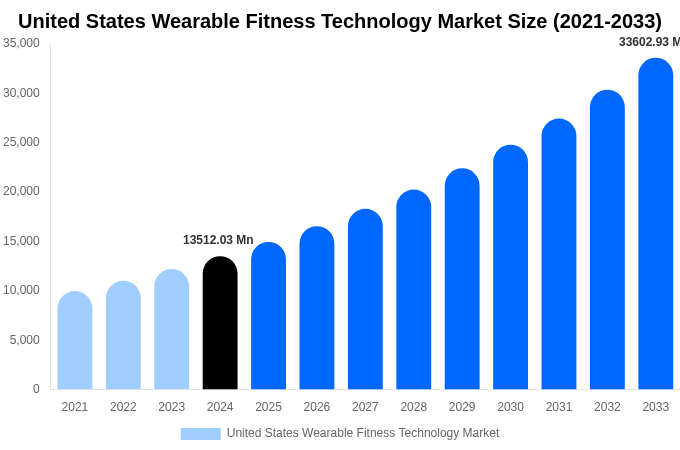
Source: DMI Analysis Company Publications, Primary Interviews.

Other Key Findings
- In 2025, United States represented 27.79% of the overall global Wearable Fitness Technology Market size.
- United States is projected to lead the global Wearable Fitness Technology Market size by 2034.
- Across North America, United States is anticipated to hold the dominant position in market size by 2034.
- United States is forecasted to expand at the fastest pace in North America, attaining USD 41707.6 Million by 2034.
United States Wearable Fitness Technology Market Dynamics
- The United States wearable fitness technology market remains one of the largest globally, driven by increasing health awareness, preventive healthcare adoption, digital wellness platforms, expanding fitness culture, and strong demand for connected health devices. Consumers increasingly purchase smartwatches, fitness trackers, smart rings, heart rate monitors, and advanced biometric wearables.
- Consumer electronics retailers, warehouse clubs, online marketplaces, pharmacies, sporting goods retailers, healthcare providers, and direct-to-consumer brands continue strengthening market accessibility. Omnichannel retail enhances customer engagement.
- Companies invest in AI-powered health analytics, ECG monitoring, blood oxygen tracking, continuous wellness monitoring, personalized fitness coaching, cloud-connected healthcare platforms, and advanced biometric sensors. Innovation focuses on predictive healthcare, intelligent analytics, and connected wellness ecosystems.
- Sustainability initiatives promote recyclable electronic components, renewable manufacturing, battery recycling, responsible sourcing, environmentally responsible production, and circular electronics programs.
Key Industry Insights
- Preventive healthcare accelerates market growth.
- AI-powered wellness strengthens innovation.
- Connected healthcare ecosystems improve user engagement.
- Sustainable electronics enhance long-term competitiveness.
United States Wearable Fitness Technology Market Device Type 2026-2034 (USD Million)
| Device Type | 2022 | 2023 | 2024 | 2025 | 2026 | 2027 | 2028 | 2029 | 2030 | 2031 | 2032 | 2033 | 2034 |
|---|---|---|---|---|---|---|---|---|---|---|---|---|---|
| Fitness Bands And Activity Trackers | XX.x | XX.x | XX.x | 7218.18 | XX.x | XX.x | XX.x | XX.x | XX.x | XX.x | XX.x | XX.x | XX.x |
| Smartwatches With Fitness Features | XX.x | XX.x | XX.x | XX.x | XX.x | XX.x | XX.x | XX.x | XX.x | XX.x | XX.x | XX.x | XX.x |
| Smart Clothing And Connected Footwear | XX.x | XX.x | XX.x | XX.x | XX.x | XX.x | XX.x | XX.x | XX.x | XX.x | XX.x | XX.x | XX.x |
| Total | XX.x | XX.x | XX.x | 15,990.66 | XX.x | XX.x | XX.x | XX.x | XX.x | XX.x | XX.x | XX.x | XX.x |
Source: DMI Analysis Company Publications, Primary Interviews.
United States Wearable Fitness Technology Market Application 2026-2034 (USD Million)
| Application | 2022 | 2023 | 2024 | 2025 | 2026 | 2027 | 2028 | 2029 | 2030 | 2031 | 2032 | 2033 | 2034 |
|---|---|---|---|---|---|---|---|---|---|---|---|---|---|
| Heart Rate And Vital Monitoring | XX.x | XX.x | XX.x | 7988.93 | XX.x | XX.x | XX.x | XX.x | XX.x | XX.x | XX.x | XX.x | XX.x |
| Activity And Sleep Tracking | XX.x | XX.x | XX.x | XX.x | XX.x | XX.x | XX.x | XX.x | XX.x | XX.x | XX.x | XX.x | XX.x |
| Sports Performance Tracking | XX.x | XX.x | XX.x | XX.x | XX.x | XX.x | XX.x | XX.x | XX.x | XX.x | XX.x | XX.x | XX.x |
| Total | XX.x | XX.x | XX.x | 15,990.66 | XX.x | XX.x | XX.x | XX.x | XX.x | XX.x | XX.x | XX.x | XX.x |
Source: DMI Analysis Company Publications, Primary Interviews.
United States Wearable Fitness Technology Market End User 2026-2034 (USD Million)
| End User | 2022 | 2023 | 2024 | 2025 | 2026 | 2027 | 2028 | 2029 | 2030 | 2031 | 2032 | 2033 | 2034 |
|---|---|---|---|---|---|---|---|---|---|---|---|---|---|
| Individual Consumers | XX.x | XX.x | XX.x | 7544.39 | XX.x | XX.x | XX.x | XX.x | XX.x | XX.x | XX.x | XX.x | XX.x |
| Gyms And Fitness Centers | XX.x | XX.x | XX.x | XX.x | XX.x | XX.x | XX.x | XX.x | XX.x | XX.x | XX.x | XX.x | XX.x |
| Corporate Wellness Programs | XX.x | XX.x | XX.x | XX.x | XX.x | XX.x | XX.x | XX.x | XX.x | XX.x | XX.x | XX.x | XX.x |
| Total | XX.x | XX.x | XX.x | 15,990.65 | XX.x | XX.x | XX.x | XX.x | XX.x | XX.x | XX.x | XX.x | XX.x |
Source: DMI Analysis Company Publications, Primary Interviews.
Inside This Report
This section explores the United States wearable fitness technology industry through digital health trends, product innovation, retail transformation, and sustainability initiatives. It highlights how manufacturers strengthen commercial strategies through intelligent, connected, and data-driven wearable health solutions.
- Regional/Country market landscape: Reviews the United States wearable fitness technology ecosystem.
- Consumer and healthcare trends: Explores wearable adoption and wellness behavior.
- Product innovation and distribution: Covers AI technologies, connected devices, and retail channels.
- Competitive and industry developments: Highlights innovation, sustainability, and market competitiveness.
Report Summary
| Report Scope | Details |
|---|---|
| Base Year for Study | 2025 |
| Study Period | 2022-2034 |
| Historical Period | 2022-2024 |
| Forecast Period | 2026-2034 |
| Market Size In 2025 | USD 15990.66 Million |
| Market Size In 2034 | USD 41445.72 Million |
| Largest segment | Fitness Bands And Activity Trackers |
| Units | Revenue in USD Million |
| CAGR | 11.24% (2026-2034) |
| Report Coverage | Revenue Forecast, Competitive Landscape, Growth Factors, Environment & Regulatory Landscape and Trends |