Japan Sun Care Products Market Size & Outlook, 2026-2034
Last Updated : 24 July, 2026 |
Study Period : 2022-2034 |
Format : PDF, Excel |
Author : Anna Morgan
Japan Sun Care Products Market Insights
- As highlighted in Deep Market Insights analysis, the Japan Sun Care Products Market, worth USD 336.48 Million in 2025, is forecasted to achieve USD 506.26 Million by 2034.
- The Japan market is anticipated to grow at a CAGR of 4.64% during the period 2026–2034.
- By 2025, Sunscreen lotions represented the largest share of the Product market size.
- Sticks is expected to remain the key growth driver within Product, registering the fastest CAGR during the forecast period.
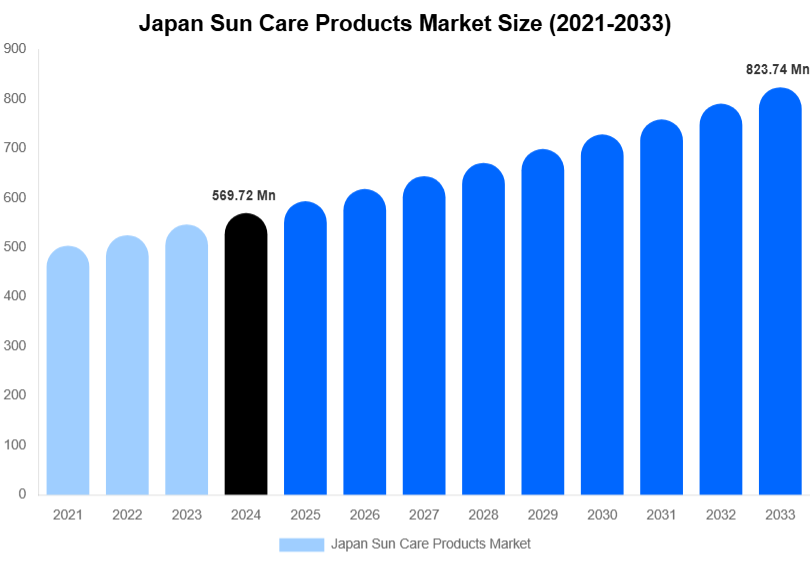
Source: DMI Analysis Company Publications, Primary Interviews.

Other Key Findings
- In 2025, Japan represented 2.46% of the overall global Sun Care Products Market size.
- United States is projected to lead the global Sun Care Products Market size by 2034.
- Across Asia Pacific, China is anticipated to hold the dominant position in market size by 2034.
- South East Asia is forecasted to expand at the fastest pace in Asia Pacific, attaining USD 412.74 Million by 2034.
Japan Sun Care Products Market Dynamics
- Japan's sun care products market is driven by strong consumer awareness of daily UV protection, skincare-focused beauty routines, and demand for multifunctional formulations. Consumers increasingly prefer lightweight sunscreen products offering broad-spectrum protection, skincare benefits, clean ingredients, and comfortable wear for everyday use.
- Drugstores, supermarkets, convenience stores, beauty specialty retailers, department stores, online marketplaces, and pharmacies strengthen accessibility through diversified omnichannel distribution. Sun care manufacturers increasingly expand premium product portfolios, improve merchandising strategies, and enhance digital commerce to strengthen consumer engagement and product availability.
- Companies invest in dermatological research, advanced UV filter technologies, mineral and hybrid sunscreen formulations, sustainable packaging, and skin-friendly ingredients to strengthen product differentiation. Innovation also focuses on water-resistant textures, moisturizing benefits, anti-aging protection, and invisible finishes that improve daily usability.
- Manufacturers collaborate with skincare brands, dermatologists, retailers, pharmacies, distributors, and research institutions to strengthen product credibility and supply chain efficiency. Continued investment in premium skincare innovation, sustainable formulations, and advanced sun protection technologies reinforces competitiveness across Japan's sun care products market.
Key Industry Insights
- Daily UV protection supports consistent usage.
- Hybrid formulations strengthen product innovation.
- Lightweight textures improve consumer acceptance.
- Dermatological research enhances product credibility.
Japan Sun Care Products Market Product 2026-2034 (USD Million)
| Product | 2022 | 2023 | 2024 | 2025 | 2026 | 2027 | 2028 | 2029 | 2030 | 2031 | 2032 | 2033 | 2034 |
|---|---|---|---|---|---|---|---|---|---|---|---|---|---|
| Sunscreen lotions | XX.x | XX.x | XX.x | 144.05 | XX.x | XX.x | XX.x | XX.x | XX.x | XX.x | XX.x | XX.x | XX.x |
| Sprays | XX.x | XX.x | XX.x | XX.x | XX.x | XX.x | XX.x | XX.x | XX.x | XX.x | XX.x | XX.x | XX.x |
| Sticks | XX.x | XX.x | XX.x | XX.x | XX.x | XX.x | XX.x | XX.x | XX.x | XX.x | XX.x | XX.x | XX.x |
| Facial suncare | XX.x | XX.x | XX.x | XX.x | XX.x | XX.x | XX.x | XX.x | XX.x | XX.x | XX.x | XX.x | XX.x |
| Total | XX.x | XX.x | XX.x | 336.48 | XX.x | XX.x | XX.x | XX.x | XX.x | XX.x | XX.x | XX.x | XX.x |
Source: DMI Analysis Company Publications, Primary Interviews.
Japan Sun Care Products Market SPF level 2026-2034 (USD Million)
| SPF level | 2022 | 2023 | 2024 | 2025 | 2026 | 2027 | 2028 | 2029 | 2030 | 2031 | 2032 | 2033 | 2034 |
|---|---|---|---|---|---|---|---|---|---|---|---|---|---|
| Low SPF (<=15) | XX.x | XX.x | XX.x | 154.35 | XX.x | XX.x | XX.x | XX.x | XX.x | XX.x | XX.x | XX.x | XX.x |
| Medium SPF (16-30) | XX.x | XX.x | XX.x | XX.x | XX.x | XX.x | XX.x | XX.x | XX.x | XX.x | XX.x | XX.x | XX.x |
| High SPF (31+) | XX.x | XX.x | XX.x | XX.x | XX.x | XX.x | XX.x | XX.x | XX.x | XX.x | XX.x | XX.x | XX.x |
| Total | XX.x | XX.x | XX.x | 336.49 | XX.x | XX.x | XX.x | XX.x | XX.x | XX.x | XX.x | XX.x | XX.x |
Source: DMI Analysis Company Publications, Primary Interviews.
Japan Sun Care Products Market Distribution 2026-2034 (USD Million)
| Distribution | 2022 | 2023 | 2024 | 2025 | 2026 | 2027 | 2028 | 2029 | 2030 | 2031 | 2032 | 2033 | 2034 |
|---|---|---|---|---|---|---|---|---|---|---|---|---|---|
| Pharmacies | XX.x | XX.x | XX.x | 169.49 | XX.x | XX.x | XX.x | XX.x | XX.x | XX.x | XX.x | XX.x | XX.x |
| Beauty stores | XX.x | XX.x | XX.x | XX.x | XX.x | XX.x | XX.x | XX.x | XX.x | XX.x | XX.x | XX.x | XX.x |
| Online | XX.x | XX.x | XX.x | XX.x | XX.x | XX.x | XX.x | XX.x | XX.x | XX.x | XX.x | XX.x | XX.x |
| Total | XX.x | XX.x | XX.x | 336.49 | XX.x | XX.x | XX.x | XX.x | XX.x | XX.x | XX.x | XX.x | XX.x |
Source: DMI Analysis Company Publications, Primary Interviews.
Inside This Report
This section examines Japan's sun care products market through evolving consumer preferences, formulation innovation, distribution developments, and competitive strategies. It highlights how manufacturers strengthen market positioning by advancing skincare-integrated sun protection, expanding omnichannel retail, and investing in dermatological innovation.
- Country market landscape: Reviews Japan's sun care ecosystem.
- Consumer and purchasing trends: Explores daily UV protection preferences.
- Product innovation and distribution: Covers hybrid formulations and retail channels.
- Competitive and industry developments: Highlights skincare innovation and sustainability.
Report Summary
| Report Scope | Details |
|---|---|
| Base Year for Study | 2025 |
| Study Period | 2022-2034 |
| Historical Period | 2022-2024 |
| Forecast Period | 2026-2034 |
| Market Size In 2025 | USD 336.48 Million |
| Market Size In 2034 | USD 506.26 Million |
| Largest segment | Sunscreen lotions |
| Units | Revenue in USD Million |
| CAGR | 4.64% (2026-2034) |
| Report Coverage | Revenue Forecast, Competitive Landscape, Growth Factors, Environment & Regulatory Landscape and Trends |