Korea Robotic Vacuum Cleaner Market Size & Outlook, 2026-2034
Last Updated : 17 August, 2026 |
Study Period : 2022-2034 |
Format : PDF, Excel |
Author : Anna Morgan
Korea Robotic Vacuum Cleaner Market Insights
- Based on Deep Market Insights findings, the Korea Robotic Vacuum Cleaner Market reached USD 131.28 Million in 2025 and is estimated to attain USD 304.85 Million by 2034.
- From 2026 to 2034, the Korea market is expected to grow at a steady CAGR of 9.75%.
- Within the Product category, Pure vacuum robots dominated in 2025 in terms of market size contribution.
- Over the forecast period, Pure vacuum robots is forecasted to deliver the fastest growth, positioning it as the most lucrative Product segment.
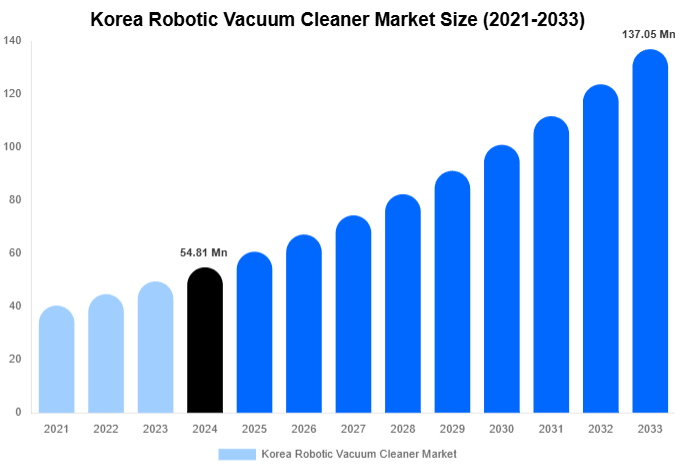
Source: DMI Analysis Company Publications, Primary Interviews.

Other Key Findings
- In 2025, Korea accounted for 1.74% of the global Robotic Vacuum Cleaner Market size.
- By 2034, United States is expected to lead the global Robotic Vacuum Cleaner Market in terms of market size.
- Within Asia Pacific, China is projected to dominate the regional Robotic Vacuum Cleaner Market size by 2034.
- India is identified as the fastest-growing market in Asia Pacific, anticipated to reach USD 1156.12 Million by 2034.
South Korea Robotic Vacuum Cleaner Market Dynamics
- South Korea's robotic vacuum cleaner market continues expanding as smart-home adoption, technology-oriented consumers, and demand for convenient household automation increase. Consumers increasingly view robotic cleaners as connected home appliances rather than simple floor-cleaning devices.
- Vacuum-and-mop robots, AI-enabled models, self-emptying systems, advanced mapping, obstacle recognition, and smart-home integration represent major product segments. Premium consumers increasingly seek hands-free cleaning with automated maintenance.
- Manufacturers are investing in AI object recognition, sophisticated navigation, automated mop washing and drying, self-emptying docks, app control, and integration with connected-home platforms. Product differentiation increasingly depends on automation and intelligence.
- Sustainability initiatives emphasize energy efficiency, durable components, washable filters, repairability, and recyclable packaging.
Key Industry Insights
- High smart-home adoption supports premium robotic cleaners.
- AI and obstacle recognition are important differentiators.
- Automated mop maintenance strengthens product value.
- Connected-home integration improves consumer convenience.
Korea Robotic Vacuum Cleaner Market Product 2026-2034 (USD Million)
| Product | 2022 | 2023 | 2024 | 2025 | 2026 | 2027 | 2028 | 2029 | 2030 | 2031 | 2032 | 2033 | 2034 |
|---|---|---|---|---|---|---|---|---|---|---|---|---|---|
| Pure vacuum robots | XX.x | XX.x | XX.x | 64.1 | XX.x | XX.x | XX.x | XX.x | XX.x | XX.x | XX.x | XX.x | XX.x |
| Vacuum-mop hybrids | XX.x | XX.x | XX.x | XX.x | XX.x | XX.x | XX.x | XX.x | XX.x | XX.x | XX.x | XX.x | XX.x |
| Robot mops | XX.x | XX.x | XX.x | XX.x | XX.x | XX.x | XX.x | XX.x | XX.x | XX.x | XX.x | XX.x | XX.x |
| Total | XX.x | XX.x | XX.x | 131.28 | XX.x | XX.x | XX.x | XX.x | XX.x | XX.x | XX.x | XX.x | XX.x |
Source: DMI Analysis Company Publications, Primary Interviews.
Korea Robotic Vacuum Cleaner Market Feature tier 2026-2034 (USD Million)
| Feature tier | 2022 | 2023 | 2024 | 2025 | 2026 | 2027 | 2028 | 2029 | 2030 | 2031 | 2032 | 2033 | 2034 |
|---|---|---|---|---|---|---|---|---|---|---|---|---|---|
| Entry (basic navigation) | XX.x | XX.x | XX.x | 66.43 | XX.x | XX.x | XX.x | XX.x | XX.x | XX.x | XX.x | XX.x | XX.x |
| Mid (mapping) | XX.x | XX.x | XX.x | XX.x | XX.x | XX.x | XX.x | XX.x | XX.x | XX.x | XX.x | XX.x | XX.x |
| Premium (self-empty) | XX.x | XX.x | XX.x | XX.x | XX.x | XX.x | XX.x | XX.x | XX.x | XX.x | XX.x | XX.x | XX.x |
| Total | XX.x | XX.x | XX.x | 131.29 | XX.x | XX.x | XX.x | XX.x | XX.x | XX.x | XX.x | XX.x | XX.x |
Source: DMI Analysis Company Publications, Primary Interviews.
Korea Robotic Vacuum Cleaner Market Channel 2026-2034 (USD Million)
| Channel | 2022 | 2023 | 2024 | 2025 | 2026 | 2027 | 2028 | 2029 | 2030 | 2031 | 2032 | 2033 | 2034 |
|---|---|---|---|---|---|---|---|---|---|---|---|---|---|
| E-commerce | XX.x | XX.x | XX.x | 69.99 | XX.x | XX.x | XX.x | XX.x | XX.x | XX.x | XX.x | XX.x | XX.x |
| Retail | XX.x | XX.x | XX.x | XX.x | XX.x | XX.x | XX.x | XX.x | XX.x | XX.x | XX.x | XX.x | XX.x |
| OEM | XX.x | XX.x | XX.x | XX.x | XX.x | XX.x | XX.x | XX.x | XX.x | XX.x | XX.x | XX.x | XX.x |
| Total | XX.x | XX.x | XX.x | 131.29 | XX.x | XX.x | XX.x | XX.x | XX.x | XX.x | XX.x | XX.x | XX.x |
Source: DMI Analysis Company Publications, Primary Interviews.
Inside This Report
This section explores South Korea's robotic vacuum cleaner industry through vacuum-and-mop, AI-enabled, self-emptying, mapping, and smart-home-compatible models.
- Country market landscape: Reviews South Korea's technology-led robotic vacuum ecosystem.
- Consumer trends: Explores automation, convenience, smart homes, premium appliances, and technology adoption.
- Product innovation and distribution: Covers AI navigation, object recognition, mop washing, self-emptying, app control, electronics retailers, and e-commerce.
- Competitive and industry developments: Highlights AI, multifunctionality, smart-home connectivity, premiumization, automation, and commercialization.
Report Summary
| Report Scope | Details |
|---|---|
| Base Year for Study | 2025 |
| Study Period | 2022-2034 |
| Historical Period | 2022-2024 |
| Forecast Period | 2026-2034 |
| Market Size In 2025 | USD 131.28 Million |
| Market Size In 2034 | USD 304.85 Million |
| Largest segment | Pure vacuum robots |
| Units | Revenue in USD Million |
| CAGR | 9.75% (2026-2034) |
| Report Coverage | Revenue Forecast, Competitive Landscape, Growth Factors, Environment & Regulatory Landscape and Trends |