Germany Plus Size Clothing Market Size & Outlook, 2026-2034
Last Updated : 27 July, 2026 |
Study Period : 2022-2034 |
Format : PDF, Excel |
Author : Anna Morgan
Germany Plus Size Clothing Market Insights
- Based on Deep Market Insights findings, the Germany Plus Size Clothing Market reached USD 4082.15 Million in 2025 and is estimated to attain USD 7349.8 Million by 2034.
- From 2026 to 2034, the Germany market is expected to grow at a steady CAGR of 6.8%.
- Within the Product category, Casual dominated in 2025 in terms of market size contribution.
- Over the forecast period, Activewear is forecasted to deliver the fastest growth, positioning it as the most lucrative Product segment.
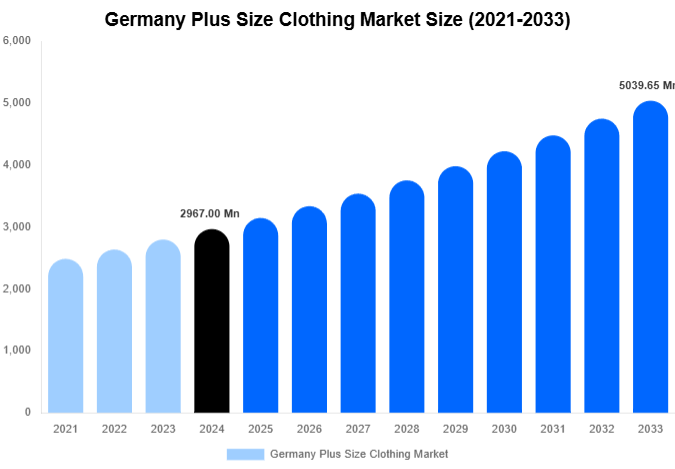
Source: DMI Analysis Company Publications, Primary Interviews.

Other Key Findings
- Germany contributed 8.64% to the global Plus Size Clothing Market size in 2025.
- By 2034, United States is forecasted to remain the largest global market for Plus Size Clothing Market.
- In Europe, Germany is projected to capture the leading share of market size by 2034.
- Among Europe markets, Spain is expected to post the fastest growth, reaching USD 3001.57 Million by 2034.
Germany Plus Size Clothing Market Dynamics
- Germany's plus size clothing market reflects growing consumer preference for fashionable, well-tailored apparel that prioritizes comfort, durability, and inclusive sizing. Shoppers increasingly seek premium everyday wear, business attire, and activewear designed specifically for diverse body shapes rather than scaled-up standard garments.
- Department stores, fashion chains, specialty retailers, online marketplaces, and direct-to-consumer brands strengthen product accessibility through broader size assortments and seamless omnichannel experiences. Digital size recommendations, customer reviews, and flexible return services improve purchase confidence and reduce fit-related uncertainty.
- Apparel manufacturers invest in advanced pattern grading, sustainable textiles, stretch-performance fabrics, and inclusive product development to improve garment fit and consistency. Innovation also focuses on timeless designs, responsible sourcing, and recyclable packaging that align with Germany's environmentally conscious consumer preferences.
- Fashion companies collaborate with designers, influencers, and body-positive advocates to improve representation and promote inclusive fashion across mainstream retail. Continued investment in digital commerce, customer engagement, and localized product collections strengthens competitive differentiation throughout Germany's apparel industry.
Key Industry Insights
- Online retail expands inclusive fashion accessibility.
- Sustainable textiles influence apparel purchasing decisions.
- Flexible return policies support e-commerce growth.
- Inclusive sizing improves long-term customer loyalty.
Germany Plus Size Clothing Market Product 2026-2034 (USD Million)
| Product | 2022 | 2023 | 2024 | 2025 | 2026 | 2027 | 2028 | 2029 | 2030 | 2031 | 2032 | 2033 | 2034 |
|---|---|---|---|---|---|---|---|---|---|---|---|---|---|
| Casual | XX.x | XX.x | XX.x | 2241.51 | XX.x | XX.x | XX.x | XX.x | XX.x | XX.x | XX.x | XX.x | XX.x |
| Formal | XX.x | XX.x | XX.x | XX.x | XX.x | XX.x | XX.x | XX.x | XX.x | XX.x | XX.x | XX.x | XX.x |
| Activewear | XX.x | XX.x | XX.x | XX.x | XX.x | XX.x | XX.x | XX.x | XX.x | XX.x | XX.x | XX.x | XX.x |
| Total | XX.x | XX.x | XX.x | 4,082.15 | XX.x | XX.x | XX.x | XX.x | XX.x | XX.x | XX.x | XX.x | XX.x |
Source: DMI Analysis Company Publications, Primary Interviews.
Germany Plus Size Clothing Market Distribution 2026-2034 (USD Million)
| Distribution | 2022 | 2023 | 2024 | 2025 | 2026 | 2027 | 2028 | 2029 | 2030 | 2031 | 2032 | 2033 | 2034 |
|---|---|---|---|---|---|---|---|---|---|---|---|---|---|
| E-commerce | XX.x | XX.x | XX.x | 2069.25 | XX.x | XX.x | XX.x | XX.x | XX.x | XX.x | XX.x | XX.x | XX.x |
| Brick-and-Mortar | XX.x | XX.x | XX.x | XX.x | XX.x | XX.x | XX.x | XX.x | XX.x | XX.x | XX.x | XX.x | XX.x |
| Specialty | XX.x | XX.x | XX.x | XX.x | XX.x | XX.x | XX.x | XX.x | XX.x | XX.x | XX.x | XX.x | XX.x |
| Total | XX.x | XX.x | XX.x | 4,082.16 | XX.x | XX.x | XX.x | XX.x | XX.x | XX.x | XX.x | XX.x | XX.x |
Source: DMI Analysis Company Publications, Primary Interviews.
Germany Plus Size Clothing Market Price Tier 2026-2034 (USD Million)
| Price Tier | 2022 | 2023 | 2024 | 2025 | 2026 | 2027 | 2028 | 2029 | 2030 | 2031 | 2032 | 2033 | 2034 |
|---|---|---|---|---|---|---|---|---|---|---|---|---|---|
| Value | XX.x | XX.x | XX.x | 2068.02 | XX.x | XX.x | XX.x | XX.x | XX.x | XX.x | XX.x | XX.x | XX.x |
| Mid | XX.x | XX.x | XX.x | XX.x | XX.x | XX.x | XX.x | XX.x | XX.x | XX.x | XX.x | XX.x | XX.x |
| Premium | XX.x | XX.x | XX.x | XX.x | XX.x | XX.x | XX.x | XX.x | XX.x | XX.x | XX.x | XX.x | XX.x |
| Total | XX.x | XX.x | XX.x | 4,082.16 | XX.x | XX.x | XX.x | XX.x | XX.x | XX.x | XX.x | XX.x | XX.x |
Source: DMI Analysis Company Publications, Primary Interviews.
Inside This Report
This section examines Germany's plus size clothing market through evolving consumer preferences, retail modernization, sizing innovation, sustainability initiatives, and commercial strategies. It highlights how apparel brands strengthen competitiveness by expanding inclusive collections, improving garment quality, and enhancing omnichannel shopping experiences.
- Country market landscape: Reviews Germany's inclusive apparel ecosystem.
- Consumer and purchasing trends: Explores comfort, quality, and style preferences.
- Product innovation and distribution: Covers sustainable materials and sizing improvements.
- Competitive and industry developments: Highlights digital retail and inclusive brand strategies.
Report Summary
| Report Scope | Details |
|---|---|
| Base Year for Study | 2025 |
| Study Period | 2022-2034 |
| Historical Period | 2022-2024 |
| Forecast Period | 2026-2034 |
| Market Size In 2025 | USD 4082.15 Million |
| Market Size In 2034 | USD 7349.8 Million |
| Largest segment | Casual |
| Units | Revenue in USD Million |
| CAGR | 6.8% (2026-2034) |
| Report Coverage | Revenue Forecast, Competitive Landscape, Growth Factors, Environment & Regulatory Landscape and Trends |